The author makes all of the following arguments in the passage, EXCEPT:
Sign in
Please select an account to continue using cracku.in
↓ →
The passage below is accompanied by a set of questions. Choose the best answer to each question.
The word ‘anarchy’ comes from the Greek 'anarkhia', meaning contrary to authority or without a ruler, and was used in a derogatory sense until 1840, when it was adopted by Pierre-Joseph Proudhon to describe his political and social ideology. Proudhon argued that organization without government was both possible and desirable. In the evolution of political ideas, anarchism can be seen as an ultimate projection of both liberalism and socialism, and the differing strands of anarchist thought can be related to their emphasis on one or the other of these.
Historically, anarchism arose not only as an explanation of the gulf between the rich and the poor in any community, and of the reason why the poor have been obliged to fight for their share of a common inheritance, but as a radical answer to the question ‘What went wrong?’ that followed the ultimate outcome of the French Revolution. It had ended not only with a reign of terror and the emergence of a newly rich ruling caste, but with a new adored emperor, Napoleon Bonaparte, strutting through his conquered territories.
The anarchists and their precursors were unique on the political Left in affirming that workers and peasants, grasping the chance that arose to bring an end to centuries of exploitation and tyranny, were inevitably betrayed by the new class of politicians, whose first priority was to re-establish a centralized state power. After every revolutionary uprising, usually won at a heavy cost for ordinary populations, the new rulers had no hesitation in applying violence and terror, a secret police, and a professional army to maintain their control.
For anarchists the state itself is the enemy, and they have applied the same interpretation to the outcome of every revolution of the 19th and 20th centuries. This is not merely because every state keeps a watchful and sometimes punitive eye on its dissidents, but because every state protects the privileges of the powerful.
The mainstream of anarchist propaganda for more than a century has been anarchist- communism, which argues that property in land, natural resources, and the means of production should be held in mutual control by local communities, federating for innumerable joint purposes with other communes. It differs from state socialism in opposing the concept of any central authority. Some anarchists prefer to distinguish between anarchist-communism and collectivist anarchism in order to stress the obviously desirable freedom of an individual or family to possess the resources needed for living, while not implying the right to own the resources needed by others. . . .
There are, unsurprisingly, several traditions of individualist anarchism, one of them deriving from the ‘conscious egoism’ of the German writer Max Stirner (1806-56), and another from a remarkable series of 19th-century American figures who argued that in protecting our own autonomy and associating with others for common advantages, we are promoting the good of all. These thinkers differed from free-market liberals in their absolute mistrust of American capitalism, and in their emphasis on mutualism.
The author makes all of the following arguments in the passage, EXCEPT:
Option A: This element is discussed in the third paragraph: {"...The anarchists and their precursors were unique on the political Left in affirming that workers and peasants, grasping the chance that arose to bring an end to centuries of exploitation and tyranny, were inevitably betrayed by the new class of politicians, whose first priority was to re-establish a centralized state power..."} Prior to making this claim, the failure of the French revolution is highlighted, and this segment is subsequently tied to it. Hence, Option A is definitely a point that is made in the passage.
Option B: This has been outlined in the fourth paragraph: {"...For anarchists, the state itself is the enemy, and they have applied the same interpretation to the outcome of every revolution of the 19th and 20th centuries. This is not merely because every state keeps a watchful and sometimes punitive eye on its dissidents, but because every state protects the privileges of the powerful... "}
Option C: The last two paragraphs present the perception associated with individualist-anarchism: {"...desirable freedom of an individual or family to possess the resources needed for living, while not implying the right to own the resources needed by others. . . .There are, unsurprisingly, several traditions of individualist anarchism, one of them deriving from the ‘conscious egoism’ of the German writer Max Stirner (1806-56), and another from a remarkable series of 19th-century American figures who argued that in protecting our own autonomy and associating with others for common advantages, we are promoting the good of all..."} Thus, we can evidently understand the statement in C to be true.
Option D, however, is not inferable from the discussion undertaken in the passage. The author does not pinpoint "a mainstream mistrust of collectivism" as the source of the misconception of anarchism "espousing lawlessness and violence". No causal element is discussed, and thus, the statement in D is not an argument that is made in the passage.
Hence, Option D is the correct answer.
The author believes that the new ruling class of politicians betrayed the principles of the French Revolution, but does not specify in what way. In the context of the passage, which statement below is the likeliest explanation of that betrayal?
The third paragraph renders us with sufficient information concerning the manner of betrayal. The failure of the Frech Revolution is being attributed to the deceit of the new class of politicians who not only prioritised the re-establishment and centralisation of authority but also unleashed a reign of terror on the ordinary masses. The author hints at this re-installation of power and the atrocities committed on the common people, who are the very drivers of the revolution, being the desertion of the principles of the French Revolution by the new ruling class of politicians. Any statement that aligns with this understanding would be a suitable answer. Option A brings in the concept of an impact on the market, which is not mentioned in the passage. Additionally, it does not signify betrayal of any kind. Same can be said about the statement in Option B. Option C is a strong candidate that symbolises betrayal. However, can we appropriately associate it with the underlying principles of the revolution? The author's primary focus is on the cost borne by the ordinary populations, and despite the revolution being realised by their sacrifices, they are still the ones being subjected to inequity and torment. Although C highlights betrayal, it does not truly coincide with the idea being conveyed. The afore-mentioned element is appropriately captured by Option D: it highlights how the new class of politicians utilised the indignation of the masses/workers for the revolution - to topple authority and rise to power - and then stab them in the back by turning to oppress them.
Which one of the following best expresses the similarity between American individualist anarchists and free-market liberals as well as the difference between the former and the latter?
We can derive our understanding of these two groups from the following: {"...There are, unsurprisingly, several traditions of individualist anarchism, one of them deriving from the ‘conscious egoism’ of the German writer Max Stirner (1806-56), and another from a remarkable series of 19th-century American figures who argued that in protecting our own autonomy and associating with others for common advantages, we are promoting the good of all. These thinkers differed from free-market liberals in their absolute mistrust of American capitalism, and in their emphasis on mutualism..."}
It is evident that both the groups prioritize individual autonomy; however, the latter does not put emphasis on mutualism. The mistrust of American capitalism is an additional facet marking the difference {but not captured in any of the options}. Option A aptly highlights the difference between the two factions, and is, hence, the correct answer.
Option B: Preferences concerning state configuration or involvement are not discussed in the passage, and hence, we can eliminate this option.
Option C: Perspectives regarding the nature of capitalism are not stated in the passage, and thus, we can effortlessly discard this option
Option D: None of the elements stated in this option can be understood from the passage, and therefore, can be rejected.
Of the following sets of concepts, identify the set that is conceptually closest to the concerns of the passage.
One has to be mindful of the question: the set that is conceptually closest to the concerns of the passage.
The passage is clearly about 'Anarchism', and the discussion pertaining to 'Revolution' is a sub-element. This elementary understanding helps us pare down the viable choices to Options A and D. 'Betrayal' is again a minor sub-element used to supplement the core argument concerning the authority of the 'State' and the justified antagonism of the anarchists towards it. Additionally, towards the end of the discussion, individual autonomy and freedom serve as the focal points. Thus, of the two likely choices, Option A is more appropriate and conceptually closest to the concerns of the passage.
According to the passage, what is the one idea that is common to all forms of anarchism?
Option A: The various derivations of anarchism cannot be associated with Pierre-Joseph Proudhon. We don't have the requisite information to support this claim.
Option B: This has been presented as the motto of every anarchist faction: wherein the state is the enemy {opposition to the centralization of power}. While there are additional beliefs associated with different schools of anarchist thought, this antagonism towards centralised power forms their core.
Option C: This belief has been shown to be limited to individualist anarchism {based on the information from the passage}; cannot be stated as a common attribute.
Option D: This assertion would be a gross understatement; the latter half of the option is especially a bit odd {no such idea has been implied}.
Hence, of the given choices, Option B is the correct answer.
The passage below is accompanied by a set of questions. Choose the best answer to each question.
Few realise that the government of China, governing an empire of some 60 million people during the Tang dynasty (618-907), implemented a complex financial system that recognised grain, coins and textiles as money. . . . Coins did have certain advantages: they were durable, recognisable and provided a convenient medium of exchange, especially for smaller transactions. However, there were also disadvantages. A continuing shortage of copper meant that government mints could not produce enough coins for the entire empire, to the extent that for most of the dynasty’s history, coins constituted only a tenth of the money supply. One of the main objections to calls for taxes to be paid in coin was that peasant producers who could weave cloth or grow grain - the other two major currencies of the Tang - would not be able to produce coins, and therefore would not be able to pay their taxes. . . .
As coins had advantages and disadvantages, so too did textiles. If in circulation for a long period of time, they could show signs of wear and tear. Stained, faded and torn bolts of textiles had less value than a brand new bolt. Furthermore, a full bolt had a particular value. If consumers cut textiles into smaller pieces to buy or sell something worth less than a full bolt, that, too, greatly lessened the value of the textiles. Unlike coins, textiles could not be used for small transactions; as [an official] noted, textiles could not “be exchanged by the foot and the inch” . . .
But textiles had some advantages over coins. For a start, textile production was widespread and there were fewer problems with the supply of textiles. For large transactions, textiles weighed less than their equivalent in coins since a string of coins . . . could weigh as much as 4 kg. Furthermore, the dimensions of a bolt of silk held remarkably steady from the third to the tenth century: 56 cm wide and 12 m long . . . The values of different textiles were also more stable than the fluctuating values of coins. . . .
The government also required the use of textiles for large transactions. Coins, on the other hand, were better suited for smaller transactions, and possibly, given the costs of transporting coins, for a more local usage. Grain, because it rotted easily, was not used nearly as much as coins and textiles, but taxpayers were required to pay grain to the government as a share of their annual tax obligations, and official salaries were expressed in weights of grain. . . .
In actuality, our own currency system today has some similarities even as it is changing in front of our eyes. . . . We have cash - coins for small transactions like paying for parking at a meter, and banknotes for other items; cheques and debit/credit cards for other, often larger, types of payments. At the same time, we are shifting to electronic banking and making payments online. Some young people never use cash [and] do not know how to write a cheque . . .
During the Tang period, which one of the following would not be an economically sound decision for a small purchase in the local market that is worth one-eighth of a bolt of cloth?
Options A and C are economically sound decisions. Option B might be a viable choice, as well. However, Option D would not be an economically sound decision for a small purchase in the local market that is worth one-eighth of a bolt of cloth. Concerning small transactions, the author highlights the limitations that stemmed from a textile form of currency: "...Furthermore, a full bolt had a particular value. If consumers cut textiles into smaller pieces to buy or sell something worth less than a full bolt, that, too, greatly lessened the value of the textiles..." Thus, cutting the cloth would greatly diminish its value {and consequently cannot be considered as a sensible decision}. Hence, Option D is the correct answer.
When discussing textiles as currency in the Tang period, the author uses the words “steady” and “stable” to indicate all of the following EXCEPT:
The author evidently highlights the stability of utilizing textiles given its abundant supply{"...textile production was widespread and there were fewer problems with the supply of textiles..."}, the steady standard of measurement {"...the dimensions of a bolt of silk held remarkably steady from the third to the tenth century: 56 cm wide and 12 m long..."} and reliable quality {"...Furthermore, a full bolt had a particular value. If consumers ..."}. Transportation is not a dominant variable that is considered in the discussion pertaining to textiles. Hence, Option A is the correct choice.
In the context of the passage, which one of the following can be inferred with regard to the use of currency during the Tang era?
Let us inspect the individual statements:
Option A: The author does not make any such claim. The following is stated in this regard: "...Grain, because it rotted easily, was not used nearly as much as coins and textiles...". Thus, the marginal usage of grains is presented relative to that of coins and textiles. Therefore, it cannot be understood that perishable currencies such as grains were not utilised for official work.
Option B: The author simply states that "...Coins did have certain advantages: they were durable, recognisable and provided a convenient medium of exchange, especially for smaller transactions..." Presenting them as being more valuable than textile currency would be incorrect.
Option C: This would be imprecise as the author portrays the following: "...Grain, because it rotted easily, was not used nearly as much as coins and textiles, but taxpayers were required to pay grain to the government as a share of their annual tax obligations, and official salaries were expressed in weights of grain..." The statement here deviates from this depiction.
Option D: This statement can be understood from the final paragraph, wherein the author states: "...In actuality, our own currency system today has some similarities even as it is changing in front of our eyes. . . . We have cash - coins for small transactions like paying for parking at a meter, and banknotes for other items; cheques...". Hence, Option D is a valid inference
According to the passage, the modern currency system shares all the following features with that of the Tang, EXCEPT that:
Let us pay heed to the following excerpt: "...In actuality, our own currency system today has some similarities even as it is changing in front of our eyes. . . . We have cash - coins for small transactions like paying for parking at a meter, and banknotes for other items; cheques and debit/credit cards for other, often larger, types of payments. At the same time, we are shifting to electronic banking and making payments online. Some young people never use cash [and] do not know how to write a cheque..."
Based on the above, we can infer Options A, B and C as the similarities that are implied. Concerning Option D, while the author does mention the present currency system as a changing/dynamic one, the same cannot be said about the Tang dynasty. The author does not highlight this element as a similarity. Hence, Option D is the correct answer.
The passage below is accompanied by a set of questions. Choose the best answer to each question.
Vocabulary used in speech or writing organizes itself in seven parts of speech (eight, if you count interjections such as Oh! and Gosh! and Fuhgeddaboudit!). Communication composed of these parts of speech must be organized by rules of grammar upon which we agree. When these rules break down, confusion and misunderstanding result. Bad grammar produces bad sentences. My favorite example from Strunk and White is this one: “As a mother of five, with another one on the way, my ironing board is always up.”
Nouns and verbs are the two indispensable parts of writing. Without one of each, no group of words can be a sentence, since a sentence is, by definition, a group of words containing a subject (noun) and a predicate (verb); these strings of words begin with a capital letter, end with a period, and combine to make a complete thought which starts in the writer’s head and then leaps to the reader’s.
Must you write complete sentences each time, every time? Perish the thought. If your work consists only of fragments and floating clauses, the Grammar Police aren’t going to come and take you away. Even William Strunk, that Mussolini of rhetoric, recognized the delicious pliability of language. “It is an old observation,” he writes, “that the best writers sometimes disregard the rules of rhetoric.” Yet he goes on to add this thought, which I urge you to consider: “Unless he is certain of doing well, [the writer] will probably do best to follow the rules.”
The telling clause here is Unless he is certain of doing well. If you don’t have a rudimentary grasp of how the parts of speech translate into coherent sentences, how can you be certain that you are doing well? How will you know if you’re doing ill, for that matter? The answer, of course, is that you can’t, you won’t. One who does grasp the rudiments of grammar finds a comforting simplicity at its heart, where there need be only nouns, the words that name, and verbs, the words that act.
Take any noun, put it with any verb, and you have a sentence. It never fails. Rocks explode. Jane transmits. Mountains float. These are all perfect sentences. Many such thoughts make little rational sense, but even the stranger ones (Plums deify!) have a kind of poetic weight that’s nice. The simplicity of noun-verb construction is useful—at the very least it can provide a safety net for your writing. Strunk and White caution against too many simple sentences in a row, but simple sentences provide a path you can follow when you fear getting lost in the tangles of rhetoric—all those restrictive and nonrestrictive clauses, those modifying phrases, those appositives and compound-complex sentences. If you start to freak out at the sight of such unmapped territory (unmapped by you, at least), just remind yourself that rocks explode, Jane transmits, mountains float, and plums deify. Grammar is . . . the pole you grab to get your thoughts up on their feet and walking.
Which one of the following statements, if false, could be seen as supporting the arguments in the passage?
We need to find a statement, which if false, aligns with the discussion/serves as a supporting argument. Let us inspect the individual options:
Option A: In its current form, this statement is in tune with the author's assertion. However, if false, it is antagonistic to the claim being made in the passage. Hence, we can eliminate this option.
Options B and C: Regardless of whether these statements are true or false, they do very little to further the idea presented in the passage.
Option D: This statement implies that complete sentences do not need nouns and verbs. However, in the passage, the author says otherwise; thus, if this sentence is false, it perfectly aligns with the argument made in the passage. Therefore, Option D, if false, could be seen as a supplementary argument.
“Take any noun, put it with any verb, and you have a sentence. It never fails. Rocks explode. Jane transmits. Mountains float.” None of the following statements can be seen as similar EXCEPT:
The author intends to highlight that the rudimentary combination of a noun and a verb serves as the simplest form of expression; two basic yet immensely significant entities coupled together that is representative of a broader and perhaps, complex group of entities {a sentence}. Option A is closest to such a relationship: vegetables and spices (two elements) combined to represent a larger group - 'dishes'. The same cannot be said about the rest of the options, since they evidently deviate from the core message being conveyed.
Which one of the following quotes best captures the main concern of the passage?
The author begins by highlighting the necessity for a set of codes (enabled by grammar) to organize communication and avoid confusion. He then proceeds to present supplementary arguments in this regard (elements associated with rhetoric and its specialists) and emphasizes how even proper, intentional simplification can be attained only through a firm grasp of the rudiments of grammar. Therefore, it can be observed that grammar is the focal point here and the correct choice should definitely align with this. Option B aptly captures the main concern raised in the passage. Options A and C fail to include the idea revolving around grammar and instead focuses on the additives. Option D is close; however, the mention of nouns and verbs is with the intention to supplement the idea highlighted in B. These simply serve as an illustration to emphasize the significance of grammar. Thus, between the two options B and D, Option B is the suitable choice.
All of the following statements can be inferred from the passage EXCEPT that:
Option A: This can be inferred from "...Must you write complete sentences each time, every time? Perish the thought. If your work consists only of fragments and floating clauses, the Grammar Police aren’t going to come and take you away..." The author presents an illustration to show how a simple combination of a noun and verb forms a complete expression.
Option B: Based on the limited information available from the passage, we can make this inference from "...no group of words can be a sentence, since a sentence is, by definition, a group of words containing a subject (noun) and a predicate (verb)..."
Option C: The author does not make any such claim. Grammar serves as a mechanism to organize communication and avoid confusion. However, the "primary purpose" of grammar is not to ensure that sentences remain "simple". Since we cannot infer this statement from the passage, it is the correct answer.
Option D: Although not explicitly mentioned, we can understand the sentiment behind using the term "Grammar Police". The author is using this as a metaphor for the strong adherents of the grammatic rules (who are perhaps swift to judge and criticize).
Therefore, we can infer all of the statements except for the one in Option C.
Inferring from the passage, the author could be most supportive of which one of the following practices?
In this question, we need to identify the statement that coincides with the aspects discussed by the author. Putting ourselves in the author's shoes, we know that grammar (and the necessity to appropriately learn it) is the primary idea that needs to be conveyed. Writers with a substantial understanding of the elementary rules in grammar can appreciate the "comforting simplicity at its heart" (is what the author claims). Thus, the author will surely support any stance that concurs with the above.
Option A: This will definitely supplement the assertion made by the author. It will enable writers with the requisite understanding of the standard governing rules - a significant necessity highlighted by the author. He is bound to favor such an action.
Option B: The author would endorse such drastic measures (does not match the tone). The pliability of grammatical rules is a noticeable comment made by the author (but only for those well-versed with it). Hence, we can eliminate this option.
Option C: The author does not portray any view that promotes the eschewal of rhetoric. This again deviates from the discussion in the passage and can be scrapped as the correct choice.
Option D: The focus is broad: on grammar (not just on punctuation and capitalization).
It is evident that Option A is the only sensible statement that the author would support here.
The passage below is accompanied by a set of questions. Choose the best answer to each question.
In the late 1960s, while studying the northern-elephant-seal population along the coasts of Mexico and California, Burney Le Boeuf and his colleagues couldn’t help but notice that the threat calls of males at some sites sounded different from those of males at other sites. . . . That was the first time dialects were documented in a nonhuman mammal. . . .
All the northern elephant seals that exist today are descendants of the small herd that survived on Isla Guadalupe [after the near extinction of the species in the nineteenth century]. As that tiny population grew, northern elephant seals started to recolonize former breeding locations. It was precisely on the more recently colonized islands where Le Boeuf found that the tempos of the male vocal displays showed stronger differences to the ones from Isla Guadalupe, the founder colony.
In order to test the reliability of these dialects over time, Le Boeuf and other researchers visited Año Nuevo Island in California—the island where males showed the slowest pulse rates in their calls—every winter from 1968 to 1972. “What we found is that the pulse rate increased, but it still remained relatively slow compared to the other colonies we had measured in the past” Le Boeuf told me.
At the individual level, the pulse of the calls stayed the same: A male would maintain his vocal signature throughout his lifetime. But the average pulse rate was changing. Immigration could have been responsible for this increase, as in the early 1970s, 43 percent of the males on Año Nuevo had come from southern rookeries that had a faster pulse rate. This led Le Boeuf and his collaborator, Lewis Petrinovich, to deduce that the dialects were, perhaps, a result of isolation over time, after the breeding sites had been recolonized. For instance, the first settlers of Año Nuevo could have had, by chance, calls with low pulse rates. At other sites, where the scientists found faster pulse rates, the opposite would have happened—seals with faster rates would have happened to arrive first.
As the population continued to expand and the islands kept on receiving immigrants from the original population, the calls in all locations would have eventually regressed to the average pulse rate of the founder colony. In the decades that followed, scientists noticed that the geographical variations reported in 1969 were not obvious anymore. . . . In the early 2010s, while studying northern elephant seals on Año Nuevo Island, [researcher Caroline] Casey noticed, too, that what Le Boeuf had heard decades ago was not what she heard now. . . . By performing more sophisticated statistical analyses on both sets of data, [Casey and Le Boeuf] confirmed that dialects existed back then but had vanished. Yet there are other differences between the males from the late 1960s and their great-great-grandsons: Modern males exhibit more individual diversity, and their calls are more complex. While 50 years ago the drumming pattern was quite simple and the dialects denoted just a change in tempo, Casey explained, the calls recorded today have more complex structures, sometimes featuring doublets or triplets. . . .
All of the following can be inferred from Le Boeuf’s study as described in the passage EXCEPT that:
Let us inspect the individual statements:
Option A: This can be inferred from the second paragraph ["...It was precisely on the more recently colonized islands where Le Boeuf found that the tempos of the male vocal displays showed stronger differences to the ones from Isla Guadalupe, the founder colony..."]. The inception of the eventual dialects has been indirectly attributed to the dynamic changes that occurred as a result of the near extinction of the elephant seals. Hence, we can infer Option A from the passage.
Option B: This can be inferred from the fourth paragraph: ["...At the individual level, the pulse of the calls stayed the same: A male would maintain his vocal signature throughout his lifetime..."] The changing variables have little to no effect of the individual vocal signature of the elephant seals. Thus, Option B can be inferred from the passage.
Option C: No such claim is made in the passage.
Option D: This can be inferred from ["...could have been responsible for this increase, as in the early 1970s, 43 per cent of the males on Año Nuevo had come from southern rookeries that had a faster pulse rate..."] and the discussion at the beginning of the final paragraph: ["...As the population continued to expand and the islands kept on receiving immigrants from the original population, the calls in all locations would have eventually regressed to the average pulse rate of the founder colony...].
Therefore, of the given statements, we cannot infer Option C.
Which one of the following conditions, if true, could have ensured that male northern elephant seal dialects did not disappear?
A noticeable clue to ensure that the male northern elephant seal dialects did not disappear is presented in the penultimate paragraph: ["...At the individual level, the pulse of the calls stayed the same: A male would maintain his vocal signature throughout his lifetime. But the average pulse rate was changing. Immigration could have been responsible for this increase, as in the early 1970s, 43 per cent of the males on Año Nuevo had come from southern rookeries that had a faster pulse rate... "]. The loss in the dialect is due to the influx of seals with a faster pulse rate and "as the population continued to expand and the islands kept on receiving immigrants from the original population, the calls in all locations would have eventually regressed to the average pulse rate of the founder colony." Thus, if the individual pulse rate of the immigrants varies or adapts to the existing population, this could preserve the dialect in a particular region. The statement in Option D reflects this specific idea and helps sustain the existing dialect in a given population. Options A and C do little to contribute to the cause of preventing the disappearance of the dialects. Option B aligns with the discussion in the passage and is responsible for the regression of the dialects. Hence, Option D is the correct answer.
Which one of the following best sums up the overall history of transformation of male northern elephant seal calls?
The following excerpt serves as an essential source for comparing the difference in the attributes of the elephant seals: ["...Yet there are other differences between the males from the late 1960s and their great-great-grandsons: Modern males exhibit more individual diversity, and their calls are more complex. While 50 years ago the drumming pattern was quite simple and the dialects denoted just a change in tempo, Casey explained, the calls recorded today have more complex structures, sometimes featuring doublets or triplets. . . ."]
In the late 1960s, the elephant seal calls were marked by having a simple drumming pattern which later transformed into calls with marked individual diversity and sophistication. Additionally, the dialects that were present in the 1960s were not evident during the study undertaken in the early 2010s, thereby indicating a decrease in the regional variations in the calls. These elements are aptly captured in Option B.
From the passage it can be inferred that the call pulse rate of male northern elephant seals in the southern rookeries was faster because:
We can make a direct inference based on the following excerpt from the fourth paragraph: ["...This led Le Boeuf and his collaborator, Lewis Petrinovich, to deduce that the dialects were, perhaps, a result of isolation over time, after the breeding sites had been recolonised. For instance, the first settlers of Año Nuevo could have had, by chance, calls with low pulse rates. At other sites, where the scientists found faster pulse rates, the opposite would have happened—seals with faster rates would have happened to arrive first..."]
Based on the above information, the only reason behind the call pulse rate of male northern elephant seals in the southern rookeries being faster would be because the male northern elephant seals of Isla Guadalupe with faster call pulse rates might have been the original settlers of this region. Option A correctly highlights this reason and is, hence, the correct answer.
Five jumbled up sentences, related to a topic, are given below. Four of them can be put together to form a coherent paragraph. Identify the odd one out and key in the number of the sentence as your answer:
1. For feminists, the question of how we read is inextricably linked with the question of what we read.
2. Elaine Showalter’s critique of the literary curriculum is exemplary of this work.
3. Androcentric literature structures the reading experience differently depending on the gender of the reader.
4. The documentation of this realization was one of the earliest tasks undertaken by feminist critics.
5. More specifically, the feminist inquiry into the activity of reading begins with the realization that the literary canon is androcentric, and that this has a profoundly damaging effect on women readers.
The passage is focused on delineating the mechanism of reading as perceived by feminists (and the criticism associated with it). The arrangement (1)-(5)-(4)-(2) forms a coherent paragraph and Statement (3) stands out like a sore thumb. While the passage describes the elements associated with a feminist perspective, (3) brings in a description of androcentric literature that does not align with the context.
The passage given below is followed by four alternate summaries. Choose the option that best captures the essence of the passage.
For nearly a century most psychologists have embraced one view of intelligence. Individuals are born with more or less intelligence potential (I.Q.); this potential is heavily influenced by heredity and difficult to alter; experts in measurement can determine a person’s intelligence early in life, currently from paper-and-pencil measures, perhaps eventually from examining the brain in action or even scrutinizing his/her genome. Recently, criticism of this conventional wisdom has mounted. Biologists ask if speaking of a single entity called “intelligence” is coherent and question the validity of measures used to estimate heritability of a trait in humans, who, unlike plants or animals, are not conceived and bred under controlled conditions.
The paragraph highlights the following:
1. The validity of the ubiquitous perspective held by psychologists {of intelligence being a measurable, unalterable entity that is greatly influenced by heredity} is now being questioned by biologists.
2. The dubiety concerning the aspect of intelligence being hereditary {given the fact that "humans, who, unlike plants or animals, are not conceived and bred under controlled conditions."}
Thus, a statement capturing these elements is bound to be the answer. Option A aptly encompasses these two key points.
Option B: Calling the widely -held perspective as conventional wisdom would be inappropriate. Additionally, the statement here fails to capture point (2).
Option C: Although close, it misses out on the second half of the discussion.
Option D: This option might appear confusing, given that it touches upon both the key elements. However, it is unspecific and comes across as a bit odd {"ways in which what is inherited" doesn't make sense}. Between Options A and D, A is definitely the better choice.
The four sentences (labelled 1, 2, 3, 4) below, when properly sequenced would yield a coherent paragraph. Decide on the proper sequencing of the order of the sentences and key in the sequence of the four numbers as your answer:
1. Relying on narrative structure alone, indigenous significances of nineteenth-century San folktales are hard to determine.
2. Using their supernatural potency, benign shamans transcend the levels of the San cosmos in order to deal with social conflict and to protect material resources and enjoy a measure of respect that sets them apart from ordinary people.
3. Selected tales reveal that they deal with a form of spiritual conflict that has social implications and concern conflict between people and living or dead malevolent shamans.
4. Meaning can be elicited, and the tales contextualized, by probing beneath the narrative of verbatim, original-language records and exploring the connotations of highly significant words and phrases.
Statement (1) introduces the predicament we face: the difficulty in understanding the indigenous significance of the nineteenth century San folktales by simply probing the narrative structure. The author indicates that there are additional variables that need to be considered. The aspect of evaluating elements beyond the "the narrative of verbatim" as highlighted in Statement (4). The outcome of such a methodology of exploring these narratives is then presented in the Statements (3) followed by (2). Statement (3) highlights dead-malevolent shamans while (2) talks about benign shamans. Hence, we obtain (1)-(4)-(3)-(2) as a coherent paragraph.
The passage given below is followed by four alternate summaries. Choose the option that best captures the essence of the passage.
As Soviet power declined, the world became to some extent multipolar, and Europe strove to define an independent identity. What a journey Europe has undertaken to reach this point. It had in every century changed its internal structure and invented new ways of thinking about the nature of international order. Now at the culmination of an era, Europe, in order to participate in it, felt obliged to set aside the political mechanisms through which it had conducted its affairs for three and a half centuries. Impelled also by the desire to cushion the emergent unification of Germany, the new European Union established a common currency in 2002 and a formal political structure in 2004. It proclaimed a Europe united, whole, and free, adjusting its differences by peaceful mechanisms.
The passage begins by highlighting Europe's continual attempt to adapt itself in a multipolar world by striving to be a dynamic entity- nationally and internationally{"changed its internal structure and invented new ways of thinking about the nature of international order"}. Post this, the author portrays how certain stimuli in the modern world has lead Europe to review its political components {"set aside the political mechanisms through which it had conducted its affairs for three and a half centuries"} and to make changes in its economic structure {"established a common currency "}. Thus, the passage presents two key elements: (1) the fact that Europe has consistently tried to adapt to a changing world and (2) the manner in which Europe has attempted to achieve that in the existing multi-polar setup. Option D correctly highlights these points.
Option A: This misses out on the point (2). Furthermore, directly ascribing the unification of Europe to its attempt to rapidly change would be incorrect.
Option B: This does not fully capture the essence of the passage and misses out on point 1.
Option C: Although the statement in this option captures point 1, it misses out on point 2.
Hence, Option D is the correct answer.
The passage given below is followed by four alternate summaries. Choose the option that best captures the essence of the passage.
For years, movies and television series like Crime Scene Investigation (CSI) paint an unrealistic picture of the “science of voices.” In the 1994 movie Clear and Present Danger an expert listens to a brief recorded utterance and declares that the speaker is “Cuban, aged 35 to 45, educated in the [...] eastern United States.” The recording is then fed to a supercomputer that matches the voice to that of a suspect, concluding that the probability of correct identification is 90%. This sequence sums up a good number of misimpressions about forensic phonetics, which have led to errors in real- life justice. Indeed, that movie scene exemplifies the so-called “CSI effect”—the phenomenon in which judges hold unrealistic expectations of the capabilities of forensic science.
The passage is primarily about the misconception regarding the capacity of forensic phonetics stemming from its portrayal in movies and television. This aspect is correctly captured by the point stated in C. The author does not question the "scientific basis" of the evidence (based on voice recognition) that is presented in legal cases. Hence, Option A can be eliminated. The claim made in Option B cannot be understood from the passage. Same can be said about Option D. Hence, Option C is the correct answer.
The four sentences (labelled 1, 2, 3, 4) below, when properly sequenced would yield a coherent paragraph. Decide on the proper sequencing of the order of the sentences and key in the sequence of the four numbers as your answer:
1. Tensions and sometimes conflict remain an issue in and between the 11 states in South East Asia (Brunei Darussalam, Cambodia, Indonesia, Laos, Malaysia, Myanmar, the Philippines, Singapore, Thailand, Timor-Leste and Vietnam).
2. China’s rise as a regional military power and its claims in the South China Sea have become an increasingly pressing security concern for many South East Asian states.
3. Since the 1990s, the security environment of South East Asia has seen both continuity and profound changes.
4. These concerns cause states from outside the region to take an active interest in South East Asian security.
Statement (3) introduces the core message: the continuing concerns in the region of South-East Asia. It highlights that since the 1990s there have been dynamic changes in the security environment of this region. Statment (1) adds details by listing the countries present in this region and the existing environment rife with tension/conflict {a transition from the 1990s into the present world}. Statement (2) continues on this line and cites an event in this regard: China becoming a pressing security concern for the regional countries. Statement (4) puts a cap on this discussion by indicating that the persisting regional instability attracts entities from outside the region. Hence, (3)-(1)-(2)-(4) forms a coherent arrangement.
Five jumbled up sentences, related to a topic, are given below. Four of them can be put together to form a coherent paragraph. Identify the odd one out and key in the number of the sentence as your answer:
1. Talk was the most common way for enslaved men and women to subvert the rules of their bondage, to gain more agency than they were supposed to have.
2. Even in conditions of extreme violence and unfreedom, their words remained ubiquitous, ephemeral, irrepressible, and potentially transgressive.
3. Slaves came from societies in which oaths, orations, and invocations carried great potency, both between people and as a connection to the all-powerful spirit world.
4. Freedom of speech and the power to silence may have been preeminent markers of white liberty in Colonies, but at the same time, slavery depended on dialogue: slaves could never be completely muted.
5. Slave-owners obsessed over slave talk, though they could never control it, yet feared its power to bind and inspire—for, as everyone knew, oaths, whispers, and secret conversations bred conspiracy and revolt.
Statements (1), (2), (4) and (5) discuss the aspect of how talking/freedom of speech was a significant facet associated with the slaves. They emphasise how this element was central to slavery { "slaves could never be completely muted"}. Contrarily, Statment (3) goes on a tangential route that associates the potency of "oaths, orations, and invocations" based on the origin of the slaves {discusses "...a connection to the all-powerful spirit world..." which is clearly out of place}. Thus, Statement (3) is the odd-one-out here.
The four sentences (labelled 1, 2, 3, 4) below, when properly sequenced would yield a coherent paragraph. Decide on the proper sequencing of the order of the sentences and key in the sequence of the four numbers as your answer:
1. Man has used poisons for assassination purposes ever since the dawn of civilization, against individual enemies but also occasionally against armies.
2. These dangers were soon recognized, and resulted in two international declarations—in 1874 in Brussels and in 1899 in The Hague—that prohibited the use of poisoned weapons.
3. The foundation of microbiology by Louis Pasteur and Robert Koch offered new prospects for those interested in biological weapons because it allowed agents to be chosen and designed on a rational basis.
4. Though treaties were all made in good faith, they contained no means of control, and so fail
Statement (1) serves as a general introduction to the topic: an inclination towards using poison {or associated agents}. The author mentions that the utility of this element has existed since the dawn of civilization. Statment (3) supplements this idea by mentioning that certain advancements served as a new avenue for the zealots of this subject. Statement (2) delineates on the safeguard that was put into place once the threat posed by this domain was realized. Statement (4) pinpoints the flaw in this safeguard. Hence, we notice that (1)-(3)-(2)-(4) forms a logical arrangement.
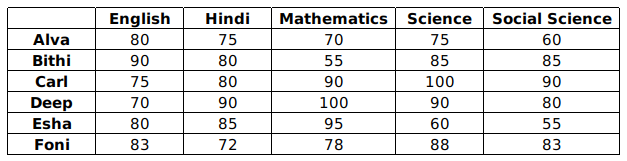
In a certain board examination, students were to appear for examination in five subjects:
English, Hindi, Mathematics, Science and Social Science. Due to a certain emergency situation, a few of the examinations could not be conducted for some students. Hence, some students missed one examination and some others missed two examinations. Nobody missed more than two examinations.
The board adopted the following policy for awarding marks to students. If a student appeared in all five examinations, then the marks awarded in each of the examinations were on the basis of the scores obtained by them in those examinations.
If a student missed only one examination, then the marks awarded in that examination was the average of the best three among the four scores in the examinations they appeared for. If a student missed two examinations, then the marks awarded in each of these examinations was the average of the best two among the three scores in the examinations they appeared for. The marks obtained by six students in the examination are given in the table below. Each of them missed either one or two examinations.

The following facts are also known.
I. Four of these students appeared in each of the English, Hindi, Science, and Social Science examinations.
II. The student who missed the Mathematics examination did not miss any other examination.
III. One of the students who missed the Hindi examination did not miss any other examination. The other student who missed the Hindi examination also missed the Science examination.
Who among the following did not appear for the Mathematics examination?
Based on Condition II, we understand that the student who missed the Mathematics examination did not miss any other examination. This indicates that the Maths score is bound to be the average of the best 3 out of the 4 exam scores obtained by this candidate. Based on this inference, we can proceed with identifying the math score that can be represented as an average of the rest of the scores. We can straightaway eliminate Deep and Esha as potential candidates, given that their Mathematics score is greater than the rest of the exam scores.
For Alva: best 3 out of 4 - 80(English), 75(Hindi), 75(Science)
Avg. = 230/3 = 76.67 $$\ne\ $$ 70
For Carl: best 3 out of 4 - 80(Hindi), 90(Social Science), 100(Science)
Avg. = 270/3 = 90 which matches the given value
$$\therefore\ $$ Carl most likely missed his Mathematics examination.
For Foni: best 3 out of 4 - 83(English), 83(Social Science), 88(Science)
Avg. = 254/3 = 84.67 $$\ne\ $$ 78
Hence, we observe that only Carl has missed his Mathematics examination. Hence, Option B is the correct answer.
Which students did not appear for the English examination?
Based on Condition II, we understand that the student who missed the Mathematics examination did not miss any other examination. This indicates that the Maths score is bound to be the average of the best 3 out of the 4 exam scores obtained by this candidate. Based on this inference, we can proceed with identifying the math score that can be represented as an average of the rest of the scores. We can straightaway eliminate Deep and Esha as potential candidates, given that their Mathematics score is greater than the rest of the exam scores. After estimating the average scores for the rest of the candidates, we observe that only Carl has missed his Mathematics examination.
For Carl: best 3 out of 4 - 80(Hindi), 90(Social Science), 100(Science)
Avg. = 270/3 = 90 which matches the given value
$$\therefore\ $$ Carl missed his Mathematics examination.
Further, based on Condition III, we can surmise that the student who missed Hindi and Science should have similar average scores in these two subjects. We notice that Alva has the same score of 75 in both Hindi and Science. The same can be said about Deep, who has a score of 90 in both these subjects. Thus, one out of Alva and Deep missed out on Hindi and Science examination, while the second individual missed out only on the Hindi examination.
Since we know that Carl, Alva and Deep are unlikely to have missed out on the English exam, we can divert our attention to determining which individual out of Bithi, Esha and Foni failed to appear for this subject. However, we notice that Bithi's English score is greater than the rest of her scores, thereby helping us eliminate her as the potential candidate.
For Esha: best 3 out of 4 - 85(Hindi), 95(Mathematics), 60(Science)
Avg. = 240/3 = 80 which matches the given value
$$\therefore\ $$ Esha most likely missed her English examination.
For Foni: best 3 out of 4 - 78(Mathematics), 83(Social Science), 88(Science)
Avg. = 249/3 = 83 which matches the given value
$$\therefore\ $$ Foni most likely missed her English examination.
Based on Condition I, we know that exactly two candidates missed the examinations for English, Hindi, Science, and Social Science.
For English, we determined these individuals to be Esha and Foni. For Hindi, we determined these individuals to be Alva and Deep. For Science, we know one of the individuals is either Alva or Deep. Given that Carl, Alva and Deep cannot be a part of the group that missed Science or Social Science exam, we can proceed by carefully scrutinizing the rest of the group that includes Bithi, Esha and Foni.
We notice that Bithi has a similar score in both Science and Social Science examination. Assuming that she did miss these exams, let us proceed to check if this was actually the case.
For Bithi: Best 2 out 3 - 90(English), 80(Hindi)
Avg = 170/2 = 85 which matches the given value
$$\therefore\ $$ Bithi is likely to have missed her Science and Social Science examinations.
We additionally notice that Foni has a similar score in English and Social Science. On considering the best 2 out of 3 scores, the average value of the score for both the subject holds (equal to 83). Thus, we can conclude that Bithi and Foni missed their Social Science examination.
Thus, the students who missed just one exam were: Carl (Mathematics); Esha (English) and one out of Alva and Deep (Hindi).
Hence of the six students, we can correctly determine the missed subjects for four of them (except Alva and Deep):
Mathematics: Carl ; English: Esha & Foni ; Hindi: Alva & Deep; Science: Bithi & one out of Alva and Deep ; Social Science: Foni & Bithi
Hence, the correct answer to this question is Option D: Esha and Foni.
What BEST can be concluded about the students who did not appear for the Hindi examination?
Based on Condition II, we understand that the student who missed the Mathematics examination did not miss any other examination. This indicates that the Maths score is bound to be the average of the best 3 out of the 4 exam scores obtained by this candidate. Based on this inference, we can proceed with identifying the math score that can be represented as an average of the rest of the scores. We can straightaway eliminate Deep and Esha as potential candidates, given that their Mathematics score is greater than the rest of the exam scores. After estimating the average scores for the rest of the candidates, we observe that only Carl has missed his Mathematics examination.
For Carl: best 3 out of 4 - 80(Hindi), 90(Social Science), 100(Science)
Avg. = 270/3 = 90 which matches the given value
$$\therefore\ $$ Carl missed his Mathematics examination.
Further, based on Condition III, we can surmise that the student who missed Hindi and Science should have similar average scores in these two subjects. We notice that Alva has the same score of 75 in both Hindi and Science. The same can be said about Deep, who has a score of 90 in both these subjects. Thus, one out of Alva and Deep missed out on Hindi and Science examination, while the second individual missed out only on the Hindi examination.
Since we know that Carl, Alva and Deep are unlikely to have missed out on the English exam, we can divert our attention to determining which individual out of Bithi, Esha and Foni failed to appear for this subject. However, we notice that Bithi's English score is greater than the rest of her scores, thereby helping us eliminate her as the potential candidate.
For Esha: best 3 out of 4 - 85(Hindi), 95(Mathematics), 60(Science)
Avg. = 240/3 = 80 which matches the given value
$$\therefore\ $$ Esha most likely missed her English examination.
For Foni: best 3 out of 4 - 78(Mathematics), 83(Social Science), 88(Science)
Avg. = 249/3 = 83 which matches the given value
$$\therefore\ $$ Foni most likely missed her English examination.
Based on Condition I, we know that exactly two candidates missed the examinations for English, Hindi, Science, and Social Science.
For English, we determined these individuals to be Esha and Foni. For Hindi, we determined these individuals to be Alva and Deep. For Science, we know one of the individuals is either Alva or Deep. Given that Carl, Alva and Deep cannot be a part of the group that missed Science or Social Science exam, we can proceed by carefully scrutinizing the rest of the group that includes Bithi, Esha and Foni.
We notice that Bithi has a similar score in both Science and Social Science examination. Assuming that she did miss these exams, let us proceed to check if this was actually the case.
For Bithi: Best 2 out 3 - 90(English), 80(Hindi)
Avg = 170/2 = 85 which matches the given value
$$\therefore\ $$ Bithi is likely to have missed her Science and Social Science examinations.
We additionally notice that Foni has a similar score in English and Social Science. On considering the best 2 out of 3 scores, the average value of the score for both the subject holds (equal to 83). Thus, we can conclude that Bithi and Foni missed their Social Science examination.
Thus, the students who missed just one exam were: Carl (Mathematics); Esha (English) and one out of Alva and Deep (Hindi).
Hence of the six students, we can correctly determine the missed subjects for four of them (except Alva and Deep):
Mathematics: Carl ; English: Esha & Foni ; Hindi: Alva & Deep; Science: Bithi & one out of Alva and Deep ; Social Science: Foni & Bithi
Hence, the correct answer to this question is Option B: Alva and Deep.
What BEST can be concluded about the students who missed the Science examination?
Based on Condition II, we understand that the student who missed the Mathematics examination did not miss any other examination. This indicates that the Maths score is bound to be the average of the best 3 out of the 4 exam scores obtained by this candidate. Based on this inference, we can proceed with identifying the math score that can be represented as an average of the rest of the scores. We can straightaway eliminate Deep and Esha as potential candidates, given that their Mathematics score is greater than the rest of the exam scores. After estimating the average scores for the rest of the candidates, we observe that only Carl has missed his Mathematics examination.
For Carl: best 3 out of 4 - 80(Hindi), 90(Social Science), 100(Science)
Avg. = 270/3 = 90 which matches the given value
$$\therefore\ $$ Carl missed his Mathematics examination.
Further, based on Condition III, we can surmise that the student who missed Hindi and Science should have similar average scores in these two subjects. We notice that Alva has the same score of 75 in both Hindi and Science. The same can be said about Deep, who has a score of 90 in both these subjects. Thus, one out of Alva and Deep missed out on Hindi and Science examination, while the second individual missed out only on the Hindi examination.
Since we know that Carl, Alva and Deep are unlikely to have missed out on the English exam, we can divert our attention to determining which individual out of Bithi, Esha and Foni failed to appear for this subject. However, we notice that Bithi's English score is greater than the rest of her scores, thereby helping us eliminate her as the potential candidate.
For Esha: best 3 out of 4 - 85(Hindi), 95(Mathematics), 60(Science)
Avg. = 240/3 = 80 which matches the given value
$$\therefore\ $$ Esha most likely missed her English examination.
For Foni: best 3 out of 4 - 78(Mathematics), 83(Social Science), 88(Science)
Avg. = 249/3 = 83 which matches the given value
$$\therefore\ $$ Foni most likely missed her English examination.
Based on Condition I, we know that exactly two candidates missed the examinations for English, Hindi, Science, and Social Science.
For English, we determined these individuals to be Esha and Foni. For Hindi, we determined these individuals to be Alva and Deep. For Science, we know one of the individuals is either Alva or Deep. Given that Carl, Alva and Deep cannot be a part of the group that missed Science or Social Science exam, we can proceed by carefully scrutinizing the rest of the group that includes Bithi, Esha and Foni.
We notice that Bithi has a similar score in both Science and Social Science examination. Assuming that she did miss these exams, let us proceed to check if this was actually the case.
For Bithi: Best 2 out 3 - 90(English), 80(Hindi)
Avg = 170/2 = 85 which matches the given value
$$\therefore\ $$ Bithi is likely to have missed her Science and Social Science examinations.
We additionally notice that Foni has a similar score in English and Social Science. On considering the best 2 out of 3 scores, the average value of the score for both the subject holds (equal to 83). Thus, we can conclude that Bithi and Foni missed their Social Science examination.
Thus, the students who missed just one exam were: Carl (Mathematics); Esha (English) and one out of Alva and Deep (Hindi).
Hence of the six students, we can correctly determine the missed subjects for four of them (except Alva and Deep):
Mathematics: Carl ; English: Esha & Foni ; Hindi: Alva & Deep; Science: Bithi & one out of Alva and Deep ; Social Science: Foni & Bithi
Hence, the correct answer to this question is Option A: Bithi & one out of Alva and Deep.
How many out of these six students missed exactly one examination?
Based on Condition II, we understand that the student who missed the Mathematics examination did not miss any other examination. This indicates that the Maths score is bound to be the average of the best 3 out of the 4 exam scores obtained by this candidate. Based on this inference, we can proceed with identifying the math score that can be represented as an average of the rest of the scores. We can straightaway eliminate Deep and Esha as potential candidates, given that their Mathematics score is greater than the rest of the exam scores. After estimating the average scores for the rest of the candidates, we observe that only Carl has missed his Mathematics examination.
For Carl: best 3 out of 4 - 80(Hindi), 90(Social Science), 100(Science)
Avg. = 270/3 = 90 which matches the given value
$$\therefore\ $$ Carl missed his Mathematics examination.
Further, based on Condition III, we can surmise that the student who missed Hindi and Science should have similar average scores in these two subjects. We notice that Alva has the same score of 75 in both Hindi and Science. The same can be said about Deep, who has a score of 90 in both these subjects. Thus, one out of Alva and Deep missed out on Hindi and Science examination, while the second individual missed out only on the Hindi examination.
Since we know that Carl, Alva and Deep are unlikely to have missed out on the English exam, we can divert our attention to determining which individual out of Bithi, Esha and Foni failed to appear for this subject. However, we notice that Bithi's English score is greater than the rest of her scores, thereby helping us eliminate her as the potential candidate.
For Esha: best 3 out of 4 - 85(Hindi), 95(Mathematics), 60(Science)
Avg. = 240/3 = 80 which matches the given value
$$\therefore\ $$ Esha most likely missed her English examination.
For Foni: best 3 out of 4 - 78(Mathematics), 83(Social Science), 88(Science)
Avg. = 249/3 = 83 which matches the given value
$$\therefore\ $$ Foni most likely missed her English examination.
Based on Condition I, we know that exactly two candidates missed the examinations for English, Hindi, Science, and Social Science.
For English, we determined these individuals to be Esha and Foni. For Hindi, we determined these individuals to be Alva and Deep. For Science, we know one of the individuals is either Alva or Deep. Given that Carl, Alva and Deep cannot be a part of the group that missed Science or Social Science exam, we can proceed by carefully scrutinizing the rest of the group that includes Bithi, Esha and Foni.
We notice that Bithi has a similar score in both Science and Social Science examination. Assuming that she did miss these exams, let us proceed to check if this was actually the case.
For Bithi: Best 2 out 3 - 90(English), 80(Hindi)
Avg = 170/2 = 85 which matches the given value
$$\therefore\ $$ Bithi is likely to have missed her Science and Social Science examinations.
We additionally notice that Foni has a similar score in English and Social Science. On considering the best 2 out of 3 scores, the average value of the score for both the subject holds (equal to 83). Thus, we can conclude that Bithi and Foni missed their Social Science examination.
Thus, the students who missed just one exam were: Carl (Mathematics); Esha (English) and one out of Alva and Deep (Hindi).
Hence of the six students, we can correctly determine the missed subjects for four of them (except Alva and Deep):
Mathematics: Carl ; English: Esha & Foni ; Hindi: Alva & Deep; Science: Bithi & one out of Alva and Deep ; Social Science: Foni & Bithi
Hence, the correct answer to this question is 3. {Carl (Mathematics); Esha (English) and one out of Alva and Deep (Hindi)}
For how many students can we be definite about which examinations they missed?
Based on Condition II, we understand that the student who missed the Mathematics examination did not miss any other examination. This indicates that the Maths score is bound to be the average of the best 3 out of the 4 exam scores obtained by this candidate. Based on this inference, we can proceed with identifying the math score that can be represented as an average of the rest of the scores. We can straightaway eliminate Deep and Esha as potential candidates, given that their Mathematics score is greater than the rest of the exam scores. After estimating the average scores for the rest of the candidates, we observe that only Carl has missed his Mathematics examination.
For Carl: best 3 out of 4 - 80(Hindi), 90(Social Science), 100(Science)
Avg. = 270/3 = 90 which matches the given value
$$\therefore\ $$ Carl missed his Mathematics examination.
Further, based on Condition III, we can surmise that the student who missed Hindi and Science should have similar average scores in these two subjects. We notice that Alva has the same score of 75 in both Hindi and Science. The same can be said about Deep, who has a score of 90 in both these subjects. Thus, one out of Alva and Deep missed out on Hindi and Science examination, while the second individual missed out only on the Hindi examination.
Since we know that Carl, Alva and Deep are unlikely to have missed out on the English exam, we can divert our attention to determining which individual out of Bithi, Esha and Foni failed to appear for this subject. However, we notice that Bithi's English score is greater than the rest of her scores, thereby helping us eliminate her as the potential candidate.
For Esha: best 3 out of 4 - 85(Hindi), 95(Mathematics), 60(Science)
Avg. = 240/3 = 80 which matches the given value
$$\therefore\ $$ Esha most likely missed her English examination.
For Foni: best 3 out of 4 - 78(Mathematics), 83(Social Science), 88(Science)
Avg. = 249/3 = 83 which matches the given value
$$\therefore\ $$ Foni most likely missed her English examination.
Based on Condition I, we know that exactly two candidates missed the examinations for English, Hindi, Science, and Social Science.
For English, we determined these individuals to be Esha and Foni. For Hindi, we determined these individuals to be Alva and Deep. For Science, we know one of the individuals is either Alva or Deep. Given that Carl, Alva and Deep cannot be a part of the group that missed Science or Social Science exam, we can proceed by carefully scrutinizing the rest of the group that includes Bithi, Esha and Foni.
We notice that Bithi has a similar score in both Science and Social Science examination. Assuming that she did miss these exams, let us proceed to check if this was actually the case.
For Bithi: Best 2 out 3 - 90(English), 80(Hindi)
Avg = 170/2 = 85 which matches the given value
$$\therefore\ $$ Bithi is likely to have missed her Science and Social Science examinations.
We additionally notice that Foni has a similar score in English and Social Science. On considering the best 2 out of 3 scores, the average value of the score for both the subject holds (equal to 83). Thus, we can conclude that Bithi and Foni missed their Social Science examination.
Thus, the students who missed just one exam were: Carl (Mathematics); Esha (English) and one out of Alva and Deep (Hindi).
Hence of the six students, we can correctly determine the missed subjects for four of them (except Alva and Deep):
Mathematics: Carl ; English: Esha & Foni ; Hindi: Alva & Deep; Science: Bithi & one out of Alva and Deep ; Social Science: Foni & Bithi
Except for Alva and Deep, we can conclusively comment of the missed subjects of the rest four. Hence, the correct answer is 4.
Ten musicians (A, B, C, D, E, F, G, H, I and J) are experts in at least one of the following three percussion instruments: tabla, mridangam, and ghatam. Among them, three are experts in tabla but not in mridangam or ghatam, another three are experts in mridangam but not in tabla or ghatam, and one is an expert in ghatam but not in tabla or mridangam. Further, two are experts in tabla and mridangam but not in ghatam, and one is an expert in tabla and ghatam but not in mridangam.
The following facts are known about these ten musicians.
1. Both A and B are experts in mridangam, but only one of them is also an expert in tabla.
2. D is an expert in both tabla and ghatam.
3. Both F and G are experts in tabla, but only one of them is also an expert in mridangam.
4. Neither I nor J is an expert in tabla.
5. Neither H nor I is an expert in mridangam, but only one of them is an expert in ghatam.
Who among the following is DEFINITELY an expert in tabla but not in either mridangam or ghatam?
Based on the given information, we can form the following Venn-diagram for ease of understanding:
The conditions help us to further bifurcate the individuals based on their expertise.
Mridangam: A and B (condition 1); one out of F and G (condition 3)
Tabla: one out of A and B (condition 1); F and G (condition 3); D (condition 2)
Ghatam: D (condition 2)
Based on condition 4, we infer that 'I' and 'J' are either experts in Ghatam or Mridangam. However, condition 5 adds that 'I' is not an expert in Mridangam. This helps us definitively zero-in on 'I' as an expert in Ghatam. Since 'I' is a Ghatam expert, J is an expert in Mridangam and 'H' is an expert in Tabla [based on conditions 4 and 5]. Thus, we can depict our understanding so far as follows:
Mridangam [total: 5] - A and B (condition 1); one out of F and G (condition 3); J (condition 4 and 5); one out of C and E {remaining experts}
Tabla [total: 6] - one out of A and B (condition 1); F and G (condition 3); D (condition 2); H (condition 4 and 5); one out of C and E {remaining experts}
Ghatam [total: 2] - D (condition 2); I (condition 4 and 5)
Thus, we observe that H is definitely an expert in tabla but not in either mridangam or ghatam. Hence, Option D is the correct answer.
Who among the following is DEFINITELY an expert in mridangam but not in either tabla or ghatam?
Based on the given information, we can form the following Venn-diagram for ease of understanding:
The conditions help us to further bifurcate the individuals based on their expertise.
Mridangam: A and B (condition 1); one out of F and G (condition 3)
Tabla: one out of A and B (condition 1); F and G (condition 3); D (condition 2)
Ghatam: D (condition 2)
Based on condition 4, we infer that 'I' and 'J' are either experts in Ghatam or Mridangam. However, condition 5 adds that 'I' is not an expert in Mridangam. This helps us definitively zero-in on 'I' as an expert in Ghatam. Since 'I' is a Ghatam expert, J is an expert in Mridangam and 'H' is an expert in Tabla [based on conditions 4 and 5]. Thus, we can depict our understanding so far as follows:
Mridangam [total: 5] - A and B (condition 1); one out of F and G (condition 3); J (condition 4 and 5); one out of C and E {remaining experts}
Tabla [total: 6] - one out of A and B (condition 1); F and G (condition 3); D (condition 2); H (condition 4 and 5); one out of C and E {remaining experts}
Ghatam [total: 2] - D (condition 2); I (condition 4 and 5)
Thus, we observe that J is definitely an expert in mridangam but not in either tabla or ghatam. Hence, Option B is the correct answer.
Which of the following pairs CANNOT have any musician who is an expert in both tabla and mridangam but not in ghatam?
Based on the given information, we can form the following Venn-diagram for ease of understanding:
The conditions help us to further bifurcate the individuals based on their expertise.
Mridangam: A and B (condition 1); one out of F and G (condition 3)
Tabla: one out of A and B (condition 1); F and G (condition 3); D (condition 2)
Ghatam: D (condition 2)
Based on condition 4, we infer that 'I' and 'J' are either experts in Ghatam or Mridangam. However, condition 5 adds that 'I' is not an expert in Mridangam. This helps us definitively zero-in on 'I' as an expert in Ghatam. Since 'I' is a Ghatam expert, J is an expert in Mridangam and 'H' is an expert in Tabla [based on conditions 4 and 5]. Thus, we can depict our understanding so far as follows:
Mridangam [total: 5] - A and B (condition 1); one out of F and G (condition 3); J (condition 4 and 5); one out of C and E {remaining experts}
Tabla [total: 6] - one out of A and B (condition 1); F and G (condition 3); D (condition 2); H (condition 4 and 5); one out of C and E {remaining experts}
Ghatam [total: 2] - D (condition 2); I (condition 4 and 5)
We observe that the pair C and E cannot have any musician who is an expert in both tabla and mridangam but not in ghatam. Hence, Option B is the correct answer.
If C is an expert in mridangam and F is not, then which are the three musicians who are experts in tabla but not in either mridangam or ghatam?
Based on the given information, we can form the following Venn-diagram for ease of understanding:
The conditions help us to further bifurcate the individuals based on their expertise.
Mridangam: A and B (condition 1); one out of F and G (condition 3)
Tabla: one out of A and B (condition 1); F and G (condition 3); D (condition 2)
Ghatam: D (condition 2)
Based on condition 4, we infer that 'I' and 'J' are either experts in Ghatam or Mridangam. However, condition 5 adds that 'I' is not an expert in Mridangam. This helps us definitively zero-in on 'I' as an expert in Ghatam. Since 'I' is a Ghatam expert, J is an expert in Mridangam and 'H' is an expert in Tabla [based on conditions 4 and 5]. Thus, we can depict our understanding so far as follows:
Mridangam [total: 5] - A and B (condition 1); one out of F and G (condition 3); J (condition 4 and 5); one out of C and E {remaining experts}
Tabla [total: 6] - one out of A and B (condition 1); F and G (condition 3); D (condition 2); H (condition 4 and 5); one out of C and E {remaining experts}
Ghatam [total: 2] - D (condition 2); I (condition 4 and 5)
If C is an expert in Mridangam, E has to be an expert in Tabla. Additionally, if F is not an expert in Mridangam, he has to be an expert only in Tabla while G will be an expert in both Tabla and Mridangam.
Tabla [total: 6] - one out of A and B (condition 1); F and G (condition 3); D (condition 2); H (condition 4 and 5); E {based on the condition given in the question}
Of these experts, A, B and G are experts of Mridangam and D is an expert of Ghatam as well. Thus, excluding these, we have F, H and E who are the experts solely in Tabla. Thus, Option A is the correct answer.
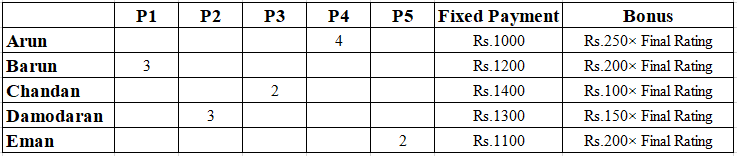
The local office of the APP-CAB company evaluates the performance of five cab drivers, Arun, Barun, Chandan, Damodaran, and Eman for their monthly payment based on ratings in five different parameters (P1 to P5) as given below:
P1: timely arrival
P2: behaviour
P3: comfortable ride
P4: driver's familiarity with the route
P5: value for money
Based on feedback from the customers, the office assigns a rating from 1 to 5 in each of these parameters. Each rating is an integer from a low value of 1 to a high value of 5. The final rating of a driver is the average of his ratings in these five parameters. The monthly payment of the drivers has two parts - a fixed payment and final rating-based bonus. If a driver gets a rating of 1 in any of the parameters, he is not eligible to get bonus. To be eligible for bonus a driver also needs to get a rating of five in at least one of the parameters. The partial information related to the ratings of the drivers in different parameters and the monthly payment structure (in rupees) is given in the table below:

The following additional facts are known.
1. Arun and Barun have got a rating of 5 in exactly one of the parameters. Chandan has got a rating of 5 in exactly two parameters.
2. None of drivers has got the same rating in three parameters.
If Damodaran does not get a bonus, what is the maximum possible value of his final rating?
Based on the given conditions, Damodaran misses out on the bonus if he gets a rating of 1 in any of the five parameters. He additionally needs to obtain a rating of 5 in at least one of the parameters. Thus, the maximum value of the range of ratings that he can acquire would be 1+3(given)+5+5+5. However, based on condition 2, he can have similar ratings in only two of the parameters. Thus, the maximum value of the final rating would be (1+3+5+5+4) /5 = 18/5 = 3.6. Hence, Option C is the correct answer.
If Eman gets a bonus, what is the minimum possible value of his final rating?
Since Eman got a bonus, he must have obtained a rating of 5 in at least one of the parameters. To minimize his final rating we need to consider the following range of values: 5(mandatory)+2(given)+2+3+3 = 15. The least value of his final rating is, therefore, 15/5 = 3. Hence, Option D is the correct answer.
If all five drivers get bonus, what is the minimum possible value of the monthly payment (in rupees) that a driver gets?
Our objective here is to minimize the final ratings in order to find the minimum value of the monthly payment. We cannot have a rating of 1 in any of the parameters since all the drives got the bonus and we need to have at least one parameter with a rating of 5. With this understanding, we obtain the following:
Arun:
Final rating = (5+4+2+2+3)/5 = 16/5 = 3.2; Fixed payment = Rs.1000
Variable payment = 3.2 * Rs. 250 = Rs.800 ; Total = Rs.(1000+800) = Rs. 1800
Barun:
Final rating = (5+3+2+2+3)/5 = 15/5 = 3; Fixed payment = Rs.1200
Variable payment = 3 * Rs. 200 = Rs.600 ; Total = Rs.(1200+600) = Rs. 1800
Chandan: {rating of 5 in exactly two parameters based on condition 1}
Final rating = (5+5+2+2+3)/5 = 17/5 = 3.4; Fixed payment = Rs.1400
Variable payment = 3.4 * Rs. 100 = Rs.340 ; Total = Rs.(1400+340) = Rs. 1740
Damodaran:
Final rating = (5+3+2+2+3)/5 = 15/5 = 3; Fixed payment = Rs.1300
Variable payment = 3 * Rs. 150 = Rs.450 ; Total = Rs.(1300+450) = Rs. 1750
Eman:
Final rating = (5+3+2+2+3)/5 = 15/5 = 3; Fixed payment = Rs.1100
Variable payment = 3 * Rs. 200 = Rs.600 ; Total = Rs.(1100+600) = Rs. 1700
Hence, we observe that the minimum value of the monthly payment is Rs. 1700. Option D is the correct answer.
If all five drivers get bonus, what is the maximum possible value of the monthly payment (in rupees) that a driver gets?
Our objective here is to maximize the final ratings in order to find the maximum possible value of the monthly payment. We cannot have a rating of 1 in any of the parameters since all the drives got the bonus and we need to have at least one parameter with a rating of 5. With this understanding, we obtain the following:
Arun: {can have only one rating of 5 based on condition 1}
Final rating = (5+4+4+3+3)/5 = 19/5 = 3.8; Fixed payment = Rs.1000
Variable payment = 3.8 * Rs. 250 = Rs.950 ; Total = Rs.(1000+950) = Rs. 1950
Barun: {can have only one rating of 5 based on condition 1}
Final rating = (5+4+4+3+3)/5 = 19/5 = 3.8; Fixed payment = Rs.1200
Variable payment = 3.8 * Rs. 200 = Rs.760 ; Total = Rs.(1200+760) = Rs. 1960
Chandan:
Final rating = (5+5+2+4+4)/5 = 20/5 = 4; Fixed payment = Rs.1400
Variable payment = 4 * Rs. 100 = Rs.400 ; Total = Rs.(1400+400) = Rs. 1800
Damodaran:
Final rating = (5+5+4+4+3)/5 = 21/5 = 4.2; Fixed payment = Rs.1300
Variable payment = 4.2 * Rs. 150 = Rs.630 ; Total = Rs.(1300+630) = Rs. 1930
Eman:
Final rating = (5+5+2+4+4)/5 = 20/5 = 4; Fixed payment = Rs.1100
Variable payment = 4 * Rs. 200 = Rs.800 ; Total = Rs.(1100+800) = Rs. 1900
Hence, we observe that the maximum possible value of the monthly payment is Rs. 1960. Option A is the correct answer.
1000 patients currently suffering from a disease were selected to study the effectiveness of treatment of four types of medicines — A, B, C and D. These patients were first randomly assigned into two groups of equal size, called treatment group and control group. The patients in the control group were not treated with any of these medicines; instead they were given a dummy medicine, called placebo, containing only sugar and starch. The following information is known about the patients in the treatment group.
a. A total of 250 patients were treated with type A medicine and a total of 210 patients were treated with type C medicine.
b. 25 patients were treated with type A medicine only. 20 patients were treated with type C medicine only. 10 patients were treated with type D medicine only.
c. 35 patients were treated with type A and type D medicines only. 20 patients were treated with type A and type B medicines only. 30 patients were treated with type A and type C medicines only. 20 patients were treated with type C and type D medicines only.
d. 100 patients were treated with exactly three types of medicines.
e. 40 patients were treated with medicines of types A, B and C, but not with medicines of type D. 20 patients were treated with medicines of types A, C and D, but not with medicines of type B.
f. 50 patients were given all the four types of medicines. 75 patients were treated with exactly one type of medicine.
How many patients were treated with medicine type B?
Of the 1000 subjects, only 500 have been considered for the treatment. This constitutes our sample set. Thus the four drugs- A, B, C and D have been administered to this set of 500 individuals, while the rest 500 have been given the placebo. Based on the given information, we can then draw the following 4-set Venn diagram:
We can solve for the number of patients who were administered the drugs A, B and D excluding C by putting in the values for set A. The required value = 250 - (25+20+30+40+20+50+35) = 30. Based on condition (c), we know that 100 patients were treated with exactly three types of medicines. Thus, we can fill the slot for the number of patients who were administered only B, C and D excluding A by 100 - (40+20+30) = 10.
Similarly, based on condition (f), we know that the candidates who were administered only dug B are 75 - (25+20+10) = 20. Post this, we can easily calculate the number of people administered with only drugs B and C by 210 - (30+20+40+50+10+20+20) = 20. We can fill in the above values to obtain the following diagram:
The sum of all the values should add up to 500. On solving for 'x' [which represents the number of people who were administered drugs B and D only], we obtain x = 150. The final representation would appear as follows:
Based on the above, the number of patients who were treated with medicine type B is equal to 340.
The number of patients who were treated with medicine types B, C and D, but not type A was:
Of the 1000 subjects, only 500 have been considered for the treatment. This constitutes our sample set. Thus the four drugs- A, B, C and D have been administered to this set of 500 individuals, while the rest 500 have been given the placebo. Based on the given information, we can then draw the following 4-set Venn diagram:
We can solve for the number of patients who were administered the drugs A, B and D excluding C by putting in the values for set A. The required value = 250 - (25+20+30+40+20+50+35) = 30. Based on condition (c), we know that 100 patients were treated with exactly three types of medicines. Thus, we can fill the slot for the number of patients who were administered only B, C and D excluding A by 100 - (40+20+30) = 10.
Similarly, based on condition (f), we know that the candidates who were administered only dug B are 75 - (25+20+10) = 20. Post this, we can easily calculate the number of people administered with only drugs B and C by 210 - (30+20+40+50+10+20+20) = 20. We can fill in the above values to obtain the following diagram:
The sum of all the values should add up to 500. On solving for 'x' [which represents the number of people who were administered drugs B and D only], we obtain x = 150. The final representation would appear as follows:
The number of patients who were treated with medicine types B, C and D, but not type A was: 10.
How many patients were treated with medicine types B and D only?
Of the 1000 subjects, only 500 have been considered for the treatment. This constitutes our sample set. Thus the four drugs- A, B, C and D have been administered to this set of 500 individuals, while the rest 500 have been given the placebo. Based on the given information, we can then draw the following 4-set Venn diagram:
We can solve for the number of patients who were administered the drugs A, B and D excluding C by putting in the values for set A. The required value = 250 - (25+20+30+40+20+50+35) = 30. Based on condition (c), we know that 100 patients were treated with exactly three types of medicines. Thus, we can fill the slot for the number of patients who were administered only B, C and D excluding A by 100 - (40+20+30) = 10.
Similarly, based on condition (f), we know that the candidates who were administered only dug B are 75 - (25+20+10) = 20. Post this, we can easily calculate the number of people administered with only drugs B and C by 210 - (30+20+40+50+10+20+20) = 20. We can fill in the above values to obtain the following diagram:
The sum of all the values should add up to 500. On solving for 'x' [which represents the number of people who were administered drugs B and D only], we obtain x = 150. The final representation would appear as follows:
The number of people who were administered drugs B and D only were 150.
The number of patients who were treated with medicine type D was:
Of the 1000 subjects, only 500 have been considered for the treatment. This constitutes our sample set. Thus the four drugs- A, B, C and D have been administered to this set of 500 individuals, while the rest 500 have been given the placebo. Based on the given information, we can then draw the following 4-set Venn diagram:
We can solve for the number of patients who were administered the drugs A, B and D excluding C by putting in the values for set A. The required value = 250 - (25+20+30+40+20+50+35) = 30. Based on condition (c), we know that 100 patients were treated with exactly three types of medicines. Thus, we can fill the slot for the number of patients who were administered only B, C and D excluding A by 100 - (40+20+30) = 10.
Similarly, based on condition (f), we know that the candidates who were administered only dug B are 75 - (25+20+10) = 20. Post this, we can easily calculate the number of people administered with only drugs B and C by 210 - (30+20+40+50+10+20+20) = 20. We can fill in the above values to obtain the following diagram:
The sum of all the values should add up to 500. On solving for 'x' [which represents the number of people who were administered drugs B and D only], we obtain x = 150. The final representation would appear as follows:
The number of patients who were treated with medicine type D was 325.
Four institutes, A, B, C, and D, had contracts with four vendors W, X, Y, and Z during the ten calendar years from 2010 to 2019. The contracts were either multi-year contracts running for several consecutive years or single-year contracts. No institute had more than one contract with the same vendor. However, in a calendar year, an institute may have had contracts with multiple vendors, and a vendor may have had contracts with multiple institutes. It is known that over the decade, the institutes each got into two contracts with two of these vendors, and each vendor got into two contracts with two of these institutes.
The following facts are also known about these contracts.
I. Vendor Z had at least one contract in every year.
II. Vendor X had one or more contracts in every year up to 2015, but no contract in any year after that.
III. Vendor Y had contracts in 2010 and 2019. Vendor W had contracts only in 2012.
IV. There were five contracts in 2012.
V. There were exactly four multi-year contracts. Institute B had a 7-year contract, D had a 4-year contract, and A and C had one 3-year contract each. The other four contracts were single-year contracts.
VI. Institute C had one or more contracts in 2012 but did not have any contract in 2011.
VII. Institutes B and D each had exactly one contract in 2012. Institute D did not have any contract in 2010.
In which of the following years were there two or more contracts?
From IV: A, B, C, D have one 3, 7, 3, 4-year contract respectively and all other contracts are one-year contracts.
From
I, Z has at least one contract every year, the only possible
combination is 7+3 or 7+4 year contract and that 7-year contract must be
from B.
From III, Vendor W had contracts only in 2012 and
from VII, Institutes B and D each had exactly one contract in 2012
=> W has got contracts from A and C.
From II. Vendor X had one
or more contracts in every year up to 2015, but no contract in any year
after that and from VI, VII: C and D didn't have any contract in 2011
and 2010 respectively => A should have X as a 3-year contract from
2010-2012. Now, for 2013-2015 X can't have B for the same. So, X must
have got contracts from either C or D in that period.
Case 1:
X has C as a 3-year contract from 2013-2015 but in this case, D can't have any contract in 2012 so, this case is not valid.
Case 2:
X has D for a 4-year contract from 2012-2015 and C must have Z for a three-year contract in the period 2017-2019 such that Z has at least one contract every year.
It is known that over the decade, the
institutes each got into two contracts with two of these vendors, and
each vendor got into two contracts with two of these institutes => A
hasn't got any contract from 2013-2019 as it has X, W in the period
2010-2012 and similarly, C shouldn't have any contracts in the years 2010,
2013, 2014, 2015, 2016.
From III, Vendor Y had contracts in
2010 and 2019 and in 2010 D and C hasn't got any contract and A has
already got 2 different contracts from two different vendors => Y has
a contract from B in 2010 => B hasn't got any contracts in 2017,
2018, 2019.
For Y the only possible contract will be from D => D has got no contracts in the years 2011, 2016, 2017, 2018.
Now, the table looks like:
'N' represents no contract.
Out of the given options, only 2015 has two contracts and rest have only one contract in that particular year.
Which of the following is true?
From IV: A, B, C, D have one 3, 7, 3, 4-year contract respectively and all other contracts are one-year contracts.
From
I, Z has at least one contract every year, the only possible
combination is 7+3 or 7+4 year contract and that 7-year contract must be
from B.
From III, Vendor W had contracts only in 2012 and
from VII, Institutes B and D each had exactly one contract in 2012
=> W has got contracts from A and C.
From II. Vendor X had one
or more contracts in every year up to 2015, but no contract in any year
after that and from VI, VII: C and D didn't have any contract in 2011
and 2010 respectively => A should have X as a 3-year contract from
2010-2012. Now, for 2013-2015 X can't have B for the same. So, X must
have got contracts from either C or D in that period.
Case 1:
X has C as a 3-year contract from 2013-2015 but in this case, D can't have any contract in 2012 so, this case is not valid.
Case 2:
X has D for a 4-year contract from 2012-2015 and C must have Z for a three-year contract in the period 2017-2019 such that Z has at least one contract every year.
It is known that over the decade, the
institutes each got into two contracts with two of these vendors, and
each vendor got into two contracts with two of these institutes => A
hasn't got any contract from 2013-2019 as it has X, W in the period
2010-2012 and similarly, C shouldn't have any contracts in the years 2010,
2013, 2014, 2015, 2016.
From III, Vendor Y had contracts in
2010 and 2019 and in 2010 D and C hasn't got any contract and A has
already got 2 different contracts from two different vendors => Y has
a contract from B in 2010 => B hasn't got any contracts in 2017,
2018, 2019.
For Y the only possible contract will be from D => D has got no contracts in the years 2011, 2016, 2017, 2018.
Now, the table looks like:
'N' represents no contract.
Option D is true.
In how many years during this period was there only one contract?
From IV: A, B, C, D have one 3, 7, 3, 4-year contract respectively and all other contracts are one-year contracts.
From
I, Z has at least one contract every year, the only possible
combination is 7+3 or 7+4 year contract and that 7-year contract must be
from B.
From III, Vendor W had contracts only in 2012 and
from VII, Institutes B and D each had exactly one contract in 2012
=> W has got contracts from A and C.
From II. Vendor X had one
or more contracts in every year up to 2015, but no contract in any year
after that and from VI, VII: C and D didn't have any contract in 2011
and 2010 respectively => A should have X as a 3-year contract from
2010-2012. Now, for 2013-2015 X can't have B for the same. So, X must
have got contracts from either C or D in that period.
Case 1:
X has C as a 3-year contract from 2013-2015 but in this case, D can't have any contract in 2012 so, this case is not valid.
Case 2:
X has D for a 4-year contract from 2012-2015 and C must have Z for a three-year contract in the period 2017-2019 such that Z has at least one contract every year.
It is known that over the decade, the
institutes each got into two contracts with two of these vendors, and
each vendor got into two contracts with two of these institutes => A
hasn't got any contract from 2013-2019 as it has X, W in the period
2010-2012 and similarly, C shouldn't have any contracts in the years 2010,
2013, 2014, 2015, 2016.
From III, Vendor Y had contracts in
2010 and 2019 and in 2010 D and C hasn't got any contract and A has
already got 2 different contracts from two different vendors => Y has
a contract from B in 2010 => B hasn't got any contracts in 2017,
2018, 2019.
For Y the only possible contract will be from D => D has got no contracts in the years 2011, 2016, 2017, 2018.
Now, the table looks like:
'N' represents no contract.
Only during 2016, 2017 and 2018, there was only one contract.
What BEST can be concluded about the number of contracts in 2010?
From IV: A, B, C, D have one 3, 7, 3, 4-year contract respectively and all other contracts are one-year contracts.
From
I, Z has at least one contract every year, the only possible
combination is 7+3 or 7+4 year contract and that 7-year contract must be
from B.
From III, Vendor W had contracts only in 2012 and
from VII, Institutes B and D each had exactly one contract in 2012
=> W has got contracts from A and C.
From II. Vendor X had one
or more contracts in every year up to 2015, but no contract in any year
after that and from VI, VII: C and D didn't have any contract in 2011
and 2010 respectively => A should have X as a 3-year contract from
2010-2012. Now, for 2013-2015 X can't have B for the same. So, X must
have got contracts from either C or D in that period.
Case 1:
X has C as a 3-year contract from 2013-2015 but in this case, D can't have any contract in 2012 so, this case is not valid.
Case 2:
X has D for a 4-year contract from 2012-2015 and C must have Z for a three-year contract in the period 2017-2019 such that Z has at least one contract every year.
It is known that over the decade, the
institutes each got into two contracts with two of these vendors, and
each vendor got into two contracts with two of these institutes => A
hasn't got any contract from 2013-2019 as it has X, W in the period
2010-2012 and similarly, C shouldn't have any contracts in the years 2010,
2013, 2014, 2015, 2016.
From III, Vendor Y had contracts in
2010 and 2019 and in 2010 D and C hasn't got any contract and A has
already got 2 different contracts from two different vendors => Y has
a contract from B in 2010 => B hasn't got any contracts in 2017,
2018, 2019.
For Y the only possible contract will be from D => D has got no contracts in the years 2011, 2016, 2017, 2018.
Now, the table looks like:
'N' represents no contract.
The Number of contracts in 2010 is three.
Which institutes had multiple contracts during the same year?
From IV: A, B, C, D have one 3, 7, 3, 4-year contract respectively and all other contracts are one-year contracts.
From
I, Z has at least one contract every year, the only possible
combination is 7+3 or 7+4 year contract and that 7-year contract must be
from B.
From III, Vendor W had contracts only in 2012 and
from VII, Institutes B and D each had exactly one contract in 2012
=> W has got contracts from A and C.
From II. Vendor X had one
or more contracts in every year up to 2015, but no contract in any year
after that and from VI, VII: C and D didn't have any contract in 2011
and 2010 respectively => A should have X as a 3-year contract from
2010-2012. Now, for 2013-2015 X can't have B for the same. So, X must
have got contracts from either C or D in that period.
Case 1:
X has C as a 3-year contract from 2013-2015 but in this case, D can't have any contract in 2012 so, this case is not valid.
Case 2:
X has D for a 4-year contract from 2012-2015 and C must have Z for a three-year contract in the period 2017-2019 such that Z has at least one contract every year.
It is known that over the decade, the
institutes each got into two contracts with two of these vendors, and
each vendor got into two contracts with two of these institutes => A
hasn't got any contract from 2013-2019 as it has X, W in the period
2010-2012 and similarly, C shouldn't have any contracts in the years 2010,
2013, 2014, 2015, 2016.
From III, Vendor Y had contracts in
2010 and 2019 and in 2010 D and C hasn't got any contract and A has
already got 2 different contracts from two different vendors => Y has
a contract from B in 2010 => B hasn't got any contracts in 2017,
2018, 2019.
For Y the only possible contract will be from D => D has got no contracts in the years 2011, 2016, 2017, 2018.
Now, the table looks like:
'N' represents no contract.
B and A have multiple contracts in a single year.
Which institutes and vendors had more than one contracts in any year?
From IV: A, B, C, D have one 3, 7, 3, 4-year contract respectively and all other contracts are one-year contracts.
From
I, Z has at least one contract every year, the only possible
combination is 7+3 or 7+4 year contract and that 7-year contract must be
from B.
From III, Vendor W had contracts only in 2012 and
from VII, Institutes B and D each had exactly one contract in 2012
=> W has got contracts from A and C.
From II. Vendor X had one
or more contracts in every year up to 2015, but no contract in any year
after that and from VI, VII: C and D didn't have any contract in 2011
and 2010 respectively => A should have X as a 3-year contract from
2010-2012. Now, for 2013-2015 X can't have B for the same. So, X must
have got contracts from either C or D in that period.
Case 1:
X has C as a 3-year contract from 2013-2015 but in this case, D can't have any contract in 2012 so, this case is not valid.
Case 2:
X has D for a 4-year contract from 2012-2015 and C must have Z for a three-year contract in the period 2017-2019 such that Z has at least one contract every year.
It is known that over the decade, the
institutes each got into two contracts with two of these vendors, and
each vendor got into two contracts with two of these institutes => A
hasn't got any contract from 2013-2019 as it has X, W in the period
2010-2012 and similarly, C shouldn't have any contracts in the years 2010,
2013, 2014, 2015, 2016.
From III, Vendor Y had contracts in
2010 and 2019 and in 2010 D and C hasn't got any contract and A has
already got 2 different contracts from two different vendors => Y has
a contract from B in 2010 => B hasn't got any contracts in 2017,
2018, 2019.
For Y the only possible contract will be from D => D has got no contracts in the years 2011, 2016, 2017, 2018.
Now, the table looks like:
'N' represents no contract.
A, B, W, X had more than one contracts in a single year
If Y is a negative number such that $$2^{Y^2({\log_{3}{5})}}=5^{\log_{2}{3}}$$, then Y equals to:
$$2^{Y^2({\log_{3}{5})}}=5^{Y^2(\log_3 2)}$$
Given, $$5^{Y^2\left(\log_32\right)}=5^{\left(\log_23\right)}$$
=> $$Y^2\left(\log_32\right)=\left(\log_23\right)=>Y^2=\left(\log_23\right)^2$$
=>$$Y=\left(-\log_23\right)^{\ }or\ \left(\log_23\right)$$
since Y is a negative number, Y=$$\left(-\log_23\right)=\left(\log_2\frac{1}{3}\right)$$
A gentleman decided to treat a few children in the following manner. He gives half of his total stock of toffees and one extra to the first child, and then the half of the remaining stock along with one extra to the second and continues giving away in this fashion. His total stock exhausts after he takes care of 5 children. How many toffees were there in his stock initially?
Let the initial number of chocolates be 64x.
First child gets 32x+1 and 32x-1 are left.
2nd child gets 16x+1/2 and 16x-3/2 are left
3rd child gets 8x+1/4 and 8x-7/4 are left
4th child gets 4x+1/8 and 4x-15/8 are left
5th child gets 2x+1/16 and 2x-31/16 are left.
Given, 2x-31/16=0=> 2x=31/16 => x=31/32.
.'. Initially the Gentleman has 64x i.e. 64*31/32 =62 chocolates.
How many 3-digit numbers are there, for which the product of their digits is more than 2 but less than 7?
Let the number be 'abc'. Then, $$2<a\times\ b\times\ c<7$$. The product can be 3,4,5,6.
We can obtain each of these as products with the combination 1,1, x where x = 3,4,5,6. Each number can be arranged in 3 ways, and we have 4 such numbers: hence, a total of 12 numbers fulfilling the criteria.
We can factories 4 as 2*2 and the combination 2,2,1 can be used to form 3 more distinct numbers.
We can factorize 6 as 2*3 and the combination 1,2,3 can be used to form 6 additional distinct numbers.
Thus a total of 12 + 3 + 6 = 21 such numbers can be formed.
The number of real-valued solutions of the equation $$2^{x}+2^{-x}=2-(x-2)^{2}$$ is:
The graphs of $$2^{x}+2^{-x} and 2-(x-2)^{2}$$ never intersect. So, number of solutions=0.
Alternate method:
We notice that the minimum value of the term in the LHS will be greater than or equal to 2 {at x=0; LHS = 2}. However, the term in the RHS is less than or equal to 2 {at x=2; RHS = 2}. The values of x at which both the sides become 2 are distinct; hence, there are zero real-valued solutions to the above equation.
How many disticnt positive integer-valued solutions exist to the equation $$(x^{2}-7x+11)^{(x^{2}-13x+42)}=1$$ ?
$$(x^{2}-7x+11)^{(x^{2}-13x+42)}=1$$
if $$(x^{2}-13x+42)$$=0 or $$(x^{2}-7x+11)$$=1 or $$(x^{2}-7x+11)$$=-1 and $$(x^{2}-13x+42)$$ is even number
For x=6,7 the value $$(x^{2}-13x+42)$$=0
$$(x^{2}-7x+11)$$=1 for x=5,2.
$$(x^{2}-7x+11)$$=-1 for x=3,4 and for X=3 or 4, $$(x^{2}-13x+42)$$ is even number.
.'. {2,3,4,5,6,7} is the solution set of x.
.'. x can take six values.
A solid right circular cone of height 27 cm is cut into two pieces along a plane parallel to its base at a height of 18 cm from the base. If the difference in volume of the two pieces is 225 cc, the volume, in cc, of the original cone is
Let the base radius be 3r.
Height of upper cone is 9 so, by symmetry radius of upper cone will be r.
Volume of frustum=$$\frac{\pi}{3}\left(9r^2\cdot27-r^2.9\right)$$
Volume of upper cone = $$\frac{\pi}{3}.r^2.9$$
Difference= $$\frac{\pi}{3}\cdot9\cdot r^2\cdot25=225$$ => $$\frac{\pi}{3}\cdot r^2=1$$
Volume of larger cone = $$\frac{\pi}{3}\cdot9r^2\cdot27=243$$
The area of the region satisfying the inequalities $$\mid x\mid-y\leq1,y\geq0$$ and $$y\leq1$$ is
The area of the region contained by the lines $$\mid x\mid-y\leq1,y\geq0$$ and $$y\leq1$$ is the white region.
Total area = Area of rectangle + 2 * Area of triangle = $$2+\left(\frac{1}{2}\times\ 2\times\ 1\right)\ =3$$
Hence, 3 is the correct answer.
On a rectangular metal sheet of area 135 sq in, a circle is painted such that the circle touches two opposite sides. If the area of the sheet left unpainted is two-thirds of the painted area then the perimeter of the rectangle in inches is
Let ABCD be the rectangle with length 2l and breadth 2b respectively.
Area of the circle i.e. area of painted region = $$\pi\ b^2$$.
Given, 4lb-$$\pi\ b^2$$=(2/3)$$\pi\ b^2$$.
=> 4lb=(5/3)$$\pi\ b^2$$.
=>l=$$\frac{5\pi}{12}b$$.
Given, 4lb=135 => 4*$$\frac{5\pi}{12}b^2$$=135 => b= $$\frac{9}{\sqrt{\ \pi\ }}$$
=> l=$$\frac{15}{4}\sqrt{\ \pi\ }$$
Perimeter of rectangle =4(l+b)=4($$\frac{15}{4}\sqrt{\ \pi\ }$$+$$\frac{9}{\sqrt{\ \pi\ }}$$ )=$$3\sqrt{\pi}(5+\frac{12}{\pi})$$.
Hence option A is correct.
A circle is inscribed in a rhombus with diagonals 12 cm and 16 cm. The ratio of the area of circle to the area of rhombus is
Let the length of radius be 'r'.
From the above diagram,
$$x^2+r^2=6^2\ $$....(i)
$$\left(10-x\right)^2+r^2=8^2\ $$----(ii)
Subtracting (i) from (ii), we get:
x=3.6 => $$r^2=36-\left(3.6\right)^2$$ ==> $$r^2=36-\left(3.6\right)^2\ =23.04$$.
Area of circle = $$\pi\ r^2=23.04\pi\ $$
Area of rhombus= 1/2*d1*d2=1/2*12*16=96.
.'. Ratio of areas = 23.04$$\pi\ $$/96=$$\frac{6\pi}{25}$$
Among 100 students, $$x_1$$ have birthdays in January, $$X_2$$ have birthdays in February, and so on. If $$x_0=max(x_1,x_2,....,x_{12})$$, then the smallest possible value of $$x_0$$ is
$$x_0=max(x_1,x_2,....,x_{12})$$
$$x_0$$ will be minimum if x1,x2...x12 are close to each other
100/12=8.33
.'. max$$(x_1,x_2,....,x_{12})$$ will be minimum if $$(x_1,x_2,....,x_{12})$$=(9,9,9,9,8,8,8,8,8,8,8,8,)
.'. Option B is correct.
A straight road connects points A and B. Car 1 travels from A to B and Car 2 travels from B to A, both leaving at the same time. After meeting each other, they take 45 minutes and 20 minutes, respectively, to complete their journeys. If Car 1 travels at the speed of 60 km/hr, then the speed of Car 2, in km/hr, is
Let the speed of Car 2 be 'x' kmph and the time taken by the two cars to meet be 't' hours.
In 't' hours, Car 1 travels $$\left(60\ \times\ t\right)\ km$$ while Car 2 travels $$\left(x\ \times\ t\right)\ km$$
It is given that the time taken by Car 1 to travel $$\left(x\ \times\ t\right)\ km$$ is 45 minutes or (3/4) hours. $$\therefore\ \frac{\left(x\ \times\ t\right)}{60}\ =\ \frac{3}{4}\ $$ or $$t=\frac{180}{4x}$$....(i)
Similarly, the time taken by Car 2 to travel $$\left(60\ \times\ t\right)\ km$$ is 20 minutes or (1/3) hours. $$\therefore\ \frac{\left(60\times\ t\right)}{x}=\frac{1}{3}$$ or $$\therefore\ t=\frac{x}{180}$$....(ii)
Equating the values in (i) and (ii), and solving for x:
$$\therefore\ \frac{180}{4x}=\frac{x}{180}\ \ \longrightarrow\ \ \ x\ =90\ kmph$$
Hence, Option B is the correct answer.
A person spent Rs 50000 to purchase a desktop computer and a laptop computer. He sold the desktop at 20% profit and the laptop at 10% loss. If overall he made a 2% profit then the purchase price, in rupees, of the desktop is
Let the price of desktop and laptop be x,y respectively.
Given,
x+y=50000...(i)
1.2x+0.9y=50000(1.02)=51000...(ii)
(ii)-0.9(i) gives
0.3x=6000=> x=20000.
A solution, of volume 40 litres, has dye and water in the proportion 2 : 3. Water is added to the solution to change this proportion to 2 : 5. If one fourths of this diluted solution is taken out, how many litres of dye must be added to the remaining solution to bring the proportion back to 2 : 3?
Initially the amount of Dye and Water are 16,24 respectively.
To make the ratio of Dye to Water to 2:5 the amount of water should be 40l for 16l of Dye=> 16l of water is added.
Now, the Dye and Water arr 16,40 respectively.
After removing 1/4th of solution the amount of Dye and Water will be 12,30l respectively.
To have Dye and Water in the ratio of 2:3, for 30l of water we need 20l of Dye => 8l of Dye should be added.
Hence , 8 is correct answer.
If $$x=(4096)^{7+4\sqrt{3}}$$, then which of the following equals to 64?
$$x=2^{12\left(7+4\sqrt{\ 3}\right)}$$.
$$x^{\frac{7}{2}}=2^{42\left(7+4\sqrt{\ 3}\right)}$$
$$x^{2\sqrt{\ 3}}=2^{24\sqrt{\ 3}\left(7+4\sqrt{\ 3}\right)}$$
$$\frac{x^{\frac{7}{2}}}{x^{2{\sqrt{3}}}}$$ = $$2^{\left(7+4\sqrt{\ 3}\right)\left(42-24\sqrt{\ 3}\right)}=2^{\left(7+4\sqrt{\ 3}\right)\left(7-4\sqrt{\ 3}\right)6}$$ =$$2^6$$.
Hence C is correct answer.
An alloy is prepared by mixing three metals A, B and C in the proportion 3 : 4 : 7 by volume. Weights of the same volume of the metals A. B and C are in the ratio 5 : 2 : 6. In 130 kg of the alloy, the weight, in kg. of the metal C is
Let the volume of Metals A,B,C we 3x, 4x, 7x
Ratio weights of given volume be 5y,2y,6y
.'. 15xy+8xy+42xy=130 => 65xy=130 => xy=2.
.'.`The weight, in kg. of the metal C is 42xy=84.
The number of distinct real roots of the equation $$(x+\frac{1}{x})^{2}-3(x+\frac{1}{x})+2=0$$ equals
Let $$a=x+\frac{1}{x}$$
So, the given equation is $$a^2-3a+2=0$$
So, $$a$$ can be either 2 or 1.
If $$a=1$$, $$x+\frac{1}{x}=1$$ and it has no real roots.
If $$a=2$$, $$x+\frac{1}{x}=2$$ and it has exactly one real root which is $$x=1$$
So, the total number of distinct real roots of the given equation is 1
If $$\log_{4}{5}=(\log_{4}{y})(\log_{6}{\sqrt{5}})$$, then y equals
$$\frac{\log\ 5}{2\log2}\ =\frac{\log\ y}{2\log2}\cdot\frac{\log\ 5}{2\log6}$$
$$\log\ 36\ =\ \log\ y;\ \therefore\ y\ =36$$
Leaving home at the same time, Amal reaches the office at 10:15 am if he travels at 8 km/hr, and at 9:40 am if he travels at 15 km/hr. Leaving home at 9.10 am, at what speed, in km/hr, must he travel so as to reach office exactly at 10 am?
The difference in the time take to traverse the same distance $$'d'$$ at two different speeds is 35 minutes. Equating this: $$\frac{d}{8}-\frac{d}{15}\ =\ \frac{35}{60}$$
On solving, we obtain $$d = 10 kms$$. Let $$x kmph$$ be the speed at which Amal needs to travel to reach the office in 50 minutes; then
$$\frac{10}{x}=\frac{50}{60}\ or\ x\ =\ 12\ kmph$$.Hence, Option B is the correct answer.
A train travelled at one-thirds of its usual speed, and hence reached the destination 30 minutes after the scheduled time. On its return journey, the train initially travelled at its usual speed for 5 minutes but then stopped for 4 minutes for an emergency. The percentage by which the train must now increase its usual speed so as to reach the destination at the scheduled time, is nearest to
Let the total distance be 'D' km and the speed of the train be 's' kmph. The time taken to cover D at speed d is 't' hours. Based on the information: on equating the distance, we get $$s\ \times\ t\ =\ \frac{s}{3}\times\ \left(t+\frac{1}{2}\right)$$
On solving we acquire the value of $$\ t\ =\frac{1}{4}$$ or 15 mins. We understand that during the return journey, the first 5 minutes are spent traveling at speed 's' {distance traveled in terms of s = $$\ \frac{s}{12}$$}. Remaining distance in terms of 's' = $$\ \frac{s}{4}-\frac{s}{12}\ =\frac{s}{6}$$
The rest 4 minutes of stoppage added to this initial 5 minutes amounts to a total of 9 minutes. The train has to complete the rest of the journey in $$15 - 9 = 6 mins$$ or {1/10 hours}. Thus, let 'x' kmph be the new value of speed. Based on the above, we get $$\frac{s}{\frac{6}{x}}\ =\frac{1}{10}\ or\ x\ =\frac{10s}{6}$$
Since the increase in speed needs to be calculated: $$\frac{\left(\frac{10s}{6}\ -s\right)}{s}\times\ 100\ =\frac{200}{3}\approx\ 67\%$$ increase.
Hence, Option C is the correct answer.
The mean of all 4-digit even natural numbers of the form 'aabb',where $$a>0$$, is
The four digit even numbers will be of form:
1100, 1122, 1144 ... 1188, 2200, 2222, 2244 ... 9900, 9922, 9944, 9966, 9988
Their sum 'S' will be (1100+1100+22+1100+44+1100+66+1100+88)+(2200+2200+22+2200+44+...)....+(9900+9900+22+9900+44+9900+66+9900+88)
=> S=1100*5+(22+44+66+88)+2200*5+(22+44+66+88)....+9900*5+(22+44+66+88)
=> S=5*1100(1+2+3+...9)+9(22+44+66+88)
=>S=5*1100*9*10/2 + 9*11*20
Total number of numbers are 9*5=45
.'. Mean will be S/45 = 5*1100+44=5544.
Option D
Two persons are walking beside a railway track at respective speeds of 2 and 4 km per hour in the same direction. A train came from behind them and crossed them in 90 and 100 seconds, respectively. The time, in seconds, taken by the train to cross an electric post is nearest to
Let the length of the train be $$ l kms$$ and speed be $$ s kmph$$. Base on the two scenarios presented, we obtain:
$$\frac{l}{s-2}=\frac{90}{3600}$$....(i) and $$\frac{l}{s-4}=\frac{100}{3600}$$...(ii)
On dividing (ii) by (i) and simplifying we acquire the value of $$s$$ as $$22 kmph$$. Substituting this value in (i), we have $$l=\frac{90}{3600}\times\ 20\ kms$$ {keeping it in km and hours for convenience}
Since we need to find $$\frac{l}{s}$$, let this be equal to $$x$$. Then, $$x\ =\ 90\times\frac{20}{22}\ =81.81\ \approx\ 82\ \sec onds\ $$
Hence, Option B is the correct choice.
If a, b and c are positive integers such that ab = 432, bc = 96 and c < 9, then the smallest possible value of a + b + c is
Since $$c<9$$, we can have the following viable combinations for $$b\times\ c\ =96$$ (given our objective is to minimize the sum):
$$48\times\ 2$$ ; $$32\times3$$ ; $$24\times\ 4$$ ; $$16\times6$$ ; $$12\times8$$
Similarly, we can factorize $$a\times\ b\ = 432$$ into its factors. On close observation, we notice that $$18\times24\ and\ 24\ \times\ 4\ $$ corresponding to $$a\times b\ and\ b\times\ c\ $$ respectively together render us with the least value of the sum of $$a+b\ +\ c\ \ =\ 18+24+4\ =46$$
Hence, Option D is the correct answer.
In a group of people, 28% of the members are young while the rest are old. If 65% of the members are literates, and 25% of the literates are young, then the percentage of old people among the illiterates is nearest to
Let 'x' be the strength of group G. Based on the information, $$0.65x$$ constitutes of literate people {the rest $$0.35x$$ = illiterate}
Of this $$0.65x$$, 75% are old people =(0.75)0.65x old literates. The total number of old people in group G is $$0.72x$$ {72% of the total}. Thus, the total number of old people who are illiterate = $$0.72x-0.4875x\ =\ 0.2325x$$. This is $$\frac{0.2325x}{0.35x}\times\ 100\ \approx\ \ 66\%$$ of the total number of illiterates. Hence, Option D is the correct answer.
Veeru invested Rs 10000 at 5% simple annual interest, and exactly after two years, Joy invested Rs 8000 at 10% simple annual interest. How many years after Veeru’s investment, will their balances, i.e., principal plus accumulated interest, be equal?
Let their individual Amounts be equal after 't' years. Let their initial investments amount to $$A_V$$ and $$A_J$$ ;
$$A_V\ =10,000\left(1+\frac{5t}{100}\right)$$ and $$A_J\ =8,000\left(1+\frac{10\left(t-2\right)}{100}\right)$$
Equating both: $$10,000\left(1+\frac{5t}{100}\right)\ =8,000\left(1+\frac{10\left(t-2\right)}{100}\right)$$
On simplifying both sides, we get: $$15t\ =\ 180\ ;\ t\ =\ 12$$
If $$f(5+x)=f(5-x)$$ for every real x, and $$f(x)=0$$ has four distinct real roots, then the sum of these roots is
Let 'r' be the root of the function. It follows that f(r) = 0. We can represent this as $$f\left(r\right)=f\left\{5-\left(5-r\right)\right\}$$
Based on the relation: $$f\left(5-x\right)=f\left(5+x\right)$$; $$f\left(r\right)=f\left\{5-\left(5-r\right)\right\}=f\left\{5+\left(5-r\right)\right\}$$
$$\therefore\ f\left(r\right)=f\left(10-r\right)$$
Thus, every root 'r' is associated with another root '(10-r)' [these form a pair]. For even distinct roots, in this case four, let us assume the roots to be as follows: $$r_1,\ \left(10-r_1\right),\ r_2,\ \left(10-r_2\right)$$
The sum of these roots = $$r_1\ +\left(10-r_1\right)+\ r_2+\ \left(10-r_2\right)\ =\ 20$$
Hence, Option D is the correct answer.
Let A, B and C be three positive integers such that the sum of A and the mean of B and C is 5. In addition, the sum of B and the mean of A and C is 7. Then the sum of A and B is
Given
A+(B+C)/2=5 => 2A+B+C=10....(i)
(A+C)/2 +B=7 => A+2B+C=14.....(ii)
(i)-(ii)=> B-A=4 => B=4+A.
Given, A, B, C are positive integers
If A=1=>B=5 => C=3
If A=2=>B=6 => C=0 but this is invalid as C is positive.
Similarly if A>2 C will be negative and cases are not valid.
Hence, A+B=6.
Educational materials for CAT preparation