The number of positive integer valued pairs (x, y), satisfying 4x - 17 y = 1 and x < 1000 is:
 CAT WhatsApp Group
Sign in
Please select an account to continue using cracku.in
↓ →
CAT WhatsApp Group
The number of positive integer valued pairs (x, y), satisfying 4x - 17 y = 1 and x < 1000 is:
y = $$\frac{4x-1}{17}$$
The integral values of x for which y is an integer are 13, 30, 47,......
The values are in the form 17n + 13, where $$ n \geq 0$$
17n + 13 < 1000
=> 17n < 987
=> n < 58.05
=> n can take values from 0 to 58 => Number of values = 59
Let a, b, c be distinct digits. Consider a two digit number $$'ab'$$ and a three digit number $$'ccb'$$, both defined under the usual decimal number system. If ($$\left(ab\right)^2=ccb$$) and $$ccb > 300$$ then the value of b is
$$(ab)^2$$ = ccb
ccb > 300
The last digit of the number ab must be same as that of the square of ab.
So, b can be 0, 1, 5 or 6.
$$20^2$$=400 and $$30^2$$=900 are three digit numbers and greater than 300. But the first 2 digits are not same. Hence, b is not 0.
If b is 5, then the ten's digit of ab's square will be 2 => c = 2. But if c is 2, then ccb is not greater than 300. Hence, b is not 5.
If b is 6, then $$26^2$$ = 576 is the only three digit number that is greater than 300. But, it is not in the form of ccb => b is not 6.
If b is 1, then $$21^2$$=441 satisfies all the given conditions => b is 1.
The remainder when $$7^{84}$$ is divided by $$342$$ is :
$$7^3$$ = 343
$$7^{84}$$ = $$(7^3)^{28}$$ = $$343^{28}$$
$$343^{28}$$ mod 342 = $$1^{28}$$ mod 342 = 1

Ten points are marked on a straight line and eleven points are marked on another straight line. How many triangles can be constructed with vertices from among the above points?
For a triangle to be formed, we need three points.
Case 1: Select 2 points on the line that has 10 points and 1 point on the line that ha 11 points.
This can be done in $$^{10}C_2$$*$$^{11}C_1$$ ways = 495 ways.
Case 2: Select 2 points on the line that has 11 points and 1 point on the line that ha 10 points.
This can be done in $$^{11}C_2$$*$$^{10}C_1$$ ways = 550 ways.
495 + 550 = 1045 ways.
For a scholarship, at most n candidates out of 2n + 1 can be selected. If the number of different ways of selection of at least one candidate is 63, the maximum number of candidates that can be selected for the scholarship is:
At least one candidate and at most n candidates among 2n+1 candidates =>
^{2n+1}C_1Total number of ways alteast one candidate can be selected = Total number of ways of selecting a candidate - total number of ways of selecting no candidates
$$\Rightarrow ^{2n+1}C_1+^{2n+1}C_2+^{2n+2}C_3+....+^{2n+1}C_{n-1}+^{2n+1}C_n = 63 $$
We know that $$^{2n+1} C_0$$ and $$^{2n+1} C_{2n+1}$$ are equal to 1.
By Binomial Expansion
$$ ^{2n+1}C_0+^{2n+1}C_1$$+... + $$^{2n+1}C_{2n}+^{2n+1}C_{2n+1} = (1+1)^{2n+1} $$ ---- Eq 1
Also $$^{2n+1}C_1$$ = $$^{2n+1}C_{2n}$$ by symmetry
and $$^{2n+1}C_2$$ = $$^{2n+1}C_{2n-1}$$ and so on
So $$\Rightarrow ^{2n+1}C_{n+1}+^{2n+1}C_{n+2}+....+^{2n+1}C_{2n-1}+^{2n+1}C_{2n} = 63 $$
Therefore, on substituting these values in Eq 1 we get
1 + 63 + 63 +1 = $$2^{2n+1}$$
$$2^{2n+1}$$ = 128
2n+1 = 7
Therefore, n=3
As at most n students can be selected, the correct answer is 3.
The speed of a railway engine is 42 Km per hour when no compartment is attached, and the reduction in speed is directly proportional to the square root of the number of compartments attached. If the speed of the train carried by this engine is 24 Km per hour when 9 compartments are attached, the maximum number of compartments that can be carried by the engine is:
The function of the speed of the train = 42 - k$$\sqrt{n}$$ where n is the number of compartments and k is a constant.
42 - k$$\sqrt{9}$$ = 24
=> 3k = 18 => k = 6
=> Function of speed = 42 - 6$$\sqrt{n}$$
Speed is 0 when 42 - 6$$\sqrt{n}$$ = 0
=> 42 = 6$$\sqrt{n}$$
=> n = 49
=> So, with a positive speed, the train can carry 48 compartments.

Total expenses of a boarding house are partly fixed and partly varying linearly with the number of boarders. The average expense per boarder is Rs. 700 when there are 25 boarders and Rs. 600 when there are 50 boarders. What is the average expense per boarder when there are 100 boarders?
Let the fixed income be x and the number of boarders be y.
x + 25y = 17500
x + 50y = 30000
=> y = 500 and x = 5000
x + 100y = 5000 + 50000 = 55000
Average expense = $$\frac{55000}{100}$$ = Rs.550.
Forty percent of the employees of a certain company are men, and 75 percent of the men earn more than Rs. 25,000 per year. If 45 percent of the company's employees earn more than Rs. 25,000 per year, what fraction of the women employed by the company earn Rs. 25,000 year or less'?
Let the number of employees be 100.
=> 40 men and 60 women.
Number of men getting more than 25000 = 30
Number of people getting more than 25000 = 45
Number of women getting more than 25000 = 45 - 30 = 15
Fraction of women getting less than 25000 = $$\frac{45}{60}$$ = $$\frac{3}{4}$$
If | r - 6 | = 11 and | 2q - 12 | = 8, what is the minimum possible value of q / r?
| r-6 | = 11 => r = -5 or 17
| 2q - 12 | = 8 => q = 10 or 2
So, the minimum possible value of q/r = 10/(-5) = -2

If n = 1 + x, where x is the product of four consecutive positive integers, then which of the following is/are true?
A. n is odd
B. n is prime
C. n is a perfect square
Let the four consecutive positive integers be $$a,a+1,a+2$$ and $$a+3$$.
Therefore, $$n=1+a(a+1)(a+2)(a+3)$$
Or, $$n = 1+(a^2+3a)*(a^2+3a+2)$$
Or, $$n = (a^2+3a)^2 + 2*(a^2+3a)+1 = (a^2+3a+1)^2$$
Hence, n is a perfect square and therefore not a prime.
The product of four consecutive positive integers is always even. Hence, n is always odd.
Therefore, from the given statements, only A and C are true.
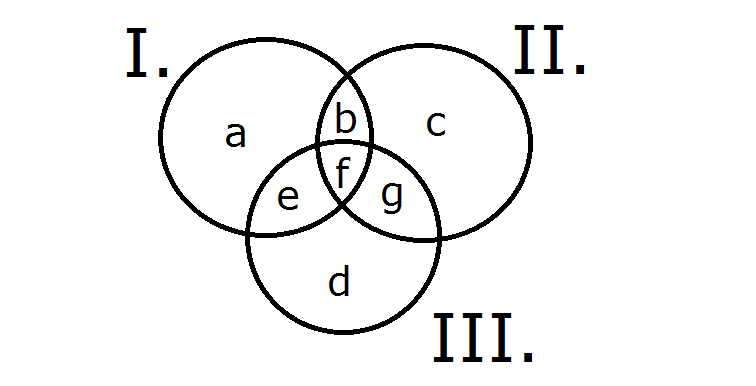
In a survey of political preference, 78% of those asked were in favor of at least one of the proposals: I, II and III. 50% of those asked favored proposal I, 30% favored proposal II, and 20% favored proposal III. If 5% of those asked favored all three of the proposals, what percentage of those asked favored more than one of the 3 proposals.
Let the distribution of votes for each of the proposal be as given below.
From the information given, we know that
a+b+c+d+e+f+g = 78 --- (1)
a+b+e+f = 50 ---- (2)
b+c+f+g = 30 ---- (3)
e+f+g+d = 20 ---- (4) and
f = 5 --- (5)
We need to find b+e+g+f = ?
In the above equations, (2)+(3)+(4) - (1) implies
(a+b+e+f)+(b+c+f+g)+(e+f+g+d) - (a+b+c+d+e+f+g) = 50+30+20-78 = 22
Or, b+e+g+2f=22.
As, f = 5, it implies that b+e+g+f=17
For two positive integers a and b define the function h(a,b):as the greatest common factor (G.C.F) of a, b. Let A be a set of n positive integers. G(A), the GCF of the elements of set A is computed by repeatedly using the function h.
The minimum number of times h is required to be used to compute G is:
Let p and q be any two elements of the set A.
For the computation of the GCF of elements of the set A, we can replace both p and q by just the GCF(p,q) and the result is unchanged.
So, for every application of the function h, we are reducing the number of elements of the set A by 1. (In this case two numbers p and q are replaced by one number GCF(p,q)).
Expanding this concept further, the minimum number of times the function h should be called is n-1

The figure below shows two concentric circles with centre 0. PQRS is a square, inscribed in the outer circle. It also circumscribes the inner circle, touching it at points B, C, D and A. What is the ratio of the perimeter of the outer circle to that of polygon ABCD?
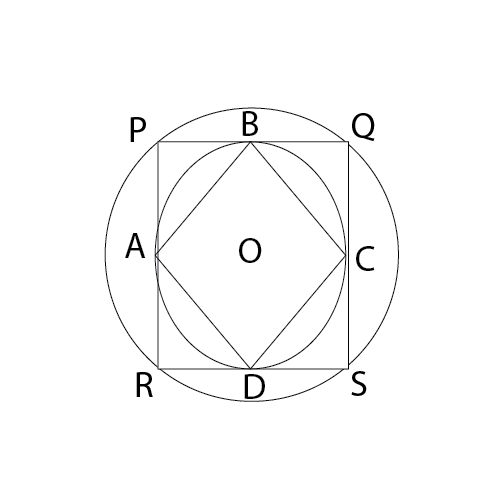
By symmetry, it is safe to assume that the polygon ABCD is a square. So, AB = PO. The perimeter of the inner square = 4 AB. The perimeter of the outer circle = $$ 2 \pi \times AB$$
So, ratio = $$ \frac{2 \pi \times AB}{4AB}$$ = $$ \frac{\pi}{2}$$
Three labeled boxes containing red and white cricket balls are all mislabeled. It is known that one of the boxes contains only white balls and one only red balls. The third contains a mixture of red and white balls. You are required to correctly label the boxes with the labels red, white and red and white by picking a sample of one ball from only one box. What is the label on the box you should sample?
All of them can be mislabeled in 2 ways:
Red box - white label
White box - Red and white label
Red and white box - Red label
Red box - red and white label
White box - Red label
Red and white box - White label
So, we would try the box with the red and white label and if it has a white ball, labelling to the boxes is done as per case 1. If it has a red ball labelling is done as per case 2.
Note: It's not a good idea to try the white label as if we get a red ball, we can't make out if we are picking from red box or red and white box. Similarly if we try from the box with red label and we get a white ball, again we can't make out if it is coming from the white box or the red and white box.
If $$n^2 = 123456787654321$$, what is $$n$$?
Observe the pattern given below.
$$11^2 = 121$$
$$111^2 = 12321$$
$$1111^2 = 1234321$$ and so on.
So, $$11111111^2 = 123456787654321$$

Abraham, Border, Charlie, Dennis and Elmer and their respective wives recently dined together and were seated at a circular table. The seats were so arranged that men and women alternated and each woman was three places distant from her husband. Mrs. Charlie sat to the immediate left of Mr. Abraham. Mrs. Elmer sat two places to the right of Mrs. Border. Who sat to the right of Mr. Abraham?
Mrs. Abraham can't be sitting next to him as per the seating arrangement. Wives sit three places away from their husbands.
Mrs. Charlie is sitting to the left of Mr. Abraham. So, she can't be sitting to his right.
Mrs. Elenor is sitting two places to the right of Mrs. Border (and not Mrs. Charlie). So, she can't be sitting right next to Mr. Abraham.
Mrs. Border and Mrs. Dennis are the remaining two wives and each is equally likely to to be sitting to the right of Mr. Abraham.
Navjivan Express from Ahmedabad to Chennai leaves Ahmedabad at 6:30 am and travels at 50km per hour towards Baroda situated 100 kms away. At 7:00 am Howrah - Ahmedabad express leaves Baroda towards Ahmedabad and travels at 40 km per hour. At 7:30 Mr. Shah, the traffic controller at Baroda realises that both the trains are running on the same track. How much time does he have to avert a head-on collision between the two trains?
The distance between Ahmedabad and Baroda is 100 Km
Navjivan express starts at 6:30 am at 50 Km/hr and Howrah expresses starts at 7:00 am at 40 Km/hr.
Distance covered by Navjivan express in 30 minutes (by 7 am) is 25 Km/hr.
So, at 7 am, the distance between the two trains is 75 Kms and they are travelling towards each other a relative speed of 50+40=90 Km/hr.
So, time taken them to meet is 75/90*60 = 50 minutes.
As, Mr. Shah realizes the problem after thirty minutes, time left to avoid collision is 50-30 = 20 minutes
There is a circle of radius 1 cm. Each member of a sequence of regular polygons S1(n), n = 4,5,6,... , where n is the number of sides of the polygon, is circumscribing the circle; and each member of the sequence of regular polygons S2(n), n = 4,5,6.... where n is the number of sides of the polygon, is inscribed in the circle. Let L1(n) and L2(n) denote the perimeters of the corresponding polygons of S1(n) and S2(n). Then $$\frac{L1(13)+2\pi }{L2(17)}$$ is
The perimeter of the circle is equal to 2$$\pi $$.
The perimeter of the polygon inscribing the circle is always greater than the perimeter of the circle => L1(13) > 2$$\pi $$
The perimeter of the polygon inscribed in the circle is always less than the perimeter of the circle => L2(13) < 2$$\pi $$
=> $$\frac{L1(13)+2\pi }{L2(17)}$$ > 2

There is a square field with each side 500 metres long. It has a compound wall along its perimeter. At one of its comers, a triangular area of the field is to be cordoned off by erecting a straight line fence. The compound wall and the fence will form its borders. If the length of the fence is 100 metres, what is the maximum area in square metres that can be cordoned off?

Let EF be the fence.
As the field is in the shape of a square, the straight line face that is put up will cordon a field of the form right angled triangle.
The area of a right angled triangle is maximum when the sides that contain the right angle are equal.
Let the side be a.
$$a^2 + a^2$$ = $$100^2$$ => $$a = 50\sqrt{2}$$
Area = $$\frac{1}{2}*50\sqrt{2}*50\sqrt{2}$$ = 2500 sq m.
If the number of coins distributed to Q is twice the number distributed to P then which one of the following is necessarily true?
From the given passage, it is given that Q>P, R>S.
According to the information Q = 2 when P = 1 or Q = 4 when P = 2.
In first case R = 4 and S = 3 and in the second case R = 3 and S = 1.
In both the instances S is odd.
If R gets at least two more coins than S, then which one of the following is necessarily true?
From the given passage, it is given that Q>P, R>S. Now it is given that R is greater than or equal to S+2. Option B will still remain true because it is given that Q>P.

If Q gets fewer coins than R, then which one of the following is not necessarily true?
From the given passage, it is given that Q>P, R>S.
When R = 4 and S = 3, then Q = 2 and P = 1.
P+Q = 2+1 = 3 which contradicts statement 1.
DIRECTIONS for the following questions: These questions are based on the situation given below: A young girl Roopa leaves home with x flowers, goes to the bank of a nearby river. On the bank of the river, there are four places of worship, standing in a row. She dips all the x flowers into the river. The number of flowers doubles. Then she enters the first place of worship, offers y flowers to the deity. She dips the remaining flowers into the river, and again the number of flowers doubles. She goes to the second place of worship, offers y flowers to the deity. She dips the remaining flowers into the river, and again the number of flowers doubles. She goes to the third place of worship, offers y flowers to the deity. She dips the remaining flowers into the river, and again the number of flowers doubles. She goes to the fourth place of worship, offers y flowers to the deity. Now she is left with no flowers in hand.
If Roopa leaves home with 30 flowers, the number of flowers she offers to each deity is:
Number of flowers after the first dipping = 60
Number of flowers after the second dipping = 2(60-y) = 120-2y
Number of flowers after the third dipping = 2(120-2y-y) = 240-6y
Number of flowers after the fourth dipping = 2(240-6y-y) = 480-14y
y = 480 - 14y
15y = 480
y = 32
The minimum number of flowers that could be offered to each deity is:
Number of flowers after the first dipping = 2x
Number of flowers after the second dipping = 2(2x-y) = 4x-2y
Number of flowers after the third dipping = 2(4x-2y-y) = 8x-6y
Number of flowers after the fourth dipping = 2(8x-6y-y) = 16x-14y
16x-14y = y
y = 16x/15
Minimum value of y = 16 when x = 15

The minimum number of flowers with which Roopa leaves home is:
Number of flowers after the first dipping = 2x
Number of flowers after the second dipping = 2(2x-y) = 4x-2y
Number of flowers after the third dipping = 2(4x-2y-y) = 8x-6y
Number of flowers after the fourth dipping = 2(8x-6y-y) = 16x-14y
16x-14y = y
y = 16x/15
Minimum value of y = 16 when x = 15
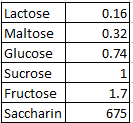
DIRECTIONS for the following two questions: The following table presents the sweetness of different items relative to sucrose, whose sweetness is taken to be 1.00.
What is the maximum amount of sucrose (to the nearest gram) that can be added to one-gram of saccharin such that the final mixture obtained is atleast 100 times as sweet as glucose?
For the mixture to be 100 times as sweet as glucose, its sweetness relative to the mixture should be at least 74.
1 gm of saccharin = 675
Let the number of grams of sucrose to be added be N. Thus, the total weight of the mixture = N + 1.
So, (675 + N) / (N+1) = 74
=> 675 + N = 74N + 74
=> 601 = 73N => N = 8.23
When N=9, sweetness will be S = (675+9)/10 = 684/10 = 68.4
When N=8, sweetness will be S = (675+8)/9 = 683/9 = 75.8
So, option b) is the correct answer.
Approximately how many times sweeter than sucrose is a mixture consisting of glucose, sucrose and fructose in the ratio of 1: 2: 3?
The relative sweetness of the mixture is (1*0.74 + 2*1 + 3*1.7) / (1+2+3) = 7.84/6 = 1.30
Option a) is the correct answer.

Answer the questions on the basis of the information given below.
These questions are based on the situation given below: A, B, C, D, E and F are a group of friends from a club. There are two housewives, one lecturer, one architect, one accountant and one lawyer in the group. There are two married couples in the group. The lawyer is married to D who is a housewife. No lady in the group is either an architect or an accountant. C, the accountant, is married to F who is a lecturer. A is married to D and E is not a housewife.
What is E?
We are given that there are two housewives, one lecturer, one architect, one lawyer and one accountant among A, B, C, D, E and F.
The other information given is that only two married couples are in the group.
We are given that the lawyer is married to D, and D is a housewife.
We are also given that no woman in the group is either an architect or an accountant.
C is an accountant, has to be male, and is married to F, who is a lecturer, who has to be female.
Putting this information in the table, we get,

We are also given that A is married to D, so this has to be the second couple, and A has to be the lawyer.
This leaves us with B and E, as well as housewife and architect professions. Given that E is not a housewife, E has to be the Architect and B has to be the housewife. Since the Architect cannot be a woman, E has to be a man, and B has to be a woman.
Putting all the information in the table, we get,

From the table, we can see that E is an Architect.
Hence, the correct answer is option B.
How many members of the group are male?
We are given that there are two housewives, one lecturer, one architect, one lawyer and one accountant among A, B, C, D, E and F.
The other information given is that only two married couples are in the group.
We are given that the lawyer is married to D, and D is a housewife.
We are also given that no woman in the group is either an architect or an accountant.
C is an accountant, has to be male, and is married to F, who is a lecturer, who has to be female.
Putting this information in the table, we get,
We are also given that A is married to D, so this has to be the second couple, and A has to be the lawyer.
This leaves us with B and E, as well as housewife and architect professions. Given that E is not a housewife, E has to be the Architect and B has to be the housewife. Since the Architect cannot be a woman, E has to be a man, and B has to be a woman.
Putting all the information in the table, we get,
From the table, we can see 3 males in the group.
Hence, the correct answer is option B.
DIRECTIONS for the following two questions: These questions are based on the situation given below: Seven university cricket players are to be honored at a special luncheon. The players will be seated on the dais along one side of a single rectangular table. A and G have to leave the luncheon early and must be seated at the extreme right end of the table, which is closest to the exit. B will receive the Man of the Match award and must be in the center chair. C and D who are bitter rivals for the position of wicket keeper, dislike one another and should be seated as far apart as possible. E and F are best friends and want to sit together.
Which of the following may not be seated at either end of the table?
_ _ _ B _ _ _
A and G will sit in 6th and 7th position from left in any order.
C and D must be as far apart as possible. Hence, they'll sit in 1st and 5th positions from left in any order.
Hence, only A, C, D and G can sit in the corners.
Among, the given options F cannot sit in the extreme end.

Which of the following pairs may not be seated together?
The arrangement of people is as follows: C/D F/E E/F B D/C A/G G/A
So, E and A can never sit together.
DIRECTIONS for the following two questions: These questions are based on the situation given below:
A rectangle PRSU, is divided into two smaller rectangles PQTU, and QRST by the line TQ. PQ=10cm, QR = 5 cm and RS = 10 cm. Points A, B, F are within rectangle PQTU, and points C, D, E are within the rectangle QRST. The closest pair of points among the pairs (A, C), (A, D), (A, E), (F, C), (F, D), (F, E), (B, C), (B, D), (B, E) are $$10 \sqrt{3}$$ cm apart.
Which of the following statements is necessarily true?

The sides of the rectangle PRSU are PR = 15 cm and
RS = 10 cm. The maximum possible distance i.e. diagonal will be $$\sqrt{325}=5\times\sqrt(13)$$ cm.
The maximum possible distance among C, D and E is $$5\times\sqrt(5)$$.
The maximum possible distance among A, B and F is $$5\times\sqrt(8)$$.
The minimum distance between points formed by taking one from A, B, F and C,D, E is $$10\times\sqrt(3)=5\times\sqrt(12)$$cm.
wkt, among all 6 points, the closest pair among them has to be less than $$5\times\sqrt(5)$$
Hence, this pair cannot be the closest among the 6 pair of points. So, the statement in option a) should be true.
AB > AF > BF; CD > DE > CE; and BF = $$6\sqrt{5}$$ cm. Which is the closest pair of points among all the six given points?
The length of the diagonal of rectangle QRST is $$\sqrt{125}$$ cm = 11 cm approximately.
BF = $$6\sqrt5$$ cm > 12 cm
So, CE is definitely shorter than BF.
Option d) is the correct answer.

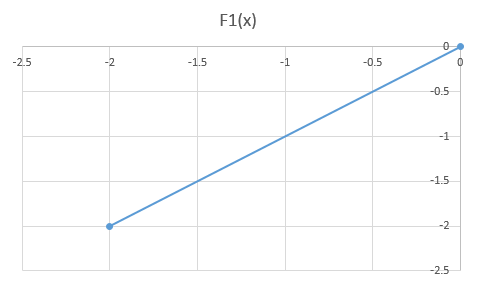
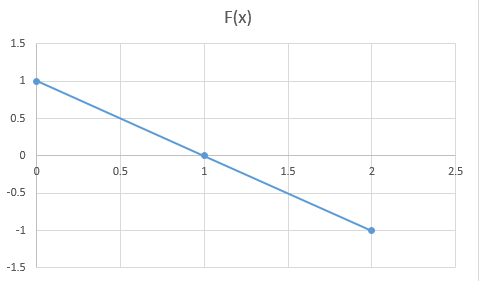
DIRECTIONS for the following questions: These questions are based on the situation given below: In each of the questions a pair of graphs F(x) and F1(x) is given. These are composed of straight-line segments, shown as solid lines, in the domain $$x\epsilon (-2, 2)$$.
choose the answer as
a. If F1(x) = - F(x)
b. if F1(x) = F(- x)
c. if F1(x) = - F(- x)
d. if none of the above is true
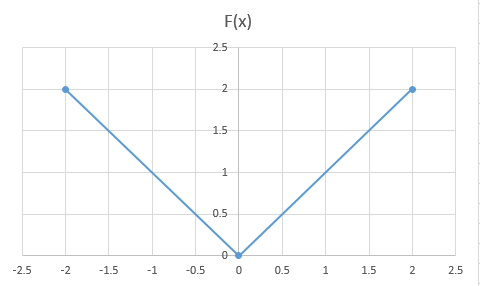
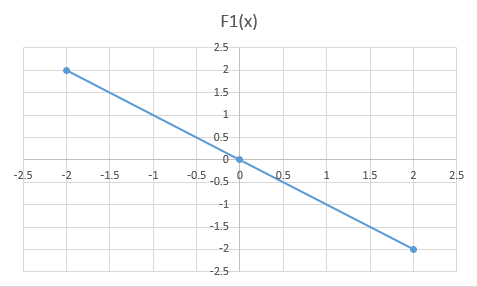
The correct relation between the two is: F(x) = | F1(x) |
So, all the three options a), b) and c) can be ruled out. Option d) is the correct answer.
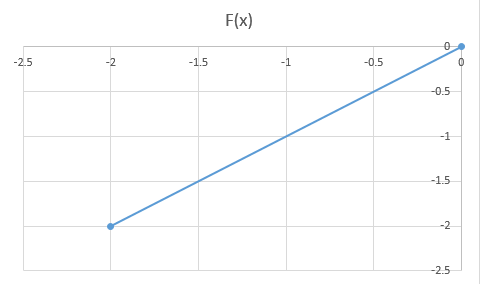
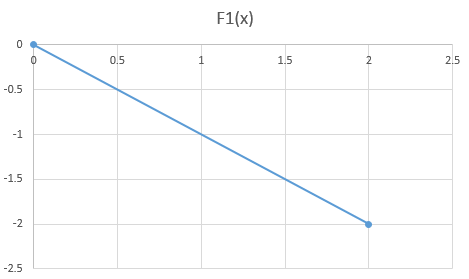
The value of F(x) for x < 0 is the same as the value of F1(x) for x > 0.
So, F1(x) = F(-x)
Option b) is the correct answer.
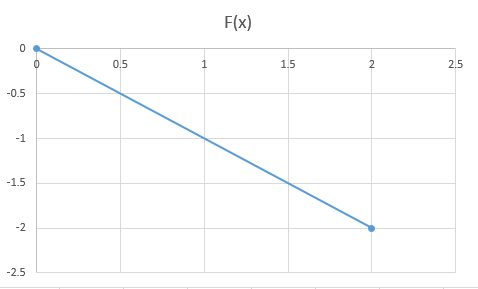
The value of F(x) for x > 0 is the same as the value of F1(x) for x < 0.
So, F1(x) = F(-x)
Option b) is the correct answer.

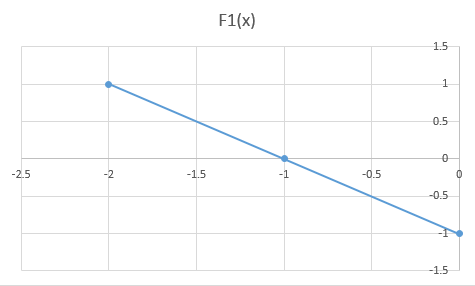
F(0) = 1 ; F1(0) = -1
F(1) = 0 ; F1(-1) = 0
F(2) = -1 ; F1(-2) = 1
=> F1(x) = -F(-x).
DIRECTIONS for the following questions: These questions are based on the situation given below:
There are m blue vessels with known volumes $$V1, V2 , ...., V_m$$, arranged in ascending order of volume, where $$v_1 > 0.5$$ litre, and $$V_m < 1$$ litre. Each of these is full of water initially. The water from each of these is emptied into a minimum number of empty white vessels, each having volume 1 litre. The water from a blue vessel is not emptied into a white vessel unless the white vessel has enough empty volume to hold all the water of the blue vessel. The number of white vessels required to empty all the blue vessels according to the above rules was n.
Among the four values given below, which is the least upper bound on e, where e is the total empty volume in the m white vessels at the end of the above process?
$$v_1 > 0.5$$
$$v_m < 1$$
As we cannot empty a blue vessel into a white vessel unless there is enough space to hold all the volume in blue vessel in the white vessel, we have to use m white vessels. This is because we cannot empty more than 1 blue vessel into 1 white vessel.
The minimum volume that can be left in each white vessel is $$1-v_m$$.
=> The minimum volume that can be left in m white vessels is $$m(1-v_m)$$, which is the least upper bound.
Let the number of white vessels needed be n1 for the emptying process described above, if the volume of each white vessel is 2 liters. Among the following values, which is the least upper bound on n1?
To find the limiting value, let us consider that all the blue vessels are of 1 litre capacity.
If all the blue vessels have 1 litre capacity, then the number of white vessels required is smallest integer greater than or equal to (m/2).
But, blue vessels are all not of the same capacity => the above value of n1 is the upper bound.

DIRECTIONS for the following questions: These questions are based on the situation given below: There are fifty integers $$a_1, a_2,...,a_{50}$$, not all of them necessarily different. Let the greatest integer of these fifty integers be referred to as $$G$$, and the smallest integer be referred to as $$L$$. The integers $$a_1$$ through $$a_{24}$$ form sequence $$S1$$, and the rest form sequence $$S2$$. Each member of $$S1$$ is less than or equal to each member of $$S2$$.
All values in S1 are changed in sign, while those in S2 remain unchanged. Which of the following statements is true?
We will give an example to disprove each of the three options A, B and C and hence, the correct answer will be option D.
Initially, if the least integer in S1 is -20 and the greatest integer in S2 is 50, then after the doing the operations mentioned in the question, the greatest integer in S1 is not greater than 50. Hence option A is false.
G is in S2 as per the given information => Option B is false.
If S1 contains numbers from 1 to 24 and S2 contains numbers from 25 to 50. Then G = 50 and L = 1. If all the numbers of S1 change in sign, G will remain 50 and will be in S2 while L will be -24 and will be in S1.
Hence, none of the statements is true always.
Elements of $$S1$$ are in ascending order, and those of $$S2$$ are in descending order. $$a_{24}$$ and $$a_{25}$$ are interchanged. Then, which of the following statements is true?
We know that $$a_{24}$$ is less than $$a_{25}$$.
So, even if $$a_{25}$$ replaces $$a_{24}$$, the ascending order still exists in S1.
But, $$a_{25}$$ is less than $$a_{26}$$. Hence, the descending order does not exist in S2 anymore.
Every element of S1 is made greater than or equal to every element of S2 by adding to each element of S1 an integer x. Then x cannot be less than:
For the least element L in $$S1$$ to be greater than the greatest element or equal to G in $$S2$$, the number that is added to L cannot be less than G - L.

DIRECTIONS for the following questions: These questions are based on the situation given below: Let x and y be real numbers
f(x, y) = | x + y |
F(f(x, y)) = -f(x, y)
G(f(x, y)) = -F(f(x, y))
Which of the following statements is true?
f(x,y) = |x+y|
F(f(x,y)) = -f(x,y) = -|x+y|
G(f(x,y)) = -F(f(x,y)) = |x+y|
Option A: F(f(x, y)) . G(f(x, y)) = -F(f(x, y)) . G(f(x, y)) =>LHS = -|x+y|$$^2$$, RHS = |x+y|$$^2$$ Hence false.
Option B: F(f(x, y)) . G(f(x, y)) > -F(f(x, y)) . G(f(x, y)), Since, LHS is smaller than RHS. False
Option C: F(f(x, y)) . G(f(x, y)) $$\neq $$ G(f(x, y)) . F(f(.x, y)), Here LHS=RHS. Hence false.
Option D:
=> G(f(x,y)) + F(f(x,y)) = 0
f(x,y) = f(-x,-y)
=> G(f(x,y)) + F(f(x,y)) + f(x,y) = f(-x.-y)
What is the value of f(G(f(1, 0)), f(F(f(1, 2)), G(f(1, 2))))?
F(f(x,y)) = -f(x,y)
G(f(x,y)) = -F(f(x,y)) = f(x,y)
G(f(1,0)) = 1
F(f(1,2)) = -3
G(f(1,2)) = 3
f(F(f(1,2)),G(f(1,2))) = 0
f(G(f(1, 0)), f(F(f(1, 2)), G(f(1, 2)))) = 1 + 0 = 1
Which of the following expressions yields $$x^2$$ as its result?
F(f(x,-x)) = 0 and G(f(x,-x)) = 0
F(f(x,x)) = -2x and G(f(x,x)) = 2x
F(f(x,x)).G(f(x,x)) = -$$4x^2$$
$$\log_216$$ = 4
=> $$\frac{-F(f(x,x)).G(f(x,x))}{\log_216}$$ = $$x^2$$

DIRECTIONS for the following questions:
These questions are based on the situation given below: A robot moves on a graph sheet with x and y-axes. The robot is moved by feeding it with a sequence of instructions. The different instructions that can be used in moving it, and their meanings are: Instruction Meaning GOTO(x,y) move to point with coordinates (x, y) no matter where you are currently WALKX(P) Move parallel to the x-axis through a distance of p, in the positive direction if p is positive, and in the negative direction if p is negative WALKY(P) Move parallel to the y-axis through a distance of p, in the positive direction if p is positive, and in the negative direction if p is negative.
The robot reaches point (6, 6) when a sequence of three instructions is executed, the first of which is a GOTO(x, y) instruction, the second is WALKX(2) and the third is WALKY(4). What are the values of x and y?
Before, the third instruction, the point on which the robot is present is (6,2).
Before, the second instruction, the point on which the robot is present is (4,2).
Hence, the values of x and y are 4 and 2 respectively.
The robot is initially at (x, y), x > 0 and y < 0. The minimum number of instructions needed to be executed to bring it to the origin (0,0) if you are prohibited from using the GOTO instruction is:
WALKX(-x) and WALKY(y) are the commands to be used for the robot to reach origin in any order.
Hence, the answer is 2.
DIRECTIONS for the following three questions
These questions are based on the situation given below:
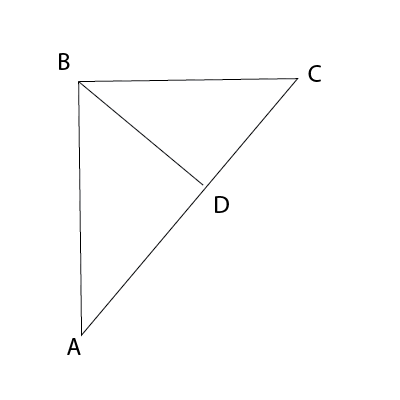
A road network (shown in the figure below) connects cities A, B, C and D. All road segments are straight lines. D is the midpoint on the road connecting A and C. Roads AB and BC are at right angles to each other with BC shorter than AB. The segment AB is 100 km long. Ms. X and Mr. Y leave A at 8:00 am, take different routes to city C and reach at the same time. X takes the highway from A to B to C and travels at an average speed of 61.875 km per hour. Y takes the direct route AC and travels at 45 km per hour on segment AD. Y's speed on segment DC is 55 km per hour.
What is the average speed of Y in km per hour?
Y takes the direct route AC and travels at 45 km per hour on segment AD. Y's speed on segment DC is 55 km per hour.
AD=DC =a(D is the midpoint on the road connecting A and C.)
The time taken by Y to reach D= a/45
Further, the time taken by Y to reach C= a/55
Y has travelled equal distances are constant speed.
=> Average speed = $$\frac{2a}{\frac{a}{45}+\frac{a}{55}}$$=$$\frac{2*45*55}{100}$$ = 49.5 kmph

The total distance traveled by Y during the journey is approximately
$$BC^2$$ + 10000 = $$AC^2$$.
$$\frac{BC+100}{61.875}$$ = $$\frac{AC}{49.5}$$ => $$\frac{BC+100}{AC}$$ = 1.25 = > BC = 1.25AC - 100
On solving these equations, we get AC as 105 and BC a 31.
=> Y traveled 105 km.
What is the length of the road segment BD?
$$BC^2$$ + 10000 = $$AC^2$$.
$$\frac{BC+100}{61.875}$$ = $$\frac{AC}{49.5}$$ => $$\frac{BC+100}{AC}$$ = 1.25 = > BC = 1.25AC - 100
On solving these equations, we get AC as 105 and BC a 31.
Let the point B be (0,0) => A = (0, -100) and C = (31,0)
D = Mid point of AC = (15.5, -50)
BD = $$\sqrt{15.5^2+50^2}$$ = 52.5 (approximately).
DIRECTIONS for the following questions: These questions are based on the situation given below: Rajiv reaches city B from city A in 4 hours, driving at the speed of 35 km per hour for the first 2 hours and at 45 km per hour for the next two hours. Aditi follows the same route, but drives at three different speeds: 30, 40 and 50 km per hour, covering an equal distance in each speed segment. The two cars are similar with petrol consumption characteristics (km per litre) shown in the figure below.
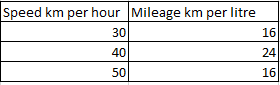
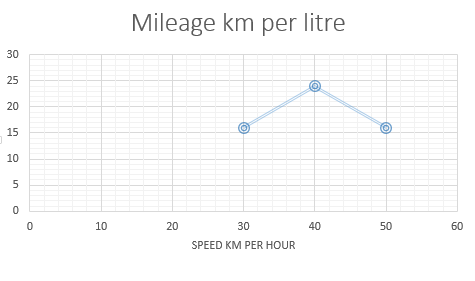
The amount of petrol consumed by Aditi for the journey is
Total distance = 35*2 + 45*2 = 160 km
Distance traveled by Aditi at each constant speed value = $$\frac{160}{3}$$
Total petrol consumed by Aditi = $$\frac{160/3}{16}$$ + $$\frac{160/3}{24}$$ + $$\frac{160/3}{16}$$ = $$\frac{10}{3}$$ + $$\frac{20}{9}$$ + $$\frac{10}{3}$$ = 6.67 + 2.22 = 8.9 litres

Zoheb would like to drive Aditi's car over the same route from A to B and minimize the petrol consumption for the trip. The amount of petrol required by him is
To minimize the petrol consumption, he must travel at 40kmph constantly through out the 160 km.
Total petrol consumed = $$\frac{160}{24}$$ = 6.67 litres.
DIRECTIONS for questions:
These questions are based on the situation given below:
Recently, Ghosh Babu spent his winter vacation on Kyakya Island. During the vacation, he visited the local casino where he came across a new card game. Two players, using a normal deck of 52 playing cards, play this game. One player is called the Dealer and the other is called the Player. First, the Player picks a card at random from the deck. This is called the base card. The amount in rupees equal to the face value of the base card is called the base amount. The face values of Ace, King, Queen and Jack are ten. For other cards, the face value is the number on the card. Once, the Player picks a card from the deck, the Dealer pays him the base amount. Then the dealer picks a card from the deck and this card is called the top card. If the top card is of the same suit as the base card, the Player pays twice the base amount to the Dealer. If the top card is of the same colour as the base card (but not the same suit) then the Player pays the base amount to the Dealer. If the top card happens to be of a different colour than the base card, the Dealer pays the base amount to the Player. Ghosh Babu played the game 4 times. First time he picked eight of clubs and the Dealer picked queen of clubs. Second time, he picked ten of hearts and the dealer picked two of spades. Next time, Ghosh Babu picked six of diamonds and the dealer picked ace of hearts. Lastly, he picked eight of spades and the dealer picked jack of spades. Answer the following questions based on these four games.
If Ghosh Babu stopped playing the game when his gain would be maximized, the gain in Rs. would have been
After the first game, Ghosh Babu picked 8 of clubs => He gets Rs 8. Then the dealer picked Queen of clubs => Ghosh Babu pays Rs 16 => Ghosh Babu is at a loss of Rs 8 after 1st game.
After the second game, Ghosh Babu picked 10 of hearts => He gets Rs 10. Then the dealer picked 2 of spades => Ghosh Babu gets another Rs 10 => Ghosh Babu is now at a profit of Rs 12.
After the third game, Ghosh Babu picked six of diamonds => He gets Rs 6. Then the dealer picked ace of hearts => Ghosh Babu pays Rs 6 to dealer => Ghosh Babu is still at a profit of Rs 12.
In the fourth game, Ghosh Babu picks 8 of spades => He gets Rs 8. The the dealer picks jack of spades => Ghosh Babu pays Rs 16 to dealer => Ghosh Babu is at a profit of Rs 4.
Hence, the maximum profit earned is Rs 12.
The initial money Ghosh Babu had (before the beginning of the game sessions) was Rs. X. At no point did he have to borrow any money. What is the minimum possible value of X?
After the first game, Ghosh Babu picked 8 of clubs => He gets Rs 8. Then the dealer picked Queen of clubs => Ghosh Babu pays Rs 16 => Ghosh Babu is at a loss of Rs 8 after 1st game.
After the second game, Ghosh Babu picked 10 of hearts => He gets Rs 10. Then the dealer picked 2 of spades => Ghosh Babu gets another Rs 10 => Ghosh Babu is now at a profit of Rs 12.
After the third game, Ghosh Babu picked six of diamonds => He gets Rs 6. Then the dealer picked ace of hearts => Ghosh Babu pays Rs 6 to dealer => Ghosh Babu is still at a profit of Rs 12.
In the fourth game, Ghosh Babu picks 8 of spades => He gets Rs 8. The the dealer picks jack of spades => Ghosh Babu pays Rs 16 to dealer => Ghosh Babu is at a profit of Rs 4.
Hence, the maximum profit earned is Rs 12.
The maximum loss that Ghosh Babu had was Rs 8.
He must have had at least Rs 8 so that he did not have to borrow any amount from others.

If the final amount of money that Ghosh Babu had with him was Rs. 100, what was the initial amount he had with him?
After the first game, Ghosh Babu picked 8 of clubs => He gets Rs 8. Then the dealer picked Queen of clubs => Ghosh Babu pays Rs 16 => Ghosh Babu is at a loss of Rs 8 after 1st game.
After the second game, Ghosh Babu picked 10 of hearts => He gets Rs 10. Then the dealer picked 2 of spades => Ghosh Babu gets another Rs 10 => Ghosh Babu is now at a profit of Rs 12.
After the third game, Ghosh Babu picked six of diamonds => He gets Rs 6. Then the dealer picked ace of hearts => Ghosh Babu pays Rs 6 to dealer => Ghosh Babu is still at a profit of Rs 12.
In the fourth game, Ghosh Babu picks 8 of spades => He gets Rs 8. The the dealer picks jack of spades => Ghosh Babu pays Rs 16 to dealer => Ghosh Babu is at a profit of Rs 4.
As Ghosh Babu earned a profit of Rs 4 and now he has Rs 100, he initially would have had 100 - 4 = Rs 96.
A. In rejecting the functionalism in positivist organization theory, either wholly or partially, there is often a move towards a political model of organization theory.
B. Thus the analysis would shift to the power resources possessed by different groups in the organization and the way they use these resources in actual power plays to shape the organizational structure.
C. At the extreme, in one set of writings, the growth of administrators in the organization is held to be completely unrelated to the work to be done and to be caused totally by the political pursuit of self- interest.
D. The political model holds that individual interests are pursued in organizational life through the exercise of power and influence.
A raises the main topic of the paragraph that is move towards political mode of organisational theory. D follows the suit where political mode is explained. B will follow D as it talks about power. C is the concluding statement of the paragraph. So the correct sequence is ADBC.
A. Group decision making, however, does not necessarily fully guard against arbitrariness and anarchy, for individual capriciousness can get substituted by collusion of group members.
B. Nature itself is an intricate system of checks and balances, meant to preserve the delicate balance between various environmental factors that affect our ecology.
C. In institutions also, there is a need to have in place a system of checks and balances which inhibits the concentration of power in only some individuals.
D. When human interventions alter this delicate balance, the outcomes have been seen to be disastrous.
Option B starts with the information of checks and balances in nature. Option D follows B which talks about human interventions in nature. option C and Option A follows the suit where it is mentioned that institutions need to have a proper system of checks and balances.

A. He was bone-weary and soul-weary, and found himself muttering, "Either I can't manage this place, or it's unmanageable."
B. To his horror, he realized that he had become the victim of an amorphous, unwitting, unconscious conspiracy to immerse him in routine work that had no significance.
C. It was one of those nights in the office. when -the office clock was moving towards four in the morning and Bennis was still not through with the incredible mass of paper stacked before him.
D. He reached for his calendar and ran his eyes down each hour, half-hour, and quarter-hour, to see where his time had gone that day, the day before, the month before.
In the sentences A, B and D, pronouns are used whereas the noun "Bennis" is used in only sentence C. Hence, C is the first sentence.
B follows D because of the cause and effect relationship. The cause is mentioned in D and B is the result.
But C and D are not related directly. Hence, A follows C and D follows A.
=> CADB is the answer.
The following sentences when arranged in the proper order form a coherent paragraph. Find the correct order.
1. With that, I swallowed the shampoo, and obtained most realistic results almost on the spot.
2. The man shuffled away into the back regions to make up a prescription, and after a moment I got through on the shop-telephone to the Consulate, intimating my location.
3. Then, while the pharmacist was wrapping up a six-ounce bottle of the mixture, I groaned and inquired whether he could give me something for acute gastric cramp.
4. I intended to stage a sharp gastric attack, and entering an old-fashioned pharmacy, I asked for a popular shampoo mixture, consisting of olive oil and flaked soap.
A, B and C cannot be the first sentence of the paragraph because of the pronouns and the situational phrases(of the situations that are not described yet) used=> D is the opening sentence of the paragraph.
As a result of the author asking for a shampoo mixture, the pharmcist wrapped a six-ounce bottle. The idea is continued in sentence C => C follows D.
As a result of the author asking for something for acute gastric cramp, the pharmacist shuffled away into the back regions. => B follows C.
Hence, DCBA is the answer.
A. Since then, intelligence tests have been mostly used to separate dull children in school from average or bright children, so that special education can be provided to the dull.
B. In other words, intelligence tests give us a norm for each age.
C. Intelligence is expressed as Intelligence quotient, and tests are developed to indicate what an average child of a certain age can do-what a 5-year-old can answer, but a 4year-old cannot, for instance.
D. Binet developed the first set of such tests in the early 1900s to find out which children in school needed special attention.
E. Intelligence can be measured by tests.
A, B and D do not fit to be the first sentence of the paragraph because of the usage of the words "since then", "in other words" and "such tests" respectively. They need at least one sentence to appear before them.
Between C and E, E fits to be the best starting sentence.
Next comes D as the author talks about what was the first development that was done in "intelligence tests".
D is followed by A as the idea created in D is continued in A.
C and B are a pair and B follows C because the content in B is a rephrase of the content in C.
Hence, EDACB is the answer.

Three airlines - IA, JA and SA - operate on the Delhi-Mumbai route. To increase the number of seats sold, SA reduced its fares and this was emulated by IA and JA immediately. The general belief was that the volume of air travel between Delhi and Mumbai would increase as a result. Which of the following, if true, would add credence to the general belief?
The stated conclusion is that volume of air travel will increase if the airfare drops. The underlying assumption is that the travellers decide whether or not to fly based on the cost of the ticket. Option C bolsters the assumption and hence supports the conclusion.
Option D weakens the argument as if travellers are not paying for their ticket, they will not be price-sensitive. The extension of the scheme to other routes or airline profitability does not necessarily reflect on how the scheme is doing over the given route.
According to McNeill, a Brahmin priest was expected to be able to recite at least one of the Vedas. The practice was essential for several centuries when the Vedas had not yet been written down. It must have had a selective effect, since priests would have been recruited from those able or willing to memorize long passages. It must have helped in the dissemination of the work, since a memorized passage can be duplicated many times.
Which one of the following can be inferred from the above passage?
The paragraph states that a memorized passage could be duplicated multiple times. Thus, we can infer that a Vedic priests memory was as reliable as an audio tape. Thus, option B can be inferred from the paragraph.
Developed countries have made adequate provisions for social security for senior citizens. State insurers (as well as private ones) offer medicare and pension benefits to people who can no longer earn. In India, with the collapse of the joint family system, the traditional shelter of the elderly has disappeared. And a State faced with a financial crunch is not in a position to provide social security. So, it is advisable that the working population give serious thought to building a financial base for itself.
Which one of the following, if it were to happen, weakens the conclusion drawn in the above passage the most?
The main conclusion of the paragraph is that the working population should save for its future given that the Indian state is not in a position to provide social security for its citizens. The underlying assumption is that the Indian state would not be in a position to provide social security even in the future. If option C is true, then this assumption is attacked and the conclusion is weakened.
Various studies have shown that our forested and hilly regions and, in general, areas where biodiversity—as reflected in the variety of flora—is high, are the places where poverty appears to be high. And these same areas are also the ones where educational performance seems to be poor. Therefore, it may be surmised that, even disregarding poverty status, richness in biodiversity goes hand in hand with educational backwardness.
Which one of the following statements, if true, can be said to best provide supporting evidence for the surmise mentioned in the passage?
The stated conclusion is that richness in biodiversity goes hand in hand with educational backwardness. The underlying assumption is that in areas with low biodiversity, the educational performance is better. As option D bolsters this assumption, it strengthens the conclusion.
Cigarettes constitute a mere 20% of tobacco consumption in India, and fewer than 15% of the 200 million tobacco users consume cigarettes., Yet these 15% contribute nearly 90% of the tax revenues to the Exchequer from the tobacco sector. The punitive cigarette taxation regime has kept the tax base narrow, and reducing taxes will expand this base.
Which one of the following best bolsters the conclusion that reducing duties will expand the tax base'?
The stated conclusion is that the tax base will increase if the taxes levied on cigarettes is reduced. The underlying assumption is that tobacco users who are not smoking cigarettes will shift to cigarettes if the taxes on them decrease. Option B supports this assumption and hence gives credence to the conclusion.
Thomas Malthus, the British clergyman turned economist, predicted that the planet would not be able to support the human population for long. His explanation was that human population grows at a geometric rate, while the food supply grows only at an arithmetic rate.
Which one of the following, if true, would not undermine the thesis offered by Malthus?
Options A, B and D offer explanations on how human population can survive. Hence, they undermine the stated conclusion.
The stated conclusion is that human population cannot last long on this planet. The underlying assumption is that what has been observed till now will continue in the future. Hence, option C bolsters this assumption and add credence to the main conclusion.
The company's coffee crop for 1998-99 totalled 8079 tonnes, an all time record. The increase over the previous year's production of 5830 tonnes was 38.58%. The previous highest crop was 6089 tonnes in 1970-71. The company had fixed a target of 8000 tonnes to be realized by the year 2000-01, and this has been achieved two years earlier, thanks to the emphasis laid on the key areas of irrigation, replacement of unproductive coffee bushes, intensive refilling and improved agricultural practices. It is now our endeavour to reach the target of 10000 tonnes in the year 2001-02. Which one of the following would contribute most to making the target of 10000 tonnes in 2001-02 unrealistic?
The main conclusion of the paragraph is that the company can continue to improve its coffee yield as it has done in the past. The underlying assumption is that the techniques used by them to improve the yield in the past would continue working in the future. Option A refutes this assumption and hence does most to weaken the argument.
Animals in general are shrewd in proportion as they cultivate society. Elephants and beavers show the greatest signs of this sagacity when they are together in large numbers, but when man invades their communities they lose all their spirit of industry. Among insects, the labours of the bee and the ant have attracted the attention and admiration of naturalists, but all their sagacity seems to be lost upon separation, and a single bee or ant seems destitute of every degree of industry. It becomes the most stupid insect imaginable, and it languishes and soon dies.
Which of the following can be inferred from the above passage?
From the options given, we can eliminate options C and D as they are unsupported by the facts given in the paragraph. Option A is not an inference that can be built from the information given in the paragraph.
The paragraph states that animals, from elephants and beavers down to the bee, lose their spirit and intelligence when they are separated from the communities and their environments are invaded by humans. Hence, option B directly follows from this premise.
For each of the two questions, indicate which of the statements given, with that particular question is consistent with the description of the unseasonable man in the passage below.
Unseasonableness is a tendency to do socially permissible things at the wrong time. The unseasonable man is the sort of person who comes to confide in you when you are busy. He serenades his beloved when she is ill. He asks a man who has just lost money by paying a bill for a friend to pay a biII for him. He invites a friend to go for a ride just after the friend has finished a long car trip. He is eager to offer services which are not wanted but which cannot be politely refused. If he is present at an arbitration, he stirs up dissension between the two parties, who were really anxious to agree. Such is the unseasonable man.
He tends to
In this paragraph, the author states that the unreasonable man tends to do things with other people which they don't want to do. For eg, the person who has lost the money won't pay the bill or the person who has just come from a long ride won't go for a ride again
Option D correctly states the tendency of the unreasonable man as the person who has heard a particular story won't hear it again.
The unseasonable man tends to
In this paragraph, the author states that the unreasonable man tends to do things with other people which they don't want to do or is irrational. For eg, the person who has lost the money won't pay the bill or the person who has just come from a long ride won't go for a ride again.
Option A correctly highlights this as it would be irrational if a person brings a higher bidder to the salesman who has just closed the deal.
In each of the following sentences, a part of the sentence is underlined. Beneath each sentence, four different ways of phrasing the underlined part are indicated. Choose the best alternative from among the four.
It was us who had left before he arrived.
In this sentence, "he" is the object while "us" is the subject. While using the third-person pronoun as a subject, we need to use "we" instead of "us". In this case, the second half of the sentence should have simple past tense. Hence, option D.
The MP rose up to say that, in her opinion, she thought the Women's Reservation Bill should be passed on unanimously.
To pass on means to die or expire. Hence, it would be incorrect in the given context. Hence, we need to use the verb "passed". Thus, we can eliminate option B and D.
"In her opinion" and "she thought" mean the same thing. Hence, we can eliminate option C as it contains repetition.
Thus, option A is the grammatically correct option.
Mr. Pillai, the president of the union and who is also a member of the community group, will be in charge of the negotiations.
The two attributes of Mr. Pillai should have parallel structure. Thus, we need to use simple present tense for the underlined part with no additional conjunctions like 'since' and 'in addition'.
Hence, option C is the correct answer.
Since the advent of cable television, at the beginning of this decade, the entertainment industry took a giant stride forward in our country.
The context indicates that the action has taken place over a period of time from some time in the past to the present. Thus, we need to use present perfect tense.
The appropriate form of the verb would be "has taken". Thus, option B.
His mother made great sacrifices to educate him, moving house on three occasions, and severing the thread on her loom's shuttle whenever Mencius neglected his lessons to make him understand the need to persevere.
For parallelism to exist, the correct word is "severing" and not "severed". Hence, options B and C can be eliminated.
A comma is not needed after lessons. Therefore, option D can be eliminated.
=> Option A is the answer.
If you are on a three-month software design project and, in two weeks, you've put together a programme that solves part of the problem, show it to your boss without delay.
This sentence is correctly phrased and there is no error in either punctuation or grammar.
Many of these environmentalists proclaim to save nothing less than the planet itself.
The word proclaim should be followed by "that" and not "to". Hence, we can eliminate options A and C. The correct phrase to use in this context is "nothing less than ...". Hence, option D.
Bacon believes that the medical profession should be permitted to ease and quicken death where the end would otherwise only delay for a few days and at the cost of great pain.
The context indicates that the action would be completed at some point in the future i.e. the patient will have passed away at some point in the future. Hence, the correct tense to use in this case is the future perfect tense i.e. 'would be delayed'. The sentence gives two reasons for administering quick death and hence these two reasons should be separated by the conjunction 'and'. From the context, we can infer that there will be a delay of a few days if quick death is not administered by the doctor. Hence, a negative conjunction like otherwise is needed for the sentence to make sense. Hence, option C.
The passage given below is followed by questions. For each question, choose the best answer.
The World Trade Organisation (WTO) was created in the early 1990s as a component of the Uruguay Round negotiation. However, it could have been negotiated as part of the Tokyo Round of the 1970s, since that negotiation was an attempt at a 'constitutional reform' of the General Agreement on Tariffs and Trade (GATT). Or it could have been put off to the future, as the US government wanted. What factors led to the creation of the WTO in the early 1990s?
One factor was the pattern of multilateral bargaining that developed late in the Uruguay Round. Like all complex international agreements, the WTO was a product of a series of trade-offs between principal actors and groups. For the United States, which did not want a new Organisation, the dispute settlement part of the WTO package achieved its longstanding goal of a more effective and more legal dispute settlement system. For the Europeans, who by the 1990s had come to view GATT dispute settlement less in political terms and more as a regime of legal obligations, the WTO package was acceptable as a means to discipline the resort to unilateral measures by the United States. Countries like Canada and other middle and smaller trading partners were attracted by the expansion of a rules-based system and by the symbolic value of a trade Organisation, both of which inherently support the weak against the strong. The developing countries were attracted due to the provisions banning unilateral measures. Finally, and perhaps most important, many countries at the Uruguay Round came to put a higher priority on the export gains than on the import losses that the negotiation would produce, and they came to associate the WTO and a rules-based system with those gains. This reasoning - replicated in many countries - was contained in U.S. Ambassador Kantor's defence of the WTO, and it amounted to a recognition that international trade and its benefits cannot be enjoyed unless trading nations accept the discipline of a negotiated rules-based environment.
A second factor in the creation of the WTO was pressure from lawyers and the legal process. The dispute settlement system of the WTO was seen as a victory of legalists over pragmatists but the matter went deeper than that. The GATT, and the WTO, are contract organisations based on rules, and it is inevitable that an Organisation created to further rules will in turn be influenced by the legal process. Robert Hudec has written of the 'momentum of legal development', but what is this precisely? Legal development can be defined as promotion of the technical legal values of consistency, clarity (or, certainty) and effectiveness; these are values that those responsible for administering any legal system will seek to maximise. As it played out in the WTO, consistency meant integrating under one roof the whole lot of separate agreements signed under GATT auspices; clarity meant removing ambiguities about the powers of contracting parties to make certain decisions or to undertake waivers; and effectiveness meant eliminating exceptions arising out of grandfather-rights and resolving defects in dispute settlement procedures and institutional provisions. Concern for these values is inherent in any rules-based system of co-operation, since without these values rules would be meaningless in the first place. Rules, therefore, create their own incentive for fulfilment.
The momentum of legal development has occurred in other institutions besides the GATT, most notably in the European Union (EU). Over the past two decades the European Court of Justice (ECJ) has consistently rendered decisions that have expanded incrementally the EU's internal market, in which the doctrine of 'mutual recognition' handed down in the case Cassis de Dijon in 1979 was a key turning point. The Court is now widely recognised as a major player in European integration, even though arguably such a strong role was not originally envisaged in the Treaty of Rome, which initiated the current European Union. One means the Court used to expand integration was the 'teleological method of interpretation', whereby the actions of member states were evaluated against 'the accomplishment of the most elementary community goals set forth in the Preamble to the [Rome] treaty'. The teleological method represents an effort to keep current policies consistent with stated goals, and it is analogous to the effort in GATT to keep contracting party trade practices consistent with stated rules. In both cases legal concerns and procedures are an independent force for further cooperation.
In large part the WTO was an exercise in consolidation. In the context of a trade negotiation that created a near- revolutionary expansion of international trade rules, the formation of the WTO was a deeply conservative act needed to ensure that the benefits of the new rules would not be lost. The WTO was all about institutional structure and dispute settlement: these are the concerns of conservatives and not revolutionaries, which is why lawyers and legalists took the lead on these issues. The WTO codified the GATT institutional practice that had developed by custom over three decades, and it incorporated a new dispute settlement system that was necessary to keep both old and new rules from becoming a sham. Both the international structure and the dispute settlement system were necessary to preserve and enhance the integrity of the multilateral trade regime that had been built incrementally from the 1940s to the 1990s.
What could be the closest reason why the WTO was not formed in the 1970s?
(b) is the correct answer choice: This answer emerges from para 2, second sentence: “... WTO was a product of a series of trade-offs between principal actors and groups.” The important players were essentially the United States; Europeans; countries like Canada and other middle and smaller trading partners; and the developing countries, which continued negotiations as part of the Uruguay Round till the 1990s. The Tokyo Round of the 1970s was an attempt at a ‘constitutional reform’ of the GATT, while what the important players eventually settled for in the WTO was the evolution of a rules-based system through multiple negotiations which obviously required time.
The most likely reason for the acceptance of the WTO package by nations was that
The passage states many countries individual reasons for accepting WTO. However, it highlights that "Finally, and perhaps most important, many countries at the Uruguay Round came to put a higher priority on the export gains than on the import losses that the negotiation would produce, and they came to associate the WTO and a rules-based system with those gains. This reasoning - replicated in many countries - was contained in U.S. Ambassador Kantor's defence of the WTO, and it amounted to a recognition that international trade and its benefits cannot be enjoyed unless trading nations accept the discipline of a negotiated rules-based environment." Hence, option B correctly captures why many countries accepted WTO.
According to the passage, WTO promoted the technical legal values partly through
Refer to the lines "Legal development can be defined as promotion of the technical legal values of consistency, clarity (or, certainty) and effectiveness; these are values that those responsible for administering any legal system will seek to maximise. As it played out in the WTO, consistency meant integrating under one roof the whole lot of separate agreements signed under GATT auspices; clarity meant removing ambiguities about the powers of contracting parties to make certain decisions or to undertake waivers; and effectiveness meant eliminating exceptions arising out of grandfather-rights and resolving defects in dispute settlement procedures and institutional provisions." Hence, we can eliminate options C and D as the passage states that these are contrary to technical legal values. From the passage, we can infer that technical legal values were promoted by integrating under one roof the different agreements signed under GATT. Hence, option A.
In the method of interpretation of the European Court of Justice,
The passage states that:
One means the Court used to expand integration was the 'teleological method of interpretation', whereby the actions of member states were evaluated against 'the accomplishment of the most elementary community goals set forth in the Preamble to the [Rome] treaty'.
Hence, option D is the correct answer.
In the statement "...it amounted to a recognition that international trade and its benefits cannot be enjoyed unless trading nations accept the discipline of a negotiated rules-based environment.", ‘it' refers to:
Let's look at the passage:
"Finally, and perhaps most important, many countries at the Uruguay Round came to put a higher priority on the export gains than on the import losses that the negotiation would produce, and they came to associate the WTO and a rules-based system with those gains. This reasoning - replicated in many countries - was contained in U.S. Ambassador Kantor's defence of the WTO, and it amounted to a recognition that international trade and its benefits cannot be enjoyed unless trading nations."
Here, "it" refers to the subject of the sentence which is "This reasoning" as contained in the defence of Ambassador Kantor of the WTO. Hence, option A.
The importance of Cassis de Dijon is that it
The passage states that:
Over the past two decades the European Court of Justice (ECJ) has consistently rendered decisions that have expanded incrementally the EU's internal market, in which the doctrine of 'mutual recognition' handed down in the case Cassis de Dijon in 1979 was a key turning point.
Hence, the doctrine of "mutual recognition" was a key turning point. Hence, option D.
Have you ever come across a painting, by Picasso, Mondrian, Miro, or any other modern abstract painter of this century, and found yourself engulfed in a brightly coloured canvas which your senses cannot interpret? Many people would tend to denounce abstractionism as senseless trash. These people are disoriented by Miro's bright, fanciful creatures and two- dimensional canvases. They click their tongues and shake their heads at Mondrian's grid works, declaring the poor guy played too many scrabble games. They silently shake their heads in sympathy for Picasso, whose gruesome, distorted figures must be a reflection of his mental health. Then, standing in front of a work by Charlie Russell, the famous Western artist, they'll declare it a work of God. People feel more comfortable with something they can relate to and understand immediately without too much thought. This is the case with the work of Charlie Russell. Being able to recognize the elements in his paintings - trees, horses and cowboys - gives people a safety line to their world of "reality". There are some who would disagree when I say abstract art requires more creativity and artistic talent to produce a good piece than does representational art, but there are many weaknesses in their arguments.
People who look down on abstract art have several major arguments to support their beliefs. They feel that artists turn abstract because they are not capable of the technical drafting skills that appear in a Russell; therefore, such artists create an art form that anyone is capable of and that is less time consuming, and then parade it as artistic progress. Secondly, they feel that the purpose of art is to create something of beauty in an orderly, logical composition. Russell's compositions are balanced and rational, everything sits calmly on the canvas, leaving the viewer satisfied that he has seen all there is to see. The modern abstractionists, on the other hand, seem to compose their pieces irrationally. For example, upon seeing Picasso's Guernica, a friend of mine asked me, "What's the point?" Finally, many people feel that art should portray the ideal and real. The exactness of detail in Charlie Russell's work is an example of this. He has been called a great historian because his pieces depict the life style, dress, and events of the times. His subject matter is derived from his own experiences on the trail, and reproduced to the smallest detail.
I agree in part with many of these arguments, and at one time even endorsed them. But now, I believe differently. Firstly, I object to the argument that abstract artists are not capable of drafting. Many abstract artists, such as Picasso, are excellent draftsmen. As his work matured, Picasso became more abstract in order to increase the expressive quality of his work. Guernica was meant as a protest against the bombing of that city by the Germans. To express the terror and suffering of the victims more vividly, he distorted the figures and presented them in a black and white journalistic manner. If he had used representational images and colour, much of the emotional content would have been lost and the piece would not have caused the demand for justice that it did. Secondly, I do not think that a piece must be logical and aesthetically pleasing to be art. The message it conveys to its viewers is more important. It should reflect the ideals and issues of its time and be true to itself, not just a flowery, glossy surface. For example, through his work, Mondrian was trying to present a system of simplicity, logic, and rational order. As a result, his pieces did end up looking like a scrabble board.
Miro created powerful, surrealistic images from his dreams and subconscious. These artists were trying to evoke a response from society through an expressionistic manner. Finally, abstract artists and representational artists maintain different ideas about 'reality'. To the representational artist, reality is what he sees with his eyes. This is the reality he reproduces on canvas. To the abstract artist, reality is what he feels about what his eyes see. This is the reality he interprets on canvas. This can be illustrated by Mondrian's Trees series. You can actually see the progression from the early recognizable, though abstracted, Trees, to his final Explanation, the grid system.
A cycle of abstract and representational art began with the first scratchings of prehistoric man. From the abstractions of ancient Egypt to representational, classical Rome, returning to abstractionism in early Christian art and so on up to the present day, the cycle has been going on. But this day and age may witness its death through the camera. With film, there is no need to produce finely detailed, historical records manually; the camera does this for us more efficiently. Maybe, representational art would cease to exist. With abstractionism as the victor of the first battle, may be a different kind of cycle will be touched off. Possibly, some time in the distant future, thousands of years from now, art itself will be physically non-existent. Some artists today believe that once they have planned and constructed a piece in their mind, there is no sense in finishing it with their hands; it has already been done and can never be duplicated.
The author argues that many people look down upon abstract art because they feel that:
All of the options have been stated in the passage by the author as reasons given by critics of modern abstract art. Hence, option D.
The author believes that people feel comfortable with representational art because:
The passage states that
"People feel more comfortable with something they can relate to and understand immediately without too much thought. "
Thus, option C correctly states why people are more comfortable with representational art.
In the author's opinion, Picasso's Guernica created a strong demand for justice since
The passage states that:
Guernica was meant as a protest against the bombing of that city by the Germans. To express the terror and suffering of the victims more vividly, he distorted the figures and presented them in a black and white journalistic manner. If he had used representational images and colour, much of the emotional content would have been lost and the piece would not have caused the demand for justice that it did.
Thus, the reason Guernica caused the demand for justice was because it vividly conveyed the terror and suffering of the victims. As the emotional content of the suffering was conveyed through the art, it produced the desired impact. Hence, option B correctly captures this point and is the answer.
The author acknowledges that Mondrian's pieces may have ended up looking like a scrabble board because
The passage states that:
For example, through his work, Mondrian was trying to present a system of simplicity, logic, and rational order. As a result, his pieces did end up looking like a scrabble board.
Hence, option C is the right answer.
The main difference between the abstract artist and the representational artist in matters of the 'ideal' and the 'real', according to the author, is:
The passage states that:
Finally, abstract artists and representational artists maintain different ideas about 'reality'. To the representational artist,
Hence, the two types of artists have completely different ideas about reality and how they represent it on canvas also differs. Thus, option A.
Each one has his reasons: for one art is a flight; for another, a means of conquering. But one can flee into a hermitage, into madness, into death. One can conquer by arms. Why does it have to be writing, why does one have to manage his escapes and conquests by writing? Because, behind the various aims of authors, there is a deeper and more immediate choice which is common to all of us. We shall try to elucidate this choice, and we shall see whether it is not in the name of this very choice of writing that the engagement of writers must be required.
Each of our perceptions is accompanied by the consciousness that human reality is a 'revealer', that is, it is through human reality that 'there is' being, or, to put it differently, that man is the means by which things are manifested. It is our presence in the world which multiplies relations. It is we who set up a relationship between this tree and that bit of sky. Thanks to us, that star which has been dead for millennia, that quarter moon, and that dark river are disclosed in the unity of a landscape. It is the speed of our auto and our airplane which organizes the great masses of the earth. With each of our acts, the world reveals to us a new face. But, if we know that we are directors of being, we also know that we are not its producers. If we turn away from this landscape, it will sink back into its dark permanence. At least, it will sink back; there is no one mad enough to think that it is going to be annihilated. It is we who shall be annihilated, and the earth will remain in its lethargy until another consciousness comes along to awaken it. Thus, to our inner certainty of being 'revealers' is added that of being inessential in relation to the thing revealed. One of the chief motives of artistic creation is certainly the need of feeling that we are essential in relationship to the world. If I fix on canvas or in writing a certain aspect of the fields or the sea or a look on someone's face which I have disclosed, I am conscious of having produced them by condensing relationships, by introducing order where there was none, by imposing the unity of mind on the diversity of things. That is, I think myself essential in relation to my creation. But this time it is the created object which escapes me; I cannot reveal and produce at the same time. The creation becomes inessential in relation to the creative activity. First of all, even if it appears to others as definitive, the created object always seems to us in a state of suspension; we can always change this line, that shade, that word. Thus, it never forces itself. A novice painter asked his teacher, 'When should I consider my painting finished?' And the teacher answered, 'When you can look at it in amazement and say to yourself "I'm the one who did that!...
Which amounts to saying 'never'. For it is virtually impossible considering one's work with someone else's eyes and revealing what has been created. But it is self-evident that we are proportionally less conscious of the thing produced and more conscious of our productive activity. When it is a matter of poetry or carpentry, we work according to traditional nonns, with tools whose usage is codified; it is Heidegger's famous 'they' who are working with our hands. In this case, the result can seem to us sufficiently strange to preserve its objectivity in our eyes. But if we ourselves produce the rules of production, the measures, the criteria, and if our creative drive comes from the very depths of our heart, then we never find anything but ourselves in our work. It is we who have invented the laws by which we judge it. It is our history, our love, our gaiety that we recognize in it. Even if we should regard it without touching it any further, we never receive from it that gaiety or love. We put them into it. The results which we have obtained on canvas or paper never seem to us objective. We are too familiar with the processes of which they are the effects. These processes remain a subjective discovery; they are ourselves, our inspiration, our ruse, and when we seek to perceive our work, we create it again, we repeat mentally the operations which produced it; each of its aspects appears as a result. Thus, in the perception, the object is given as the essential thing and the subject as the inessential.
The latter seeks essentiality in the creation and obtains it, but then it is the object which becomes the inessential. The dialectic is nowhere more apparent than in the art of writing, for the literary object is a peculiar top which exists only in movement. To make it come into view a concrete act called reading is necessary, and it lasts only as long as this act can last. Beyond that, there are only black marks on paper. Now, the writer can not read what he writes, whereas the shoemaker can put on the shoes he has just made if they are to his size, and the architect can live in the house he has built. In reading, one foresees; one waits. He foresees the end of the sentence, the following sentence, the next page. He waits for them to confirm or disappoint his foresights. The reading is composed of a host of hypotheses, followed by awakenings, of hopes and deceptions, Readers are always ahead of the sentence they are reading in a merely probable future which partly collapses and partly comes together in proportion as they progress, which withdraws from one page to the next and forms the moving horizon of the literary object. Without waiting, without a future, without ignorance, there is no objectivity.
The author holds that:
The passage states that "Each of our perceptions is accompanied by the consciousness that human reality is a 'revealer', that is, it is through
Hence, option C is stated in the paragraph.
It is the author's contention that:
We can eliminate options C and D as they are contrary to what is stated in the passage. The passage states that all facets of nature, and not artistic creations, are revealed by human consciousness. The passage states that:
"The latter seeks essentiality in the creation and obtains it, but then it is the object which becomes the inessential."
Hence, we can infer option B.
The passage makes a distinction between perception and creation in terms of
Perception and Creation are explained in terms of essentiality and non-essentiality in the third and fourth paras of the passage.
Hence the answer is Option D.
The art of writing manifests the dialectic of perception and creation because
The passage states that :
The dialectic is nowhere more apparent than in the art of writing, for the literary object is a peculiar top which exists only in movement. To make it come into view a concrete act called reading is necessary, and it lasts only as long as this act can last.
Hence, option A directly follows from the passage.
A writer, as an artist,
The passage states that:
One of the chief motives of artistic creation is certainly the need of feeling that we are essential in relationship to the world.
Hence, an artist makes us feel essential vis-a-vis nature.
Since World War II, the nation-state has been regarded with approval by every political system and every ideology. In the name of modernisation in the West, of socialism in the Eastern bloc, and of development in the Third World, it was expected to guarantee the happiness of individuals as citizens and of peoples as societies. However, the state today appears to have broken down in many parts of the world. It has failed to guarantee either security or social justice, and has been unable to prevent either international wars or civil wars. Disturbed by the claims of communities within it, the nation-state tries to repress their demands and to proclaim itself as the only guarantor of security of all. In the name of national unity, territorial integrity, equality of all its citizens and non-partisan secularism, the state can use its powerful resources to reject the demands of the communities; it may even go so far as genocide to ensure that order prevails.
As one observes the awakening of communities in different parts of the world, one cannot ignore the context in which identity issues arise. It is no longer a context of sealed frontiers and isolated regions but is one of integrated global systems. In a reaction to this trend towards globalisation, individuals and communities everywhere are voicing their desire to exist, to use their power of creation and to play an active part in national and international life.
There are two ways in which the current upsurge in demands for the recognition of identities can be looked at. On the positive side, the efforts by certain population groups to assert their identity can be regarded as "liberation movements", challenging oppression and injustice. What these groups are doing - proclaiming that they are different, rediscovering the roots of their culture or strengthening group solidarity - may accordingly be seen as legitimate attempts to escape from their state of subjugation and enjoy a certain measure of dignity. On the downside, however, militant action for recognition tends to make such groups more deeply entrenched in their attitude and to make their cultural compartments even more watertight. The assertion of identity then starts turning into self-absorption and isolation, and is liable to slide into intolerance of others and towards ideas of "ethnic cleansing", xenophobia and violence.
Whereas continuous variations among peoples prevent drawing of clear dividing lines between the groups, those militating for recognition of their group's identity arbitrarily choose a limited number of criteria such as religion, language, skin colour, and place of origin so that their members recognise themselves primarily in terms of the labels attached to the group whose existence is being asserted. This distinction between the group in question and other groups is established by simplifying the feature selected. Simplification also works by transforming groups into essences, abstractions endowed with the capacity to remain unchanged through time. In some cases, people actually act as though the group has remained unchanged and talk, for example, about the history of nations and communities as if these entities survived for centuries without changing, with the same ways of acting and thinking, the same desires, anxieties, and aspirations. Paradoxically, precisely because identity represents a simplifying fiction, creating uniform groups out of disparate people, that identity performs a cognitive function. It enables us to put names to ourselves and others, form some idea of who we are and who others are, and ascertain the place we occupy along with the others in the world and society. The current upsurge to assert the identity of groups can thus be partly explained by the cognitive function performed by identity. However, that said, people would not go along as they do, often in large numbers, with the propositions put to them, in spite of the sacrifices they entail, if there was not a very strong feeling of need for identity, a need to take stock of things and know "who we are", "where we come from", and "where we are going".
Identity is thus a necessity in a constantly changing world, but it can also be a potent source of' violence and disruption. How can these two contradictory aspects of identity be reconciled? First, we must bear the arbitrary nature of identity categories in mind, not with a view to eliminating all forms of identification—which would be unrealistic since identity is a cognitive necessity—but simply to remind ourselves that each of us has several identities at the same time. Second, since tears of nostalgia are being shed over the past, we recognise that culture is constantly being recreated by cobbling together fresh and original elements and counter-cultures. There are in our own country a large number of syncretic cults wherein modern elements are blended with traditional values or people of different communities venerate saints or divinities of particular faiths. Such cults and movements are characterised by a continual inflow and outflow of members which prevent them from taking on a self-perpetuating existence of their own and hold out hope for the future, indeed, perhaps for the only possible future. Finally, the nation-state must respond to the identity urges of its constituent communities and to their legitimate quest for security and social justice. It must do so by inventing what the French philosopher and sociologist, Raymond Aron, called "peace through law". That would guarantee justice both to the state as a whole and its parts, and respect the claims of both reason and emotions. The problem is one of reconciling nationalist demands with the exercise of democracy.
According to the author, happiness of individuals was expected to be guaranteed in the name of:
The passage states that:
"In the name of modernisation in the West, of socialism in the Eastern bloc, and of development in the Third World, it was expected to guarantee the happiness of individuals as citizens and of peoples as societies."
Hence, only option A is correct.
Demands for recognition of identities can be viewed:
Option A can be inferred from the following line:"There are two ways in which the current upsurge in demands for the recognition of identities can be looked at." The author goes on to mention an upside and a downside.
Option B can be concluded from the given lines:"On the downside, however, militant action for recognition tends to make such groups more deeply entrenched in their attitude and to make their cultural compartments even more watertight."
Option C can be concluded from the following lines:"What these groups are doing - proclaiming that they are different, rediscovering the roots of their culture or strengthening group solidarity - may accordingly be seen as legitimate attempts to escape from their state of subjugation and enjoy a certain measure of dignity."
Hence, all three options directly follow from the passage.
Going by the author's exposition of the nature of identity, which of the following statements is untrue?
The passage states that:
"First, we must bear the arbitrary nature of identity categories in mind, not with a view to eliminating all forms of identification—which would be unrealistic since identity is a cognitive necessity ."
Hence, we can eliminate option C.
It also states that:
"Identity is thus a necessity in a constantly changing world, but it can also be a potent source of' violence and disruption. "
Thus option B can be eliminated.
The passage states that:
"Paradoxically, precisely because identity represents a simplifying fiction, creating uniform groups out of disparate people, that identity performs a cognitive function."
Hence, all options except D are eliminated. Hence, none of the above.
According to the author, the nation-state
The passage states that:
"However, the state today appears to have broken down in many parts of the world. It has failed to guarantee either security or social justice, and has been unable to prevent either international wars or civil wars. Disturbed by the claims of communities within it, the nation-state tries to repress their demands and to proclaim itself as the only guarantor of security of all. In the name of national unity, territorial integrity, equality of all its citizens and non-partisan secularism, the state can use its powerful resources to reject the demands of the communities; it may even go so far as genocide to ensure that order prevails."
Hence, we can eliminate options A, C and D as they contradict what is given above. The author states that the state will do anything, including genocide, to preserve order. Hence, we can infer option B.
Which of the following views of the nation-state cannot be attributed to the author?
The passage states that:
However, the state today appears to have broken down in many parts of the world. It has failed to guarantee either security or social justice, and has been unable to prevent either international wars or civil wars. Disturbed by the claims of communities within it, the nation-state tries to repress their demands and to proclaim itself as the only guarantor of security of all. In the name of national unity, territorial integrity, equality of all its citizens and non-partisan secularism, the state can use its powerful resources to reject the demands of the communities; it may even go so far as genocide to ensure that order prevails.
Hence, options A, B and D are directly given in the passage. However, option C is not mentioned in the passage and is inconsistent with what is stated in the passage.
The persistent patterns in the way nations fight reflect their cultural and historical traditions and deeply rooted attitudes that collectively make up their strategic culture. These patterns provide insights that go beyond what can be learnt just by comparing armaments and divisions. In the Vietnam War, the strategic tradition of the United States called for forcing the enemy to fight a massed battle in an open area, where superior American weapons would prevail. The United States was trying to re-fight World War II in the jungles of Southeast Asia, against an enemy with no intention of doing so.
Some British military historians describe the Asian way of war as one of indirect attacks, avoiding frontal attacks meant to overpower an opponent. This traces back to Asian history and geography: the great distances and harsh terrain have often made it difficult to execute the sort of open-field clashes allowed by the flat terrain and relatively compact size of Europe. A very different strategic tradition arose in Asia. The bow and arrow were metaphors for an Eastern way of war. By its nature, the arrow is an indirect weapon. Fired from a distance of hundreds of yards, it does not necessitate immediate physical contact with the enemy. Thus, it can be fired from hidden positions. When fired from behind a ridge, the barrage seems to come out of nowhere, taking the enemy by surprise. The tradition of this kind of fighting is captured in the classical strategic writings of the East. The 2,000 years' worth of Chinese writings on war constitutes the most subtle writings on the subject in any language. Not until Clausewitz, did the West produce a strategic theorist to match the sophistication of Sun-tzu, whose Art of War was written 2,300 years earlier.
In Sun-tzu and other Chinese writings, the highest achievement of arms is to defeat an adversary without fighting. He wrote: "To win one hundred victories in one hundred battles is not the acme of skill. To subdue the enemy without fighting is the supreme excellence." Actual combat is just one among many means towards the goal of subduing an adversary. War contains too many surprises to be a first resort. It can lead to ruinous losses, as has been seen time and again. It can have the unwanted effect of inspiring heroic efforts in an enemy, as the United States learned in Vietnam, and as the Japanese found out after Pearl Harbor. Aware of the uncertainties of a military campaign, Sun-tzu advocated war only after the most thorough preparations. Even then it should be quick and clean. Ideally, the army is just an instrument to deal the final blow to an enemy already weakened by isolation, poor morale, and disunity. Ever since Sun-tzu, the Chinese have been seen as masters of subtlety who take measured actions to manipulate an adversary without his knowledge. The dividing line between war and peace can be obscure. Low-level violence often is the backdrop to a larger strategic campaign. The unwitting victim, focused on the day-to-day events, never realizes what's happening to him until it's too late. History holds many examples. The Viet Cong lured French and U.S. infantry deep into the jungle, weakening their morale over several years. The mobile army of the United States was designed to fight on the plains of Europe, where it could quickly move unhindered from one spot to the next. The jungle did more than make quick movement impossible; broken down into smaller units and scattered in isolated bases, US forces were deprived of the feeling of support and protection that ordinarily comes from being part of a big army. The isolation of U.S. troops in Vietnam was not just a logistical detail, something that could be overcome by, for instance, bringing in reinforcements by helicopter. In a big army reinforcements are readily available. It was Napoleon who realized the extraordinary effects on morale that come from being part of a larger formation. Just the knowledge of it lowers the soldier's fear and increases his aggressiveness. In the jungle and on isolated bases, this feeling was removed. The thick vegetation slowed down the reinforcements and made it difficult to find stranded units. Soldiers felt they were on their own.
More important, by altering the way the war was fought, the Viet Cong stripped the United States of its belief in the inevitability of victory, as it had done to the French before them. Morale was high when these armies first went to Vietnam. Only after many years of debilitating and demoralizing fighting did Hanoi launch its decisive attacks, at Dienbienphu in 1954 and against Saigon in 1975. It should be recalled that in the final push to victory the North Vietnamese abandoned their jungle guerrilla tactics completely, committing their entire army of twenty divisions to pushing the South Vietnamese into collapse. This final battle, with the enemy's army all in one place, was the one that the United States had desperately wanted to fight in 1965. When it did come out into the open in 1975, Washington had already withdrawn its forces and there was no possibility of re-intervention. The Japanese early in World War II used a modern form of the indirect attack, one that relied on stealth and surprise for its effect. At Pearl Harbor, in the Philippines, and in Southeast Asia, stealth and surprise were attained by sailing under radio silence so that the navy's movements could not be tracked. Moving troops aboard ships into Southeast Asia made it appear that the Japanese army was also "invisible." Attacks against Hawaii and Singapore seemed, to the American and British defenders, to come from nowhere. In Indonesia and the Philippines the Japanese attack was even faster than the German blitz against France in the West.
The greatest military surprises in American history have all been in Asia. Surely there is something going on here beyond the purely technical difficulties of detecting enemy movements. Pearl Harbor, the Chinese intervention in Korea, and the Tet offensive in Vietnam all came out of a tradition of surprise and stealth. U.S. technical intelligence – the location of enemy units and their movements was greatly improved after each surprise, but with no noticeable improvement in the American ability to foresee or prepare what would happen next. There is a cultural divide here, not just a technical one. Even when it was possible to track an army with intelligence satellites, as when Iraq invaded Kuwait or when Syria and Egypt attacked Israel, surprise was achieved. The United States was stunned by Iraq's attack on Kuwait even though it had satellite pictures of Iraqi troops massing at the border. The exception that proves the point that cultural differences obscure the West's understanding of Asian behavior was the Soviet Union's 1979 invasion of Afghanistan. This was fully anticipated and understood in advance. There was no surprise because the United States understood Moscow's worldview and thinking. It could anticipate Soviet action almost as well as the Soviets themselves, because the Soviet Union was really a Western country.
The difference between the Eastern and the Western way of war is striking. The West's great strategic writer, Clausewitz, linked war to politics, as did Sun-tzu. Both were opponents of militarism, of turning war over to the generals. But there all similarity ends. Clausewitz wrote that the way to achieve a larger political purpose is through destruction of the enemy's army. After observing Napoleon conquer Europe by smashing enemy armies to bits, Clausewitz made his famous remark in On War (1932) that combat is the continuation of politics by violent means. Morale and unity are important, but they should be harnessed for the ultimate battle. If the Eastern way of war is embodied by the stealthy archer, the metaphorical Western counterpart is the swordsman charging forward, seeking a decisive showdown, eager to administer the blow that will obliterate the enemy once and for all. In this view, war proceeds along a fixed course and occupies a finite extent of time, like a play in three acts with a beginning, a middle, and an end. The end, the final scene, decides the issue for good.
When things don't work out quite this way, the Western military mind feels tremendous frustration. Sun-tzu's great disciples, Mao Zedong and Ho Chi Minh, are respected in Asia for their clever use of indirection and deception to achieve an advantage over stronger adversaries. But in the West their approach is seen as underhanded and devious. To the American strategic mind, the Viet Cong guerrilla did not fight fairly. He should have come out into the open and fought like a man, instead of hiding in the jungle and sneaking around like a cat in the night.
According to the author, the main reason for the U.S. losing the Vietnam war was
In the passage, the author talks about how America was not able to adapt its way of fighting according to the terrain and culture it found itself in. America was used to fighting open field battles and struggled to fight in the jungles against guerilla war tactics. Hence, option D best captures this point.
Which of the following statements does not describe the 'Asian' way of war?
Option B is given as an example of the Western way of war while options A, C and D are characteristics of the Asian way of war. Hence, option B.
Which of the following is not one of Sun-tzu's ideas?
Option A is contrary to what is stated in the passage.
In Sun-tzu and other Chinese writings, the highest achievement of arms is to defeat an adversary without fighting. He wrote: "To win one hundred victories in one hundred battles is not the acme of skill. To subdue the enemy without fighting is the supreme excellence."
Sun-tzu believed that war should not be the first resort. Hence, option A is definitely not one of his ideas.
The difference in the concepts of war of Clausewitz and Sun-tzu is best characterized by
The passage states that:
The West's great strategic writer, Clausewitz, linked war to politics, as did Sun-tzu. Both were opponents of militarism, of turning war over to the generals. But there all similarity ends.
Hence, we can eliminate options A and B.
The contrast between the two strategic writers view has been described by the following lines. Clausewitz's view was:
In this view, war proceeds along a fixed course and occupies a finite extent of time, like a play in three acts with a beginning, a middle, and an end. The end, the final scene, decides the issue for good.
Hence, the two writers had different conceptions of how the structure, time and sequence of war.
To the Americans, the approach of the Viet Cong seemed devious because
The passage states that:
To the American strategic mind, the Viet Cong guerrilla did not fight fairly. He should have come out into the open and fought like a man, instead of hiding in the jungle and sneaking around like a cat in the night.
Hence, option A.
According to the author, the greatest military surprises in American history have been in Asia because
Refer to the following lines:"Pearl Harbor, the Chinese intervention in Korea, and the Tet offensive in Vietnam all came out of a tradition of surprise and stealth. U.S. technical intelligence - the location of enemy units and their movements was greatly improved after each surprise, but with no noticeable improvement in the American ability to foresee or prepare what would happen next".
Here the author suggests that even though the techanical intelligence of USA increased, they couldn't counter stealth based attack.
1. Making people laugh is tricky.
A. At times, the intended humour may simply not come off.
B. Making people laugh while trying to sell them something is a tougher challenge, since the commercial can fall flat on two grounds.
C. There are many advertisements which do amuse but do not even begin to set the cash tills ringing.
D. Again, it is rarely sufficient for an advertiser simply to amuse the target audience in order to reap the sales benefit.
6. There are indications that in substituting the hard sell for a more entertaining approach, some agencies have rather thrown out the baby with the bath water.
The first sentence is B as it continues the tone of the opening sentence. OptionA follows next where one of the situation is mentioned where the advertisements can fall flat. D follows B where the author mentions the consequences of amusement to reap the sales benefit. C follows D as it mentions the instances where the ads amuses the audience. Sentence 6 is the conclusion presented.
The correct order is BADC.
1. Picture a termite colony, occupying a tall mud hump on an African plain.
A. Hungry predators often invade the colony and unsettle the balance.
B. The colony flourishes only if the proportion of soldiers to workers remains roughly the same, so that the queen and workers can be protected by the soldiers, and the queen and soldiers can be serviced by the workers.
C. But its fortunes are presently restored, because the immobile queen, walled in well below ground level, lays eggs not only in large enough numbers, but also in the varying proportions required.
D. The hump is alive with worker termites and soldier termites going about their distinct kinds of business. 6. How can we account for her mysterious ability to respond like this to events on the distant surface?
6. How can we account for a mysterious ability to respond like this to events on the distant surface?
(1) talks about a “mud hump” which is further talked about in D which describes “the hump is alive ...”. Hence, D follows 1. Similarly, BA is also a pair as B talks about ‘the proportion of soldiers to workers’ i.e. some kind of ratio and A talks about unsettling this balance. This should be followed by C which talks about ‘restoring of fortunes’ by the ‘queen termite laying eggs on a as required basis’ which in turn should be followed by 6 which comments on this ‘mysterious ability’ of the queen termite. Thus, the correct sequence is- DBAC.
1. High-powered outboard motors were considered to be one of the major threats to the survival of the Beluga whales.
A. With these, hunters could approach Belugas within hunting range and profit from its inner skin and blubber.
B. To escape an approaching motor, Belugas have learned to dive to the ocean bottom and stay there for up to 20 minutes, by which time the confused predator has left.
C. Today, however, even with much more powerful engines, it is difficult to come close, because the whales seem to disappear suddenly just when you thought you had them in your sights.
D. When the first outboard engines arrived in the early 1930s, one came across 4 and 8 HP motors.
6. Belugas seem to have used their well-known sensitivity to noise to evolve an ‘avoidance' strategy to outsmart hunters and their powerful technologies.
From the first sentence, we know that high-powered outboard motors are not major threats anymore because of the usage of the word "were".
The author starts explaining this statement by giving information about the past in sentence D.
A follows D bacause the athor explains in A how the motors are used.
Now, the author talks about the present in C, whose idea is continued in B.
Hence, DACB is the answer.
1. The reconstruction of history by post-revolutionary science texts involves more than a multiplication of historical misconstructions.
A. Because they aim quickly to acquaint the student with what the contemporary scientific community thinks it knows, textbooks treat the various experiments, concepts, laws and theories of the current normal science as separately and as nearly seriatim as possible.
B. Those misconstructions render revolutions invisible; the arrangement of the still visible material in science texts implies a process that, if it existed, would deny revolutions a function.
C. But when combined with the generally unhistorical air of science writing and with the occasional systematic misconstruction, one impression is likely to follow.
D. As pedagogy this technique of presentation is unexceptionable.
6. Science has reached its present state by a series of individual discoveries and inventions that, when gathered together, constitute the modem body of technical knowledge.
B is the first sentence in the sequence. "Misconstructions" is the key word here. In (1), there is a mention of "misconstructions" which is referred to again in B. Since, only option A mentions B first in the list, option A is the right answer.
DIRECTIONS for questions: Each question consists of five statements followed by options consisting of three statements put together in a specific order. Choose the option which indicates a valid argument, that is, where the third statement is a conclusion drawn from the preceding two statements. Example:
A. All cigarettes are hazardous to health.
B. Brand X is a cigarette.
C. Brand X is hazardous to health.
ABC is a valid option, where statement C can be concluded from statements A and B.
A. All software companies employ knowledge workers.
B. Tara Tech employs knowledge workers.
C. Tara Tech is a software company.
D. Some software companies employ knowledge workers.
E. Tara Tech employs only knowledge workers.
A says that all software companies employ knowledge workers.
C says that Tara tech is a software company.
So, we can say that Tara Tech employs knowledge workers.
Hence, ACB is the answer.
A. Traffic congestion increases carbon monoxide in the environment.
B. Increase in carbon monoxide is hazardous to health.
C. Traffic congestion is hazardous to health.
D. Some traffic congestion does not cause increased carbon monoxide.
E. Some traffic congestion is not hazardous to health.
Option A: Traffic congestion and increase in carbon monoxide are hazardous to health. But, we cannot infer that one is a result of other. Hence, option A is wrong.
Option B: Option B is wrong because the traffic congestion that does not cause increased carbon monoxide might cause some thing else that is hazardous to health.
Option C: C and D are not related. So, we cannot infer E.
Option D: Increase in Carbon monoxide is hazardous to health and traffic congestion increases Carbon monoxide. So, we can say that traffic congestion is hazardous to health.
A. Apples are not sweets.
B. Some apples are sweet.
C. All sweets are tasty.
D. Some apples are not tasty.
E. No apple is tasty.
Option A: All sweets are tasty and no apple is tasty
=> Apples and sweets are disjoint sets.
=> A can be inferred.
Hence, CEA is the correct order.
A. Some towns in India are polluted.
B. All polluted towns should be destroyed.
C. Town Meghana should be destroyed.
D. Town Meghana is polluted.
E. Some towns in India should be destroyed.
Option A: We do not know if town Meghana is in India. So, we cannot infer the statement E. Hence, option A is wrong.
Option B: All polluted towns must be destroyed and some towns in India are polluted => Some towns in India must be destroyed. Option B is correct.
A. No patriot is a criminal.
B. Bundledas is not a criminal.
C. Bundledas is a patriot.
D. Bogusdas is not a patriot.
E. Bogusdas is a criminal.
Option A: No patriot is a criminal and Bundledas is a Patriot => Bundledas is not a Criminal.
Option A is correct as we can infer B from A and C.
A. Ant eaters like ants.
B. Boys are ant eaters.
C. Balaram is an ant eater.
D. Balaram likes ants.
E. Balaram may eat ants.
Option A: DCA
A cannot be inferred from D and C.
Option B: ADC
Ant eaters like ants and Balaram likes ants. From this, we cannot say that Balaram is an anteater.
But, from A and C, we can infer D.
Hence, ACD is the answer => Option D.
A. All actors are handsome.
B. Some actors are popular.
C. Ram is handsome.
D. Ram is a popular actor.
E. Some popular people are handsome.
Option a) is incorrect. Ram need not necessarily be a popular actor.
Option b) is also incorrect. The first two statements talk about actors whereas the third statement talks about people. So, it cannot be deduced.
Option c) is also incorrect. The first two statements talk about Ram whereas the third statement talks about all actors. So, it cannot be deduced.
Option d) is the correct answer. The third statement can be deduced from the first two statements.
A. Modern industry is technology driven.
B. BTI is a modern industry.
C. BTI is technology driven.
D. BTI may be technology driven.
E. Technology driven industry is modem.
The statements can be understood by the Venn Diagram below.
Modern industry is technology driven ( Modern industry is a subset of technology driven)
BTI is a modern industry ( BTI is a subset of modern industry)
Hence, BTI is technology driven (BTI is a subset of technology driven.)
Since this holds, the statements are implied.

A. All Golmal islanders are blue coloured people.
B. Some smart people are not blue coloured people.
C. Some babies are blue coloured.
D. Some babies are smart.
E. Some smart people are not Golmal islanders.
The relationship between Golmal Islanders, Blue colored people and some smart people is as shown in the diagram below.
Since some smart people and golmal islanders are non-intersecting sets,option B holds true.

A. MBAs are in great demand.
B. Ram and Sita are in great demand.
C. Ram is in great demand.
D. Sita is in great demand.
E. Ram and Sita are MBAs.
The sentence Ram and Sita are in great demand is a conclusion that can be drawn from Ram and Sita are MBAs and MBAs are in great demand.
DIRECTIONS for questions: Each question has a main statement followed by four statements labelled A, B, C and D. Choose the ordered pair of statements where the first statement implies the second, and the two statements are logically consistent with the main statement.
Either the orangutan is not angry, or he frowns upon the world.
A. The orangutan frowns upon the world.
B. The orangutan is not angry.
C. The orangutan does not frown upon the world.
D. The orangutan is angry.
The sentence can be written as follows:
Orangutan is angry => He frowns upon the world.
Orangutan doesn't frown upon the world => He is not angry.
So, CB and DA follow.
Either Ravana is a demon, or he is a hero.
A. Ravana is a hero.
B. Ravana is a demon.
C. Ravana is not a demon.
D. Ravana is not a hero.
Ravana is not a hero implies he is a demon
Ravana is not a demon implies he is a hero.
And both these statements are implied from the original sentence.
So the answer is both DB and CA.
Whenever Rajeev uses the internet, he dreams about spiders.
A. Rajeev did not dream about spiders.
B. Rajeev used the internet.
C. Rajeev dreamt about spiders.
D. Rajeev did not use the internet.
Of the given four options, only A is correct.
Note: If Rajiv dreamt about spiders, it doesn't necessarily mean that he used the internet. But if he didn't dream about spiders, he didn't use the internet.
If I talk to my professors, then I do not need to take a pill for headache.
A. I talked to my professors.
B. I did not need to take a pill for headache.
C. I needed to take a pill for headache.
D. I did not talk to my professors.
If A => B, then ~B => ~A
Using this logic, we can say that:
I talked to the professors => I did not need to take a pill for headache
I needed to take a pill for headache => I did not talk to the professors.
So, AB and CD are correct.
DIRECTIONS for questions: Each question has a set of four statements. Each statement has three segments. Choose the alternative where the third segment in the statement can be logically deduced using both the preceding two, but not just from one of them.
A. No cowboys laugh. Some who laugh are sphinxes. Some sphinxes are not cowboys.
B. All ghosts are fluorescent. Some ghosts do not sing. Some singers are not fluorescent.
C. Cricketers indulge in swearing. Those who swear are hanged. Some who are hanged are not cricketers.
D. Some crazy people are pianists. All crazy people are whistlers. Some whistlers are pianists.
Consider A: Some sphinxes laugh. No cowboy laughs => Some sphinxes are definitely not cowboys.
So, it will be either option a) or c).
Consider D: All crazy people are whistlers. Some crazy people are pianists. So, the crazy people who are pianists are also whistlers => Some whistlers are pianists.
So, option c) is the correct answer.
A. All good people are knights. All warriors are good people. All knights are warriors.
B. No footballers are ministers. All footballers are tough. Some ministers are players.
C. All pizzas are snacks. Some meals are pizzas. Some meals are snacks.
D. Some barkers are musk-deer. All barkers are sloth bears. Some sloth bears are musk-deer.
Options C and D are the correct ones as shown in the Venn Diagrams below.

A. Dinosaurs are pre-historic creatures. Water-buffaloes are not dinosaurs. Water-buffaloes are not pre- historic creatures.
B. All politicians are frank. No frank people are crocodiles. No crocodiles are politicians.
C. No diamond is quartz. No opal is quartz. Diamonds are opals.
D. All monkeys like bananas. Some GI Joes like bananas. Some GI Joes are monkeys.
Only B is the correct option. That can be explained from the Venn Diagram below:

A. All earthquakes cause havoc. Some landslides cause havoc. Some earthquakes cause landslides.
B. All glass things are transparent. Some curios are glass things. Some curios are transparent.
C. All clay objects are brittle. All XY are clay objects. Some XY are brittle.
D. No criminal is a patriot. Ram is not a patriot. Ram is a criminal.
In A, there need not be an intersection between earthquakes and landslides.
In B, the curios that are glass things are transparent. So, some curios are transparent. So, B is correct.
In C, since all clay objects are brittle and XY are clay objects, some XY are brittle.
Option c) is the correct answer.
A. MD is an actor. Some actors are pretty. MD is pretty.
B. Some men are cops. All cops are brave. Some brave people are cops.
C. All cops are brave. Some men are cops. Some men are brave.
D. All actors are pretty; MD is not an actor; MD is not pretty.
The relationship between men, cops and brave people is shown in the Venn Diagram below. Hence, B is the correct option.

A. All IIMs are in India. No BIMs are in India. No IIMs are BIMs.
B. All IIMs are in India. No BIMs are in India. No BIMs are IIMs.
C. Some IIMs are not in India. Some BIMs are not in India. Some IIMs are BIMs.
D. Some IIMs are not in India. Some BIMs are not in India. Some BIMs are IIMs.
A)
All IIMs are in India. For IIMs to be BIMs, at least some BIMs must be in India. But they are not according to the second part of the sentence. Hence, No IIMs are BIMS => Third part can be inferred => A is true
B)
All IIMs are in India. For BIMs to be IIMs, at least some BIMs must be in India. But they are not according to the second part of the sentence. Hence, No BIMs are IIMs.
C and D cannot be inferred as there is a possibility that no IIMs are BIMs.
A. All mammals are viviparous. Some fish are viviparous. Some fish are mammals.
B. All birds are oviparous. Some fish are not oviparous. Some fish are birds.
C. No mammal is oviparous. Some creatures are oviparous and some are not. Some creatures are not mammals.
D. Some creatures are mammals. Some creatures are viviparous. Some mammals are viviparous.
Mammals are not oviparous. Some creatures are oviparous. Those creatures are not mammals. Hence, C is the correct answer.

A. Many singers are not writers. All poets are singers. Some poets are not writers.
B. Giants climb beanstalks. Some chicken do not climb beanstalks. Some chicken are not giants.
C. All explorers live in snowdrifts. Some penguins live in snowdrifts. Some penguins are explorers.
D. Amar is taller than Akbar. Anthony is shorter than Amar. Akbar is shorter than Anthony.
Only B is the correct option and that can be explained from the Venn Diagram below:

A. A few farmers are rocket scientists. Some rocket scientists catch snakes. A few farmers catch snakes.
B. Poonam is a kangaroo. Some kangaroos are made of teak. Poonam is made of teak.
C. No bulls eat grass. All matadors eat grass. No matadors are bulls.
D. Some skunks drive Cadillacs. All skunks are polar bears. Some polar bears drive Cadillacs.
A) The few farmers who are rocket scientists need not be the rocket scientists that catch snakes. Hence, A is wrong.
B) Poonam need not be one of those Kangaroos that are made of teak. Hence, B is wrong.
C) No bull eats grass and all matadors eat grass. We can infer that bulls and matadors are distinct sets. Hence, C is correct.
D) Bears that are Cadillacs will also be polar bears. Hence, some polar bears are Cadillacs is true. So, D is correct.
These questions are based on the situation given below:
The figure below presents sales and net profit, in Rs. Crores, of IVP Ltd for the five years from 1994-95 to 1998-99. During this period, the sales increased from Rs.100 Crores to Rs. 680 Crores. Correspondingly, the net profit increased from Rs. 2.5 Crores to Rs. 12 Crores. Net profit is defined as the excess of sales over total costs.
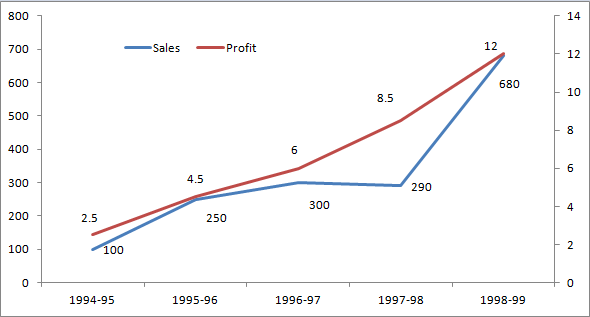
The highest percentage of growth in sales, relative to the previous year, occurred in
Percentage growth in sales in the year 1995-96 is 250/100 - 1 = 150%
Percentage growth in sales in the year 1996-97 is 300/250 - 1 = 20%
Percentage growth in sales in the year 1997-98 is 290/300 - 1 = -3.33%
Percentage growth in sales in the year 1998-99 is 680/290 - 1 = 134%
Hence, the percentage growth in sales is maximum in the year 1995-96
The highest percentage growth in net profit, relative to the previous year, was achieved in
Percentage growth in net profit in the year 1995-96 is 4.5/2.5 - 1 = 80%
Percentage growth in net profit in the year 1996-97 is 6/4.5 - 1 = 33.33%
Percentage growth in net profit in the year 1997-98 is 8.5/6 - 1 = 41.67%
Percentage growth in net profit in the year 1998-99 is 12/8.5 - 1 = 41.17%
Hence, the percentage growth in net profit is maximum in the year 1995-96
Defining profitability as the ratio of net profit to sales, IVP Ltd. recorded the highest profitability in
Profitability in the year 1994-95 is 2.5/100 = 2.5%
Profitability in the year 1995-96 is 4.5/250 = 1.8%
Profitability in the year 1996-97 is 6/300 = 2%
Profitability in the year 1997-98 is 8.5/290 = 2.93%
Profitability in the year 1998-99 is 12/680 = 1.76%
Hence, the profitability is maximum in the year 1997-98
With regarded to profitability as defined in the earlier question, it can be concluded that
Profitability in the year 1994-95 is 2.5/100 = 2.5%
Profitability in the year 1995-96 is 4.5/250 = 1.8%
Profitability in the year 1996-97 is 6/300 = 2%
Profitability in the year 1997-98 is 8.5/290 = 2.93%
Profitability in the year 1998-99 is 12/680 = 1.76%
Profitability increased/decreased in some years, hence the first three options are wrong.
So, the correct answer is option (d)
Consider the information provided in the figure below relating to India's foreign trade in 1997-98 and the first eight months of 1998-99.
Total trade with a region is defined as the sum of exports to and imports from that region.
Trade deficit is defined as the excess of imports over exports. Trade deficit may be negative.
A:USA. B:Germany C:Other EU. D:U.K. E:Japan F:Russia
G:Other East Europe H:OPEC I:Asia J:Other LDCs K:Others
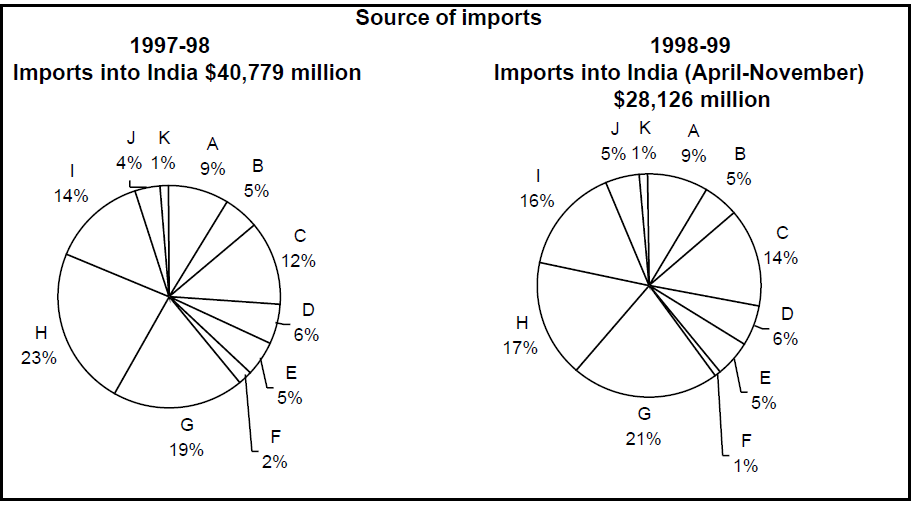
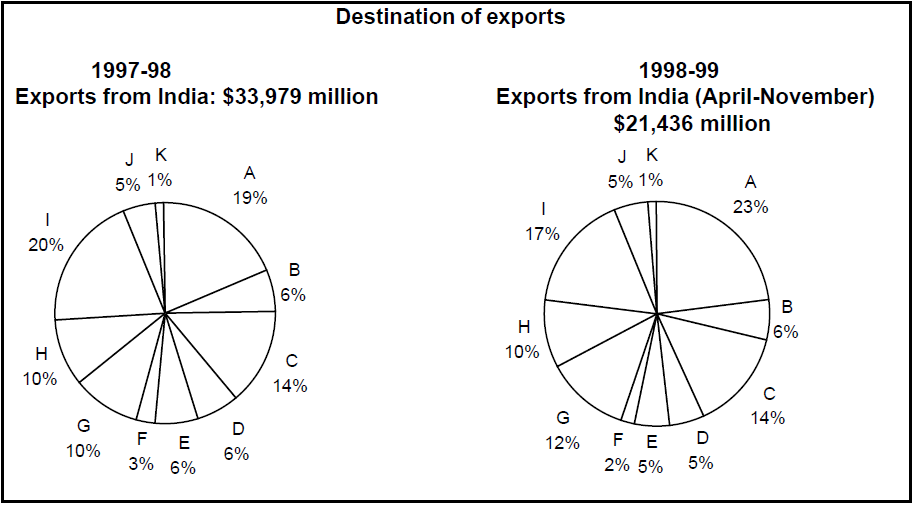
What is the region with which India had the highest total trade in 1997-98?
The four major trading partners with India in 1997-98 are A, G, H and I.
From the numbers, we can ignore the others for this questions.
Total trade with A in the year 1997-98 is 9%*40779 + 19%*33979 = 10,126
Total trade with G in the year 1997-98 is 19%*40779 + 10%*33979 = 11,146
Total trade with H in the year 1997-98 is 23%*40779 + 10%*33979 = 12,777
Total trade with I in the year 1997-98 is 14%*40779 + 20%*33979 = 12,505
Hence, the correct option is block H which is OPEC
In 1997-98 the amount of Indian exports, in millions US $, to the region with which India had the lowest total trade, is approximately
In both imports and exports, India did the least amount of trade in 1997-98 with K (both equal to 1%).
Hence, India had the lowest total trade with K in the year 1997-98.
The amount of Indian exports equals 1%*33979 = 340 millions
In 1997-98, the trade deficit with respect to India, in billions of US $, for the region with the highest trade deficit with respect to India, is approximately equal to
In order to find the trading partner with the highest trade deficit, we have to look for countries from whom India imported a lot but exported little.
The two countries which are important here are G and H. However, the exports to both are the same. But the imports from H are more than the imports from G.
So, the trading partner with whom India has the highest trade deficit is H.
The amount of trade deficit equals 23%*40779 - 10%*33979 = 5981 mio ~ 6 bn
What is the region with the lowest trade deficit with India in 1997-98?
In order to find the country which has the least trade deficit with India, we have to look for countries whom India exported a lot and imported less.
The only two countries which fit the bill are countries A and I.
Trade deficit of A with India in 1997-98 is 9%*40779 - 19%*33979 = -2.78 billion
Trade deficit of I with India in 1997-98 is 14%*40779 - 20%*33979 = -1.08 billion
Hence, the country with the least trade deficit is country A or USA
Assume that the average monthly exports from India and imports to India during the remaining four months of 1998-99 would be the same as that for the first eight months of the year. What is the region to which India’s exports registered the highest percentage growth between1997-98 and 1998-99?
Since the increase in imports and exports is at average, the exports and imports in the next 4months will be half of their respective first eight months.
Exports in the first 8 months of 1998-1999 is $21436 so, in the next 4 months it will be 21436/2 = 10718
Total exports= 21346+10718=32154.
Although total imports have been increased the percentage share for all is decreased expect A and G. This means surely one of A and G has the highest increase.
Percentage growth in exports of country A is (23%*32154 - 19%*33979)/19%*33979 = 14.5%
Percentage growth in exports of country G is (12%*32154 - 10%*33979)/10%*33979 = 13.5 %
Hence, the region to which Indian exports witnessed the highest percentage growth is region A i.e USA
Assume that the average monthly exports from India and imports to India during the remaining four months of 1998-99 would be the same as that for the first eight months of the year. What is the percentage growth rate in India’s total trade deficit between 1997-98 and 1998-99?
Since the increase in imports and exports is at average, the exports and imports in the next 4months will be half of their respective first eight months.
Exports in first 8 months of 1998-1999 is $21436 so, in next 4 months it will be 21436/2 = 10718
Total exports= 21346+10718=32154.
Similarly, total imports= 28126+ 28126/2 = 42189
Trade deficit = 42189-32064= 10035
Trade deficit in 1997-98= 40779-33979=6800.
Increase = (10035-6800)/6800 = 47.5%
These questions are based on the price fluctuations of four commodities - arhar, pepper, sugar and gold during February - July 1999 as described in the figures below:

Price change of a commodity is defined as the absolute difference in ending and beginning prices expressed as a percentage of the beginning. What is the commodity with the highest price change?
Price change of arhar = (2105-1700)/1700 = 23.82%
Price change of pepper = (19250-18500)/18500 = 4.05%
Price change of sugar = (1430 - 1440)/1430 = -0.69%
Price change of gold = (3850 - 4250)/3850 = -9.41%
Hence, the price change is maximum for arhar.
Price volatility (PV) of a commodity is defined as follows: PV = (highest price during the period - lowest price during the period / average price during the period. What is the commodity with the lowest price volatility?
Volatility for arhar is (2300-1500)/1900 = 42%
Volatility for pepper is (19500-17500)/18500 = 10.8%
Volatility for sugar is (1500-1410)/1450 = 6.2%
Volatility for gold is (4300-3800)/4050 = 12%
Hence, the volatility is least for sugar.
Mr. X, a funds manager with an investment company invested 25% of his funds in each of the four commodities at the beginning of the period. He sold the commodities at the end of the period. His investments in the commodities resulted in:
The profit percentage equals 25%*(2105/1700-1) + 25%*(19250/18500-1) + 25%*(1430/1440-1) + 25%*(3850/4250-1)
This equals 25%*(23.82% + 4.05% -0.69% - 9.41%) = 25%*17.77 = 4.4%
The closest option to this is option (d)
The price volatility of the commodity with the highest PV during the Febrauary-July period is approximately equal to:
Volatility for arhar is (2300-1500)/1900 = 42%
Volatility for pepper is (19500-17500)/18500 = 10.8%
Volatility for sugar is (1500-1410)/1450 = 6.2%
Volatility for gold is (4300-3800)/4150 = 12%
Hence, the highest volatility is around 40%
These questions are based on the table below presenting data on percentage population covered by drinking water and sanitation facilities in selected Asian countries.

Country A is said to dominate B or A > B if A has higher percentage in total coverage for both drinking water and sanitation facilities, and, B is said to be dominated by A, or B < A. A country is said to be on the coverage frontier if no other country dominates it. Similarly, a country is not on the coverage frontier if it is dominated by at least one other country.
What are the countries on the coverage frontier?
Bangladesh has the highest percentage in drinking water facilities. Let us see which countries it dominates. This is possible if it has greater sanitation facilities also as compared to the other country.
Bangladesh has better sanitation facilities than India, China, Pakistan and Nepal. So those Bangladesh dominates those four countries and they are not on the coverage frontier.
Similarly, Philippines has the highest percentage of sanitation facilities. Let us see which countries it dominates. This is possible if it has greater drinking water coverage also.
Philippines has greater drinking water coverage than all countries except Bangladesh. Hence, it dominates all the countries except Bangladesh. So, no other country is on the coverage frontier.
Hence, the only countries on the coverage frontier are Bangladesh and Philippines.
Which of the following statements are true?
A. India > Pakistan and India > Indonesia
B. India > China and India > Nepal
C. Sri Lanka > China
D. China > Nepal
India has lesser sanitation facilities than Pakistan. Hence it is false that India > Pakistan. So statement A is false.
India has greater sanitation facilities as well as drinking water coverage than China. Similar is the case between India and Nepal.
Hence, India > China and India > Nepal. So, statement B is true.
Sri Lanka has lesser drinking water coverage than China. Hence, statement C is false.
China has greater sanitation facilities as well as drinking water coverage than Nepal. Hence, China > Nepal and statement D is true.
So, the only two true statements are B and D.
Using only the data presented under Sanitation facilities columns, it can be concluded that rural population in India, as a percentage of its total population is approximately
Let total rural population in India be R and urban population in India be U.
Total population in India = T = U + R
Based on the sanitation facilities table,
$$\frac{70}{100}$$ U + $$\frac{14}{100}$$ R = $$\frac{29}{100}$$(U + R)
Solving, we get
$$\frac{U}{R}$$ = $$\frac{15}{41}$$
U : R = 15 : 41
Rural population % = $$\frac{41}{15+41}\times\ 100$$ = $$\frac{41}{56}\times\ 100$$ = 73.2%
Again, using only the data presented under Sanitation facilities columns, sequence China, Indonesia and Philippines in ascending order of rural population as a percentage of their respective total populations. The correct order is:
Let total rural population in China be A and urban population in China be B.
Total population in India = T = A + B
Based on the sanitation facilities table,
$$\frac{74}{100}$$ B + $$\frac{7}{100}$$ A = $$\frac{24}{100}$$(A + B)
Solving, we get
$$\frac{A}{B}$$ = $$\frac{50}{17}$$
A : B = 50 : 17
Rural population % = $$\frac{50}{50+17}\times\ 100$$ = $$\frac{50}{67}\times\ 100$$ = 74.6%
Let total rural population in Indonesia be C and urban population in Indonesia be D.
Total population in India = T = C + D
Based on the sanitation facilities table,
$$\frac{40}{100}$$ C + $$\frac{73}{100}$$ D = $$\frac{51}{100}$$(C + D)
Solving, we get
$$\frac{C}{D}$$ = $$\frac{22}{11}$$
C : D = 2 : 1
Rural population % = $$\frac{2}{2+1}\times\ 100$$ = $$\frac{2}{3}\times\ 100$$ = 66.7%
Let total rural population in Philippines be R and urban population in Philippines be U.
Total population in India = T = R + U
Based on the sanitation facilities table,
$$\frac{88}{100}$$ U + $$\frac{66}{100}$$ R = $$\frac{77}{100}$$(U + R)
Solving, we get
$$\frac{U}{R}$$ = $$\frac{11}{11}$$
U : R = 1 : 1
Rural population % = $$\frac{1}{1 + 1}\times\ 100$$ = $$\frac{1}{2}\times\ 100$$ = 50%
Ascending order: Philippines, Indonesia, China
Therefore, answer is option A.
India is not on the coverage frontier because
A. it is lower than Bangladesh in terms of coverage of drinking water facilities.
B. it is lower than Sri Lanka in terms of coverage of sanitation facilities.
C. it is lower than Pakistan in terms of coverage of sanitation facilities.
D. it is dominated by Indonesia.
For a country to be on the coverage frontier, it should not be dominated by any other country. That is no other country should have both (sanitation facilities and drinking water coverage) better than it.
The first three options, though true, are not the reason for India not being on the coverage frontier. That is because they don't mention the other parameter at all.
For example, option A doesn't mention sanitation facilites while options B and C don't mention drinking water coverage. Hence, none of A,B and C are the reason India is not on the coverage frontier.
Option D is factually wrong as Indonesia has lesser drinking water coverage than India and doesn't dominate it.
Hence, none of the options given are correct.
These relate to the above table with the additional provison that the gap between the population coverages of ‘sanitation facilities’ and ‘drinking water facilities’ is a measure of disparity in coverage.
The country with the most disparity in coverage of rural sector is
The most disparity in rural sector is in India = 79-14 = 65
The disparity in all other countries is less than 65.
These relate to the above table with the additional provison that the gap between the population coverages of ‘sanitation facilities’ and ‘drinking water facilities’ is a measure of disparity in coverage.
The country with the least disparity in coverage of urban sector is
The least disparity => The least difference between the coverage in urban drinking water facilities and the coverage in urban sanitation facilities.
Phillipines has a disparity of 92-88 = 4, which is the least.
Hence, option C is the answer.
Each question is followed by two statements, A and B. Choose the option based on the given statements and questions
The average weight of students in a class is 50 kg. What is the number of students in the class?
A. The heaviest and the lightest members of the class weigh 60 kg and 40 kg respectively.
B. Exclusion of the heaviest and the lightest members from the class does not change the average weight of the students.
Using statement A, we cannot infer the number of students in the class.
Using statement B, we can say that the sum of weights of heaviest and the lighest persons is equal to twice the average weight of the class. But we cannot infer the number of students in the class.
Using both the statements as well, we do not have any information through which we can find the answer.
Hence, option D is the answer.
A small storage tank is spherical in shape. What is the storage volume of the tank?
A. The wall thickness of the tank is 1 cm.
B. When the empty spherical tank is immersed in a large tank filled with water,20 litres of water overflow from the large tank.
Using statement 1, we come to know that if the inner radius is r, then the outer radius is r+1
Using statement 2, Volume = 20 l = 20000$$cm^3$$
$$\frac{4}{3} \pi (r+1)^3-r^3$$ = 20000
We can calculate r using this equation.
Mr. X starts walking northwards along the boundary of a field, from point A on the boundary, and after walking for 150 metres reaches B, and then walks westwards, again along the boundary, for another 100 metres when he reaches C. What is the maximum distance between any pair of points on the boundary of the field?
A.The field is rectangular in shape.
B.The field is a polygon, with C as one of its vertices and A the mid point of a side.
Using only statement A, we know that the shape of th field is rectangle. We cannot infer anything else with only statement A.
Using only statement B, we know that C is one of the vertices, but we do not know how many vertices exist.
Using both A and B, we know that the field is rectangular in shape and the length and breadth are 300 metres and 100 metres.
Hence, we can find the value of the diagonal which is the maximum distance between any two points inside the field.
Hence, option C is the answer.
A line graph on a graph sheet shows the revenue for each year from 1990 through 1998 by points and joins the successive points by straight line segments. The point for revenue of 1990 is labelled A, that for 1991 as B, and that for 1992 as C. What is the ratio of growth in revenue between 91-92 and 90-91?
A.The angle between AB and X-axis when measured with a protractor is 40 degrees, and the angle between CB and X-axis is 80 degrees.
B.The scale of Y-axis is 1 cm = 1000 Rs.
Growth = Change in value on Y-axis / Change in value on X-axis = Tangent of the angle made by the line with the X-axis
In statement 1, since we know both the angles, we can calculate the growth for both the periods and hence the ratio of growths.
Using statement 2 alone, we cannot determine the answer. Option a) is the correct answer.
There is a circle with centre C at the origin and radius r cm. Two tangents are drawn from an external point D at a distance d cm from the centre. What are the angles between each tangent and the X-axis?
A.The coordinates of D are given
B.The X-axis bisects one of the tangents.
From statement I, We can draw the following figure

From the figure we can say that in triangle GCD we know 2 sides GC and CD, so we can find the third side
Also we can find the angle GDC(Using trigonometric ratios)
Similarly in triangle CDE, we know CE and DE, so we can find angle CDE.
From this we can get the angle FDE. Now in right angled triangle FDE, we can find the angle DFE.
So we can answer from statement I
Now let us consider statement II
 By using trigonometric relations angle CFG can be calculated.
From this we can get angle DFE
Iin triangle CGD we can find angles GDC(Using trigonometric ratios)
Now GDC = CDJ
Thus we can find EDH and from that we can find EHD.
Hence the question can be answered from statement II alone.
Find a pair of real numbers x and y that satisfy the following two equations simultaneously. It is known that the values of a, b, c, d, e and f are non-zero. ax + by = c dx + ey = f
A. a = kd and b = ke, c = kf, k is not equal to 0
B. a = b = 1, d = e = 2, f is not equal to 2c
ax + by = c
dx + ey = f
Using statement A, we can modify the equation ax + by + c to k(dx+ey=f)
=> We cannot find the point (x,y).
Using statement B, we can change the equations to x + y = c and 2x + 2y = f (f not equal to 2c)
As the slopes are equal and the intercepts are not equal, we can say that the equations do not have a solution.
Hence, we can answer the question using statement B but not A.
Three professors A, B and C are separately given three sets of numbers to add. They were expected to find the answers to 1+1, 1+1+2, and 1+1 respectively. Their respective answers were 3, 3, and b How many of the professors are mathematicians?
A. A mathematician can never add two numbers correctly, but can always add three numbers correctly.
B. When a mathematician makes a mistake in a sum, the error is + I or -1.
The value of b is unknown in this question.
Using Statement a, we can say that B is not a mathematician. A may be or may not be a mathematician as we do not know whether he can add three numbers correctly or not. Similarly C may be or may not be a mathematician as we do not know the value of b.
Using statement b, We cannot find out for sure if A and C are mathematicians or not.
So the question cannot be answered even by using both statements together.
How many among the four students A, B, C and D have passed the exam'?
A.The following is a true statement: A and B passed the exam.
B.The following is a false statement: At least one among C and D has passed the exam.
Using only the first statement, we know that A and B passed the exam. We can't infer anything about C and D.
Using only the second statement, we know that C and D failed the exam. We can't infer anything about A and B.
Using both the statements, we can say that A and B passed the exam and C and D failed the exam.
What is the distance x between two cities A and B in integral number of Kms?
A.x satisfies the equation $$\log_2 x = \sqrt{x}$$
B. x less than or equal to 10 Kms
Both x = 4 and x = 16 satisfy the condition in statement A.
Using only statement B, we cannot find the unique value of x.
Using both A and B, we can infer that x = 4
Hence, option C is the answer.
Mr. Mendel grew one hundred flowering plants from black seeds and white seeds, each seed giving rise to one plant. A plant gives flowers of only one colour. From a black seed comes a plant giving red or blue flowers. From a white seed comes a plant giving red or white flowers. How many black seeds were used by Mr. Mendel?
A. The number of plants with white flowers was 10.
B. The number of plants with red flowers was 70.
Using only statement A, we can say that at least 10 white seeds were used. But we cannot find the exact number.
Using only statement B, we cannot make any inference.
Using both the statements, we can only make the same conclusion as we made using statement A.
Hence, the question cannot be answered by using both the statements together.

How many airports of type ‘1’ handle more than 35 lakh passengers each?
The airports with serial numbers 1, 3, 4, 6, 8 and 11 are of type ‘1’ and handle more than 35 lakh passengers.
How many airports outside of AP handle more than 40 lakh passengers each?
The first 9 airports handle more than 40 lakh passengers each, out of which 3 are in AP and 6 are outside AP.

Educational materials for CAT preparation
 Share
Share
