91- 6303239042


 Group
Group


 Preferred Source

 Google Discover
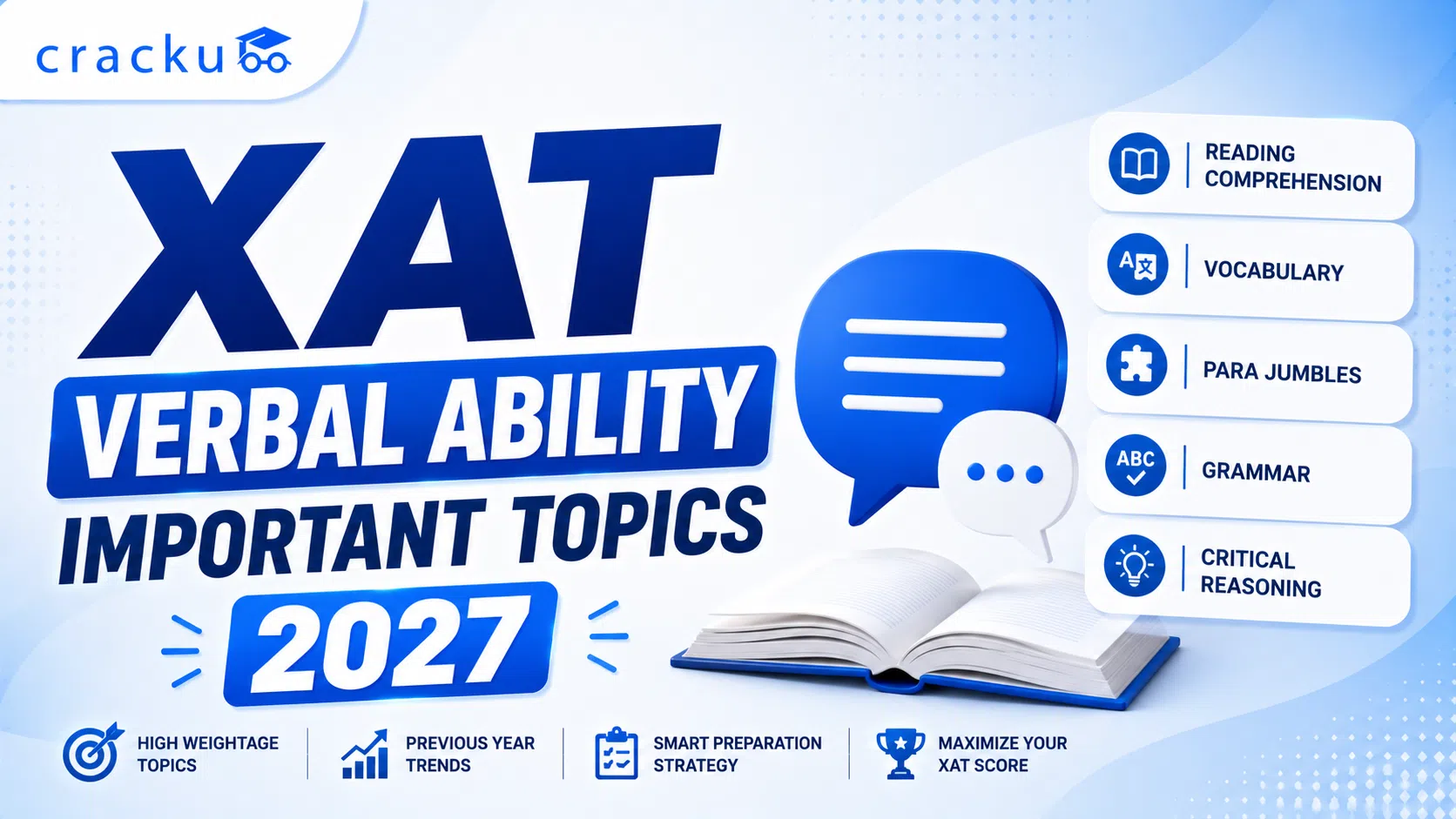
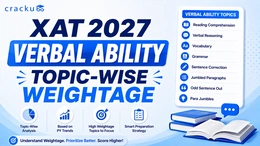
Many XAT 2027 aspirants ignore Verbal Ability, but these 7- 9 questions every year play an important role in improving the overall percentile. However, many XAT aspirants spend months preparing without knowing which topics to prioritise. Analysis of previous years' XAT papers shows that Reading Comprehension, Grammar, Vocabulary, Fill in the Blanks, and Critical Reasoning constantly carry the highest weightage. To get good marks in VALR, students must focus on every important topic of this section.
XAT Verbal Ability Important Topics 2027
Verbal Ability combined with Logical Reasoning forms one single section, VALR, with around 26 questions asked every year from this section in the XAT exam. From Verbal Ability part, around 9-11 questions are asked, and the remaining questions are from Logical Reasoning. Reading Comprehension carries the highest weightage, followed by grammar, vocabulary, sentence structure, and logical language skills. These are some of the most important Verbal ability topics which students need to prepare for sincerely.
XAT Verbal Ability Important Topics 2027 | |||
Verbal Ability Topic | Expected Questions (Out of 8–10) | Difficulty | Importance |
Vocabulary (Word Usage, Synonyms, Contextual Meaning) | 2–3 | Easy to Moderate | Very High |
Grammar (Error Detection, Sentence Correction) | 2–3 | Moderate | Very High |
Fill in the Blanks | 1–2 | Easy to Moderate | High |
Para Completion | 1–2 | Moderate | High |
Idioms & Phrases | 0–1 | Easy | Medium |
Sentence Improvement | 0–1 | Moderate | Medium |
Analogy & Word Relationships | 0–1 | Moderate | Medium |
Sentence Rearrangement / Para Jumbles* | 0–1 | Moderate | Medium |
Read Also, How to Score 99+ Percentile in XAT 2027, Complete Study Plan
XAT Verbal Ability Syllabus 2027
The XAT Verbal Ability syllabus is officially known as Verbal Ability and Logical Reasoning syllabus. XLRI Jamshedpur's official authority responsible for taking the XAT exam does not release any official XAT syllabus. On the basis of previous year papers their are 26 questions in VALR section
XAT Verbal Ability Syllabus 2027 | |
Topic | Description |
Grammar | Tests concepts such as subject-verb agreement, tenses, articles, prepositions, modifiers, conjunctions, and sentence structure. |
Vocabulary | Covers synonyms, antonyms, contextual word usage, one-word substitutions, and commonly confused words. |
Fill in the Blanks | Assesses vocabulary and grammar by selecting the most appropriate word or phrase to complete a sentence. |
Sentence Correction | Requires identifying and correcting grammatical, structural, or usage errors in sentences. |
Error Detection | Tests the ability to identify grammatical, punctuation, spelling, or syntax errors in a sentence. |
Para Completion | Involves selecting the most suitable sentence to logically complete a paragraph. |
Sentence Improvement | Evaluates the ability to improve sentence clarity, grammar, and overall correctness. |
Idioms & Phrases | Tests understanding of commonly used idiomatic expressions and their contextual meanings. |
Word Usage | Assesses whether a word has been used correctly in a given context. |
Verbal Reasoning | Includes language-based reasoning questions that require logical interpretation and contextual understanding. |
Note: XLRI does not provide an official Verbal Ability syllabus. The topics listed in the table are based on analysis of previous years' XAT question papers and the repeating concepts asked in the Verbal Ability section.
Read Also, XAT Important Topics 2027, Section-wise Weightage with Analysis
XAT Verbal Ability Preparation Strategy
Verbal Ability requires a different XAT preparation strategy compared to other MBA exams because of its unique poetry comprehension, tough critical reasoning, and negative marking for unattempted questions where 0.10 marks will be deducted beyond the first 8 skipped questions. Below in the table, a phase-wise preparation strategy is given:
XAT Verbal Ability Preparation Strategy | |||
Phase | Duration | Focus Areas | What You Should Do |
Phase 1: Build Strong Fundamentals | Months 1–2 | Grammar, Vocabulary & Reading | Start with grammar concepts (tenses, articles, prepositions, subject-verb agreement), improve vocabulary by learning 10–15 new words daily, read newspapers/editorials for 20–30 minutes, solve basic Verbal Ability questions, and practise topic-wise exercises. |
Phase 2: Practice & Improve Accuracy | Months 3–4 | Question Practice & Concept Application | Solve topic-wise practice papers, attempt sectional tests (2–3 per week), practise previous years' XAT questions, analyse mistakes, maintain a mistake notebook, continue daily reading, and focus on improving accuracy before increasing speed. |
Phase 3: Mock Tests & Revision | Last 2 Months | Exam Readiness & Time Management | Attempt full-length XAT mock tests (1–2 per week in the beginning, then 2–3 per week), revise grammar rules and vocabulary daily, solve mixed question sets, do mock analysis, strengthen weak topics, and practice solving questions within the actual exam time limit. |
XAT Verbal Ability Questions
XAT Verbal Ability Questions are asked to test students' command over grammar, vocabulary, contextual understanding, and logical language skills. Based on XAT previous years' papers, questions are more inclined towards application rather than memory. Understanding the question types and patterns helps students prepare strategically and improve accuracy in the XAT 2027 exam.
XAT Verbal Ability Questions | |
Verbal Ability Topic | What You Can Expect in XAT |
Grammar (Error Detection & Sentence Correction) | Questions are usually context-based rather than rule-based. Candidates are expected to identify grammatical errors related to subject-verb agreement, tenses, modifiers, articles, prepositions, and sentence structure instead of relying only on memorised rules. |
Vocabulary (Word Usage & Contextual Meaning) | Vocabulary questions primarily test contextual understanding. Instead of asking direct synonym or antonym questions, XAT often checks whether a word is used correctly in a given sentence or passage. |
Fill in the Blanks | Most questions require selecting the most appropriate word or phrase based on grammar, vocabulary, and the logical flow of the sentence. Some questions may involve choosing the best pair of words. |
Para Completion | Candidates are required to identify the sentence that logically completes a paragraph by maintaining coherence, continuity, and the author's line of thought. |
Sentence Rearrangement (Para Jumbles) | Para-jumbles are generally conventional in nature and require arranging sentences into a coherent sequence using logical connectors, chronology, and contextual clues. |
Sentence Improvement | Questions ask candidates to identify the best revision of a sentence by improving grammar, clarity, style, or sentence construction while preserving the original meaning. |
Idioms & Phrases | Idiom-based questions assess the contextual meaning of commonly used expressions rather than simple memorization. Candidates must choose the option that best fits the sentence. |
Reading Comprehension-based Verbal Ability | Some Verbal Ability questions may be linked to short passages and test contextual vocabulary, author's tone, implied meaning, and interpretation of specific statements. |
Overall Verbal Ability Pattern | XAT Verbal Ability emphasizes contextual language skills, logical interpretation, and application of grammar and vocabulary. Direct factual or memory-based questions are relatively uncommon compared to application-oriented questions. |
High Weightage Verbal Ability Topics in XAT 2027
Verbal Ability in XAT every year asks multiple high-weightage topics like Reading Comprehension (RC) and Critical Reasoning (CR), which tests both conceptual clarity and question-solving speed more than it requires in-depth analysis of questions. These RC passages are about some of the common topics like philosophy, literature, and social sciences, while CR questions test logical analysis and argument evaluation.
High-Weightage Verbal Ability Topics in XAT | |
Main Topic | Sub-Topics |
Reading Comprehension (Highest Priority) | Inference-based RCs, Main Idea, Author's Tone, Vocabulary in Context, Fact vs Opinion, Philosophy, Literature, Social Science & Abstract Passages |
Critical Reasoning | Assumptions, Strengthen & Weaken Arguments, Inference, Conclusions, Statement Evaluation, Cause & Effect, Argument Analysis |
Para Jumbles & Para Completion | Sentence Rearrangement, Logical Sequencing, Paragraph Completion, Identify Opening & Closing Sentence, Coherent Flow of Ideas |
Vocabulary & Usage | Synonyms, Antonyms, Fill in the Blanks, Contextual Vocabulary, Idioms & Phrases, Cloze Test, Word Usage |
Grammar | Sentence Correction, Error Spotting, Parts of Speech, Subject-Verb Agreement, Tenses, Modifiers, Parallelism |
Verbal Logic | Statement–Conclusion, Statement–Assumption, Analogies, Syllogisms, Logical Consistency, Odd Sentence Out |
How can I improve my score in the XAT Verbal Ability section?
Verbal Ability is an important topic to improve the overall VALR score, as every year 9-11 questions are asked from this part only, which makes this part a big deciding factor to get a high percentile in the overall XAT exam. Students need to focus on Reading Comprehension, Critical Reasoning, Core Vocabulary to get a good hold over Verbal Ability.
- Understand High Weightage Topics: Focus more on RC, Critical Reasoning, Jumbled words, Fill in the Blanks, these are high-priority topics for students preparing for XAT.
- Start Focusing On Time Management: Verbal Ability questions appear in the Verbal & Logical Ability section. Out of a total of 170 minutes, students should aim to spend not more than 40 minutes on Verbal & Logical Ability section.
- Practice Previous Year Questions (PYQs): Solve XAT previous year papers regularly to understand the exam pattern, repeating question types, and know the difficulty level. Analyse every mistake to avoid repeating it.
- Attempt Regular Mock Tests: Take sectional and full-length XAT mock tests every week. Check your performance carefully and identify weak topics in Verbal Ability, and revise them daily to improve both accuracy and speed.
Read Also, India's #1 XAT Online Coaching 2027 By Sayali Mam(99.998%iler)
XAT Verbal Ability Important Topics 2027: Conclusion
Preparing the XAT Verbal Ability Important Topics 2027 systematically can significantly improve your overall VALR score and XAT percentile. Candidates should prioritise Grammar, Vocabulary, Reading Comprehension, Fill in the Blanks, and Para Completion while practising previous year questions to understand the latest exam pattern.
A balanced preparation strategy that combines concept building, regular mock tests, and continuous revision is the key to success. By focusing on the high-weightage topics and analysing your performance consistently, you can maximise your accuracy and confidently score well in the XAT 2027 examination.