91- 6303239042
Based on the passage, which of the following options would be the most appropriate for citizens to learn history?
Sign in
Please select an account to continue using cracku.in
↓ →
Please read the passage below and answer the questions that follow:
If history doesn’t follow any stable rules, and if we cannot predict its future course, why study it? It often seems that the chief aim of science is to predict the future - meteorologists are expected to forecast whether tomorrow will bring rain or sunshine; economists should know whether devaluing the currency will avert or precipitate an economic crisis; good doctors foresee whether chemotherapy or radiation therapy will be more successful in curing lung cancer. Similarly, historians are asked to examine the actions of our ancestors so that we can repeat their wise decisions and avoid their mistakes. But it never works like that because the present is just too different from the past. It is a wast of time to study Hannibal’s tactics in the Second Punic War so as to copy them in the Third World War. What worked well in cavalry battles will not necessarily be of much benefit in cyber warfare. Science is not just about predicting the future, though. Scholars in all fields often seek to broaden our horizons, thereby opening before us new and unknown futures. This is especially true of history. Though historians occasionally try their hand at prophecy (without notable success), the study of history aims above all to make us aware of possibilities we don’t normally consider. Historians study the past not in order to repeat it, but in order to be liberated from it. Each and every one of us has been born into a given historical reality, ruled by particular norms and values, and managed by a unique economic and political system. We take this reality for granted, thinking it is natural, inevitable and immutable. We forget that our world was created by an accidental chain of events, and that history shaped not only our technology, politics and society, but also our thoughts, fears and dreams. The cold hand of the past emerges from the grave of our ancestors, grips us by the neck and directs our gaze towards a single future. We have felt that grip from the moment we were born, so we assume that it is a natural and inescapable part of who we are. Therefore we seldom try to shake ourselves free, and envision alternative futures. Studying history aims to loosen the grip of the past. It enables us to turn our head this way and that, and begin to notice possibilities that our ancestors could not imagine, or didn’t want us to imagine. By observing the accidental chain of events that led us here, we realise how our very thoughts and dreams took shape - and we can begin to think and dream differently. Studying history will not tell us what to choose, but at least it gives us more options.
Based on the passage, which of the following options would be the most appropriate for citizens to learn history?
In the passage the author reiterates the fact that studying history widens our vision and the penultimate sentence of the passage states that by studying the accidental chain of events that led us here, we realise how our thoughts and dreams took shape and we begin to think and dream differently. Therefore, if every street in India were to display a plague that lists all its previous names, it would help us realise how our very own thoughts and dreams took shape and thereby, help us begin to think and dream differently. Therefore, only option B would be the most appropriate for the citizens to learn history.
Options A and C restrict themselves only to British names of streets and do not speak about the history of India prior to British rule and hence they can be eliminated. Options D and E fail to explain why it would be appropriate for citizens to learn history so they can be eliminated to.
Which of the following options is the closest to the essence of the passage?
Refer lo lines 9 and 10 of the passage - "Scholars in all fields....This is especially true of history" - and the last four lines of the passage, from which it can be understood that studying history helps us to think and dream differently and it gives us more options. Hence it can be said that option E is closest to the main idea which the author intends to convey. Option A can be understood from the passage but it does not bring out the main idea of the passage. Options B, C and D are too generalised statements.
Read the following sentences:
1. A historian successfully predicted a political crisis based on similar events of the last century.
2. Using the latest technology, doctors could decipher the microbe causing the disease.
3. Students who prepared for an examination by perusing past 10 years' question papers did not do well in the examination.
4. A tribe in Andaman learns to predict epidemic outbreaks by listening to the stories of how their ancestors predicted the past outbreaks.
Which of the statement(s) above, if true would contradict the view of the author?
The author of the passage believes that history doesn't follow strict rules, so we can't really predict the future by looking at the past. They think that trying to directly copy past solutions for today's problems won't work because things are always changing.
Statement 1 contradicts this because it says a historian successfully predicted something based on the past, which the author says is unlikely.
Statement 4 also contradicts the author because it says a tribe learned to predict future epidemics from past stories, again suggesting that the past can help predict the future, which the author doubts.
Statements 2 and 3 don't go against the author's main point about the unpredictability of history and the limitations of directly applying past lessons.
Hence, correct option is Option D.

Please read the passage below and answer the questions that follow:
Rene Descartes’ assertion that ideas may be held true with certainty if they are “clear and distinct” provides the context for Peirce’s title, “How to Make Our Ideas Clear.” Peirce argued that an idea may seem clear if it is familiar. Distinctness depends on having good definitions, and while definitions are desirable they do not yield any new knowledge or certainty of the truth of empirical propositions. Peirce argues that thought needs more than a sense of clarity; it also needs a method for making ideas clear. Once we have made an idea clear, then we can begin the task of determining its truth. The method that Peirce offers came to be known as the pragmatic method and the epistemology on which it depends is pragmatism. Peirce rejected Descartes’ method of doubt. We cannot doubt something, for the sake of method, that we do not doubt in fact. In a later essay, he would state as his rule “Dismiss make-believes.” This refers to Descartes’ method of doubting things, in the safety of his study, such things as the existence of the material world, which he did not doubt when he went out on the street. Peirce proposed that a philosophical investigation can begin from only one state of mind, namely, the state of mind in which we find ourselves when we begin. If any of us examines our state of mind, we find two kinds of thoughts: beliefs and doubts. Peirce had presented the interaction of doubt and belief in an earlier essay “The Fixation of Belief”.
Beliefs and doubts are distinct. Beliefs consist of states of mind in which we would make a statement; doubts are states in which we would ask a question. We experience a doubt as a sense of uneasiness and hesitation. Doubt serves as an irritant that causes us to appease it by answering a question and thereby fixing a belief and putting the mind to rest on that issue. A common example of a doubt would be arriving in an unfamiliar city and not being sure of the location of our destination address in relation to our present location. We overcome this doubt and fix a belief by getting the directions. Once we achieve a belief, we can take the necessary action to reach our destination. Peirce defines a belief subjectively as something of which we are aware and which appeases the doubt. Objectively, a belief is a rule of action. The whole purpose of thought consists in overcoming a doubt and attaining a belief. Peirce acknowledges that some people like to think about things or argue about them without caring to find a true belief, but he asserts that such dilettantism does not constitute thought. The beliefs that we hold determine how we will act. If we believe, rightly or wrongly, that the building that we are trying to reach sits one block to our north, we will walk in that direction. We have beliefs about matters of fact, near and far. For example, we believe in the real objects in front of us and we believe generally accepted historical statements. We also believe in relations of ideas such as that seven and five equal twelve. In addition to these we have many beliefs about science, politics, economics, religion and so on. Some of our beliefs may be false since we are capable of error. To believe something means to think that it is true.
According to Peirce, for a particular thought, which of the following statements will be correct?
Refer to the lines 5 and 6 of paragraph 2 "Peirce defines a belief subjectively as something of which we are aware and which appeases the doubt." From this it can be inferred that a doubt may lead to a belief. The word "subjectively" suggests that a doubt may lead to a belief. Hence it cannot be said categorically that a doubt always leads to a belief.
"A candidate has applied for XAT". According to Peirce, it indicates that:
It is stated in the passage that once we achieve a belief, we can take the necessary action to reach our destination. From this it is explicit that a candidate believes that he/she has faith in the application process and that is the reason why he/she has applied for XAT. A candidate's trust in the application process leads him or her to apply for the exam that is the main reason which prompts him or her to apply for the exam that is the main reason which prompts him or her to apply for the exam. Hence option (A) is the best answer to this question.
Which of the following words is the closest in meaning to "dilettantism"?
The word "dilettantism" means amateurism or inexpertness. Pierce acknowledges that some people like to think about things or argue about them without caring to find a true belief, but he asserts that such dilettantism does not constitute thought. By refering to people who don't care to find out a true belief, it can be understood that Pierce is referring to people who indulge in mere guess work. Hence, from the given options the word "guess" is closest in meaning to the word dilettante.
.webp)
A person thinks that s/he has to keep awake for twenty hours in a day to score well in an examination, but is awake for only fifteen hours.
For the above statement, which of the following options will be right, according to Peirce?
It is stated in the second paragraph of the passage that Pierce acknowledges that some people like to think about things or argue about them without caring to find a true belief, but he asserts that such dilettantism does not constitute thought. From this it can be inferred that a person thinks that he/she has to keep awake for twenty hours in a day to score well in an examination, but is awake for only fifteen hours, that the person is merely holding a thought without caring to find a true belief. Hence option B is the appropriate answer to this question.
Please read the passage below and answer the questions that follow:
It is sometimes said that consciousness is a mystery in the sense that we have no idea what it is. This is clearly not true. What could be better known to us than our own feelings and experiences? The mystery of consciousness is not what consciousness is, but why it is.
Modern brain imaging techniques have provided us with a rich body of correlations between physical processes in the brain and the experiences had by the person whose brain it is. We know, for example, that a person undergoing stimulation in her or his ventromedial hypothalamus feels hunger. The problem is that no one knows why these correlations hold. It seems perfectly conceivable that ventromedial hypothalamus stimulation could do its job in the brain without giving rise to any kind of feeling at all. No one has even the beginnings of an explanation of why some physical systems, such as the human brain, have experiences. This is the difficulty David Chalmers famously called ‘the hard problem of consciousness’.
Materialists hope that we will one day be able to explain consciousness in purely physical terms. But this project now has a long history of failure. The problem with materialist approaches to the hard problem is that they always end up avoiding the issue by redefining what we mean by ‘consciousness’. They start off by declaring that they are going to solve the hard problem, to explain experience; but somewhere along the way they start using the word ‘consciousness’ to refer not to experience but to some complex behavioural functioning associated with experience, such as the ability of a person to monitor their internal states or to process information about the environment. Explaining complex behaviours is an important scientific endeavour. But the hard problem of consciousness cannot be solved by changing the subject.
In spite of these difficulties, many scientists and philosophers maintain optimism that materialism will prevail. At every point in this glorious history, it is claimed, philosophers have declared that certain phenomena are too special to be explained by physical science - light, chemistry, life - only to be subsequently proven wrong by the relentless march of scientific progress.
Before Galileo it was generally assumed that matter had sensory qualities: tomatoes were red, paprika was spicy, flowers were sweet smelling. How could an equation capture the taste of spicy paprika? And if sensory qualities can’t be captured in a mathematical vocabulary, it seemed to follow that a mathematical vocabulary could never capture the complete nature of matter. Galileo’s solution was to strip matter of its sensory qualities and put them in the soul (as we might put it, in the mind). The sweet smell isn’t really in the flowers, but in the soul (mind) of the person smelling them … Even colours for Galileo aren’t on the surfaces of the objects themselves, but in the soul of the person observing them. And if matter in itself has no sensory qualities, then it’s possible in principle to describe the material world in the purely quantitative vocabulary of mathematics. This was the birth of mathematical physics.
But of course Galileo didn’t deny the existence of the sensory qualities. If Galileo were to time travel to the present day and be told that scientific materialists are having a problem explaining consciousness in purely physical terms, he would no doubt reply, “Of course they do, I created physical science by taking consciousness out of the physical world!”
Which of the following statements captures the essence of the passage?
The author argues throughout the passage that materialists cannot solve the hard problem of consciousness, which is backed by Galileo's observations. This is captured by Option B.
Option A is a minor point. Option C is not true according to the passage. Option D is far-fetched. Option E has been disapproved in the passage.
Which of the following options would most likely be an example of the hard problem?
"The problem is that no one knows why these correlations hold. It seems perfectly conceivable that ventromedial hypothalamus stimulation could do its job in the brain without giving rise to any kind of feeling at all. No one has even the beginnings of an explanation of why some physical systems, such as the human brain, have experiences. This is the difficulty David Chalmers famously called ‘the hard problem of consciousness’."
Thus, it can be inferred that the questions related to the human brain having experiences are the hard problem of consciousness.
Now, out of the above options, option B and E comes close.
But since option E is framed as a problem while B is a general statement,
The correct option is E.

Which of the following statements can be inferred from the passage?
Option A is denied by 'Explaining complex behaviour in an important scientific endeavor. But the hard problem of consciousness cannot be solved by changing the subject'. Option B is denied by 'But the hard problem of consciousness cannot be solved by changing the subject'. Option C is denied by 'philosophers have declared that certain phenomena are too special to be explained by physical science... only to be subsequently proven wrong by the relentless march of scientific progress'. Option E is denied by 'It is sometimes said that consciousness is a mystery in the sense that we have no idea what it is. This is clearly not true'. Option D is supported by the last sentence of the passage! Refer to 'I created physical science by taking consciousness out of the physical world'
Please read the passage below and answer the questions that follow:
Labor and capital are the opposite poles of capitalist society. This polarity begins in each enterprise and is realized on a national and even international scale as a giant duality of classes which dominates the social structure. And yet this polarity is incorporated in a necessary identity between the two. Whatever its form, whether as money or commodities or means of production, capital is labor: it is labor that has been performed in the past, the objectified product of preceding phases of the cycle of production which becomes capital only through appropriation by the capitalist and its use in the accumulation of more capital. At the same time, as living labor which is purchased by the capitalist to set the production process into motion, labor is capital. That portion of money capital which is set aside for the payment of labor, the portion which in each cycle is converted into living labor power, is the portion of capital which stands for and corresponds to the working population, and upon which the latter subsists. Before it is anything else, therefore, the working class is the animate part of capital, the part which will set in motion the process that yields to the total capital its increment of surplus value. As such, the working class is first of all, raw material for exploitation. This working class lives a social and political existence of its own, outside the direct grip of capital. It protests and submits, rebels or is integrated into bourgeois society, sees itself as a class or loses sight of its own existence, in accordance with the forces that act upon it and the moods, conjunctures, and conflicts of social and political life. But since, in its permanent existence, it is the living part of capital, its occupational structure, modes of work, and distribution through the industries of society are determined by the ongoing processes of the accumulation of capital. It is seized, released, flung into various parts of the social machinery and expelled by others, not in accord with its own will or self-activity, but in accord with the movement of capital.
While labor is capital, it is poles apart from each other because:
The paragraph begins with the question statement and justifies it towards the end of the passage - 'not in accord with its own (labor's) will.... but in accord with the movement (will) of capital'. Option A and D are untrue. C and E are out of context. Basically, the passage argues that while there are similarities between labor and capital, they are very different, because capital controls labor.
According to the passage, what does the working class subsists on?
Option E is supported by 'living labor which is purchased by the capitalist.....That portion....is the portion.... upon which the latter (labor) subsists'.
This means that the capitalist buys labor power from workers (i.e., wages are paid to workers in exchange for their labor), which is then used in the production process to generate surplus value.
So, "living labor purchased by the capitalist" is a valid and accurate phrase based on the passage.

Which of the following statements will be true, according to the passage?
Option D is the correct answer. The passage discusses how the working class, referred to as "living labor," is exploited through the processes of capital accumulation. The working class is portrayed as "the raw material for exploitation" and is directly linked to capital accumulation, resulting in the extraction of surplus value. The passage highlights that the working class is shaped by and subjected to the movement of capital, which leads to their exploitation.
Option A: The passage does not state that capital exploits the working class. Instead, it emphasizes the exploitation within the broader context of capital accumulation, not 'capital'.
Option B: The passage does not state that the working class, once converted into capital, is exploited solely by the bourgeoisie. It emphasizes more on the transformation of labor into the capital cycle rather than the specific exploitation by the bourgeois.
Option C: The passage mentions that the working class faces social and political conflicts, but it does not connect those conflicts to their exploitation.
Option E: While the passage refers to the working class as "raw material for exploitation," it does not describe them as "raw material for capital."
Read the following statements and answer the question that follows:
Rank the above five statements so as to make it a logical sequence:
3-1-4 forms a logical sequence as the "its" in 1 refers to the hyperspace theory mentioned in 3. The ten dimensions mentioned in 1 are explained in brief in 4.
5-2 forms a pair as 2 explains the popularity of the theory among the scientific community even though it has not been proven in a laboratory, as mentioned in 5.
Hence, the answer is option A.
Read the following statements and answer the question that follows:
1. It is less appealing, but morally more urgent, to understand the actions of the perpetrators.
2. It is easy to sanctify policies or identities by the deaths of the victims.
3. The victims were people; a true identification with them would involve grasping their lives rather than grasping at their deaths.
4. The moral danger, after all, is never that one might become a victim but that one might be a perpetrator or a bystander.
5. By definition the victims are dead, and unable to defend themselves from the use that others make of their deaths.
Rank the five statements given so as to make a logical sequence:
2-1-4 forms a logical sequence as it tells us to examine why the perpetrators may have committed the crime and the moral danger it puts us in.
3-5 forms a pair as it mentions the victims of a crime.
Hence, option C is the answer.

Read the following paragraph and answer the question that follows:
Arti is planning for higher studies and her future goals include working as a manager of a non-profit organization designed to provide assistance to under-represented populations. Arti researched the mission statements of various colleges and discovered that college X, a small private college with a fee of Rs. 8 lakhs per year, was dedicated to producing compassionate and curious leaders. College Y, a large institute with a fee of Rs. 9 lakh per year, promoted itself as a leading research facility. Based on her research, she decided to apply to college X rather than College Y.
Which of the following options is the most likely explanation of Arti's decision?
Arti's long term goals include working towards improving the lives of under- represented populations. It was natural that she would search for a college that was dedicated to producing compassionate (tender or gentle or caring) leaders. She as any other student would have done - choose her college since its mission was similar to hers. Thus, option D is the correct choice. The other choices talk about cost, personalised attention from professors etc and are, therefore, irrelevant.
Carefully read the following statement:
The payoff from ________ in education is so ______ and _______ that it is almost ________ as a predictor of economic change over a five to ten year period.
Fill in the blanks meaningfully, in the above statement, from the following options.
The sentence is written in a negative tone. Hence, option C is eliminated.
In option A, small and insignificant have similar meanings and thus, won't be used together. Hence, A is eliminated.
In option B, the word "productivity" is not suitable for the given sentence, as the sentence indicates some form of payment made for education. Hence, option B is eliminated.
Among options C and D, D is most suitable as for the predictor to be useless/irrelevant; it has to be random and not predictable.
Carefully read the following paragraphs:
The Lannisters had ______ gold than the Tyrells until the Lannister army sacked Highgarden and took the Tyrell fortune to pay back the Iron Bank. On the other hand, the Northern army has ______ than 10,000 men and therefore, Jon needs to bend the knee to Daenerys. What happens in the story next is dependent on George R. Martin, the writer of the series. For ______, he has not written anything further and we hope George R. Martin will get around to finishing the book _______. But as it happens, ________, book releases are delayed.
Fill in the blanks meaningfully, in the above paragraph, from the following options.
The first blank should be either "fewer" or "less". Since gold is uncountable here and the army is mentioned as 10000(countable), the adjective "less" will be used with gold and "fewer" with the army. Hence, options B, D and E are eliminated.
"some time" is used when a period of unspecified time is mentioned. Hence, it will be used in the third blank.
"sometime" is used to denote an uncertain time in past or future. Hence, it will be used for the fourth blank.
Hence, the answer is option A.

Which of the following sentences contains correct and meaningful usage of the underlined words?
'Unique from' is incorrect in this context, while 'different from' is the proper expression to be used. Therefore, options A and D are eliminated.
Option E is incorrect as the conjuction 'but' conveys the idea correctly. Among the options B and C, option B is incorrect as the '...but he hadn't expected no criticism from her' is illogical.
Option C the contains correct and meaningful usage of the underlined words
A spirit that lives in this world and does not wear the shirt of love, such an existence in a deep disgrace.
Be foolish in love, because love is all there is.
There is no way into presence except through love exchange.
If someone asks, But what is love? Answer, dissolving the will.
True freedom comes to those who have escaped the question of freewill and fate.
Love is an emperor. The two worlds play across him. He barely notices their tumbling game.
Love and lover live in eternity. Other desires are substitute for that way of being.
How long do you lay embracing a corpse? Love rather the soul, which cannot be held.
Anything born in spring dies in the fall, but love is not seasonal.
With wine pressed from grapes, expect a hangover.
But this love path has no expectations. You are uneasy riding the body?
Dismount, travel lighter. Wings will be given.
Be clear like mirror holding nothing.
Be clean of pictures and the worry that comes with images.
Gaze into what is not ashamed or afraid of any truth.
Contain all human faces in your own without any judgment of them.
Be pure emptiness. What is inside of that? You ask. Silence is all I can say.
Lovers have some secrets they keep.
How are the words "freewill", "fate" and "will" used in the poem above?
In the poem, "will" is directly presented as something to be "dissolved" to understand love. It indicates an opposition where love requires the surrender of individual will. "Freewill" and "fate" are positioned as concerns that one must "escape" to achieve true freedom, a state that seems closely linked to the profound love the poem describes. The poem suggests that preoccupation with personal autonomy and predetermined events keeps one bound to a lower level of existence, while true love and freedom lie in transcending these concerns. Therefore, in the context of the poem's spiritual and transcendent view of love, these concepts represent aspects of a less enlightened state that are in opposition to the selfless and boundless nature of love it promotes. Hence, all the three words are opposites of love.
Which of the following is the closest interpretation of "lovers have some secrets that they keep"?
The poem talks about a very deep and pure kind of love that wants you to be open and empty inside, like a clear mirror. In this kind of love, the idea that lovers keep secrets might seem odd. So, the closest meaning is that the real "secret" of love is actually to have no secrets at all between you. It's about being completely open and honest with each other.
Option A is eliminated by 'Be clear like mirror holding nothing'; 'profundity of knowledge' is thus irrelevant. Option C is eliminated by 'Be pure emptiness'; 'freedom from emptiness' would thus be antonymous. Option D is eliminated by ' Contain all human faces in your own without any judgement of them'; 'being a fine judge of human quality' is thus antonymous to the received wisdom. Option E is neglected by 'this love path has no expectations'. 'Silence is all' fortifies option B.

Read the following paragraph and answer the question that follows:
The size of oceanic waves is a function of the velocity of the wind and of fetch, the length of the surface of the water subject to those winds. The average impact of waves against a coastline is a function of the size of the waves and the shape of the sea bottom. The degree of erosion on coastline is a function of the average impact of waves and the geologic composition of the coastline.
According to the above paragraph, which of the following options will be true?
The relation can be depicted as follows(Variables -------> Function):
The velocity of the wind and of fetch, the length of the surface of the water subject to those winds -------> Size of oceanic waves
Size of the waves and the shape of the sea bottom ------->The average impact of waves against a coastline
The average impact of waves against a coastline, the geologic composition of the coastline -------> The degree of erosion on the coastline
Since only option E is following the flow, the correct option is E.
Read the following paragraph and answer the question that follows:
Indian religious and ethical space is different from that of the western countries. The Vedas, the Upanishads, the Bhagavad Gita, the Ramayana, and the Mahabharata etc. enrich Indian religious and social space. Details of the treatment of human values and Dharmas have a long tradition. They are often compared, contrasted and debated by the characters in the Ramayana and the Mahabharata. In the process, it has given birth to a tradition of dharma, which has been transferred from generation to generation. Ethical discourse was not a one-time affair. From time to time, religious leaders from various regions of India nourished and strengthened the Indian ethical arena. Tiruvalluvar (second century B.C.), Kabir from Uttar Pradesh (fifteenth century A.D.), Nanak from Punjab (fifteenth century A.D), Alvars and Nayanmars of Tamil Nadu (eighth century A.D.), Basaveswara of Karnataka (Twelfth century A.D.), Sri Chaitanya (Sixteenth century) were prominent.
Which of the following assumptions will make the above paragraph redundant?
The central idea of the given paragraph is that Indian religious and ethical space is different from that of the western countries. The remaining part of the paragraph explains how Indian religious works placed emphasis on the concept of Dharma. The author is trying to promote Dharma as something unique to the Indian culture. Therefore, any idea that challenges this assumption will make the paragraph redundant. Option E states that the western culture also places emphasis on human values and dharma, taking away the uniqueness of Indian culture. Therefore, option E is the right answer.
Read the following statement:
A manager seeks approval for conducting a training programme on 'openness'. He puts forward the following arguments in favour of the program to his CEO.
Which of the following arguments is the least likely to have a logical fallacy?
Option A: Since a group of employees attended the program, a change in the openness of only one participant does not give much incentive to the CEO to give the approval. Thus, this is not the correct option.
Option B: Although this option speaks well of the programme, it does not provide any evidence of the efficacy of the programme. Thus, this is not the correct option.
Option C: Since this option provides consolidation to the efficacy of the program, this is the correct answer. This option is the least likely to have a logical fallacy, as it refers to internal studies that suggest a causal link between 'openness' and a desirable outcome (increased innovation). While the quality of these studies is unknown, the argument attempts to use evidence rather than relying on anecdotes, authority, false choices, or emotional appeals.
Option D: Giving his CEO an ultimatum is not a good idea for the approval. Thus, this is not the correct option.
Option E: Emotional appeal will have a similar effect as that of the previous option. Thus, this is not the correct option.
Thus, the correct option is C.

Read the following paragraph:
"Music probably does something interesting," explains neuropsychologist Catherine Loveday of the University of Westminster. "It stimulates the brain in a very powerful way, because of our emotional connection with it." Unlike brain-games, playing an instrument is a rich and complex experience. This is because it's integrating information from senses like vision, hearing, and touch, along with fine movements. This can result in long-lasting changes in the brain. This can also be applicable in the business world.
Go through the following statements:
1. Playing a musical instrument is a unique experience involving vision, hearing and touch.
2. Instrumental musicians are far more creative than vocalists.
3. Playing brain games does not integrate various senses and movements as much as playing a musical instrument.
4. Integrating the five senses is critical in the business world.
Which of the above statements can definitely be interpreted based on the passage above?
Statement 1: This is a distorted inference drawn from the passage and hence is not a correct statement.
Statement 2: Since vocalists are not inside the scope of the paragraph, this is not a correct statement.
Statement 3: "Unlike brain games, playing an instrument is a rich and complex experience. This is because it's integrating information from senses like vision, hearing, and touch, along with fine movements."
From the above lines, it can be inferred that playing brain games does not integrate various senses and movements as much as playing a musical instrument.
Thus, this is a correct statement.
Statement 4: This is a distorted inference as it is nowhere mentioned or implied that the five senses are critical in the business world and hence is not a correct statement.
Thus, the correct option is C.
Carefully read the following statement:
Though he thought of himself as a/an ______ person, his boss's abusive behaviour made him talk back. However, as he engaged in a/an _______ with his boss, all he got in response was a/an _______, which only filled him with _____
Fill in the blanks meaningfully, in the above statement, from the following options:
The last part of the sentence, "made him talk back," indicates that he considered himself a calm person. Among the options, nonchalant means calm and relaxed. Thus, the first blank will be filled with "nonchalant".
Thus, the possible answers are A and E.
By the context of the passage, the last blank must have a word meaning a feeling of emptiness or dissatisfaction. Thus, the perfect choice for the blank is "ennui".
Hence, the answer is option A.
Answer the following questions on the basis of information given in the following situation.
Satyender heads a branch of a Micro-Finance company. The company provides small-size loans catering to rural households. As the head of the branch, he supervises three collection officers - Palani, Sayed, and Godwin. Palani was recently transferred by the company from another branch.
Sayed feared Palani's transfer may pull down the performance of the branch, as he felt Palani was transferred due to his poor performance in the previous branch.
Which of the following information will most likely assuage Sayed's fear?
We cannot predict the future performance using the past records. Therefore, any option that stresses on the track record to allay the fear can be eliminated.
Options A, B, C, and D use the past performance as a tool to assert that the person will perform well. Therefore, we can eliminate these options. Only option E states that Sayed has an option to exclude the new joinee's performance. Even if Palani fails to perform, Sayed will not have to bear the brunt for the same. Therefore, option E will encourage Sayed to provide Palani with a chance and hence, option E is the right answer.

Three months later, Palani submitted local travel bills to Satyender for reimbursement. Satyender realized that the bill amount was 30% higher than expected.
Which of the following options, if true, will enable Satyender take a decision that shall set a precedent, which is least likely to be misused in the future?
Option A provides a justification why Palani's expenses are on a higher side. Also, the other options involve a level of subjectivity. The truth in the claims cannot be verified in the other options and hence, a decision cannot be arrived. Option A talks about a quantifiable reason and hence, Satyendar can make a decision. Therefore, option A is the right answer.
Satyender is allocating territories to his subordinates for the coming financial year. So far, Palani's performance has been poor and this allocation will decide his future in the organization.
Which of the following information will be the least useful to Satyender in taking a fair allocation decision?
To make a decision, there must be a factor that encourages/discourages the distribution of territories to his subordinates.
Options A shows that Sayed has been a good performer, and can be allotted a fair share of the territories. Option B shows that Sayed is in a tight spot, and hence can be allowed to focus more on his territory and not assign him significantly more territories.
Similarly, Options D and E provide info as to how the performance of Godwin has been. They would help Satyender to decide to assign more territories or fewer territories according to the performance of Godwin over the past years.
Note that C provides no such factor of consideration. It merely states that there is a new territory that faces stiff competition. What about the other territories, what should be their distribution? Even we are unsure about this territory. Let us say Palani's performance is poor. But should this territory be assigned to Godwin or Sayed, who is a better performer? Hence, C does not lead us anywhere.
Answer questions 30-32 on the basis of information given in the following situation.
Lal & Sons, a family business, comprises three different companies in three different industries. Sudarshan Lal was heading this entire business from the inception. Two years ago, he hired three managers, one for each company and Chhaganlal Jha as Chief Executive Officer (CEO) to look after the entire business. These three managers are reporting to the CEO. However, Sudarshan Lal and his family still own the entire business, though they are not involved in day to day operations.
Two years after the handing over, Sudarshan was concerned that none of the companies, except one, is profitable.
Which of the following information, if true, will most likely reduce Sudarshan's concerns?
A per the information provided in the question we need to look for a case that provides the required assurance of how the current and the future prospects may turn out.
Since a financial institution that acts as an independent researcher has a very positive outlook towards the loss-making company's prospects in the future. This provides the required assurance for not just Sudarshan but for all the key stakeholders. Hence is very crucial to understand how things stand currently for the company.
It will be appropriate that it was handed over to professionals but unless any results are provided from the professional advice this might not be significant enough to assure Sudarshan.
The huge success in one industry cannot be translated or expected to compensate for the loss in the other two industries.
We are not aware if the replaced employees are incompetent or poorly performing employees. Hence this does not hold significance in assuring the required confidence.
If people are leaving at a much higher rate compared to the industry average then this becomes a matter of concern and hence is not correct.
Some of the senior employees who left Lal & Sons in recent past have complained to Sudarshan that the long cherished values of the organization such as respect for elders, job security etc. are being compromised.
Which of the following options, if true, will indicate to Sudarshan that the employees are misleading him?
We need to find the option where we can say that the senior employees are misguiding Sudarshan, which is best explained in option B. The senior employees were given respected positions that means they were being valued which contradicts the senior person's claims. The other options can be eliminated.
Chhaganlal Jha, the CEO, was certain that someone in his leadership team was leaking information to Sudarshan Lal, well before Chhaganlal communicated.
Given the following options, how best should Chagganlal Jha respond to this situation?
The leakage of information should be prevented. Sudharsan Lal is supposed to know the proceedings of the company but it should be through a formal communication channel.
We can eliminate option B since it proposes an immature course of action.
Option C can be eliminated as well since it proposes no step to curb the leak of information.
We can eliminate option D since it does not propose any course of action.
Option E can be eliminated as well since it spoils the relationship between him and the business heads. Also, it fails to find out the person responsible for leaking the information and even if someone is fired, there is no way to know whether Chhaganlal has fired the right person.
Chaganlal should request Sudharsan to be patient till he gives out the information. This will ensure that Sudharsan will not have the need to depend on second-hand information and hence, will address the root cause of the issue. Therefore, option A is the right answer.
Answer questions 33-35 on the basis of information given in the following situation.
Rose is the Queen of Kingdom A and Emily is the Queen of Kingdom B; both share a common border. They also share a border with Kingdom C, a much larger kingdom, ruled by King Jonathan who has expansive ambitions. Though individually their armies were no match to his might, together their armies were more powerful than King Jonathan’s army.
Jonathan’s kingdom also bordered Kingdom K on the opposite side, making Kingdom C a buffer state between Kingdoms A, B and K. Kingdom K is ruled by King Summer Sault, who united a group of warring and belligerent tribes under his aegis. Kingdom K and Kingdom C had continuous skirmishes with each other.
Jonathan realized that he has limited arms and ammunition to fight on all the three fronts simultaneously. Therefore, he planned to double the arms and ammunition which will take a few years. When this news reached Emily and Rose they held a secret meeting to discuss the situation.
Which of the following actions, by Emily and Rose, will be the best suited to delay Jonathan's plan?
Emily and Rose together are more powerful than Jonathan. By attacking Jonathan they will be able to engage him in war and delay by diverting his resources towards war. Thus option D would delay Jonathan's plan.
Jonathan aims to invade and annex Kingdom K once and for all.
Which of the following options will best enable him to accomplish the ambition?
Rose and Emily would not help Jonathan in annexing K as it may make him stronger. Hence, neither option A nor B can be the answer. It is not indicated if Rose and Emily have any intentions of attacking Jonathan. Even if a rift is created between Emily and Rose, they would realise the intentions of Jonathan when he attempts to annex K. Thus, Jonathan should secretly double his army so that neither Emily nor Rose would know about it. Hence, option D is the best option.
King Summer Sault was growing tired of the warring tribes, who slowed down the overall economic development of Kingdom K.
Which of the following is the best option for King Summer Sault to focus on economic development?
Eliminating the tribes is not a viable option as it will further aggravate the problem so option B can be eliminated. Option A cannot be the answer as Jonathan may become a threat in future. Option D further aggravates the problem. Option E does not help in controlling the tribes. Option C is the best option for King Summer Sault to focus on economic development.
Answer questions 36-38 on the basis of information given in the following situation.
Ava is the CEO of Ratan Brothers, a bicycle manufacturing company. The organization is doing well financially, with a steadily increasing share price. Recently, Ava promoted Bhushan, her nephew, to the position of head of procurement after he completed five years in the organization. After the promotion, he was automatically inducted into the quality council headed by Ava.
Dev and Sons is a supplier to Ratan Brothers. It supplies “ball bearings”, an important part of any bicycle. After Bhushan took over, he switched to a new supplier citing quality deficiencies in Dev and Sons’ product. Dev and Sons responded by publicly declaring that quality was not compromised. Further, it alleged that its competitor bribed Bhushan to get the contract.
Post this public allegation, the share price of Ratan Brothers started falling.
Which of the following is the best option for Ava to immediately stem the falling stock prices?
The goal is to find a solution that will immediately stem the falling stock prices.
Here, the options A, D and E will not help and can even exacerbate the problem and hence are eliminated.
Option B could help, but the committee’s investigation might take a considerable time, and we want an immediate solution.
Option C will show the consumers that the company prioritises quality. Their openness to letting people scrutinise the relevant documents will show that the company has nothing to hide.
Hence, this option has the best chance of solving the problem and is the answer.
Under pressure from media and suppliers, Ava constituted a cross-functional committee of senior executives to investigate Dev and Sons' allegation against Bhushan. The committee exonerated Bhushan. However, rumors within the organization began to spread that the decision was influenced by nepotism.
Which of the following should be the best response from Ava?
We need a solution that will show all the employees that the decision to exonerate Bhushan was based on facts and his merit and not nepotism.
Options A, C and D, will have the opposite effect, as doing nothing and sacking the employees will increase the people’s suspicions and give rise to even more rumours.
Option B suggests forcing Bhushan to resign temporarily, but doing so will show that Ava does not have confidence in the committee’s decision.
Option E is the best among these. A town hall meeting, open to all employees, will show that the committee and Ava are not afraid to answer any questions that may arise and demonstrates their willingness to be transparent about their decision, with their employees.
Hence, option E is the answer.
A few months after the issue of Dev and Sons, a vigilance committee discovered some financial irregularities attributable to Bhushan in his earlier stint as a senior manager in marketing. The board of directors was concerned about this and demanded a response from the CEO.
Ava contemplated following responses:
1. Offer to resign from the post of CEO, since as the CEO she is ultimately responsible for everything in the organization.
2. Sack Bhushan immediately and make the reason public.
3. Have a town hall meeting with all the employees and deny any financial irregularities in the organization.
4. Communicate to the board that as the CEO, the organization's financial health is her top priority, on which she has delivered stellar performance in the last five years.
5. Inform the board that Bhushan was promoted because his initiatives helped the company immensely.
Which of the following sequence of actions is the most appropriate for Ava?
Here we require actions that show that some action is being taken against the accused and that someone takes responsibility for letting the wrongdoings happen.
Response 3’s suggestion of denying all the financial irregularities will cause suspicions to rise among the employees regarding the morals of Ava and the presumed nepotism that led to Bhushan’s appointment and promotion.
Response 4 tries to avoid blame by stating the good financial performance of the company.
Thus, these two options will be eliminated.
Responses 1(taking responsibility), 2(taking action against the accused) and 5(reason for Bhushan's appointment and promotion) are the most appropriate actions.
Thus option A, containing all these responses, is the correct answer.
A courier service has offices at three locations: Jamshedpur, Kharagpur and Howrah. Its employees travel by trains from one location to another for pick-up and delivery. It takes 40 minutes for an employee to travel from any railway station to the nearest office (and another 40 minutes for coming back); the paperwork to deliver the parcel at the respective office takes an additional 10 minutes. Assume employees do not waste any time.
Employees have the option to choose front any of the trains, whose timetable is given in the table below. Assume all trains travel on time and there is no time gap between arrival and departure of a train. Further, assume that the employee boards the train as soon as it arrives at the station.
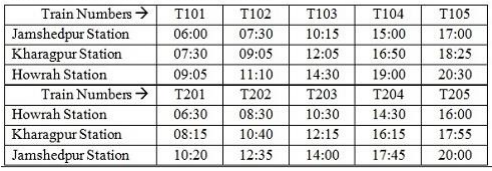
What will be the minimum time required to deliver a parcel at Kharagpur office from Jamshedpur station and come back to Jamshedpur station?
Let’s consider the case where the employee takes the T102 train.
(S)He leaves the Jamshedpur station at 7:30 and arrives at Kharagpur station at 9:05. It takes them 40+10+40 = 90mins to deliver the package and returns to the station at 10:35.
(S)He then takes the T202 train from the Kharagpur station and arrives at the Jamshedpur station at 12:35.
Thus, the total journey takes place between 7:30 and 12:35, i.e., 5 hours and 5 minutes.
Hence, option B is the answer.
An employee, starting from Howrah station, has to deliver one parcel at Kharagpur office and another parcel at Jamshedpur office. His task starts the moment he boards the train at Howrah station, and gets completed immediately after delivering the second parcel.
Which of the following trains should he board at Howrah station to minimize the time required to complete his task?
T201: Howrah station to Kharagpur station (6:30 - 8:15) --> Delivery (8:16 - 9:45) --> Kharagpur to Jamshedpur via T202 (10:40 - 12:35) --> Delivery (12:35 - 13:25). Thus, a total of 6hr 55mins.
T202: Howrah station to Kharagpur station (8:30 - 10:45) --> Delivery (10:46 - 12:10) --> Kharagpur to Jamshedpur via T203 (12:15 - 1400) --> Delivery (14:01 - 14:50). Thus, a total of 6hr 20mins.
T204: Howrah station to Kharagpur station (14:30 - 16:15) --> Delivery (16:16 - 17:45) --> Kharagpur to Jamshedpur via T205 (17:55 - 20:00) --> Delivery (20:01 - 20:50). Thus, a total of 6hr 20mins.
Thus, T202 and T204 require the least amount of time.
Hence, option E is the answer.
An employee, starting from Kharagpur station, has to deliver one parcel at Howrah office and another parcel at Jamshedpur office. His task starts the moment he boards the train at Kharagpur station, and gets completed immediately after delivering the second parcel.
Which of the following trains should he board at Kharagpur station to minimize the time required to complete the task?
Answer questions 42-43 on the basis of information given in the following situation.
Three persons, A, B and C, lived on an island hill. A lived on the top of the island hill, B occupied the middle portion of the hill and C occupied the bottom of the hill. The top of the hill received good rainfall, the main source of water in the hill, though this portion of the hill had few trees. The middle of the hill however was lush with trees offering timber. The bottom of the hill had a good amount of stones and sand. A, B and C assessed their wealth in terms of ownership of timber, water, stones and sand available in the island hill only. During heavy rains, stones and sand from the top and middle portion of the hill rolled over to the bottom. When the rains stopped, both A and B claimed that some stones rolled down from their lands to the land occupied by C. They wanted the stones back. But C argued that rolling down of stones is a natural process.
All three approached a wise man for the settlement of the ownership dispute.
Which of the following is the best option available for the wise man?
The dispute is regarding the ownership of stones. Neither option A nor C is a fair decision as not every stone is rolled down. Moreover, some of the stones rolled down form B's region also. Option B is irrelevant as there is no issue with ownership of water and neither there is a necessity to cause hardship to B. Rolling down of stones does not lead to transfer of ownership. Thus option D is the best among the given options.
Six months later, the three realized that the solution offered by the wise man in the previous question wasn't working to the satisfaction of all, because it did not help them find the appropriate value of resources. Therefore, they reverted to status quo ante. After one year, all three of them wanted to construct a house each, on their respective property. Three types of resources-1.Timber, 2.water and 3.stone & sand- were required to build a house. While each had one resource in abundance none of them had all the three in sufficient quantity. They still could not come to an agreement on how to fairly value and use each other's resources to construct the house. They again approached the wise man for advice.
The wise man studied the situation carefully and proposed the following actions:
1. The governing body of the United Federation of Islands, of which the island hill is a part, should take ownership of all the three properties and construct houses for the three.
2. Each person should own one third of each of the resources.
3. The three persons should arrive at the value of resources by trading the resources among them.
Which of the following is the most appropriate in the best interests of A, B and C?
Option C is the best option as they have to optimize the resources based on the individual demand.
Option A all the three lose control over the problems.
Option B again may not lead to sufficiency for construction of each of the house.
Answer questions 44-45 on the basis of information given in the following situation.
Ramesh, the owner of an auto-component manufacturing company in Sanand, had just returned after attending the funeral of his employee, Pankaj Kumar, who had died of cancer at the age of 35. Pankaj was a hardworking and sincere employee with impeccable performance record. Pankaj was the sole bread earner for his family with negligible savings and was survived by his wife and two school going children. His wife will get around 8 lakh rupees accrued to Pankaj as social security benefit.
A large number of employees wanted the organization to employ Pankaj’s wife on compassionate grounds so that she could support her family. Though Ramesh was sympathetic to the demand, he realized that this could set a precedence, where the organization will have to provide jobs for everyone with similar conditions in the future. In fact, only recently, Ramesh had refused a request for a job to the daughter of an employee, who had died a few months before he was to retire.
Ramesh formed a committee to look into this matter and the committee came up with the following suggestions:
1. Create a fund to take care of immediate family expenses.
2. Finance the school and college education of his children.
3. Sponsor the vocational education of his wife and subsequently help her find a job.
4. Purchase insurance for all the family members.
5. Request all employees of the organization to contribute towards the welfare of the family.
Which of the following options, from the above suggestions, will be the most sustainable for Pankaj's family?
Suggestion 5 cannot be a part of the correct solution as the employees themselves have requested the organisation for help.
Suggestion 4 is the matter concerning the private life of the employee family.
Suggestion 1 is to set up a precautionary fund covering expected expenditure for all such employees, which may be costly.
Ramesh, along with senior managers, was in the process of designing a policy to deal with such issues in the future.
Which of the following policy statements will be the least amenable to misuse in the future?
When all the stake holders are involved, there would be checks and balances and hence the scope of misuse is the least. Therefore, option E is the best choice here.
Madhuri Apte, a busy professional, rents out her studio apartment located in South Mumbai. Since she stays three hours away from the studio apartment, she uses a networked digital lock to monitor the property remotely. Each customer gets a temporary and unique access code for the digital lock that enables them to enter the studio apartment for the duration of stay. The apartment’s entrance door can also be opened with physical keys and Madhuri Apte has two such keys in her possession.
Madhuri Apte has employed a cleaner who has a permanent access code to enter the apartment for cleaning every day. She is available only between 15:00 hrs and 17:00 hrs.
Madhuri Apte’s apartment caters largely to international customers. A customer typically stays for 3 days, paying an average rent of $125 per day.
While Madhuri Apte's studio apartment gets good feedback on other aspects, many seem unhappy as they found the operation of the digital lock complicated.
Which of the following options is the best for Madhuri Apte in this context?
Switching to physical lock will be a retrograde step. Digital lock provides Madhuri with an option to monitor her apartment remotely and a physical lock will not allow her to do the same. Therefore, we can eliminate option A.
We can eliminate option B too since it suffers from the same flaw as option A.
It has been given that the cleaner will be available only for a limited period every day. Therefore, the cleaner cannot be asked to explain the working of digital lock and hence, we can eliminate option C as well.
Madhuri cannot afford to be indifferent. Doing so will result in unsatisfied customers. Therefore, we can eliminate option D as well.
Option E states that Madhuri should educate her customers using a video on how to operate the digital lock. Releasing such a tutorial will ensure that the grievance of the customers get redressed. Also, Madhuri can continue using the digital lock as well. Therefore, option E is the right answer.
Madhuri's apartment received good feedback from the guests, except with respect to the operation of the digital lock. She decided to leave a spare physical key in the house for her guests. Recently some of the guests had forgotten to leave the key behind during checkout. Making a spare key will cost $500 and will take about 10 days to arrive. She was confused if she should continue leaving the spare key and was looking for a way out.
Which of the following would be the best way out for her?
Option A is limiting the choices, not the best solution in this case.
Option B is incorrect as it increases operational effort for Madhuri.
Option C is ruled out as cleaner cannot stay whenever guests leave the apartment.
Option D is not an effective solution as customers may still not leave their keys behind despite the polite reminders given to the customers.
Option E addresses the concerns that customers don't leave the keys behind, as well gave an option to recover a portion of the cost, if such incidents still occur.
Option E is correct.
Find the value of the expression: $$10 + 10^3 + 10^6 + 10^9$$
$$10 + 10^3 + 10^6 + 10^9 = 10 + 1000 + 1000000 + 1000000000$$
=$$1001001010$$
Therefore, option D is the right answer.
Abdul, Bimal, Charlie and Dilbar can finish a task in 10, 12, 15 and 18 days respectively. They can either choose to work or remain absent on a particular day. If 50 percent of the total work gets completed after 3 days, then, which of the following options is possible?
Let us assume the amount of work to be finished = LCM of {10, 12, 15, 18} = 180 units.
The amount of work which Abdul can complete in a day = $$\dfrac{180}{10}$$ = 18 units.
The amount of work which Bimal can complete in a day = $$\dfrac{180}{12}$$ = 15 units.
The amount of work which Charlie can complete in a day = $$\dfrac{180}{15}$$ = 12 units.
The amount of work which Dilbar can complete in a day = $$\dfrac{180}{18}$$ = 10 units.
It is given that 50 percent of the total work gets completed after 3 days. Therefore, we can say that 90 units of work was completed in 3 days.
Let us check options.
Option A: Each of them worked for exactly 2 days.
In this case amount of work completed = 2*(10+15+12+18) = 110 units.
Option B: Bimal and Dilbar worked for 1 day each, Charlie worked for 2 days and Abdul worked for all 3 days.
In this case amount of work completed = 1*(10+15)+2*(12)+3*(18) = 103 units.
Option C: Abdul and Charlie worked for 2 days each, Dilbar worked for 1 day and Bimal worked for all 3 days.
In this case amount of work completed = 1*(10)+3*(15)+2*(18+12) = 115 units.
Option D: Abdul and Dilbar worked for 2 days each, Charlie worked for 1 day and Bimal worked for all 3 days.
In this case amount of work completed = 1*(12)+3*(15)+2*(18+10) = 113 units.
Option E: Abdul and Charlie worked for 1 day each, Bimal worked for 2 days and Dilbar worked for all 3 days.
In this case amount of work completed = 1*(18+12)+2*(15)+3*(10) = 90 units.
Therefore, we can say that option E is the correct answer.
If the diagonals of a rhombus of side 15 cm are in the ratio 3:4, find the area of the rhombus.
It is given that the length of the diagonals are in 3:4. Let '3x', and '4x' be the lengths of semi-diagonals as shown in the figure. We know that diagonals of a rhombus intersect each other perpendicularly.
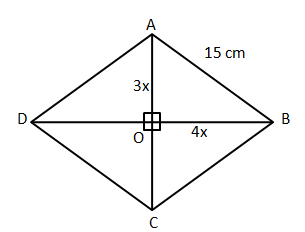
In right angle triangle AOB,
$$AB^2=AO^2+BO^2$$
$$\Rightarrow$$ $$AB= \sqrt{AO^2+BO^2}$$
$$\Rightarrow$$ $$AB= \sqrt{(3x)^2+(4x)^2}$$
$$\Rightarrow$$ $$15= 5x$$
$$\Rightarrow$$ $$x= 3$$cm.
Therefore, we can say that the length of diagonals = 6x and 8x or 18 and 24 cm.
Hence, the area of the rhombus = $$\dfrac{1}{2}*18*24$$ = 216 cm$$^2$$. Therefore, option E is the correct answer.
The price of a product is P. A shopkeeper raises its price by X% and then offers a discount of Y% on the raised price. The discounted price again becomes P. If Y is the difference between X and Y, then find X.
Let the cost price of the article be Rs.100.
The shopkeeper raises the price by x% and then decreases it by y%.
As a result, he reaches the cost price of the article.
Also, it has been given that y is the difference between y% and x%.
$$y = x-y$$
$$2y = x$$
We know that $$(1+2y)(1-y)*100 = 100$$
$$(1+2y)(1-y) = 1$$
$$1-y+2y-2y^2 = 1$$
$$2y^2-y=0$$
$$2y = 1$$
$$y = 1/2$$ or $$0.5$$
$$x = 2y$$
=> $$x = 1$$ or $$x = 100$$%
Therefore, option D is the right answer.
A mixture comprises water and liquids A and B. The volume of water is 1/3rd of the total mixture and the volume of liquids A and B are in the ratio 5:3. To remove the water, the mixture is passed through a porous medium which completely absorbs the water and partially absorbs liquid A. Altogether this porous medium absorbs 200 ml of the initial mixture. If the ratio of volume of liquids A and B in the residual concentrated mixture becomes 7:9 then find the volume of water absorbed by the porous medium.
Liquids A and B are in the ratio 5:3. The volume of water is one-third the total mixture.
Let us assume the volume of the total mixture to be 24x.
Volume of liquid A = 10x
Volume of liquid B = 6x
Volume of water = 8x
The mixture is passed through some medium that absorbs water completely and some quantity of liquid A.
Water absorbed = 8x
Let the amount of liquid A absorbed be y.
8x+y = 200
=> y = 200-8x -----(1)
It has been given that (10x-y)/6x = 7/9
Substituting (1), we get,
(10x-200+8x)/6x = 7/9
(18x-200)/6x = 7/9
162x-1800=42x
120x = 1800
=> x = 1800/120
Amount of water absorbed = 8*1800/120 = 120 ml.
Therefore, option E is the right answer.
A coin of radius 3 cm is randomly dropped on a square floor full of square shaped tiles of side 10 cm each. What is the probability that the coin will land completely within a tile? In other words, the coin should not cross the edge of any tile.
The radius of the coin is 3 cm.
So, if the coin should not cross the edge, the centre of the coin should at least be 3 cm away from the edge of the tile.

In the given diagram the center of the circle should lie in the blue region. As we can see, the area in which the centre of the coin can fall is a square of side 10-3-3 = 4 cm.
Therefore, the area in which the centre of the coin can fall is 16 square cm.
Area of the tile = 100 square cm.
Required probability = 16/100 = 0.16.
Therefore, option E is the right answer.
It takes 2 liters to paint the surface of a solid sphere. If this solid sphere is sliced into 4 identical pieces, how many liters will be required to paint all the surfaces of these 4 pieces.
2 litres are required to paint the surface of a solid sphere.
Surface area of the solid sphere = $$4\pi*r^2$$
Now, the solid sphere is cut into 4 identical parts. This is possible only when the sphere is cut into 4 quarter spheres.
After making the first cut, 2 hemispheres will be formed. 2 circles of area $$\pi*r^2$$ will get exposed in addition to the surface area of the sphere (the base surface of the bottom hemisphere and the base of the top hemisphere).
Now, another perpendicular cut will be made along the diameter of the sphere. 2 additional surfaces will get exposed again (one on left hemisphere and the another on the right hemisphere).
Area exposed after making 4 identical pieces = $$4*\pi*r^2$$ + $$2*\pi*r^2$$ + $$2*\pi*r^2$$
= $$8*\pi*r^2$$
2 litres of paint is required to paint an area of $$4\pi*r^2$$
=> 4 litres of paint will be required to paint an area of $$8*\pi*r^2$$.
Therefore, option D is the right answer.
Every day a person walks at a constant speed, $$V_1$$ for 30 minutes. On a particular day, after walking for 10 minutes at $$V_1$$, he rested for 5 minutes. He finished the remaining distance of his regular walk at a constant speed, $$V_2$$, in another 30 minutes. On that day, find the ratio of $$V_2$$ and his average speed (i.e., total distance covered /total time taken including resting time).
The man walks with a speed of V1 for 30 minutes.
=> Distance covered = 30*V1.
On a particular day, he walks for 10 minutes at V1, takes a rest of 5 minutes, and then covers the distance by walking at V2 for 30 minutes.
=> 10*V1 + 30*V2 = 30*V1
20*V1 = 30*V2
V1 = 1.5V2---------(1)
=> Total distance = 30*1.5*V2 = 45V2.
Now, we know that the person took 10 + 5 + 30 = 45 minutes to cover the entire distance.
=> Average speed = 45V2/45 = V2.
Ratio of V2 and the average speed = 1:1.
Therefore, option A is the right answer.
A boat, stationed at the North of a lighthouse, is making an angle of 30° with the top of the lighthouse. Simultaneously, another boat, stationed at the East of the same lighthouse, is making an angle of 45° with the top of the lighthouse. What will be the shortest distance between these two boats? The height of the lighthouse is 300 feet. Assume both the boats are of negligible dimensions.
One boat is stationed to the North of the light house and the other boat is stationed to the East of the light house.

The boat stationed to the East subtends an angle of 45 degrees and the boat stationed to the North subtends an angle of 30 degrees.
Now, distance between the boat stationed to the East and the light house,d1 = tan 45
$$300/d1 = 1$$
=> $$d1 = 300$$ feet
Distance between the boat stationed to the North and the light house,d2 = tan 30
$$300/d2 = 1/\sqrt{3}$$
=> $$d2=300\sqrt{3}$$
Shortest distance between the 2 boats = $$\sqrt{300^2+(300\sqrt{3})^2}$$
= $$300*\sqrt{4}$$
= $$600$$ feet.
Therefore, option C is the right answer.
Two different quadratic equations have a common root. Let the three unique roots of the two equations be A, B and C - all of them are positive integers. If (A + B + C) = 41 and the product of the roots of one of the equations is 35, which of the following options is definitely correct?
It has been given that A+B+C = 41.
Let the common root be B.
All the roots are positive integers.
The product of the roots of one of the equations is 35.
35 can be obtained only in 2 ways - either as 5*7 or 35*1.
A+B+C = 41.
If A and B are 5 and 7 in any order, then C = 41 - 5 - 7 = 29.
If A and B are 35 and 1 in any order, then C = 41 - 35 - 1 = 5.
As we can see, in either case, 5 is one of the 3 roots.
Therefore, option C is the right answer.
An antique store has a collection of eight clocks. At a particular moment, the displayed times on seven of the eight clocks were as follows: 1:55 pm, 2:03 pm, 2:11 pm, 2:24 pm, 2:45 pm, 3:19 pm and 4:14 pm. If the displayed times of all eight clocks form a mathematical series, then what was the displayed time on the remaining clock?
Let us find out the difference between the times given to figure out the pattern.
The times given are 1:55 pm, 2:03 pm, 2:11 pm, 2:24 pm, 2:45 pm, 3:19 pm and 4:14 pm.
The difference between 2 consecutive times given are 8 minutes, 8 minutes, 13 minutes, 21 minutes, 34 minutes, and 55 minutes.
We can observe that the difference between the times are in the Fibonacci series.
8 + 13 = 21
21 + 13 = 34
34 + 21 = 55
The Fibonacci series is as follows:
1,1,2,3,5,8,13,21,34,55.
But the first difference in the times given is 8.
Therefore, the missing time must be such that it divides the interval of 8 minutes into 3 minutes and 5 minutes.
The missing time should be 1:58 pm and hence, option B is the right answer.
The number of boys in a school was 30 more than the number of girls. Subsequently, a few more girls joined the same school. Consequently, the ratio of boys and girls became 3:5. Find the minimum number of girls, who joined subsequently.
Assume that there was at least one girl at the start.
Let the number of girls in the school be G.
=> Number of boys = G+30.
Some girls joined the class and the number of boys and girls became 3:5.
Let the number of girls who joined the class be 'X'.
It has been given that (G+30)/(G+X) = 3/5
5G + 150 = 3G + 3X
2G + 150 = 3X
=> X = (2G/3) + 50.
2G has to be divisible by 3.
Therefore, the least value that G can take is 3.
When G = 3, X = 2 + 50
X = 52.
The least number of girls who could have joined is 52.
Therefore, option E is the right answer.
A girl travels along a straight line, from point A to B at a constant speed, $$V_1$$ meters/sec for T seconds. Next, she travels from point B to C along a straight line, at a constant speed of $$V_2$$ meters/sec for another T seconds. BC makes an angle 105° with AB. If CA makes an angle 30° with BC, how much time will she take to travel back from point C to A at a constant speed of $$V_2$$ meters/sec, if she travels along a straight line from C to A?
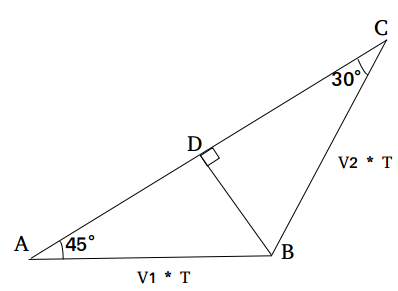
We draw BD perpendiculat to AC.
In right angled triangle BDC, BD / BC = sin 30°
or, BD = (V2 * T)/2 ......(i)
In right angled triangle BDA, BD / BA = sin 45°
Or, BD = (V1 * T)/$$\sqrt{2}$$ ......(ii)
From (i) and (ii), we get
V2 / V1 = $$\sqrt{2}$$
Total distance to be travelled from C to A = CD + DA = $$\sqrt{3}$$BD + BD
= BD($$1 + \sqrt{3}$$)
Replacing BD = (V2 * T)/2 in the avove equation,
CA = $$\dfrac{\text{(V2 * T)}}{2} (1 + \sqrt{3}$$)
Time taken at speed V2 = $$0.5(\sqrt{3}+1)$$T
Hence, option C is the correct answer.
In the final semester, an engineering college offers three elective courses and one mandatory course. A student has to register for exactly three courses: two electives and the mandatory course. The registration in three of the four courses is: 45, 55 and 70. What will be the number of students in the elective with the lowest registration?
The number of candidates registered for 3 of the 4 courses is 45, 55, and 70.
There are 2 cases.
70 can be the total number of students registered in an elective or the mandatory course.
Case (i):
70 students have registered in an elective.
Each student will choose 2 electives.
=> Total number of electives chosen = 2* total number of students.
45+55+70 = 2*number of students.
Number of students = 170/2 = 85.
In this case, the number of students in the elective with the lowest registration=45
Case (ii):
70 students have registered in the mandatory class.
=> 45+55+x = 2*70
=> x =40.
In this case, the number of students in the elective with the lowest registration is 40
As we can see, the number of students in the elective with the lowest registration can be 40 or 45.
Therefore, option E is the right answer.
X and Y are the digits at the unit's place of the numbers (408X) and (789Y) where X ≠ Y. However, the digits at the unit's place of the numbers $$(408X)^{63}$$ and $$(789Y)^{85}$$ are the same. What will be the possible value(s) of (X + Y)?
All numbers from 1 to 9 repeat their last digits over a cycle of 4.
63 can be written as 4k+3.
85 can be written as 4k+1.
Some number's third power should yield the first digit as some number's first power.
$$2^3$$ will yield $$8$$ as the last digit (2 and 8 is a possible solution).X+Y = 10
$$3^3$$ will yield $$7$$ as the last digit (3 and 7 is a possible solution).X + Y = 10
$$4^3$$ will yield $$4$$ as the last digit and hence, can be eliminated.
$$5$$ and $$6$$ yield $$5$$ and $$6$$ respectively as the last digit for any power and hence, can be eliminated.
$$7^3$$ will yield $$3$$ as the last digit (7 and 3 is a possible solution). X+Y=10.
$$8^3$$ will yield $$2$$ as the last digit. 8+2 =10.
As we can see, X+Y = 10 in all the cases. Therefore, option B is the right answer.
If $$2 \leq |x - 1| \times |y + 3| \leq 5$$ and both $$x$$ and $$y$$ are negative integers, find the number of possible combinations of $$x$$ and $$y$$.
2 ≤ |x - 1| × |y + 3| ≤ 5
The product of two positive number lies between 2 and 5.
As x is a negative integer, the minimum value of |x - 1| will be 2 and the maximum value of |x - 1| will be 5 as per the question.
When, |x - 1| = 2, |y + 3| can be either 1 or 2
So, for x = -1, y can be - 4 or - 2 or - 5 or -1.
Thus, we get 4 pairs of (x, y)
When |x - 1| = 3, |y + 3| can be 1 only
So, for x = - 2, y can be -4 or -2
Thus, we get 2 pairs of the values of (x, y)
When |x - 1| = 4, |y + 3| can be 1 only
So, for x = - 3, y can be -4 or -2
Thus, we get 2 pairs of the values of (x, y)
When |x - 1| = 5, |y + 3| can be 1 only
So, for x = - 4, y can be -4 or -2
Thus, we get 2 pairs of the values of (x, y)
Therefore, we get a total of 10 pairs of the values of (x, y)
Hence, option E is the correct answer.
David has an interesting habit of spending money. He spends exactly £X on the Xth day of a month. For example, he spends exactly £5 on the 5th of any month. On a few days in a year, David noticed that his cumulative spending during the last 'four consecutive days' can be expressed as $$2^N$$ where N is a natural number. What can be the possible value(s) of N?
The sum of 4 consecutive numbers should be a power of 2.
The powers of 2 are 1, 2, 4, 8, 16, 32, 64, 128. The maximum possible value that 4 consecutive days can take is 28 + 29 + 30 + 31 = 118.
We can eliminate 1, 2, 4, and 8 since sum of 4 consecutive integers is always greater than 9.
Let the first day be x.
x+x+1+x+2+x+3 = 16
=> 4x = 10
x = 2.5
We can eliminate 16.
Let us check for 32.
x+x+1+x+2+x+3 = 32
4x = 26.
x is not an integer.
Let us check the case in which x is the last day of the month.
Even in the month of February, the least value that x can take is 28.
28+1+2+3 = 34 > 32.
We can eliminate 32 as well.
Let us check for 64.
4x+6 = 64
4x = 58
The sum of no 4 consecutive days in the same month can be expressed as 4k+6.
Let us check the cases in which 2 months are involved.
29+30+1+2 = 62 < 64.
30 + 31 + 1 + 2 = 64. This is a possible combination.
There are 7 months with 31 days in a year. We have to eliminate December since 1 will spill over to the 1st of January of the next year.
Therefore, in a year, there will be 6 such instances. Therefore, option B is the right answer.
A cone of radius 4 cm with a slant height of 12 cm was sliced horizontally, resulting into a smaller cone (upper portion) and a frustum (lower portion). If the ratio of the curved surface area of the upper smaller cone and the lower frustum is 1:2, what will be the slant height of the frustum?
The ratio of the curved surface area of the upper cone to the lower frustum is 1:2.
=> the ratio of the curved surface area of the upper cone to the total cone = 1:3.
Curved surface area (CSA) of a cone = $$\pi*r*l$$
For the given cone, the slant height, $$l=12$$cm
CSA of the cone = $$48*\pi$$
CSA of the smaller cone = $$16*\pi$$
Both the slant height and the radius would have been reduced by the same ratio. Let that ratio be $$x$$.
$$x^2*48*\pi$$=$$16\pi$$
=>$$x^2=\frac{1}{3}$$
$$x=\frac{1}{\sqrt{3}}$$
Slant height of the smaller cone = $$\frac{12}{\sqrt{3}}$$
Slant height of the frustum = $$12-\frac{12}{\sqrt{3}}$$
= $$12*\frac{\sqrt{3}-1}{\sqrt{3}}$$
=$$12*\frac{(3-\sqrt{3})}{3}$$
=$$12-4\sqrt{3}$$
Therefore, option D is the right answer.
Two circles with radius 2R and R$$\sqrt{2}$$ intersect each other at points A and B. The centers of both the circles are on the same side of AB. O is the center of the bigger circle and ∠AOB is 60°. Find the area of the common region between two circles.
Let us draw the diagram according to the given info,
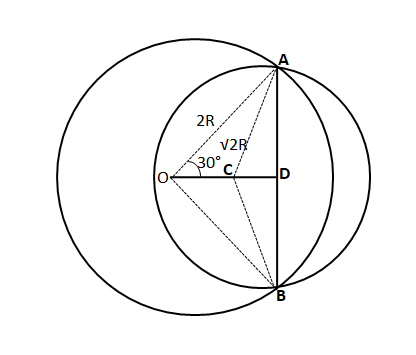
We can see that AD = AO*cos60° = 2R*$$\dfrac{1}{2}$$ = R
In triangle, ACD
$$\Rightarrow$$ $$sinACD=\dfrac{AC}{AC}$$
$$\Rightarrow$$ $$sinACD=\dfrac{R}{\sqrt{2}*R}$$ = $$\dfrac{1}{\sqrt{2}}$$
$$\Rightarrow$$ $$\angle$$ ACD = 45°
By symmetry we can say that $$\angle$$ BCD = 45°
Therefore we can say that $$\angle$$ ACB = 90°
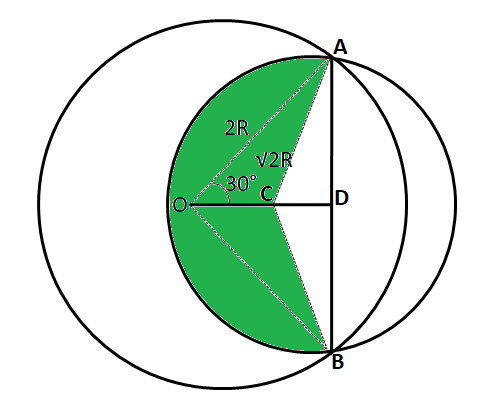
Hence, the area colored by green color = $$\dfrac{270°}{360°}*\pi*(\sqrt{2}R)^2$$ = $$\dfrac{3}{2}*\pi*R^2$$ ... (1)
Area of triangle ACB = $$\dfrac{1}{2}*R*2R$$ = $$R^2$$ ... (2)
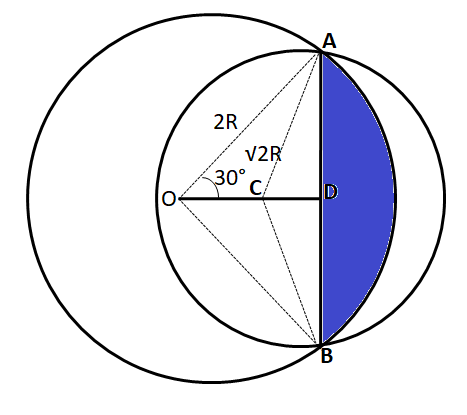
Area shown in blue color = $$\dfrac{60°}{360°}*\pi*(2R)^2-\dfrac{\sqrt{3}}{4}*(2R)^2$$ = $$\dfrac{2}{3}*\pi*R^2-\sqrt{3}*R^2$$ ... (3)
By adding (1) + (2) + (3)
Therefore, the area of the common region between two circles = $$\dfrac{3}{2}*\pi*R^2$$ + $$R^2$$ + $$\dfrac{2}{3}*\pi*R^2-\sqrt{3}*R^2$$
$$\Rightarrow$$ $$(\dfrac{13\pi}{6}+1-\sqrt{3})R^2$$
Hence, option C is the correct answer.
These statements provide data that may help answer the respective questions. Read the questions and the statements and determine if the data provided by the statements is sufficient or insufficient, on their own or together, to answer the questions. Accordingly, choose the appropriate option given below the questions.
A group of six friends noticed that the sum of their ages is the square of a prime number. What is the average age of the group?
Statement I: All members are between 50 and 85 years of age.
Statement II: The standard deviation of their ages is 4.6.
Sum of the ages of the 6 friends is the square of a prime number.
Statement I states that all the members were aged between 50 and 85 years. There are 6 friends in total. Therefore, the sum of the ages can vary from 6*50 to 6*85.
Sum of the ages of the 6 persons should lie between 300 and 510.
361 is the only square of a prime number (19) in the given range. Therefore, statement I alone is sufficient to answer the question.
Statement II states that the standard deviation of their ages is 4.6. SD gives us how much the values deviate from the mean. We cannot obtain the mean using the SD. Therefore, statement II alone is insufficient to answer the question without knowing the values in the data set.
Therefore, option A is the right answer.
These statements provide data that may help answer the respective questions. Read the questions and the statements and determine if the data provided by the statements is sufficient or insufficient, on their own or together, to answer the questions. Accordingly, choose the appropriate option given below the questions.
Harry and Sunny have randomly picked 5 cards each from a pack of 10 cards, numbered from 1 to 10. Who has randomly picked the card with number 2 written on it?
Statement I: Sum of the numbers on the cards picked by Harry is 5 more than that of Sunny.
Statement II: One has exactly four even numbered cards while the other has exactly four odd numbered cards.
Harry and Sunny have cards numbered from 1 to 10.
Sum of the number of cards picked by them = 1+2+3+...+10 = 55.
Sum of the numbers on the cards picked by Harry is 5 more than that of Sunny.
Let x be the sum of the numbers picked by Sunny.
x+x+5 = 55
x = 25
25 can be written as 10+9+1+2+3 or 9+7+5+1+3 etc. (There are many such combinations). We cannot determine the person who has card number 2.
Statement I alone is insufficient.
Statement II states that one of the 2 persons has exactly 4 even-numbered cards.
The person with 4 even-numbered cards might or might not contain card number 2. Therefore, statement II alone is insufficient.
Combining both the statements, we know that the sum of the numbers on the cards with Harry is 5 more than the sum of the number on the cards with Sunny. Therefore, the sum of the number of cards with Sunny should be 25 and Harry should be 30.
Sum of the 5 even numbers = 2+4+6+8+10 = 30.
Sum of the 5 odd numbers = 1+3+5+7+9 = 25.
By replacing one of the odd numbers with even numbers, we have to make the sums 30 and 25. We cannot replace an odd number with an even number and still get the sum as 25. Therefore, the set with 4 odd numbers must add up to 30 and the set with 4 even numbers must add up to 25. We can interchange 1 with 6 or 3 with 8 or 5 with 10. The card with number 2 will always remain with the person with 4 even cards. The card with number 25 will always remain with Sunny. Therefore, we can determine the answer using both the statements together and hence, option D is the right answer.
Six teams are playing in a hockey tournament where each team is playing against every other team exactly once. At an intermediate stage, the status is as follows:
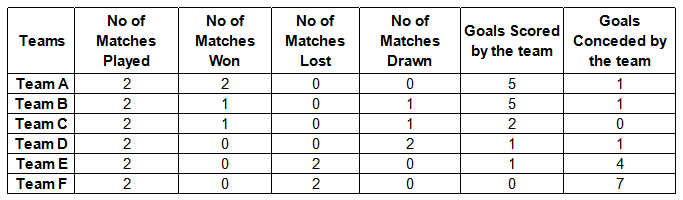
Notes:
• The team that scores more goals than it concedes wins the match, while if both the teams score the same no. of goals, the match is declared drawn.
• Ina match played between Team X and Team Y, if team X scores 1 and concedes none. then the score line would read: Team X — Team Y (1-0)
Which of the following matches are yet to be played?
Team A has won both its matches and scored 5 goals while conceding 1. Thus, the possible scorelines for team A are (4-1) & (1-0), (3-1) & (2-0), (2-1) & (3-0).
Similarly, the possible outcomes for others teams are as follows:
B: (5-1) & (0-0) and (4-0) & (1-1)
C: (2-0) & (0-0) and (1-0) & (1-1)
D: (0-0) & (1-1)
E: (0-2) & (1-2) and (0-1) & (1-3)
F: (0-1) & (0-6), (0-2) & (0-5) and so on.
By carefully observing the above scorelines, the following table can be obtained.
.png)
Thus, the matches Team A - Team B and Team E - Team F are yet to take place.
Hence, option E is the answer.
Which of the following score line is a possible outcome in the tournament?
Team A has won both its matches and scored 5 goals while conceding 1. Thus, the possible scorelines for team A are (4-1) & (1-0), (3-1) & (2-0), (2-1) & (3-0).
Similarly, the possible outcomes for others teams are as follows:
B: (5-1) & (0-0) and (4-0) & (1-1)
C: (2-0) & (0-0) and (1-0) & (1-1)
D: (0-0) & (1-1)
E: (0-2) & (1-2) and (0-1) & (1-3)
F: (0-1) & (0-6), (0-2) & (0-5) and so on.
By carefully observing the above scorelines, the following table can be obtained.
_BPtiWT6.png)
The above table shows that Team A - Team E match has the score-line (2 - 1).
Hence, option B is the answer.
Which of the following score line is not a possible outcome in the tournament?
Team A has won both its matches and scored 5 goals while conceding 1. Thus, the possible scorelines for team A are (4-1) & (1-0), (3-1) & (2-0), (2-1) & (3-0).
Similarly, the possible outcomes for others teams are as follows:
B: (5-1) & (0-0) and (4-0) & (1-1)
C: (2-0) & (0-0) and (1-0) & (1-1)
D: (0-0) & (1-1)
E: (0-2) & (1-2) and (0-1) & (1-3)
F: (0-1) & (0-6), (0-2) & (0-5) and so on.
By carefully observing the above scorelines, the following table can be obtained.
_qArrNUq.png)
From the above table, we can see that options B, C and D are possible and option A is not.
Hence, option A is the answer.
The graph below represent the performance of four professors, across years. measured on four variables: Percentage of time spent on research, teaching, feedback on (a scale of 10. right-hand side) and number of publications (right-hand side). Assume that the cumulative time spent per year on research and teaching activities are same for all four professors and each of them taught only one course of 90 classroom hours.
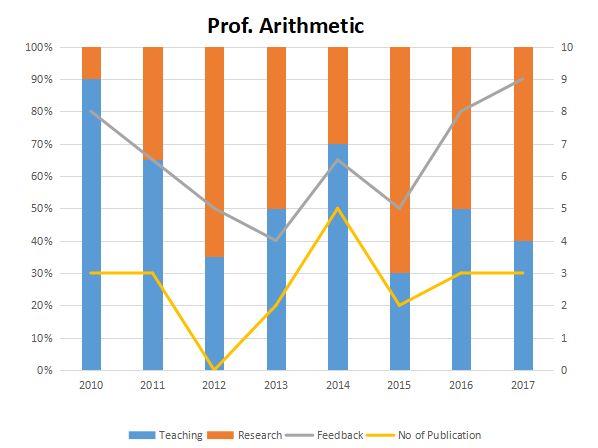
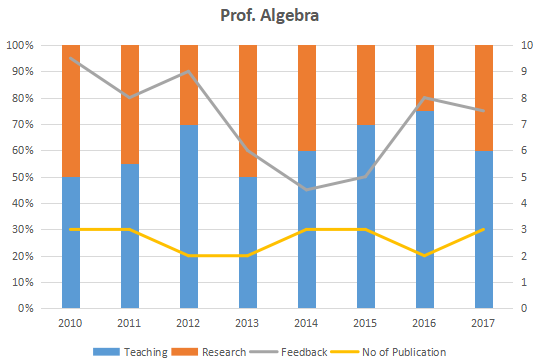
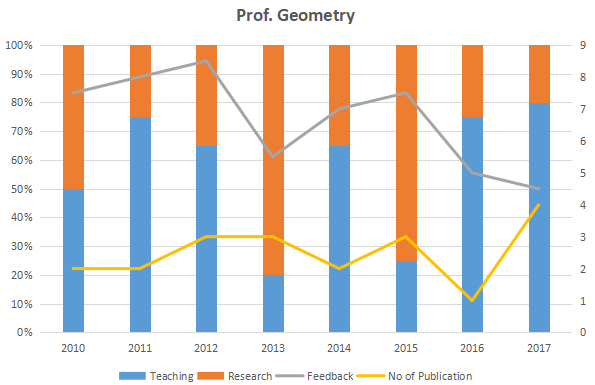
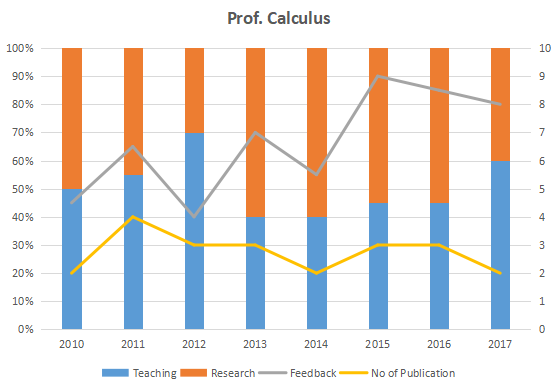
Which of the following, shows the maximum year to year percentage growth in feedback?
Let the required percentage be P.
Option A: PA = (6.5 - 4) * 100/ 4 = 62.5%
Option B: PB = (8 - 5) * 100/ 5 = 60%
Option C: PC = (7 - 4) * 100/ 4 = 75%
Option D: PD = (9 - 5.5) * 100/ 5.5 = 63.63%
Thus, option C shows the maximum year-on-year growth and is the answer.
Count the number of instances in which "annual decreasing efforts in research" is accompanied with "annual increase in feedback"?
Prof. Arithmetic: There are two such instances, during 2013-14 and 2015-16
Prof. Algebra: There are three such instances, during 2011-12, 2014-15 and 2015-16
Prof. Geometry: There are two such instances, during 2010-11 and 2013-14
Prof. Calculus: There are two such instances, during 2010-11 and 2014-15
Thus, there are 2+3+2+2 = 9 such instances.
Hence, option C is the answer.
Research efficiency is the ratio of cumulative number of publication for a period of 3 years to the cumulative number of hours spent on research activity in those 3 years. Which of the following professors is the least efficient researcher for the period 2015 to 2017?
Research efficiency = (total number of publications)/(total time spent in research)
Prof. Arithmetic: RE = (8) / [90*(0.7 + 0.5 + 0.6)] = 8 / (18 * 9)
Prof. Algebra: RE = (8) / [90*(0.3 + 0.4 + 0.25)] = 8 / (9.5 * 9)
Prof. Geometry: RE = (8) / [90*(0.75 + 0.25 + 2)] = 8 / (12 * 9)
Prof. Calculus: RE = (8) / [90*(0.55 + 0.55 + 0.4)] = 8 / (15 * 9)
Thus, we can observe that Prof. Arithmetic has the lowest efficiency.
Hence, option A is the answer.
Which of the following is not a Cryptocurrency?
Who won the Nobel Prize for Economics in 2017?
What is Showrooming?
Showrooming is the process in which an individual visits a showroom to know how a product looks and feels before buying it online at a discount. Therefore, option B is the right answer.
Which of these have not been included in Government of India Act, 1935?
What is Article 35 a: of Indian Constitution?
Which of the following is not a landlocked country?
Which of the following options is the correct list of core industries as defined by IIP?
IIP (Index of Industrial Production) defined 8 core industries in India. They are
1.Coal
2. Crude oil
3. Natural gas
4. Refinery products
5. Fertilizers
6. Steel
7. Cement
8. Electricity
Therefore, option B is the right answer.
Match the surnames of head of states (former or current) to the countries.
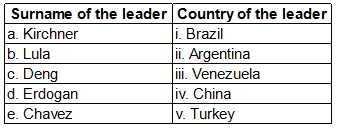
Cristina Elisabet Fernández de Kirchner was the former President of Argentina.
Luiz Inácio Lula da Silva was the former President of Brazil.
Deng Xiaoping is the former President of China.
Recep Tayyip Erdogan is the President of Turkey.
Hugo Chavez is the former President of Venezuela.
Therefore, option B is the right answer.
Match the following Indus Valley sites to the states:
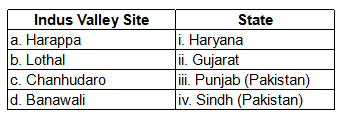
Harappa is located in the Punjab province of Pakistan.
Lothal is located in Gujarat in India.
Chanhudaro is located in the Sindh province of Pakistan.
Banawali is located in Haryana.
Therefore, option A is the right answer.
Which of the following Indian business houses (conglomerate) started its operation with companies like Philips Carbon Black, Asian Cables, Agarpara Jute and Murphy(India)?
The RPG group was founded by R.P.Goenka. The group initially started with companies such as Philips Carbon Black, Asian Cables, Agarpara Jute and Murphy. Therefore, option C is the right answer.
Which of the following spacecrafts, in 2017, plunged into the planet it was exploring?
The Time magazine’s person of the year 2017 is:
Which of the following is NOT one of the World Heritage Sites?
Match the Music festivals to their states:
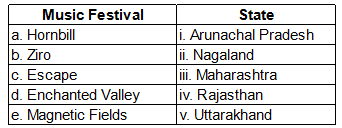
Hornbill is the music festival held in Nagaland.
Ziro is the name of the town in the Arunachal pradesh where the musical festival is held.
Escape is the musical festival held in Uttarakhand.
Enchanted Valley carnival is held in Aamby valley, Maharashtra.
Magnetic fields is the music festival held at Alsisar Mahal, Rajasthan.
Therefore, option C is the right answer.
If a company encourages its employees to use its own products to understand customers’ perception, then the company is engaging in:
Which of the following is not a video streaming service?
Which of the following is not a French overseas territory?
Match the rockets/missions to their space agencies:
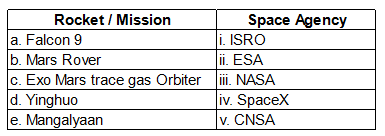
Falcon 9 is owned by Space X, the company founded by Elon Musk.
NASA owns the Mars rover mission.
Exo Mars Trace Gas orbiter is a project of the European Space Agency (ESA).
Yinghuo-I is the Chinese Mars exploration probe developed by China National Space Administration (CNSA).
Mangalyaan is the Mars Orbiter Mission developed by ISRO, India.
Therefore, option C is the right answer.
Who is the independent athlete to win a gold medal at 2016 Summer Olympics?
Fehaid Al-Deehani is from Kuwait. Al-Deehani had won the bronze medal twice for Kuwait in Men's double trap shooting in 2000 and 2012. Kuwait was banned from Olympics in 2016 and hence, Al-Deehani participated as an independent athlete and won gold in the event. Therefore, option B is the right answer.
Which of the following mobile manufacturing companies DOES NOT have its headquarters in China?
Name the only Indian (or from Indian origin) to win Abel Prize?
What is a Hundi?
Windhoek, Suva and Ulaanbaatar are the capital cities of:
Which of the following is the most recent club to join ISL?
Match the brands with the companies:
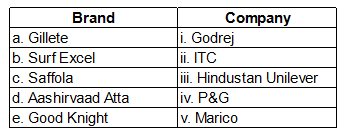
Gillete is a subsidiary of Procter and Gamble (P&G).
Surf Excel is a brand owned by Hindustan Unilever.
Saffola oil is owned by Marico India.
Aashirvaad atta is owned by ITC.
Good Knight is owned by Godrej.
Therefore, option B is the right answer.
Start your IIM journey with the right preparation and crack CAT 2026.

Educational materials for CAT preparation
 Share
Share