91- 6303239042
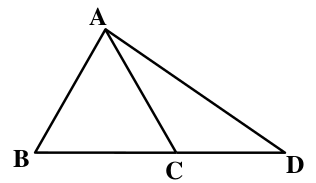
In the figure below, AB = AC = CD. If ADB = 20°, what is the value of BAD?
Sign in
Please select an account to continue using cracku.in
↓ →
In the figure below, AB = AC = CD. If ADB = 20°, what is the value of BAD?

AB = AC = CD, => $$\angle CAD = \angle CDA = 20^{\circ}$$
and $$\angle ABC = \angle ACB$$
In $$\triangle$$ ACD
=> $$\angle ACD + \angle CAD + \angle CDA = 180^{\circ}$$
=> $$\angle ACD = 180^{\circ} - 20^{\circ} - 20^{\circ} = 140^{\circ}$$
=> $$\angle ACB = 180^{\circ} - 140^{\circ} = 40^{\circ} = \angle ABC$$
Similarly, In $$\triangle$$ ABC
=> $$\angle BAC = 180^{\circ} - 40^{\circ} - 40^{\circ} = 100^{\circ}$$
$$\therefore \angle BAD = 100^{\circ} + 20^{\circ} = 120^{\circ}$$
In an amusement park, a visitor gets to ride on three different rides (A, B and C) for free. On a particular day 77 opted for ride A, 55 opted for B and 50 opted for C; 25 visitors opted for both A and C, 22 opted for both A and B, while no visitor opted for both B and C. 40 visitors did not opt for ride A and B, or both. How many visited the amusement park on that day?

From the figure, $$a + 22 + 25 = 77$$
=> $$a = 77 - 47 = 30$$
Similarly, $$c = 55 - 22 = 33$$
and $$b = 50 - 25 = 25$$
It is given that 40 visitors did not opt for ride A and B, or both
=> $$b + d = 40$$
=> $$d = 40 - 25 = 15$$
$$\therefore$$ Total number of people who visited with the entry pass on that day
= $$a + b + c + d + 22 + 25$$
= $$30 + 25 + 33 + 15 + 47 = 150$$
$$\triangle$$ABC and $$\triangle$$XYZ are equilateral triangles of 54 cm sides. All smaller triangles like $$\triangle$$ANM, $$\triangle$$OCP, $$\triangle$$QPX etc. are also equilateral triangles. Find the area of the shape MNOPQRM.
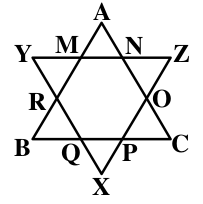
AB = 54 cm and $$\triangle$$ANM , $$\triangle$$OCP , $$\triangle$$OPX are equilateral triangles.
=> MN = MR = NO = OP = PQ = QR = $$\frac{54}{3} = 18$$ cm
Thus, MNOPQRM is a regular hexagon with side 18 cm
$$\therefore$$ Area of MNOPQRM = $$\frac{3 \sqrt{3}}{2} (side)^2$$
= $$\frac{3 \sqrt{3}}{2} \times 18^2 = 486 \sqrt{3} cm^2$$
Akhtar plans to cover a rectangular floor of dimensions 9.5 meters and 11.5 meters using tiles. Two types of square shaped tiles are available in the market. A tile with side 1 meter costs Rs. 100 and a tile with side 0.5 meters costs Rs. 30. The tiles can be cut if required. What will be the minimum cost of covering the entire floor with tiles?
Area of rectangular floor = $$9.5 \times 11.5$$
= $$109.25 m^2$$
Now, cost of covering $$109 m^2$$ (with 1x1 tiles) = $$109 \times 100$$ = Rs. 10,900
Cost of covering $$0.25 m^2$$ (with 0.5 m square tile) = Rs. 30
$$\therefore$$ Total cost = $$10,900 + 30 = Rs. 10,930$$
Anita, Biplove, Cheryl, Danish, Emily and Feroze compared their marks among themselves. Anita scored the highest marks, Biplove scored more than Danish. Cheryl scored more than at least two others and Emily had not scored the lowest.
Statement I: Exactly two members scored less than Cheryl.
Statement II: Emily and Feroze scored the same marks.
Which of the following statements would be sufficient to identify the one with the lowest marks?
Let A,B,C,D,E,F represents Anita, Biplove, Cheryl, Danish, Emily and Feroze respectively.
Statement I : It is not sufficient as nothing is mentioned about D and F.
Statement II : E = F, thus E and F cannot score the lowest.
Also, C scored higher than at least 2 and B scored more than D while A scored the highest.
The only person left with the lowest marks can be D.
Thus, statement II alone is sufficient.
Rani bought more apples than oranges. She sells apples at Rs. 23 apiece and makes 15% profit. She sells oranges at Rs. 10 a piece and makes 25% profit. If she gets Rs. 653 after selling all the apples and oranges, find her profit percentage.
Let number of apples = $$x$$ and oranges = $$y$$
=> $$23x + 10y = 653$$ $$(x > y)$$
Since, 653 has last digit 3, which is possible when 23 is multiplies by 1,11,21,31 and so on.
Also, $$x > y$$ => $$x = 21$$ and $$y = 17$$
=> C.P. of 1 apple = $$\frac{100}{115} \times 23 = 20$$
C.P. of 1 orange = $$\frac{100}{125} \times 10 = 8$$
=> Total C.P. = $$(21 \times 20) + (17 \times 8) = 420 + 136 = 556$$
$$\therefore$$ Profit % = $$\frac{653 - 556}{556} \times 100 = 17.4 \%$$
Consider the set of numbers {1, 3, $$3^{2}$$, $$3^{3}$$,…...,$$3^{100}$$}. The ratio of the last number and the sum of the remaining numbers is closest to:
Set : {$$1, 3, 3^{2}, 3^{3},…...,3^{100}$$}
Clearly, this set is a G.P. with common ratio, $$r = 3$$
Sum of G.P. = $$\frac{a (r^n - 1)}{r - 1}$$
Number of terms = 101
Last term = $$3^{100}$$
Sum of remaining terms = $$\frac{1 (3^{100} - 1)}{3 - 1}$$
= $$\frac{3^{100} - 1}{2}$$
$$\therefore$$ Required ratio = $$\frac{3^{100}}{\frac{3^{100} - 1}{2}}$$
= $$\frac{3^{100} \times 2}{3^{100} - 1}$$
$$\approx \frac{3^{100} \times 2}{3^{100}} = 2$$
f is a function for which f(1)= 1 and f(x) = 2x + f(x - 1) for each natural number x$$\geq$$2. Find f(31)
Expression : $$f(x) = 2x + f(x - 1)$$ and $$f(1) = 1$$
Putting, $$x = 2$$
=> $$f(2) = 2 \times 2 + f(1) = 4 + 1 = 5$$
and $$f(3) = 2 \times 3 + f(2) = 6 + 5 = 11$$
Similarly, $$f(4) = 2 \times 4 + f(3) = 8 + 11 = 19$$
The pattern followed is : $$f(n) = n^2 + (n - 1)$$
Now, $$n = 31$$
$$\therefore f(31) = 31^2 + (31 - 1) = 961 + 30 = 991$$
Two numbers in the base system B are 2061$$_{B}$$ and 601$$_{B}$$. The sum of these two numbers in decimal system is 432. Find the value of 1010$$_B$$ in decimal system.
Converting numbers in decimal system
=> $$2061_B = 2B^3 + 6B + 1$$
and $$601_B = 6B^2 + 1$$
Acc. to ques, => $$2B^3 + 6B + 1 + 6B^2 + 1 = 432$$
Solving above equation, we get : $$B = 5$$
$$\therefore 1010_5$$ in decimal system = $$1(5)^3 + 1(5) = 130$$
Note :- This question is technically wrong as we cannot have digit 6 in Base 5.
A water tank has M inlet pipes and N outlet pipes. An inlet pipe can fill the tank in 8 hours while an outlet pipe can empty the full tank in 12 hours. If all pipes are left open simultaneously, it takes 6 hours to fill the empty tank. What is the relationship between M and N?
M inlet pipe can fill $$(\frac{M}{8})^{th}$$ part of the tank in 1 hour.
Similarly, N outlet pipes can empty $$(\frac{N}{12})^{th}$$ part of the tank in 1 hour.
=> $$\frac{M}{8} - \frac{N}{12} = \frac{1}{6}$$
=> $$6 M - 4 N = 8$$
=> $$M = \frac{4 + 2 N}{3}$$
If, N = 1, => M = 2 => $$M : N = 2 : 1$$
If, N = 4, => M = 4 => $$M : N = 1 : 1$$
Thus, Ans - (E)
Company ABC starts an educational program in collaboration with Institute XYZ. As per the agreement, ABC and XYZ will share profit in 60 : 40 ratio. The initial investment of Rs.100,000 on infrastructure is borne entirely by ABC whereas the running cost of Rs. 400 per student is borne by XYZ. If each student pays Rs. 2000 for the program find the minimum number of students required to make the program profitable, assuming ABC wants to recover its investment in the very first year and the program has no seat limits.
XYZ running cost = Rs 400/student
Each student pays Rs 2000
Profit = 2000 - 400 = 1600
ABC receives 60% of profit, i.e. 1600*0.6 = Rs 960
XYZ begins to make profit from first student itself.
For ABC to recover its investment, number of students should be 100000/960 = 104.16
Therefore, partnership needs at least 105 students to reach break even point.
The answer is option C.
Study the figure below and answer the question:

Four persons walk from Point A to Point D following different routes. The one following ABCD takes 70 minutes. Another person takes 45 minutes following ABD. The third person takes 30 minutes following route ACD. The last person takes 65 minutes following route ACBD. IF all were to walk at the same speed, how long will it take to go from point B to point C?
AB + BC + CD = 70 ------------(i)
AB + BD = 45 ------------------(ii)
AC + CD = 30 ------------------(iii)
AC + CB + BD = 65 ------------(iv)
Adding (i) & (iv)
=> AB + BC + CD + AC + CB + BD = 70 + 65
(AB + BD) + 2 BC + (AC + CD) = 135
From (ii) & (iii)
=> 45 + 2 BC + 30 = 135
=> 2 BC = 135 - 75 = 60
=> BC = $$\frac{60}{2} = 30$$ min
Each day on Planet M is 10 hours, each hour 60 minutes and each minute 40 seconds. The inhabitants of Planet M use 10 hour analog clock with an hour hand, a minute hand and a second hand. If one such clock shows 3 hours 42 minutes and 20 seconds in a mirror what will be the time in Planet M exactly after 5 minutes?
10 hour analog clock is used.
Time in mirror = 3 hours 42 minutes and 20 seconds
=> Actual time = 10 - (3 hrs 42 min 20 sec)
= 6 hrs 17 min 20 sec
$$\therefore$$ Time after 5 minutes = 6 hrs 22 min 20 sec
a, b, c are integers, |a| ≠ |b| ≠|c| and -10 ≤ a, b, c ≤ 10. What will be the maximum possible value of [abc - (a + b + c)]?
|a| ≠ |b| ≠|c| and -10 ≤ a, b, c ≤ 10
Expression : $$[abc - (a + b + c)]$$
For maximum value, two of a,b and c should be negative, as all three negative will make abc negative.
Thus, max value will occur if $$a = -10 , b = -9 , c = 8$$
=> Max value = $$[(-10 \times -9 \times 8) - (-10 -9 + 8)]$$
= $$720 + 11 = 731$$
A square piece of paper is folded three times along its diagonal to get an isosceles triangle whose equal sides are 10 cm. What is the area of the unfolded original piece of paper?
When a square sheet is folded in half, its area is also halved. Now, an isosceles right triangle is formed after folded. For 2nd & 3rd folds, again areas halved each time and isosceles right triangle is formed
Equal sides = 10 cm
Area of last such triangle = $$\frac{1}{2} \times 10 \times 10 = 50 cm^2$$
$$\therefore$$ Area of original square = $$50 \times 2 \times 2 \times 2$$
= $$400 cm^2$$
The difference between the area of the circumscribed circle and the area of the inscribed circle of an equilateral triangle is 2156 sq. cm. What is the area of the equilateral triangle?
Assume that $$\pi=\frac{22}{7}$$
Let radius of incircle = $$r$$, => Radius of circumcircle = $$2r$$
Difference in area = $$\pi [(2r)^2 - (r)^2] = 2156$$
=> $$3 \times \frac{22}{7} \times r^2 = 2156$$
=> $$r^2 = \frac{2156 \times 7}{66}$$
=> $$r = \sqrt{\frac{686}{3}}$$
Now, height of equilateral triangle = $$3 r = \frac{\sqrt{3}}{2} a$$ (where $$a$$ is side of triangle)
=> $$3 \times \sqrt{\frac{686}{3}} = \frac{\sqrt{3}}{2} a$$
=> $$a = 2 \sqrt{686}$$
$$\therefore$$ Area of triangle = $$\frac{\sqrt{3}}{4} a^2$$
= $$\frac{\sqrt{3}}{4} \times 4 \times 686 = 686 \sqrt{3} cm^2$$
A person standing on the ground at point A saw an object at point B on the ground at a distance of 600 meters. The object started flying towards him at an angle of 30° with the ground. The person saw the object for the second time at point C flying at 30° angle with him. At point C, the object changed direction and continued flying upwards. The person saw the object for the third time when the object was directly above him. The object was flying at a constant speed of 10 kmph.

Find the angle at which the object was flying after the person saw it for the second time. You may use additional statement(s) if required.
Statement I: After changing direction the object took 3 more minutes than it had taken before.
Statement II: After changing direction the object travelled an additional 200√3 meters.
Which of the following is the correct option?

If the object does not change direction at point C then it will be at D above the person. But since it is given that object changed direction and continued flying upwards, thus object would reach point E.
$$\triangle$$ ABC is isosceles triangle ($$\because \angle CAG = \angle ABC$$)=> CG is perpendicular bisector to AB => BG = 300 m
In $$\triangle$$ BCG
=> $$cos 30 = \frac{BG}{BC}$$
=> $$\frac{\sqrt{3}}{2} = \frac{300}{BC}$$
=> $$BC = \frac{600}{\sqrt{3}} = 200 \sqrt{3}$$
Now, according to statement I, time can increase only when the angle with ground level will increase.
But, according to statement II, if CD = $$200 \sqrt{3}$$ (= BC), then at constant speed, it will not take any additional time and thus there should not be any increase in angle.
But in first statement direction has been changed whereas in second statement direction has not been changed.
So both the statements are inconsistent with each other.
For two positive integers a and b, if $$(a + b)^{(a + b)}$$ is divisible by 500, then the least possible value of a $$\times$$ b is:
If $$(a + b)^{(a + b)}$$ is divisible by 500,
$$500 = 2^2 \times 5^3$$
=> Least value of $$a + b = 2 \times 5 = 10$$
For least $$a$$ and $$b$$, let $$a = 1$$
=> $$b = 10 - 1 = 9$$
$$\therefore$$ Min $$(a \times b) = 1 \times 9 = 9$$
Pradeep could either walk or drive to office. The time taken to walk to the office is 8 times the driving time. One day, his wife took the car making him walk to office. After walking 1km, he reached a temple when his wife called to say that he can now take the car. Pradeep figure that continuing to walk to the office will take as long as walking back home and then driving to the office. Calculate the distance between the temple and the office.

Let walking speed = $$a$$
=> Driving speed = $$8a$$
Let the distance between temple and office = x
Acc. to ques,
=> $$\frac{x}{a} = \frac{1}{a} + \frac{x + 1}{8 a}$$
=> $$8x = 8 + x + 1$$
=> $$x = \frac{9}{7}$$
If a, b and c are 3 consecutive integers between -10 to +10 (both inclusive), how many integer values are possible for the expression?
$$\frac{a^3+b^3+c^3+3abc}{(a+b+c)^2}$$=?
Since a,b,c are consecutive integers
=> $$a = b-1$$ and $$c = b+1$$
Expression : $$\frac{a^3+b^3+c^3+3abc}{(a+b+c)^2}$$
= $$\frac{(b - 1)^3 + b^3 + (b + 1)^3 + 3 (b - 1) b (b + 1)}{(b - 1 + b + b + 1)^2}$$
= $$\frac{b^3 + 3b + b^3 + b^3 + 3b + 3b^3 - 3b}{9 b^2}$$
= $$\frac{6 b^3 + 3 b}{9 b^2} = \frac{2 b^2 + 1}{3 b}$$
Putting different values of b from - 10 to 10, we can verify that only - 1 and 1 satisfies to get integer values for the expression.
Ans - (C)
In the figure below, two circular curves y and x create 60° and 90° angles with their respective centres. If the length of the bottom curve Y is 10$$\pi\ $$, find the length of the other curve.

.PNG)
Let P and Q be the centres of the circles with arcs x and y respectively.
Thus, $$\angle APB = 90$$ and $$\angle AQB = 60$$
Also, length of arc $$y = 10 \pi$$ cm
=> $$\frac{\theta}{360} \times 2 \pi r = 10 \pi$$
=> $$\frac{1}{6} \times 2 \times r = 10$$
=> $$r = AQ = 10 \times 3 = 30$$ cm
=> AB = 30 ($$\because \triangle$$ AQB is equilateral triangle)
Also, $$\triangle$$ APB is right isosceles triangle, => $$AP = \frac{30}{\sqrt{2}}$$
$$\therefore$$ Arc length = $$x = \frac{90}{360} \times 2 \pi \times \frac{30}{\sqrt{2}}$$
= $$\frac{15 \pi}{\sqrt{2}}$$
ABCD is a quadrilateral such that AD = 9 cm, BC = 13 cm and $$\angle$$DAB = $$\angle$$BCD = 90°. P and Q are two points on AB and CD respectively, such that DQ : BP = 1 : 2 and DQ is an integer. How many values can DQ take, for which the maximum possible area of the quadrilateral PBQD is 150 sq.cm?

Let $$DQ = x$$, => $$BP = 2x$$
Acc. to ques,
=> $$ar (\triangle BPD) + ar (\triangle BQD) \leq ar (PBQD)$$
=> $$(\frac{1}{2} \times AD \times BP) + (\frac{1}{2} \times BC \times QD) \leq 150$$
=> $$(\frac{1}{2} \times 9 \times 2x) + (\frac{1}{2} \times 13 \times x) \leq 150$$
=> $$31x \leq 300$$ => $$x \leq \frac{300}{31}$$
=> $$x \leq 9.68$$
Thus, for $$x$$ to be an integer and positive, 9 different values (1 to 9) are possible.
Study the data given in the table below and answer the question that follow:

All figures are in percentage
Based on survey of ‘shop types’ Kamath categorized Indian states into four geographical regions as shown in the table above. His boss felt that the categorization was inadequate since important labels were missing. Kamath argued that no further labels are required to interpret the data.
A consultant observing the data made the following two inferences:
Inference I: The number of Grocers per-thousand-population is the highest in North India.
Inference II: The number of Cosmetic per-thousand-population is the highest in South India.
Which of following options is DEFINITELY correct?
Since the population of the different areas is unknown, None of the two statements can be inferred.
Hence D is the correct answer.
The average size of Food Shops in East India was twice that of Food Shops in West India. Which of the following cannot be inferred from the above data?
Since there is no data available about the population of the different areas, all the other options except C can be inferred. Option C cannot be inferred as it talks about the ratio of the customers.
Hence C is the correct answer.
Bala collected the same data five years after Kamath, using the same categorization.
Which of the following statements can DEFINITELY be concluded?
Option A,B ,C,D talk about the increase or decrease in the number of shops with respect to each other. Since the total number of shops can be different in two different years, hence they cannot be definitely concluded.
Option E compares the numbers of shops of two types in the same year. Since the percentage is given and total number of shops is same, hence E can be concluded. Hence E is the correct answer.
Study the graph below and answer the questions that follow:
This graph depicts the last eight years’ annual salaries (in Rs. lacs.) offered to student during campus placement. Every year 100 students go through placement process. However, at least one of them fails to get placed. The salaries of all unplaced students are marked zero and represented in the graph.

The bold line in the graph presents Mean salaries at various years.
In which year were a maximum number of students offered salaries between Rs. 20 to Rs.30 lacs(both inclusive)?
Let's tabulate the information given in the graph,
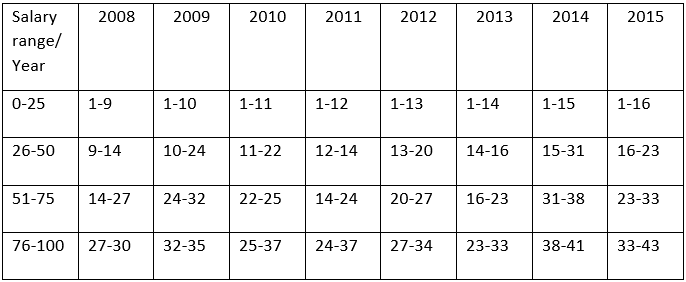
For a salary range we can get the highest and the lowest value of the range but cannot get the distribution of individual student.
In the year 2008 we have a complete salary range(76-100) inside it and some students of the range 51-75.
In the year 2009 some students of the range 51-75 and some students of the range 75-100.
In the year 2010 some students of the range 51-75 and some students of the range 75-100.
In the year 2012 we have a complete salary range 51-75 inside it and some students of the range (76-100) .
Since we cannot determine the exact students and cannot infer a particular year, Hence answer is E i.e cannot be determined.
Identify the years in which the annual median salary is higher by at least 60% than the average salary of the preceding year?
Let's tabulate the information given in the graph,
In all the options since 2009 is given
Lets check if 2009 is satisfying the given criteria
Median salary of 2009 = 24 l
Avg salary of 2008 = 16 l
So Median salary of 2009 is between 40 to 50% higher than 2008 avg salary.
Hence options 1,3,4,5 can be negated .
Option B is the correct answer
Identify the number of years in which the difference between the average salaries of the top 25% and the bottom 25% is more than Rs. 20 lacs:
Let's tabulate the information given in the graph,
The number of years cannot be calculated with precision as the distribution pattern is unknown .
Hence E is the correct answer
If the average salary is computed excluding students with no offers, in how many years will the new average salary be greater than the existing median salary? Refer the table below for number of students without offers.

Let's tabulate the information given in the graph,
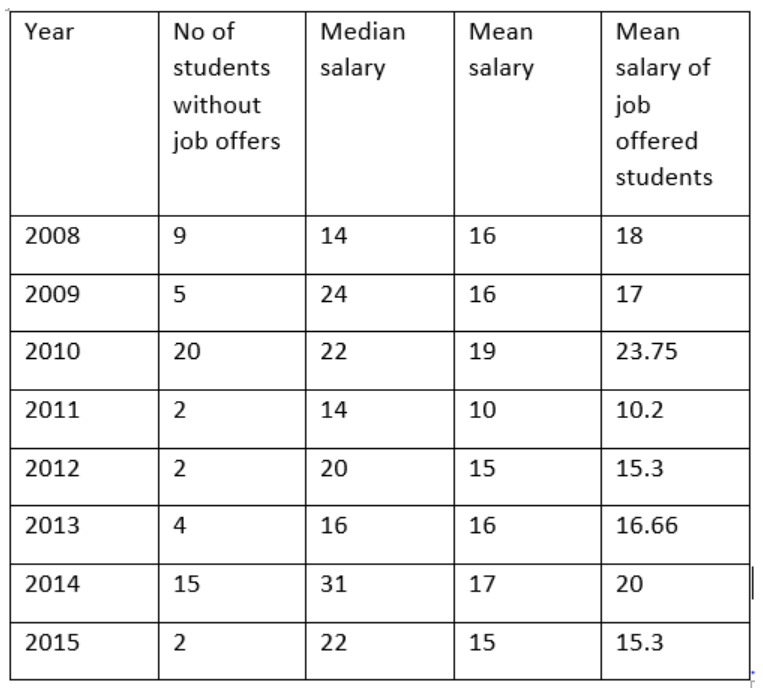
It is clear from the table that the mean salary after discarding the unemployed students is greater than the mean salary for the years 2008,2010,2013
Hence A is the correct answer.
Start your IIM journey with the right preparation and crack CAT 2026.

Educational materials for CAT preparation
 Share
Share