91- 6303239042



 Group
 Group


 Preferred Source

 Google Discover
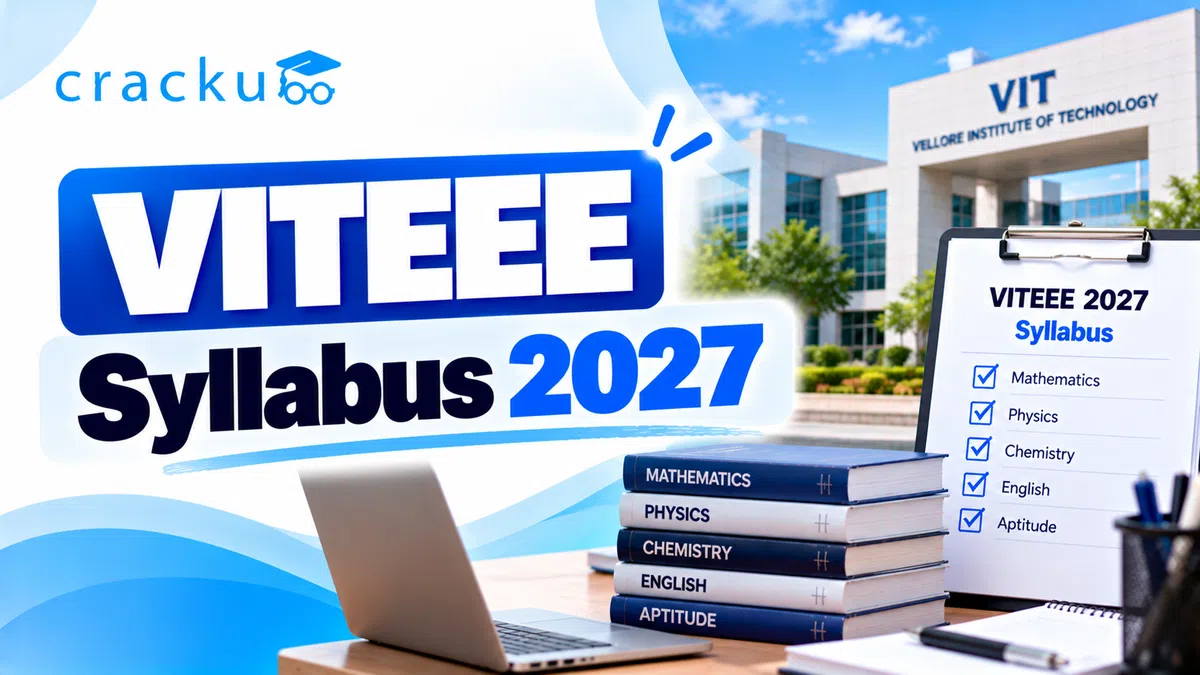
VITEEE Syllabus 2027
VIT conducts its entrance test (VITEEE) in a CBT mode for BTech admissions. Interested students can select MPCEA and BPCEA based on their qualifying subjects. VITEEE contains 100 MCQs with a total duration of 2 hours. VIT has released separate syllabus PDFs for all 5 subjects.
The syllabus covers topics from Classes 11 and 12, but not all topics are like board topics or the ones asked in JEE Main. Before you choose a chapter for revision, it is necessary to check VIT's prescribed units. While some topics require essential practice, others may be out of syllabus. The subject-wise breakdown in the following sections covers official units and their main topics. Students can also download the VITEEE 2027 syllabus PDF from the official admission website.
Subject | |
|---|---|
Physics | |
Chemistry | |
Mathematics | |
Biology | |
English and Aptitude |
VITEEE 2027 Physics Syllabus
The VITEEE 2027 Physics syllabus contains 14 units covering mechanics, electricity, heat, optics, and modern physics. The Physics section carries 25 questions. Mechanics includes Kinematics, Newton's Laws, Work, Energy, Momentum, and Rotational Dynamics. These chapters require students to understand physical concepts and apply formulas to numerical problems.
Students can begin with completed chapters and identify the concepts that still need revision. For additional numerical practice, JEE Questions cover overlapping topics such as Thermodynamics and Current Electricity. However, students should follow VITEEE's official syllabus when selecting questions for practice.
The following table lists all 14 official Physics units and their main topics.
Physics Unit | Key Topics Covered |
Units and Measurements | SI units, dimensions, significant figures, errors, uncertainty |
Kinematics and Newtonian Dynamics | Motion, Newton's laws, friction, projectile and circular motion |
Work, Energy, and Momentum | Work, power, conservation laws, momentum, collisions |
Rotational Dynamics and Gravitation | Torque, moment of inertia, Kepler's laws, satellites |
Mechanical Properties of Matter | Elasticity, fluid pressure, buoyancy, viscosity, surface tension |
Oscillations and Mechanical Waves | SHM, resonance, standing waves, Doppler effect |
Thermal Physics | Heat transfer, kinetic theory, thermodynamics, heat engines |
Electrostatics | Coulomb's law, electric fields, Gauss's law, capacitors |
Current Electricity | Resistance, Kirchhoff's laws, electrical circuits, potentiometer |
Magnetism | Magnetic forces, Biot-Savart law, magnetic materials |
Electromagnetic Induction and Electromagnetic Waves | Faraday's law, AC circuits, RLC resonance, EM spectrum |
Optics | Reflection, refraction, lenses, interference, diffraction, polarization |
Modern Physics | Photoelectric effect, atomic models, radioactivity, nuclear energy |
Electronics | Semiconductors, diodes, rectifiers, logic gates |
VITEEE 2027 Chemistry Syllabus
The VITEEE 2027 Chemistry syllabus contains 6 major sections and has 25 questions.. These cover:
- Physical Chemistry
- Analytical Chemistry
- Inorganic Chemistry
- Coordination
- Material Chemistry
- 2 organic chemistry divisions
Physical Chemistry includes the following topics. Students need to understand formulas, chemical principles, and reaction behaviour across these topics.
- Atomic Structure
- Chemical Bonding
- Thermodynamics
- Chemical Kinetics.
Analytical Chemistry covers:
- Electrochemistry
- Chemical Equilibrium
- Solutions
- Environmental Chemistry.
Inorganic Chemistry includes:
- Periodic properties
- s-, p-, d-, and f-block elements
The remaining sections cover coordination compounds, solid-state chemistry, organic reactions, and functional groups. Biomolecules, polymers, and Chemistry in Everyday Life also appear in the official syllabus.
Students should check the official Chemistry syllabus before using JEE Main study material. Certain concepts overlap, but the prescribed topics may differ between the examinations. Students can solve JEE PYQ for additional practice in shared Physical, Inorganic, and Organic Chemistry topics.
The table below follows VIT's 6 section Chemistry syllabus.
Chemistry Section | Major Topics |
Physical Chemistry | Atomic structure, chemical bonding, thermodynamics, chemical kinetics |
Analytical Chemistry | Electrochemistry, chemical and ionic equilibrium, solutions, environmental chemistry |
Inorganic Chemistry | Periodic properties, s-block, p-block, d-block, f-block elements |
Coordination and Material Chemistry | Coordination compounds, solid-state chemistry, surface chemistry, colloids |
Basic Principles of Organic Chemistry and Functionalized Organic Compounds | Reaction mechanisms, isomerism, alcohols, ethers, aldehydes, ketones |
Carboxylic Acids, Organic Nitrogen Compounds, Biomolecules and Polymers | Carboxylic acids, amines, carbohydrates, proteins, polymers, everyday chemistry |
VITEEE 2027 Mathematics Syllabus
The VITEEE 2027 Mathematics syllabus contains 10 units and carries 40 questions in the MPCEA paper. Students must cover Matrices, Trigonometry, Complex Numbers, Analytical Geometry, and Vector Algebra.Calculus forms another part of the syllabus. It covers Differential Calculus, Integral Calculus, and Ordinary Differential Equations. Probability, Statistics, and Discrete Mathematics are also included.
The syllabus covers specific concepts such as mean value theorems, Bayes' theorem, and mathematical logic. Students preparing for JEE Main can practise overlapping topics through a JEE Mains Mock Test. Timed practice can help them identify calculation errors and topics requiring more revision.
The table below lists all 10 Mathematics units from the official VITEEE 2027 syllabus.
Mathematics Unit | Core Topics |
Matrices and Applications | Matrices, determinants, inverse matrices, linear equations, linear programming |
Trigonometry and Complex Numbers | Trigonometric functions, inverse trigonometry, complex numbers, De Moivre's theorem |
Analytical Geometry of Two Dimensions | Straight lines, conic sections, tangents, normals, eccentricity |
Vector Algebra | Scalar product, vector product, scalar and vector triple products |
Analytical Geometry of Three Dimensions | Direction cosines, lines, planes, skew lines, shortest distance |
Differential Calculus | Limits, continuity, differentiation, mean value theorems, maxima and minima |
Integral Calculus and its Applications | Definite and indefinite integrals, reduction formulae, areas, curve length |
Ordinary Differential Equations | Order, degree, first-order differential equations, Bernoulli's equations |
Probability and Statistics | Conditional probability, Bayes' theorem, random variables, mean, variance |
Discrete Mathematics | Sets, relations, sequences, permutations, combinations, binomial theorem, mathematical logic |
VITEEE 2027 Biology Syllabus
The VITEEE 2027 Biology syllabus applies to candidates choosing the BPCEA examination combination. Biology replaces Mathematics in this paper and contains 40 questions. The official syllabus has 10 units covering plant biology, human biology, genetics, and biotechnology. Foundational topics include Taxonomy, Cell and Molecular Biology, and Reproduction in plants and humans.
Students should compare these units with their existing Biology study material before starting revision. The VITEEE Biology syllabus may not match every topic in the NEET syllabus. BPCEA candidates should also check VIT's programme-specific eligibility rules before selecting their preferred BTech courses.
The following table covers all 10 official Biology units and their main topics.
Biology Unit | Main Topics Covered |
Taxonomy | Biological classification, three domains of life, plant morphology, animal classification |
Cell and Molecular Biology | Cell structure, cell division, DNA, RNA, replication, gene expression |
Reproduction | Asexual reproduction, plant reproduction, human reproduction, reproductive health |
Genetics and Evolution | Mendelian inheritance, mutations, chromosomal disorders, Darwinism, Hardy-Weinberg principle |
Human Health and Diseases | Infectious diseases, pathogens, immunity, vaccines, cancer, HIV and AIDS |
Biochemistry | Carbohydrates, proteins, lipids, enzymes, glycolysis, Krebs cycle |
Plant Physiology | Water transport, mineral nutrition, photosynthesis, transpiration, plant hormones |
Human Physiology | Digestion, respiration, circulation, excretion, nervous and endocrine systems |
Biotechnology and its Applications | Recombinant DNA, gene therapy, GMOs, tissue culture, biofertilizers, DNA fingerprinting |
Biodiversity, Ecology and Environment | Ecosystems, biodiversity conservation, pollution, climate change, population growth |
VITEEE English and Aptitude Syllabus 2027
The VITEEE English and Aptitude Syllabus 2027 applies to both MPCEA and BPCEA candidates. Each section comprises 5 questions. Aptitude questions assess numerical reasoning, logical relationships, and the ability to interpret information. In English, you may encounter short passages, lines of poetry, or questions based on language usage.
- Aptitude covers Data Interpretation, Data Sufficiency, Syllogism, Number Series, Coding-Decoding, and Clocks, Calendars and Directions.
- English covers reading comprehension, grammar, and pronunciation through multiple-choice questions.
VIT sets the English syllabus at the higher-secondary or equivalent level. The table below shows the topics included in both sections.
Topic | Question Types and Assessment Areas |
English | Reading comprehension, poetry-based questions, grammar, pronunciation |
Data Interpretation | Tables, pie charts, bar charts, line graphs, mixed charts |
Data Sufficiency | Determining whether the given statements provide enough information |
Syllogism | Logical conclusions from two or three statements |
Number Series, Coding & Decoding | Number patterns, letter coding, number coding, mixed coding |
Clocks, Calendars and Directions | Clock angles, mirror images, dates, odd days, directions, distances |
How to Download the VITEEE Syllabus 2027 PDF
VIT provides the VITEEE Syllabus 2027 PDF on its main website. Students can download separate PDFs for Physics, Chemistry, Mathematics, Biology, and English & Aptitude.
The website lists all 5 syllabus links below the examination pattern. Students should download the subjects relevant to their chosen examination combination and keep digital copies of the syllabus for revision. Follow these steps to get the official syllabus PDFs.
Steps | Portal Navigation |
Step 1 | Visit VITEEE official website. |
Step 2 | Scroll to the examination pattern section. |
Step 3 | Find the five subject-wise syllabus links. |
Step 4 | Open the required subject PDF. |
Step 5 | Save the PDF and download the remaining subjects. |
VITEEE Syllabus 2027: Conclusion
The VITEEE Syllabus 2027 provides a subject-wise roadmap for candidates preparing for the VIT Engineering Entrance Examination. From Physics and Chemistry to Mathematics or Biology, English, and Aptitude, understanding the prescribed units helps students plan revision, identify weak areas, and focus on relevant topics. Candidates should also download the official syllabus PDF and verify the topics for their selected examination combination.
For effective preparation, complete the syllabus systematically, practise topic-wise questions, and use timed mock tests to improve speed and accuracy. Although JEE Main resources can help with overlapping concepts, always prioritise the official VITEEE syllabus. A clear understanding of the syllabus is the first step towards a focused and well-planned VITEEE 2027 preparation strategy.