91- 6303239042


 Group
Group


 Preferred Source

 Google Discover
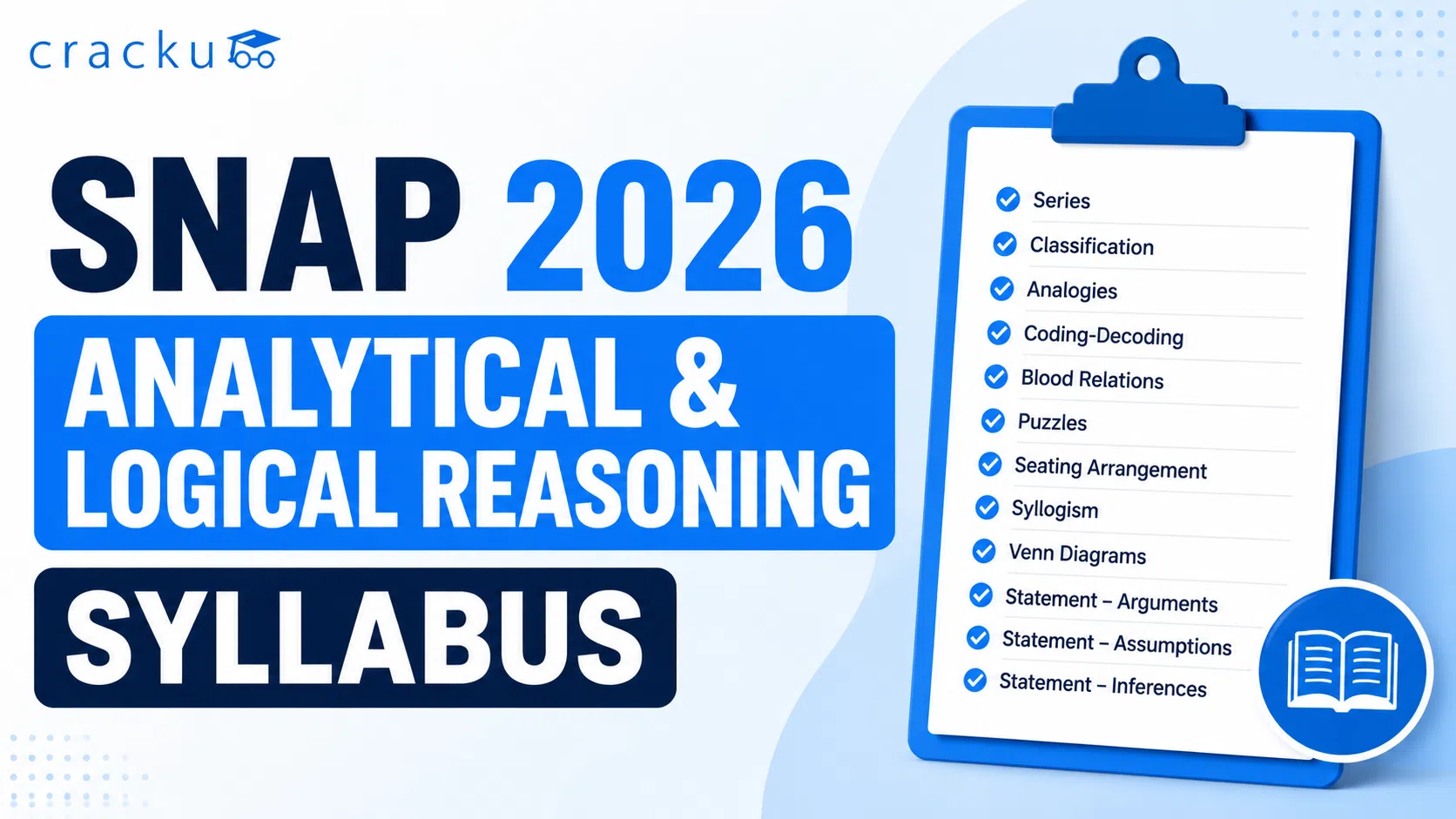
SNAP Analytical and Logical Reasoning Syllabus 2026
The Analytical & Logical Reasoning (A-LR) section of the SNAP 2026 exam tests a candidate’s reasoning and problem-solving skills. To perform well, it is important to practice a wide range of Verbal and Non-Verbal Reasoning questions. Candidates should focus on learning shortcuts and smart techniques to solve problems quickly and accurately.
Below are the key topics included in the A-LR syllabus of SNAP:
SNAP Analytical and Logical Reasoning Syllabus 2026 | |
|---|---|
Category | Topics Covered |
Verbal Reasoning | Cause & Effect, Analogies, Syllogisms, Statement–Conclusion, Statement-Assumption |
Puzzles | Linear & Circular Seating Arrangement, Blood Relations, Direction Sense, Clocks & Calendars |
Non-Verbal Reasoning | Series, Analogies, Odd One Out, Coding-Decoding, Visual/Pattern Recognition |
Critical Reasoning | Strengthening & Weakening Arguments, Inference, Conclusion |
Other Important Topics | Decision Making, Venn Diagrams, Input–Output, Logical Sequences, Ranking & Ordering |
SNAP Analytical and Logical Reasoning Syllabus PDF
The SNAP Analytical and Logical Reasoning Syllabus PDF is a detailed guide created to help applicants in effectively preparing for the SNAP exam's Logical Reasoning section. It covers all of the important topics, including logical reasoning, critical reasoning, blood relations, seating arrangement, riddles, coding-decoding, syllogisms, clocks, calendars, and series-based questions.
As a result, the SNAP Analytical and Logical Reasoning syllabus PDF is a useful tool for making a well-planned strategy. The SNAP Analytical and Logical Reasoning Syllabus 2026 PDF is available for free download.
SNAP Analytical and Logical Reasoning Important Topics 2026
The following are the important topics for Analytical and Logical Reasoning for SNAP 2026:
SNAP Analytical and Logical Reasoning Syllabus PDF | |
Topic Category | Topics Covered |
Arrangement-Based | Linear Arrangements, Matrix Arrangements, Seating Puzzles |
Reasoning | Syllogisms, Statement and Conclusion, Cause and Effect |
Coding | Coding and Decoding, Symbol-Based Problems |
Relations | Blood Relations, Family Tree Questions. |
Series | Number/Letter Series, Missing Sequences. |
Read Also, SNAP 2026 Preparation Strategy by Maruti Sir, Check Now
SNAP Analytical and Logical Reasoning Preparation Strategy 2026
The Analytical and Logical Reasoning section of the SNAP is normally of moderate difficulty, and the questions are doable, however, if there is inadequate practice, this section can be difficult. So keep practising.
Solve each SNAP reasoning question at least three times. You will understand the questions on the first attempt, solve them correctly on the second attempt, and solve them faster on the third attempt.
Practicing different types of questions over time can allow you to find methods and shortcuts that you can use in the exam to answer puzzles more quickly.
Don't stop with knowing the right answer. Read the explanation to see why a specific option is correct. This is exactly what reasoning is all about. If you find the reason, you can answer any LR question.
Insufficient practice with SNAP reasoning questions can lead to confusion. So, practise more and more.
Read Also, SNAP Syllabus 2026 PDF, Important Topics, Exam Pattern
SNAP Analytical and Logical Reasoning Exam Pattern 2026 (Expected)
The A-LR section of the SNAP 2026 question paper will have a maximum of 25 marks. The difficulty level will be moderate, and it has been found over the years that most questions are doable. However, speed and accuracy are the main goals. Check out the SNAP analytical and Logical reasoning Exam Pattern 2026 (Expected):
A-LR section of SNAP 2026 will have 25 questions in MCQ form
Every question will carry one mark
Negative marking of 0.25 marks will be made to each wrong attempt
An attempt of 18-19 questions with 85 per cent accuracy can be considered a good attempt
Read also, SNAP QADI and DS Syllabus 2026, Important Topics, Weightage
SNAP Analytical and Logical Reasoning Difficulty Level Analysis
The AR & LR section is normally easy, but slightly longer owing to reasoning variation. Questions from Course of Action, Cause-Effect, Syllogisms, and Statement-based logic were highly doable, allowing students to achieve a good score.
SNAP Analytical and Logical Reasoning Difficulty Level Analysis | |
|---|---|
Question types | Level of difficulty |
Verbal Reasoning | |
Syllogisms | Easy |
Course of Action, Ethical Course of Action | Easy |
Critical Reasoning – Weaken | Easy |
Implicit Statements | Easy |
Cause Effect | Easy |
Statement Arguments | Easy |
Non-Verbal Reasoning | |
Complete the series (2 numbers, 2 combined) | Easy-Difficult |
Linear Arrangement | Easy-Medium |
Matrix Arrangement | Easy-Medium |
Family Tree | Easy-Medium |
Calendar | Easy-Medium |
Clocks | Easy |
Binary Logic | Difficult |
Coding | Easy |
Read Also, SNAP General English Syllabus 2026, Important Topics, Weightage
SNAP Analytical and Logical Reasoning Syllabus 2026 : Conclusion
The SNAP Analytical and Logical Reasoning Syllabus 2026 covers a wide range of reasoning topics designed to test a candidate’s analytical thinking, logical ability, and problem-solving skills. Important areas such as puzzles, syllogisms, coding-decoding, blood relations, and critical reasoning play a major role in the section and require regular practice.
To score well in the SNAP Analytical and Logical Reasoning section, candidates should focus on improving speed, accuracy, and question selection. Practicing mock tests, understanding shortcuts, and revising important reasoning concepts consistently can significantly improve overall performance in SNAP 2026.