Join WhatsApp Icon JEE WhatsApp Group

NTA JEE Main 9th April 2016 Online - Physics

For the following questions answer them individually

In the following $$I$$ refers to current and other symbols have their usual meaning. Choose the option that corresponds to the dimensions of electrical conductivity:

A rocket is fired vertically from the earth with an acceleration of 2g, where g is the gravitational acceleration. On an inclined plane inside the rocket, making an angle $$\theta$$ with the horizontal, a point object of mass m is kept. The minimum coefficient of friction $$\mu_{min}$$ between the mass and the inclined surface such that the mass does not move is:

Which of the following option correctly describes the variation of the speed v and acceleration 'a' of a point mass falling vertically in a viscous medium that applies a force $$F = -kv$$, where 'k' is a constant, on the body? (Graphs are schematic and not drawn to scale)

A car of weight W is on an inclined road that rises by 100 m over a distance of 1 km and applies a constant frictional force $$\frac{W}{20}$$ on the car. While moving uphill on the road at a speed of 10 ms$$^{-1}$$, the car needs power P. If it needs power $$\frac{P}{2}$$ while moving downhill at speed v then the value of v is:

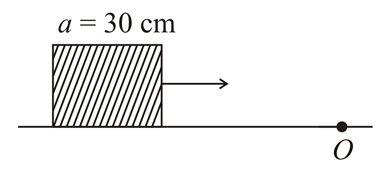
A cubical block of side 30 cm is moving with velocity 2 m s$$^{-1}$$ on a smooth horizontal surface. The surface has a bump at a point O as shown in the figure. The angular velocity (in rad/s) of the block immediately after it hits the bump, is:

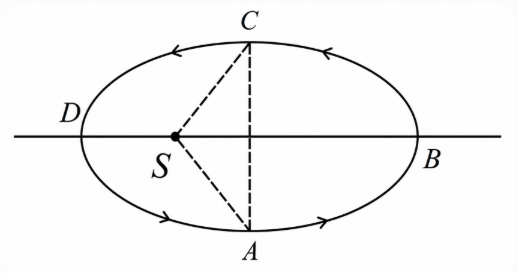
The figure shows an elliptical path $$ABCD$$ of a planet around the sun $$S$$ such that the area of triangle $$CSA$$ is $$\frac{1}{4}^\text{th}$$ the area of the ellipse (see the figure below) with $$DB$$ as the major axis, and $$CA$$ as the minor axis. If $$t_1$$ is the time taken for the planet to go over the path $$ABC$$ and $$t_2$$ for the path taken over $$CDA$$ then:

image

A uniformly tapering conical wire is made from a material of Young's modulus $$Y$$ and has a normal, unextended length $$L$$. The radii, at the upper and lower ends of this conical wire, have values $$R$$ and $$3R$$, respectively. The upper end of the wire is fixed to a rigid support and a mass $$M$$ is suspended from its lower end. The equilibrium extended length, of this wire, would equal:

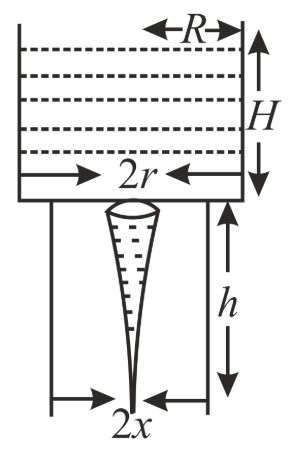
Consider a water jar of radius R that has water filled up to height H and is kept on a stand of height h. Through a hole of radius r (r << R) at its bottom, the water leaks out and the stream of water coming down towards the ground has a shape like a funnel as shown in the figure. If the radius of the cross-section of water stream when it hits the ground is x, then:

image

A simple pendulum made of a bob of mass m and a metallic wire of a negligible mass has a time period of 2 s at $$T = 0°C$$. If the temperature of the wire is increased, and the corresponding change in its time period is plotted against its temperature, the resulting graph is a line of slope $$S$$. If the coefficient of linear expansion of metal is $$\alpha$$, then the value of $$S$$ is

Two particles are performing simple harmonic motion in a straight line about the same equilibrium point. The amplitude and time period for both particles are same and equal to A and T, respectively. At time $$t = 0$$ one particle has displacement A while the other one has displacement $$-\frac{A}{2}$$ and they are moving towards each other. If they cross each other at time t, then t is:

Two engines pass each other moving in opposite directions with uniform speed of 30 m/s. One of them is blowing a whistle of frequency 540 Hz. Calculate the frequency heard by driver of second engine before they pass each other. Speed of sound is 330 m/sec:

The potential (in volts) of a charge distribution is given by
$$V(z) = 30 - 5z^2$$ for $$|z| \leq 1$$ m
$$V(z) = 35 - 10|z|$$ for $$|z| \geq 1$$ m.
$$V(z)$$ does not depend on x and y. If this potential is generated by a constant charge per unit volume $$\rho_0$$ (in units of $$\epsilon_0$$) which is spread over a certain region, then choose the correct statement.

Three capacitors each of 4 $$\mu$$F are to be connected in such a way that the effective capacitance is 6 $$\mu$$F. This can be done by connecting them

To know the resistance $$G$$ of a galvanometer by half deflection method, a battery of emf $$V_E$$ and resistance $$R$$ is used to deflect the galvanometer by angle $$\theta$$. If a shunt of resistance $$S$$ is needed to get half deflection the $$G$$, $$R$$ and $$S$$ are related by the equation:

A 50 $$\Omega$$ resistance is connected to a battery of 5 V. A galvanometer of resistance 100 $$\Omega$$ is to be used as an ammeter to measure current through the resistance, for this a resistance $$r_S$$ is connected to the galvanometer. Which of the following connections should be employed if the measured current is with in 1% of the current without the ammeter in the circuit?

A magnetic dipole is acted upon by two magnetic fields which are inclined to each other at an angle of 75°. One of the fields has a magnitude of 15 mT. The dipole attains stable equilibrium at an angle of 30° with this field. The magnitude of the other field (in mT) is close to

To find the focal length of a convex mirror, a student records the following data:
Object pin: 22.2 cm, Convex Lens: 32.2 cm, Convex Mirror: 45.8 cm, Image Pin: 71.2 cm
The focal length of the convex lens is $$f_1$$ and that of mirror is $$f_2$$. Then taking index correction to be negligibly small, $$f_1$$ and $$f_2$$ are close to:

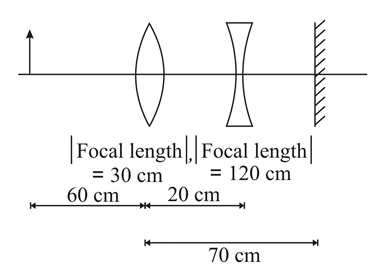
A convex lens, of focal length 30 cm, a concave lens of focal length 120 cm, and a plane mirror are arranged as shown. For an object kept at a distance of 60 cm from the convex lens, the final image, formed by the combination, is a real image, at a distance of:

In Young's double-slit experiment, the distance between slits and the screen is 1 m and monochromatic light of wavelength 600 nm is being used. A person standing near the slits is looking at the fringe pattern. When the separation between the slits is varied, the interference pattern disappears for a particular distance $$d_0$$ between the slits. If the angular resolution of the eye is $$\frac{1}{60}°$$, then the value of $$d_0$$ is close to

When photons of wavelength $$\lambda_1$$ are incident on an isolated sphere, the corresponding stopping potential is found to be $$V$$. When photons of wavelength $$\lambda_2$$ are used, the corresponding stopping potential was thrice that of the above value. If light of wavelength $$\lambda_3$$ is used then find the stopping potential for this case:

An electron in a hydrogen atom makes a transition from $$n = 2$$ to $$n = 1$$ and emits a photon. This photon strikes a doubly ionized lithium atom which was already in an excited state and completely removes the orbiting electron. The least quantum number for the excited state of the lithium-ion for the process is

An unknown transistor needs to be identified as a npn or pnp type. A multimeter, with +ve and -ve terminals, is used to measure resistance between different terminals of transistor. If terminal 2 is the base of the transistor then which of the following is correct for a pnp transistor?

A Zener diode with a breakdown voltage of 4 V is connected in series with a resistance $$R$$ to a battery of emf 10 V. The maximum power dissipation rating for the Zener diode is 1 W. The value of $$R$$ to ensure maximum power dissipation across the diode is

An audio signal consists of two distinct sounds: one a human speech signal in the frequency band of 200 Hz to 2700 Hz, while the other is a high frequency music signal in the frequency band of 10200 Hz to 15200 Hz. The ratio of the AM signal band width required to send both the signals together to the AM signal band width required to send just the human speech is: