
Join Our JEE Preparation Group
Prep with like-minded aspirants; Get access to free daily tests and study material.
Sign in
Please select an account to continue using cracku.in
↓ →
Join Our JEE Preparation Group
Prep with like-minded aspirants; Get access to free daily tests and study material.
A convex lens, of focal length 30 cm, a concave lens of focal length 120 cm, and a plane mirror are arranged as shown. For an object kept at a distance of 60 cm from the convex lens, the final image, formed by the combination, is a real image, at a distance of:
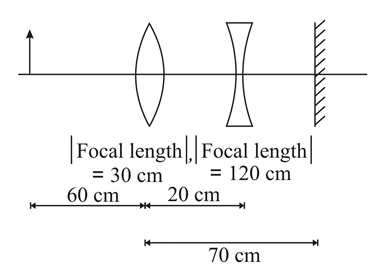
The lens formula is $$\frac{1}{v} - \frac{1}{u} = \frac{1}{f}$$
1. Reflection from convex lens:
$$\frac{1}{v_1} - \frac{1}{-60} = \frac{1}{30} \implies \frac{1}{v_1} = \frac{1}{30} - \frac{1}{60} = \frac{1}{60}$$
$$v_1 = +60$$ cm
2. Reflection from concave lens:
The concave lens is placed $$20$$ cm to the right of the convex lens. The first image acts as a virtual object for the concave lens.
Object distance ($$u_2$$): $$60\text{ cm} - 20\text{ cm} = +40$$ cm.
$$\frac{1}{v_2} - \frac{1}{40} = \frac{1}{-120} \implies \frac{1}{v_2} = \frac{1}{40} - \frac{1}{120} = \frac{3-1}{120} = \frac{1}{60}$$
$$v_2 = +60$$ cm
3. Reflection from plane mirror:
The distance between the convex lens and the mirror is $$70$$ cm. The distance between the concave lens and the mirror is $$70\text{ cm} - 20\text{ cm} = 50$$ cm. The image from the concave lens is $$60$$ cm to its right, which puts it $$60\text{ cm} - 50\text{ cm} = 10$$ cm behind the mirror. For a plane mirror, a virtual object $$10$$ cm behind it produces a real image $$10$$ cm in front of it.
4. Final image:
The mirror is located at $$70$$ cm from the convex lens. The real image is $$10$$ cm in front (to the left) of the mirror.
Distance from convex lens = $$70\text{ cm} - 10\text{ cm} = 60$$ cm.
Was this solution helpful?
Create a FREE account and get:
_1.webp)

Educational materials for JEE preparation

Ask our AI anything

AI can make mistakes. Please verify important information.
AI can make mistakes. Please verify important information.
