
Join Our JEE Preparation Group
Prep with like-minded aspirants; Get access to free daily tests and study material.
Sign in
Please select an account to continue using cracku.in
↓ →
Join Our JEE Preparation Group
Prep with like-minded aspirants; Get access to free daily tests and study material.
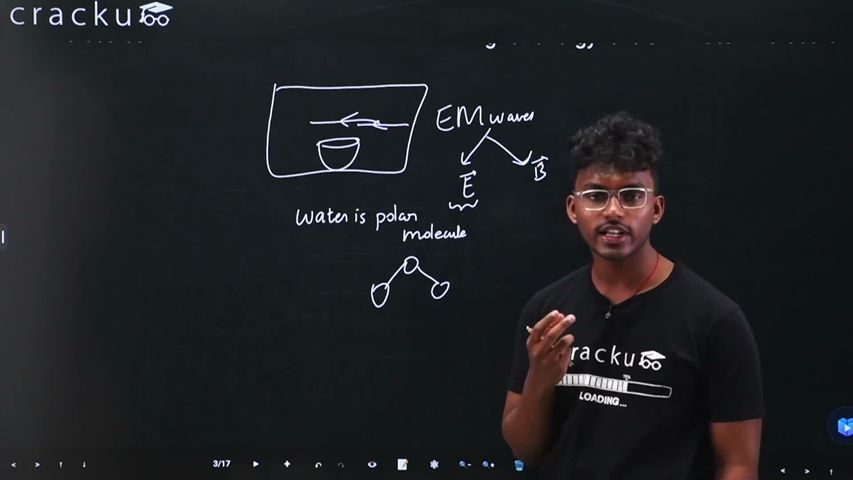
A microwave oven works by emitting microwave radiation, which is a form of electromagnetic wave with frequency around $$2.45 \times 10^9$$ Hz (2.45 GHz).
Water molecules are polar molecules, meaning they have a positive end and a negative end (a permanent electric dipole moment).
When microwaves pass through food, the oscillating electric field of the microwave exerts a torque on these polar water molecules. This causes the water molecules to rotate rapidly, trying to align with the changing direction of the electric field.
This rapid rotation of water molecules increases their rotational kinetic energy. As these rapidly rotating molecules collide with neighbouring molecules, the rotational energy is converted into thermal energy (heat), which cooks the food.
The energy of microwaves (approximately $$10^{-5}$$ eV) falls in the range that corresponds to rotational energy levels of molecules, not vibrational or electronic energy levels.
Therefore, a microwave oven acts on the principle of giving rotational energy to water molecules, which is Option A.
Was this solution helpful?
Click on the Email ☝️ to Watch the Video Solution
Create a FREE account and get:
_1.webp)

Educational materials for JEE preparation

Ask our AI anything

AI can make mistakes. Please verify important information.
AI can make mistakes. Please verify important information.
