
Join Our JEE Preparation Group
Prep with like-minded aspirants; Get access to free daily tests and study material.
Sign in
Please select an account to continue using cracku.in
↓ →
Join Our JEE Preparation Group
Prep with like-minded aspirants; Get access to free daily tests and study material.
A cubical block of side 30 cm is moving with velocity 2 m s$$^{-1}$$ on a smooth horizontal surface. The surface has a bump at a point O as shown in the figure. The angular velocity (in rad/s) of the block immediately after it hits the bump, is:
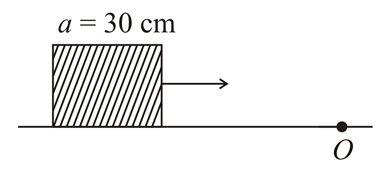
Let the mass of the cubical block be $$m$$ and its edge length be $$a=30\ \text{cm}=0.30\ \text{m}$$. The centre of mass (C.M.) is at the geometrical centre of the cube, i.e. $$a/2=0.15\ \text{m}$$ above the horizontal surface and $$0.15\ \text{m}$$ behind the bump.
The block is sliding with a purely translational velocity $$v_0 = 2\ \text{m s}^{-1}$$ towards the bump. The bump touches the block at the point $$O$$ situated on the front bottom edge. Immediately after the impulsive contact, the point $$O$$ is at rest (there is no slipping at the instant of collision), so the block executes a pure rotation about $$O$$ with some angular velocity $$\omega$$.
Because the impulsive normal force at $$O$$ passes through $$O$$ itself, it exerts zero moment about that point. Hence angular momentum about point $$O$$ is conserved during the impact.
1. Initial angular momentum about $$O$$ (just before impact)
The position vector of the C.M. from $$O$$ has a horizontal component $$-0.15\ \text{m}$$ (opposite to the direction of motion) and a vertical component $$+0.15\ \text{m}$$. Denoting the horizontal direction of motion as the $$x$$-axis and the vertically upward direction as the $$z$$-axis, we write
$$\vec r = (-0.15)\hat i + (0.15)\hat k.$$
The velocity vector is $$\vec v_0 = +2\hat i\ \text{m s}^{-1}.$$
Using the vector formula for translational angular momentum, $$\vec L_i = m\,\vec r \times \vec v_0,$$ we obtain
$$\vec L_i = m\left[(-0.15)\hat i + 0.15\hat k\right] \times (2\hat i) = m\,(0.15)(2)\,\hat k \times \hat i = m(0.30)\,\hat j.$$
Only the magnitude is needed, so
$$L_i = m \times 0.30\ \text{kg m}^2\text{s}^{-1}.$$
2. Moment of inertia of the cube about the axis through $$O$$
First, the moment of inertia about a parallel axis through the centre for an axis along an edge (here the $$y$$-axis) is
$$I_{\text{C.M.}}=\frac{1}{12}m(a^2+a^2)=\frac16 m a^2.$$
Using the parallel-axis theorem, $$I_O = I_{\text{C.M.}} + m r^2,$$ where $$r = \sqrt{(0.15)^2+(0.15)^2}=0.15\sqrt2\ \text{m},\qquad r^2=\frac{a^2}{2}.$$
Thus
$$I_O = \frac16 m a^2 + m\left(\frac{a^2}{2}\right) = m a^2\left(\frac16+\frac12\right) = m a^2\left(\frac{1+3}{6}\right) = \frac{2}{3}m a^2.$$
With $$a=0.30\ \text{m}$$,
$$I_O = \frac23 m(0.30)^2 = \frac23 m(0.09) = 0.06\,m\ \text{kg m}^2.$$
3. Final angular momentum about $$O$$ (just after impact)
After the collision the block rotates about $$O$$ only, so
$$L_f = I_O \,\omega = 0.06\,m\,\omega.$$
4. Conservation of angular momentum about $$O$$
Setting initial and final angular momenta equal,
$$m(0.30) = 0.06\,m\,\omega.$$
The mass $$m$$ cancels, giving
$$0.30 = 0.06\,\omega \quad\Longrightarrow\quad \omega = \frac{0.30}{0.06} = 5.0\ \text{rad s}^{-1}.$$
Hence, the correct answer is Option B.
Was this solution helpful?
Create a FREE account and get:
_1.webp)

Educational materials for JEE preparation

Ask our AI anything

AI can make mistakes. Please verify important information.
AI can make mistakes. Please verify important information.
