
Join Our JEE Preparation Group
Prep with like-minded aspirants; Get access to free daily tests and study material.
Sign in
Please select an account to continue using cracku.in
↓ →
Join Our JEE Preparation Group
Prep with like-minded aspirants; Get access to free daily tests and study material.
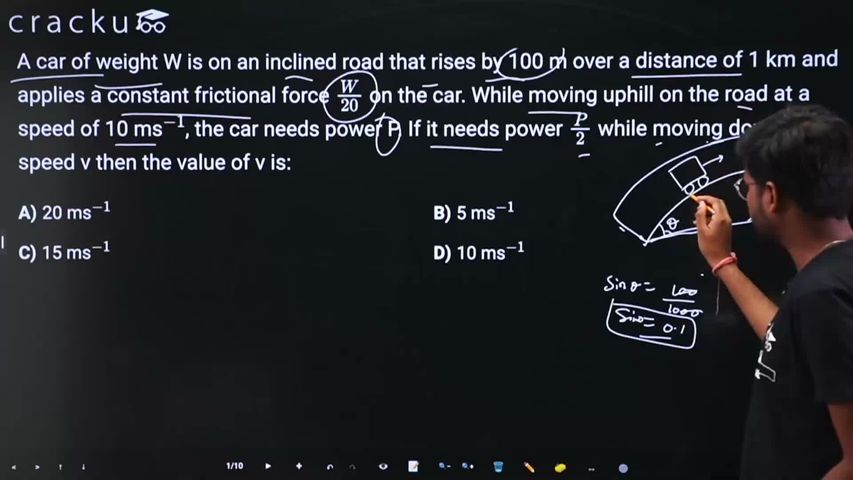
A car of weight W is on an inclined road that rises by 100 m over a distance of 1 km and applies a constant frictional force $$\frac{W}{20}$$ on the car. While moving uphill on the road at a speed of 10 ms$$^{-1}$$, the car needs power P. If it needs power $$\frac{P}{2}$$ while moving downhill at speed v then the value of v is:
First we translate the geometry of the road into a mathematical form. The road climbs 100 m in a horizontal distance of 1 km (that is 1000 m). For an inclined plane the trigonometric relation is $$\sin\theta=\frac{\text{vertical rise}}{\text{length of road}}.$$ So we have
$$\sin\theta=\frac{100}{1000}=0.1.$$
Now let us examine the car while it is going uphill with constant speed 10 ms$$^{-1}$$. Three forces act along the slope:
1. The component of the weight trying to pull the car downward: $$W\sin\theta=W\times0.1.$$ 2. The frictional force opposing motion, given directly as $$\frac{W}{20}=0.05W.$$ 3. The driving force supplied by the engine, which we shall call $$F_u$$.
Because the speed is constant, the net force along the slope must be zero, hence
$$F_u=W\sin\theta+\frac{W}{20}=0.1W+0.05W=0.15W.$$
The standard formula for mechanical power is
$$\text{Power}= \text{Force}\times\text{Velocity}.$$
Therefore the power needed for uphill motion is
$$P = F_u \times 10 = 0.15W \times 10 = 1.5W.$$
Next we repeat the analysis for downhill motion. While descending the car moves down the slope, so the component of the weight now helps the motion, whereas friction still resists it. Let $$F_d$$ be the force supplied by the engine when the car comes downhill at constant speed $$v$$. Taking the downward direction as positive, the force balance is
$$W\sin\theta - \frac{W}{20} + F_d = 0.$$
Substituting $$\sin\theta=0.1$$ and $$\frac{W}{20}=0.05W$$ we get
$$0.1W - 0.05W + F_d = 0 \quad\Longrightarrow\quad F_d = -0.05W.$$
The negative sign tells us that the engine must actually apply a force uphill (i.e. it is acting like a brake) whose magnitude is $$0.05W$$. The power that the engine must supply in this situation is therefore
$$P_{\text{down}} = |F_d| \times v = 0.05W \times v.$$
According to the problem this downhill power equals $$\dfrac{P}{2}$$, so
$$0.05W \times v = \frac{1}{2}P = \frac{1}{2}\times1.5W = 0.75W.$$
Dividing both sides by $$0.05W$$ gives
$$v = \frac{0.75W}{0.05W} = 15\ \text{ms}^{-1}.$$
Hence, the correct answer is Option C.
Was this solution helpful?
Click on the Email ☝️ to Watch the Video Solution
Create a FREE account and get:
_1.webp)

Educational materials for JEE preparation

Ask our AI anything

AI can make mistakes. Please verify important information.
AI can make mistakes. Please verify important information.
