
Join Our JEE Preparation Group
Prep with like-minded aspirants; Get access to free daily tests and study material.
Sign in
Please select an account to continue using cracku.in
↓ →
Join Our JEE Preparation Group
Prep with like-minded aspirants; Get access to free daily tests and study material.
The figure shows an elliptical path $$ABCD$$ of a planet around the sun $$S$$ such that the area of triangle $$CSA$$ is $$\frac{1}{4}^\text{th}$$ the area of the ellipse (see the figure below) with $$DB$$ as the major axis, and $$CA$$ as the minor axis. If $$t_1$$ is the time taken for the planet to go over the path $$ABC$$ and $$t_2$$ for the path taken over $$CDA$$ then:
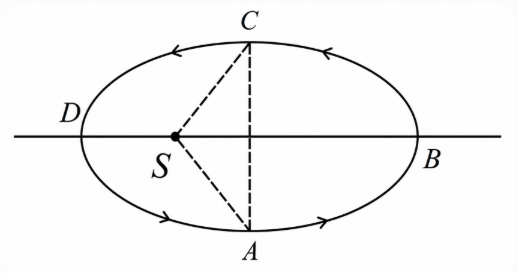
Kepler's Second Law states that a line joining a planet and the Sun sweeps out equal areas during equal intervals of time.
$$t \propto \text{Area swept}$$
The minor axis $$CA$$ divides the ellipse into two equal halves. Therefore, the area of the elliptical sector to the left of line $$CA$$ is exactly $$\frac{A}{2}$$.
$$\text{Area swept over path } CDA = (\text{Area of the half-ellipse to the left of } CA) - (\text{Area of } \triangle CSA)$$
$$\text{Area swept for } t_2 = \frac{A}{2} - \frac{A}{4} = \frac{A}{4}$$
$$\text{Area swept for } t_1 = \text{Total Area} - (\text{Area swept for } t_2)$$
$$\text{Area swept for } t_1 = A - \frac{A}{4} = \frac{3A}{4}$$
$$\frac{t_1}{t_2} = \frac{\text{Area for } t_1}{\text{Area for } t_2}$$
$$\frac{t_1}{t_2} = \frac{3A/4}{A/4} = 3$$
$$t_1 = 3t_2$$
Was this solution helpful?
Click on the Email ☝️ to Watch the Video Solution
Create a FREE account and get:
_1.webp)

Educational materials for JEE preparation

Ask our AI anything

AI can make mistakes. Please verify important information.
AI can make mistakes. Please verify important information.
