 91- 6303239042
The value of $$\sqrt{2023\sqrt{2022\sqrt{2021 \times 2019 + 1} + 1} + 1}$$ is
Sign in
Please select an account to continue using cracku.in
↓ →

Join Our JEE Preparation Group
Prep with like-minded aspirants; Get access to free daily tests and study material.
The value of $$\sqrt{2023\sqrt{2022\sqrt{2021 \times 2019 + 1} + 1} + 1}$$ is
The innermost quantity is $$2021 \times 2019 + 1$$ which can be written as $$(2020+1)(2020-1) + 1$$
Using the property that $$(a+b)(a-b) = a^2 - b^2$$ we get
$$(2020+1)(2020-1) + 1 = 2020^2 -1^2 +1=2020^2$$
Hence, the square root of the innermost quantity is $$2020$$. The next radical becomes $$\sqrt{2022 \times 2020 + 1} $$
We can again rewrite this using the same property mentioned above to get $$(2021+1)(2021-1) + 1 = 2021^2-1^2 +1 = 2021^2$$
$$\sqrt{2021^2} = 2021$$. Now we can again rewrite this in the same way to get
$$\sqrt{2023 \times 2021 + 1} = \sqrt{(2022+1)(2022-1) +1} = \sqrt{2022^2-1^2+1}=2022$$.
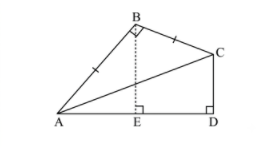
In the adjoining figure, $$(\triangle ABC)$$ is an isosceles right-angled triangle. $$(BE)$$ is perpendicular to $$(AD)$$. If $$(BE) = 1\text{ cm}$$, then the area in $$\text{cm}^2$$ of quadrilateral $$(ABCD)$$ is
Loading solution...
If $$a+b+c=0$$, then the value of $$\frac{(a^2+b^2+c^2)^2}{a^4+b^4+c^4}$$ is
Loading solution...
.webp)
Ram, Rahim, Robin and Ria are four children, the product of whose ages is $$5040$$. Ram is older than Rahim by one year, older than Robin by two years and older than Ria by three years. The age of Ram (in years) is
Loading solution...
A fruit-seller sells apples, oranges and pineapples. In his stock, $$20\%$$ are pineapples and $$60\%$$ are oranges. There are $$40$$ apples. If half the oranges are replaced by pineapples, how many pineapples are there in the shop now?
Loading solution...
A carpenter can repair $$4$$ tables in $$5$$ hours. The time (in hours) for him to repair, (at the same rate) $$7$$ tables is
Loading solution...
.webp)
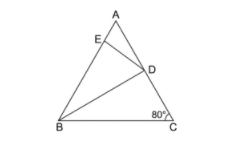
In the adjoining figure, $$AB=AC$$, $$\angle C=80^\circ$$ and $$BC=BD=DE$$. Then the measure in degrees of $$\angle ADE$$ is
Loading solution...
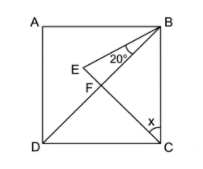
In the adjoining figure, $$ABCD$$ is a square and $$BE=AB$$. If the measure of $$\angle DFC$$ is $$x^\circ$$, then the value of $$2x$$ in degrees is
Loading solution...
Two real numbers $$a$$ and $$b$$, where $$a>b$$, are given such that their sum is equal to $$4$$ times their difference. The value of $$\frac{2ab}{3(a^2-b^2)}$$ is
Loading solution...
.webp)
The average of three numbers is $$x$$. Two of the three numbers are $$y$$ and $$z$$. Then the third number is
Loading solution...
From a natural number $$3$$ is subtracted, then the result is divided by $$4$$ and the outcome is increased by $$4$$. The whole result is then divided by $$5$$, and the final resulting number is $$2$$. Then the natural number taken in the beginning is
Loading solution...
For all permissible natural numbers $$n$$, the number $$\frac{9n^2-64}{n-1-\frac{1}{1-\frac{n}{n+4}}}$$ is
Loading solution...
The number of solutions of the equation $$\sqrt{x+5}+\sqrt{3x+4}=\sqrt{12x+1}$$ is
Loading solution...
If $$\frac{1}{1 \times 3}+\frac{1}{2 \times 4}+\frac{1}{3 \times 5}+\cdots+\frac{1}{n(n+2)}=\frac{3553}{4830}$$, then $$n$$ is
Loading solution...
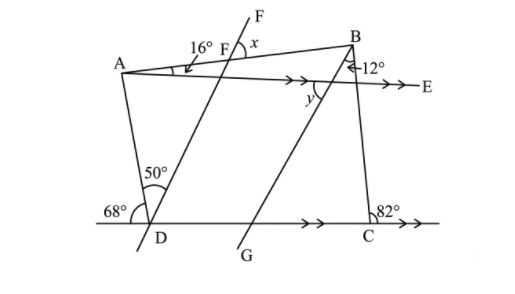
In the adjoining figure, $$\angle BAE=16^\circ$$ and $$\angle CBG=12^\circ$$. Then the measure of $$x+y$$ in degrees is
Loading solution...
There are $$3$$ pineapples, $$6$$ bananas and $$7$$ apples. Each fruit of the same category has the same price. The total amount of the fruits in the first row is Rs. $$44$$, that of the third row is Rs. $$54$$ and that of the first column is Rs. $$72$$. Then the total amount in rupees of the fruits in the second row is
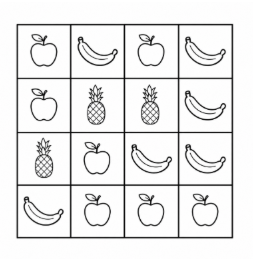
Loading solution...
If $$2^{2^{x^2-1}}=16$$, then the value of $$x^4$$ is
Loading solution...
In the adjoining figure, two rectangles and two right-angled triangles are arranged as shown. The numbers shown inside each are their respective areas. Then the area of $$A$$ is
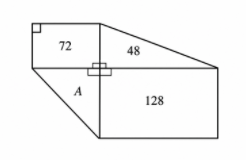
Loading solution...
The sum of the length and breadth of a rectangle is $$6\text{ cm}$$. A square is constructed whose side is equal to the diagonal of the rectangle. If the ratio of the areas of the square and the rectangle is $$\frac{5}{2}$$, then the area of the square in $$\text{cm}^2$$ is
Loading solution...
If the area of a circle of radius $$5$$ is numerically $$x\%$$ of its circumference, then $$x$$ is
Loading solution...
There are $$3$$ positive real numbers. The second is greater than the first by the same amount that the third is greater than the second. The product of the two smaller numbers is $$85$$ and that of the two bigger numbers is $$115$$. Then the difference between the smallest and the greatest numbers is
Loading solution...
The numbers $$1,3,6,10,\ldots$$ are called triangular numbers. The $$n$$th triangular number is $$T_n=\frac{n(n+1)}{2}$$. Then the value of $$T_{3n+1}-9T_n$$ is equal to
Loading solution...
I read $$\frac{3}{8}$$ of a book on one day and $$\frac{4}{5}$$ of the remainder on another day. If $$30$$ pages are still unread, then the total number of pages in the book is
Loading solution...
Three persons $$A,B,C$$ participate in a running race of $$1\text{ km}$$ distance. When $$A$$ and $$B$$ run, $$A$$ wins by $$60$$ seconds. When $$A$$ and $$C$$ run, $$A$$ wins by $$375\text{ m}$$. When $$B$$ and $$C$$ run, $$B$$ wins by $$30$$ seconds. If the time taken by $$B$$ to run $$1\text{ km}$$ is $$x$$ minutes and $$30$$ seconds, then $$x$$ is
Loading solution...
A ruler with no mark on it can measure its own length $$AB$$. A ruler with only one mark on it can measure $$3$$ lengths $$AB,AC,BC$$. A ruler with two marks on it can measure $$6$$ lengths $$AB,AC,CD,DB,AD,CB$$. Then the number of lengths a ruler with $$4$$ marks on it can measure is
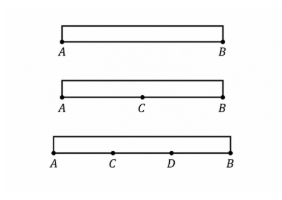
Loading solution...
In the adjoining figure, the value of $$x$$ in degrees is
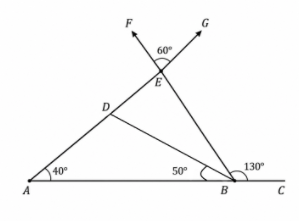
Loading solution...
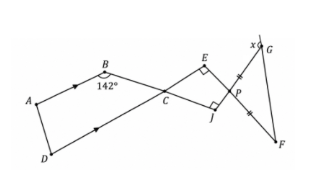
In the adjoining figure, $$AB$$ || $$DC$$. Also, $$PG=PF$$. The measure of angle $$x$$ in degrees is
Loading solution...
The sum of the first and last of four consecutive odd integers is $$52$$. The sum of all of them is
Loading solution...
The square root of a number plus $$2$$ gives the number itself. Then the number is
Loading solution...
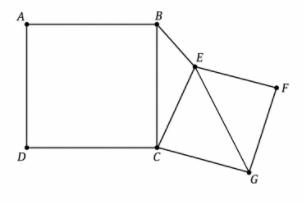
$$ABCD$$ and $$CEFG$$ are two squares such that the extension of $$GE$$, a diagonal of $$CEFG$$, passes through $$B$$. Given $$BE=6\text{ cm}$$ and $$CG=4\sqrt{2}\text{ cm}$$, then the area of square $$ABCD$$ in $$\text{cm}^2$$ is
Loading solution...
Predict your JEE Main percentile, rank & performance in seconds

Educational materials for JEE preparation
 Share
Share