Sign in
Please select an account to continue using cracku.in
↓ →

Join Our JEE Preparation Group
Prep with like-minded aspirants; Get access to free daily tests and study material.
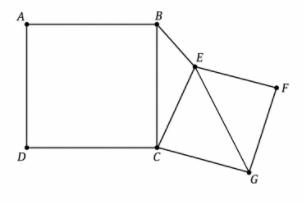
$$ABCD$$ and $$CEFG$$ are two squares such that the extension of $$GE$$, a diagonal of $$CEFG$$, passes through $$B$$. Given $$BE=6\text{ cm}$$ and $$CG=4\sqrt{2}\text{ cm}$$, then the area of square $$ABCD$$ in $$\text{cm}^2$$ is
Correct Answer: 116
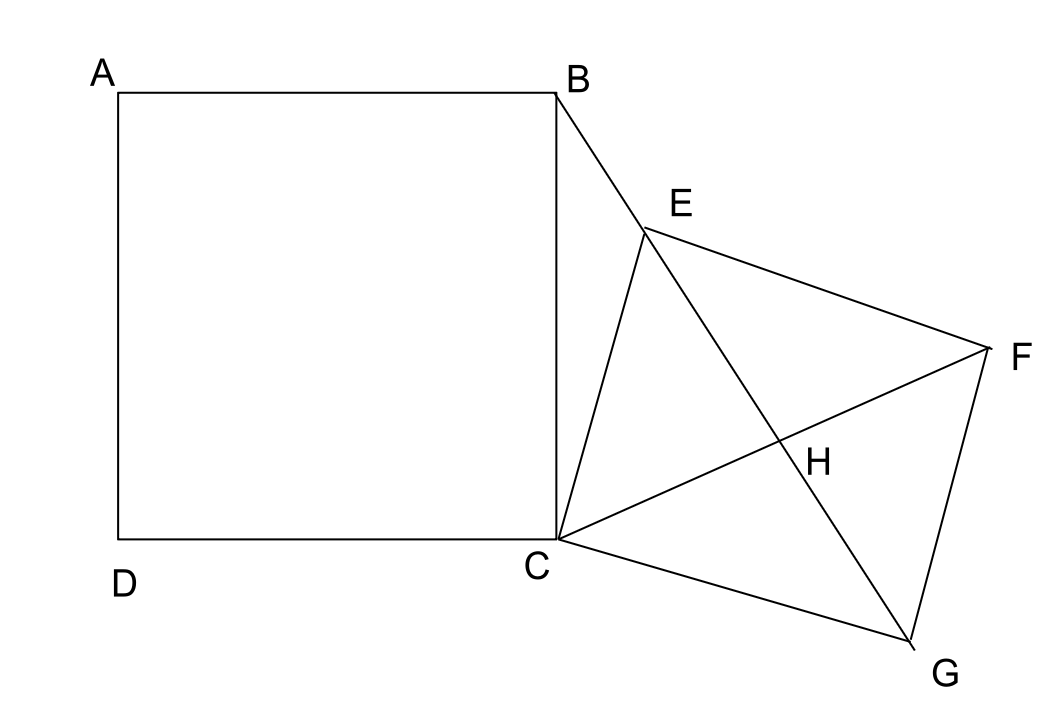
The side of square $$CEFG$$ is $$CG=4\sqrt{2}$$, so its diagonal $$GE$$ is $$\sqrt{(4\sqrt{2})^2+(4\sqrt{2})^2 }= 8$$cm
In a square, the diagonals bisect each other perpendicularly.
Thus, $$ CH = EH = \dfrac{8}{2} = 4$$cm
In $$\triangle BHC$$ we can apply Pythagoras theorem to find the length of BC
$$BH = 6+4 = 10, CH = 4 \implies BC = \sqrt{10^2 + 4^2} = \sqrt{116}$$cm
Thus, Area of the square is
$$BC^2 = 116\text{cm}^2$$
Was this solution helpful?
_1.webp)
Predict your JEE Main percentile, rank & performance in seconds

Educational materials for JEE preparation

Ask our AI anything

AI can make mistakes. Please verify important information.
AI can make mistakes. Please verify important information.
 91- 6303239042
