There is a 6-digit number in which the first and the fourth digit from the first are the same, the second and the fifth digit from the first are the same and the third and the sixth digit from the first are the same. Then the number is always
NMTC kaprekar ( sub junior level) 7th and 8th Aug 31 2024
For the following questions answer them individually
Solution
Let the number be $$abcabc$$. Its value is $$100000a+10000b+1000c+100a+10b+c=1001(100a+10b+c)$$. Since $$1001=7\times 11\times 13$$, the number is always divisible by $$11$$.
Starting from the number $$1$$, Ritu generates a series of numbers as $$1,3,6,11,18,29,42,\ldots$$ such that the differences of the consecutive numbers from the beginning give consecutive primes. In this series she came across a perfect square for the first time. The square root of this perfect square is
Solution
Starting with $$1$$, add the consecutive primes $$2,3,5,7,11,\ldots$$. The terms obtained are $$1,3,6,11,18,29,42,59,78,101,130,161,198,239,282,329,382,441$$. The first new perfect square is $$441=21^2$$, so its square root is $$21$$.
The expression $$\frac{x\left(\frac{\sqrt{x}+\sqrt{y}}{2y\sqrt{x}}\right)^{-1}+y\left(\frac{\sqrt{x}+\sqrt{y}}{2x\sqrt{y}}\right)^{-1}}{\left(\frac{x+\sqrt{xy}}{2xy}\right)^{-1}+\left(\frac{y+\sqrt{xy}}{2xy}\right)^{-1}}$$ reduces to
Solution
The numerator becomes $$\frac{2xy\sqrt{x}}{\sqrt{x}+\sqrt{y}}+\frac{2xy\sqrt{y}}{\sqrt{x}+\sqrt{y}}=2xy$$. Writing $$x=\left(\sqrt{x}\right)^2$$ and $$y=\left(\sqrt{y}\right)^2$$, the denominator becomes $$\frac{2xy}{x+\sqrt{xy}}+\frac{2xy}{y+\sqrt{xy}}=2\sqrt{xy}$$. Therefore the expression equals $$\frac{2xy}{2\sqrt{xy}}=\sqrt{xy}$$.
.webp)
The sum of the digits of a two-digit number is multiplied by $$8$$ and the result is found to be $$13$$ more than the number. Then the two-digit number is
Solution
Let the tens digit be $$a$$ and the units digit be $$b$$. Then $$8(a+b)=10a+b+13$$, which gives $$7b=2a+13$$. The only valid digit pair is $$a=4$$ and $$b=3$$, so the number is $$43$$, which is prime.
A water tank is fitted with four different taps as outlets. If the tank is full, it takes $$1\ \text{hour}$$ to empty the tank when the first tap alone is opened, it takes $$2\ \text{hours}$$ to empty the tank when the second tap alone is opened, it takes $$3\ \text{hours}$$ when the third tap alone is opened and $$4\ \text{hours}$$ to empty the tank when the fourth tap alone is opened. . When all the taps are opened simultaneously, the full tank will be emptied in
Solution
The combined emptying rate is $$1+\frac{1}{2}+\frac{1}{3}+\frac{1}{4}=\frac{25}{12}$$ tanks per hour. Hence the required time is $$\frac{12}{25}$$ hour. This is $$\frac{12}{25}\times 60=28.8$$ minutes, which lies between $$28$$ and $$29$$ minutes.
Two primes $$p,q$$ are such that $$p+q$$ is odd and $$q-10p=23$$. Then $$q-20p$$ equals
Solution
Since the sum of two primes is odd, one of the primes must be $$2$$. The equation $$q-10p=23$$ cannot hold with $$q=2$$, so $$p=2$$ and $$q=43$$. Therefore $$q-20p=43-40=3$$.
.webp)
Which one of the following is a false statement?
Solution
If the diagonals of a quadrilateral bisect each other, the quadrilateral is a parallelogram. A parallelogram need not be a rectangle because its angles need not be right angles. Therefore the last statement is false.
Soham has his $$23^{\text{rd}}$$ birthday on $$1^{\text{st}}$$ January $$2024$$ and he noticed that $$2024$$ is divisible by $$23$$. If he lives till $$100$$ years of age, how many times other than the above, his age would be a divisor of the then year?
Solution
Soham was born in $$2001$$, so at age $$n$$ the year is $$2001+n$$. The condition requires $$n$$ to divide $$2001+n$$, which is equivalent to $$n$$ dividing $$2001$$. Since $$2001=3\times 23\times 29$$, the future ages after $$23$$ and up to $$100$$ that work are $$29,69,87$$, giving $$3$$ more occasions.
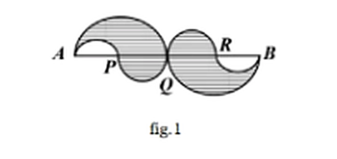
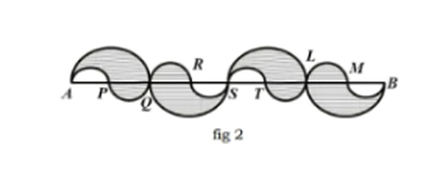
Consider the two figures shown here. $$AB=16\ \text{cm}$$ in both the figures. Points $$P,Q,R$$ divide $$AB$$ into equal lengths in figure $$1$$. Similarly, $$P,Q,R,S,T,L,M$$ divide $$AB$$ into equal lengths in figure $$2$$. All the curves are semicircles. If $$[a]$$ and $$[b]$$ are the areas of the shaded figures respectively in figure $$1$$ and figure $$2$$, then
Solution
In figure $$1$$, the shaded parts combine to form one complete circle of radius $$4\ \text{cm}$$, so $$[a]=\pi(4)^2=16\pi$$. In figure $$2$$, they combine to form two complete circles of radius $$2\ \text{cm}$$, so $$[b]=2\pi(2)^2=8\pi$$. Thus $$[a]-[b]=8\pi$$, which is non-zero.
.webp)
The sum of $$11$$ consecutive natural numbers is $$121$$. The sum of the next three numbers is
Solution
Let the first of the $$11$$ numbers be $$n$$. Then $$11n+(1+2+\cdots+10)=121$$, so $$11n+55=121$$ and $$n=6$$. The next three numbers after $$6$$ through $$16$$ are $$17,18,19$$, whose sum is $$54$$.
A big ship wrecked and $$1000$$ people landed on a remote island. The food material was available for them for $$60$$ days. After $$16$$ days another small ship, which had no food stock, wrecked and $$100$$ people landed on the same island. The number of days the food material for all of them is available is
Solution
The initial food stock is $$1000\times 60=60000$$ person-days. In the first $$16$$ days, $$1000\times 16=16000$$ person-days are consumed, leaving $$44000$$ person-days. For $$1100$$ people, this lasts $$\frac{44000}{1100}=40$$ days.
Two numbers are respectively $$28\%$$ and $$70\%$$ of a third number. The percentage of the first number to the second is
Solution
Let the third number be $$N$$. The first two numbers are $$0.28N$$ and $$0.70N$$. Their percentage ratio is $$\frac{0.28N}{0.70N}\times 100=40\%$$.
The sum of two natural numbers is $$150$$. Their HCF is $$15$$. The number of pairs of such numbers is
Solution
Write the numbers as $$15x$$ and $$15y$$, where $$\gcd(x,y)=1$$. Then $$x+y=10$$. The coprime unordered pairs are $$(1,9)$$ and $$(3,7)$$, so there are $$2$$ pairs.
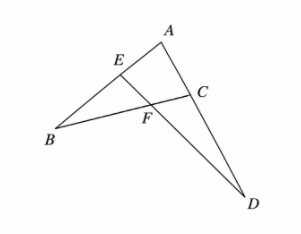
$$ABC$$ and $$ADE$$ are isosceles triangles. If $$\angle BFD=156^\circ$$, then $$\angle A$$ equals
Solution
Let $$\angle A=x$$. Since $$AB=BC$$, the base angle $$\angle ACB=x$$, and since $$AD=DE$$, the base angle $$\angle AED=x$$. In quadrilateral $$ACEF$$, the four interior angles are $$x,x,x$$ and $$156^\circ$$, so $$3x+156^\circ=360^\circ$$ and $$x=68^\circ$$.
Some students are made to stand in rows of equal number, one behind the other. Saket is in the $$3^{\text{rd}}$$ row from the front and $$5^{\text{th}}$$ row from the back. He is $$4^{\text{th}}$$ from the left and $$6^{\text{th}}$$ from the right. The total number of students is
Solution
The number of rows is $$3+5-1=7$$ because Saket's row is counted from both directions. The number of students in each row is $$4+6-1=9$$. Hence the total number of students is $$7\times 9=63$$.
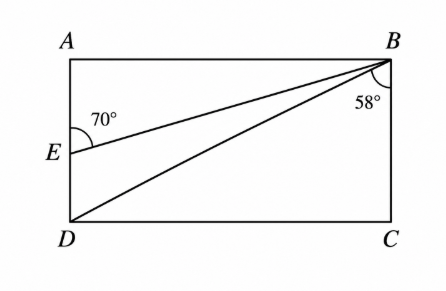
In the adjoining figure, $$ABCD$$ is a rectangle. Then $$\angle EBD$$ is ______ degrees.
Backspace
789
456
123
0.-
Clear All
789
456
123
0.-
Clear All
Solution
Since the corner at $$B$$ is a right angle and the marked angle at $$E$$ is $$70^\circ$$, $$\angle ABE=90^\circ-70^\circ=20^\circ$$. Also, $$\angle DBC=58^\circ$$. Therefore $$\angle EBD=90^\circ-20^\circ-58^\circ=12^\circ$$.
An infinite sequence of positive numbers $$x_1,x_2,x_3,\ldots,x_n,x_{n+1},\ldots$$ satisfies $$x_n^2=(3n+7)+(n-3)x_{n+1}$$, where $$x_n$$ is the $$n^{\text{th}}$$ term of the sequence. Then the numerical value of $$x_1$$ is ______.
Backspace
789
456
123
0.-
Clear All
789
456
123
0.-
Clear All
Solution
Put $$n=3$$ to get $$x_3^2=16$$, so positivity gives $$x_3=4$$. Next, putting $$n=2$$ gives $$x_2^2=13-x_3=9$$, so $$x_2=3$$. Finally, putting $$n=1$$ gives $$x_1^2=10-2x_2=4$$, hence $$x_1=2$$.
For $$n\ge 2$$ and $$n\in\mathbb{Z}$$, the smallest positive integer $$n$$ for which none of the fractions $$\frac{17}{n+17},\frac{18}{n+18},\frac{19}{n+19},\ldots,\frac{100}{n+100}$$ can be simplified is ______.
Backspace
789
456
123
0.-
Clear All
789
456
123
0.-
Clear All
Solution
For each numerator $$k$$, $$\gcd(k,n+k)=\gcd(k,n)$$. Therefore $$n$$ must be coprime to every integer from $$17$$ through $$100$$. Every prime at most $$100$$ divides at least one number in this range, so the smallest possible prime factor of $$n$$ is $$101$$, and the least valid value is $$101$$.
In triangle $$ABC$$, $$AB=15\ \text{cm}$$, $$BC=20\ \text{cm}$$ and $$CA=25\ \text{cm}$$. Then the length of the shortest altitude of the triangle in $$\text{cm}$$ is ______.
Backspace
789
456
123
0.-
Clear All
789
456
123
0.-
Clear All
Solution
Since $$15^2+20^2=25^2$$, the triangle is right-angled and its area is $$\frac{1}{2}\times 15\times 20=150\ \text{cm}^2$$. The shortest altitude is drawn to the longest side, which is $$25\ \text{cm}$$. Thus $$150=\frac{1}{2}\times 25\times h$$, giving $$h=12$$.
The units digit of $$19^{2025}+999^{2023}$$ is ______.
Backspace
789
456
123
0.-
Clear All
789
456
123
0.-
Clear All
Solution
Both powers have the same units digit as an odd power of $$9$$. An odd power of $$9$$ ends in $$9$$, so the sum ends like $$9+9=18$$. Therefore the units digit is $$8$$.
$$N$$ is a two-digit number. When $$6$$ is added to the tens digit and $$2$$ is subtracted from the units digit, we get a two-digit number which is equal to $$3N$$. Then $$N$$ is ______.
Backspace
789
456
123
0.-
Clear All
789
456
123
0.-
Clear All
Solution
Let $$N=10a+b$$. The new number is $$10(a+6)+(b-2)=N+58$$, and it equals $$3N$$. Hence $$N+58=3N$$, so $$N=29$$.
$$ABCD$$ is a quadrilateral. $$AB$$ is parallel to $$CD$$ and $$AB>CD$$. If $$AD=AB=BC$$ and $$\angle ADC=140^\circ$$, then the measure of $$\angle CAB$$ is ______ degrees.
Backspace
789
456
123
0.-
Clear All
789
456
123
0.-
Clear All
Solution
Since $$AB\parallel CD$$, the consecutive interior angles give $$\angle DAB=180^\circ-140^\circ=40^\circ$$. Also, $$AD=BC$$ makes the trapezium isosceles, so $$\angle ABC=40^\circ$$. In triangle $$ABC$$, $$AB=BC$$, so if $$\angle CAB=\angle ACB=x$$, then $$2x+40^\circ=180^\circ$$ and $$x=70^\circ$$.
The product of two positive numbers $$x$$ and $$y$$ is $$4$$ times their sum and the same product is $$8$$ times their difference. If $$x\ge y$$, then $$x$$ is ______.
Backspace
789
456
123
0.-
Clear All
789
456
123
0.-
Clear All
Solution
The conditions give $$xy=4(x+y)$$ and $$xy=8(x-y)$$. Equating the right sides gives $$4(x+y)=8(x-y)$$, so $$x=3y$$. Substituting into the first equation gives $$3y^2=16y$$, and positivity gives $$y=\frac{16}{3}$$ and hence $$x=16$$.
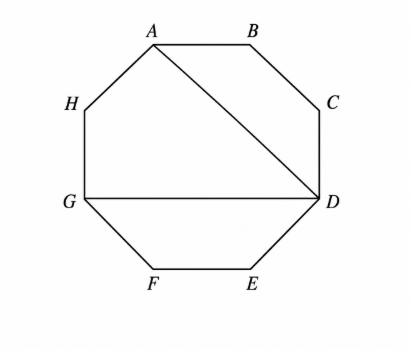
In the adjoining figure, $$ABCDEFGH$$ is a regular octagon. The measure of $$\angle ADG$$ in degrees is ______.
Backspace
789
456
123
0.-
Clear All
789
456
123
0.-
Clear All
Solution
The vertices of a regular octagon lie on a circle, and each central angle is $$\frac{360^\circ}{8}=45^\circ$$. The minor arc from $$A$$ to $$G$$ through $$H$$ spans two sides, so its measure is $$90^\circ$$. The inscribed angle $$\angle ADG$$ subtending this arc is half of $$90^\circ$$, which is $$45^\circ$$.
If $$2^{3a+2}=4^{b+7}$$ and $$3^{a+10}=27^{2b+10}$$, then the value of $$a^2+b^2$$ is ______.
Backspace
789
456
123
0.-
Clear All
789
456
123
0.-
Clear All
Solution
Comparing powers of $$2$$ gives $$3a+2=2b+14$$, so $$3a-2b=12$$. Comparing powers of $$3$$ gives $$a+10=6b+30$$, so $$a-6b=20$$. Solving these equations gives $$a=2$$ and $$b=-3$$, hence $$a^2+b^2=4+9=13$$.
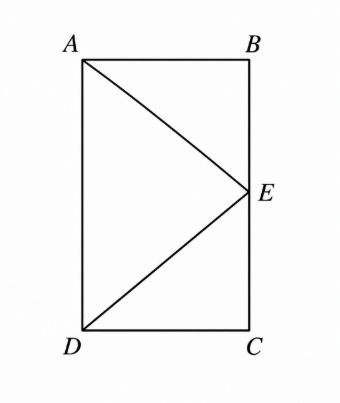
$$ABCD$$ is a rectangle. $$AB=6$$ and $$AD=10$$. $$E$$ is a point on $$BC$$ such that $$AE=10$$. Then the area of triangle $$\triangle ADE$$ in square units is ______.
Backspace
789
456
123
0.-
Clear All
789
456
123
0.-
Clear All
Solution
Take $$AD$$ as the base of triangle $$ADE$$. Since $$E$$ lies on the side $$BC$$ of the rectangle, its perpendicular distance from $$AD$$ equals $$AB=6$$. Therefore the area is $$\frac{1}{2}\times 10\times 6=30$$ square units.
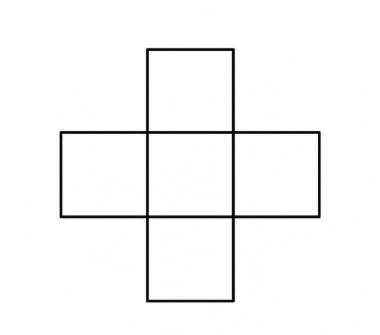
The numbers $$1,4,7,10$$ and $$13$$ are placed in each box of the figure, such that the sums of the numbers in the horizontal or vertical boxes are the same. The largest possible value of the horizontal or vertical sum is ______.
Backspace
789
456
123
0.-
Clear All
789
456
123
0.-
Clear All
Solution
To maximize the common sum, place the largest number $$13$$ in the centre because it is counted in both lines. The remaining numbers can be paired as $$1+10=11$$ and $$4+7=11$$. Thus each line has sum $$13+11=24$$.
The number of integer pairs $$(m,n)$$ such that $$m(n^2+1)=48$$ is ______.
Backspace
789
456
123
0.-
Clear All
789
456
123
0.-
Clear All
Solution
Since $$n^2+1$$ must divide $$48$$, check the divisors of $$48$$ that are one more than a perfect square. The possibilities are $$n^2+1=1$$ and $$n^2+1=2$$, giving $$n=0,1,-1$$. Each value determines one integer $$m$$, so there are $$3$$ ordered pairs.
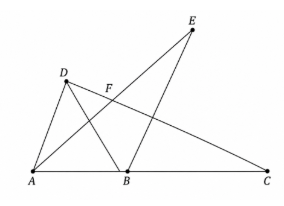
In the adjoining figure, triangles $$\triangle ABD$$ and $$\triangle BCE$$ are equilateral triangles. The measure of $$\angle AFC$$ is ______ degrees.
Backspace
789
456
123
0.-
Clear All
789
456
123
0.-
Clear All
Solution
Triangles $$ABE$$ and $$DBC$$ are congruent because $$AB=BD$$, $$BE=BC$$ and both included angles at $$B$$ are $$120^\circ$$. Let $$\angle AEB=\angle DCB=x$$. Then in triangle $$FEC$$, $$\angle FEC=60^\circ+x$$ and $$\angle FCE=60^\circ-x$$, so the exterior angle $$\angle AFC$$ equals their sum, which is $$120^\circ$$.
The value of $$\frac{\sqrt[4]{27\cdot\sqrt[3]{9}}}{\sqrt[6]{9\cdot 3^3\cdot\sqrt{3}}}$$ is ______.
Backspace
789
456
123
0.-
Clear All
789
456
123
0.-
Clear All
Solution
The numerator is $$\sqrt[4]{3^3\cdot 3^{2/3}}=3^{11/12}$$. The denominator is $$\sqrt[6]{3^2\cdot 3^3\cdot 3^{1/2}}=3^{11/12}$$. Their ratio is therefore $$1$$.

