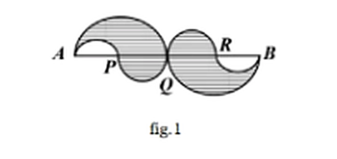
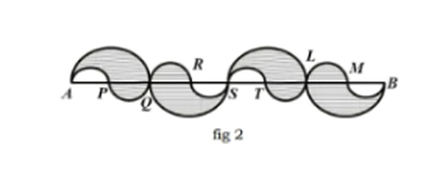
Consider the two figures shown here. $$AB=16\ \text{cm}$$ in both the figures. Points $$P,Q,R$$ divide $$AB$$ into equal lengths in figure $$1$$. Similarly, $$P,Q,R,S,T,L,M$$ divide $$AB$$ into equal lengths in figure $$2$$. All the curves are semicircles. If $$[a]$$ and $$[b]$$ are the areas of the shaded figures respectively in figure $$1$$ and figure $$2$$, then
Solution
In figure $$1$$, the shaded parts combine to form one complete circle of radius $$4\ \text{cm}$$, so $$[a]=\pi(4)^2=16\pi$$. In figure $$2$$, they combine to form two complete circles of radius $$2\ \text{cm}$$, so $$[b]=2\pi(2)^2=8\pi$$. Thus $$[a]-[b]=8\pi$$, which is non-zero.
Get AI Help
Book Free CAT Mentorship
Get personalized CAT strategy from a 99%iler
500+ students mentored
OTP Verification
Enter the 6-digit code sent to your phone
Booking Summary
Enter OTP
Didn't receive the OTP?