91- 6303239042


 Group


 Preferred Source

 Google Discover
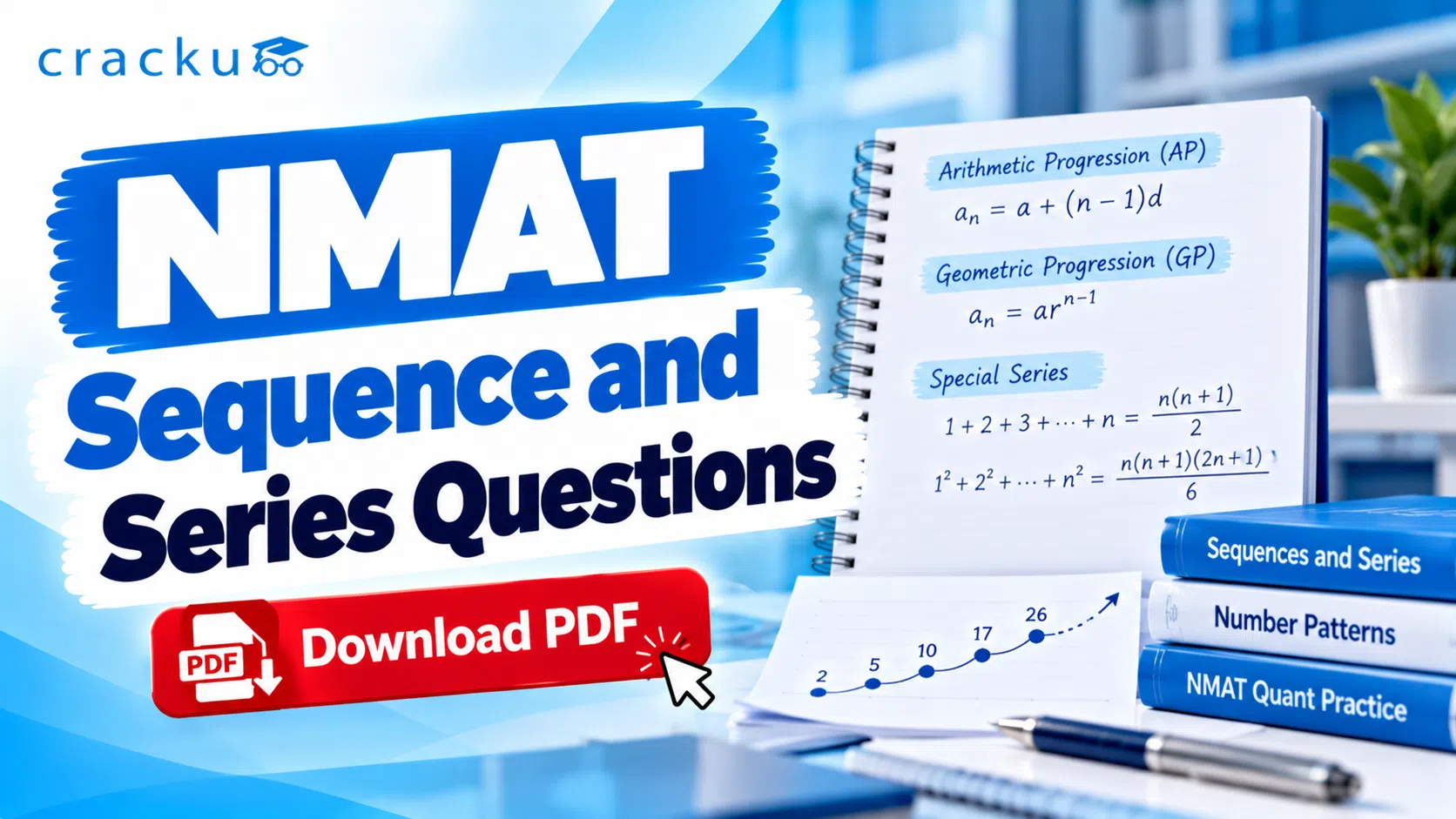
NMAT Sequence and Series Questions
Sequence and Series is one of the most formula-driven topics in the NMAT Quantitative Skills section. The section has 36 questions to be solved in 52 minutes, and Sequence and Series usually accounts for 1 to 2 of them. Since NMAT has no negative marking, every question you solve quickly and correctly adds directly to your scaled score.
Most NMAT Sequence and Series questions are built on two progressions: the Arithmetic Progression, where a fixed number is added each time, and the Geometric Progression, where each term is multiplied by a fixed ratio. Standard patterns include finding the nth term, the sum of n terms, the number of terms between two values, three or four terms in AP or GP, the sum of an infinite GP, sums of natural numbers, squares and cubes, and finding the missing or wrong term in a number series.
NMAT is a computer-adaptive test, so solving formula-based questions like these quickly and accurately helps you reach higher-difficulty questions. Number-series patterns can also appear in the Logical Reasoning section, so the practice pays off beyond Quant.
Try to solve 10 to 15 Sequence and Series questions daily, mixing AP and GP questions, sum-based questions, number series questions and Data Sufficiency questions. This builds the pattern recognition you need to finish the Quant section on time.
NMAT Sequence and Series Questions PDF
A single NMAT Sequence and Series Questions PDF lets you practise every important pattern in one place instead of searching through books and websites. It also makes last-minute revision quick, since the AP and GP formulas and solved examples sit together.
This PDF covers the nth term and sum of an AP, the nth term and sum of a GP, the sum of an infinite GP, choosing terms in AP or GP, arithmetic and geometric means, sums of natural numbers, squares and cubes, missing and wrong terms in number series, and an NMAT-style Data Sufficiency question. Every question comes with a step-by-step solution so you can check both your answer and your method.
Solve the questions in a timed setting, aiming for about 1.5 minutes per question. After each set, go through the solutions and note where a symmetric choice of terms or the average-term shortcut could have saved time. Revisit the questions you got wrong after a few days to make sure the concept has stuck.
Download NMAT Sequence and Series Questions PDF
How to Solve NMAT Sequence and Series Questions
Here are some methods that can help you solve NMAT Sequence and Series questions quickly and accurately:
Identify the progression first: Check the difference between consecutive terms. If it is constant, the sequence is an AP. If the ratio between consecutive terms is constant, it is a GP. Spending five seconds on this tells you which formula to use.
Use the middle term for AP sums: The sum of an AP equals the number of terms × the average of the first and last terms. For 7, 11, 15, …, 87: number of terms = (87 − 7) ÷ 4 + 1 = 21, so the sum = 21 × (7 + 87) ÷ 2 = 21 × 47 = 987.
Learn the key results by heart:
- nth term of an AP = a + (n − 1)d
- Sum of n terms of an AP = n/2 × [2a + (n − 1)d] = n/2 × (first term + last term)
- Number of terms in an AP = (Last term − First term) ÷ d + 1
- nth term of a GP = a × r^(n − 1)
- Sum of n terms of a GP = a × (r^n − 1) ÷ (r − 1), where r ≠ 1
- Sum of an infinite GP = a ÷ (1 − r), where −1 < r < 1
- Arithmetic mean of a and b = (a + b) ÷ 2; geometric mean = √(ab); harmonic mean = 2ab ÷ (a + b)
- For positive numbers, AM ≥ GM ≥ HM, and GM² = AM × HM
- Sum of the first n natural numbers = n(n + 1) ÷ 2
- Sum of their squares = n(n + 1)(2n + 1) ÷ 6; sum of their cubes = [n(n + 1) ÷ 2]²
- Sum of the first n odd numbers = n²; sum of the first n even numbers = n(n + 1)
Choose terms symmetrically: Take three terms in AP as a − d, a, a + d, and four terms as a − 3d, a − d, a + d, a + 3d. For a GP, take three terms as a/r, a, ar. The common difference or ratio then cancels in the sum or product. If three numbers in AP add up to 24 and multiply to 440, the middle term is 8, so (8 − d)(8 + d) = 55, giving d = 3 and the numbers 5, 8 and 11.
Work through number series in layers: First check the differences. If they do not settle, check the differences of the differences, then ratios, then squares and cubes with a small adjustment, then alternate terms. In 2, 6, 12, 20, 30, the differences are 4, 6, 8, 10, so the next term is 30 + 12 = 42.
Find the wrong term using the majority: In a wrong-term question, most terms follow the rule. Build the pattern from the terms that fit and the odd one out shows itself.
Check the conditions on GP formulas: The infinite sum formula works only when the common ratio lies between −1 and 1. Confirm this before applying it, especially when the options look close.
For Data Sufficiency, do not solve fully: An AP is fixed by any two independent facts, such as the first term and the common difference, or any two terms. Stop as soon as you see whether a statement gives you two such facts.
Question 1
The sum of $$n-$$ terms of sequence $$\dfrac{1}{1\times2}+\dfrac{1}{2\times3}+\dfrac{1}{3\times4}.......$$ is
correct answer:- 4
Question 2
DIRECTION for the question: Solve the following question and mark the best possible option.
A car company sold 150 cars in a special 6-day sale. Each day, the company sold 6 more than the previous day. How many cars were sold on the 6th day?
correct answer:- 2
Question 3
Find the 1st term of an A. P whose 8th and 12th terms are 39 and 59 respectively
correct answer:- 2
Question 4
Find the value of $$\dfrac{1}{4 \times 5} + \dfrac{1}{5 \times 6} + \dfrac{1}{6 \times 7} + ....... + \dfrac{1}{10 \times 11}$$:
correct answer:- 3
Question 5
What is the 95th term of the following letter series?
A, A, B, B, B, B,C, C,C, C,C, C, D, D, D, D, D, D, D, D, E, ...
correct answer:- 3

Question 6
If seventh and eleventh terms of an arithmetic progression are 31 and 47 respectively. then fifteenth termis
correct answer:- 2
Question 7
Let $$a_1, a_2, ......... a_{19}$$ be the first 19 terms of an arithmetic progression where $$a_1 + a_8 + a_{12} + a_{19} = 224$$. The sum $$a_1 + a_2 + a_3 + ........ + a_{19}$$ is equal to
correct answer:- 3
Question 8
Each of the series S1 = 2 + 4 + 6 + ......... and S2 = 3 + 6 + 9 + ......... is continued
to 100 terms. Find how many terms are identical.
correct answer:- 2
Question 9
What is the sum of the first 11 terms of an arithmetic progression if the 3rd term is -1 and the 8th term is 19?
correct answer:- 2
Question 10
Let $$a_1$$, $$a_2$$,............., $$a_{3n}$$ be an arithmetic progression with $$a_1$$ = 3 and $$a_{2}$$ = 7. If $$a_1$$+ $$a_{2}$$ +...+ $$a_{3n}$$= 1830, then what is the smallest positive integer m such that m($$a_1$$+ $$a_{2}$$ +...+ $$a_n$$) > 1830?
correct answer:- 2

Question 11
There are 8436 steel balls, each with a radius of 1 centimeter, stacked in a pile, with 1 ball on top, 3 balls in the second layer, 6 in the third layer, 10 in the fourth, and so on. The number of horizontal layers in the pile is
correct answer:- 3
Question 12
The sum of 3rd and 15th elements of an arithmetic progression is equal to the sum of 6th, 11th and 13th elements of the same progression. Then which element of the series should necessarily be equal to zero?
correct answer:- 3
Question 13
The number of common terms in the two sequences 17, 21, 25,…, 417 and 16, 21, 26,…, 466 is
correct answer:- 3
Question 14
There are 8436 steel balls, each with a radius of 1 centimeter, stacked in a pile, with 1 ball on top, 3 balls in the second layer, 6 in the third layer, 10 in the fourth, and so on. Determine the number of horizontal layers in the pile?
correct answer:- 2
Question 15
A man earns Rs 20 on the first day and spends Rs 15 on the next day. He again
earns Rs 20 on the third day and spends Rs 15 on the fourth day. If he continues to save like
this, how soon will he have Rs 60 in hand?
correct answer:- 1