Group
Group
 Group
Group


 Preferred Source

 Google Discover
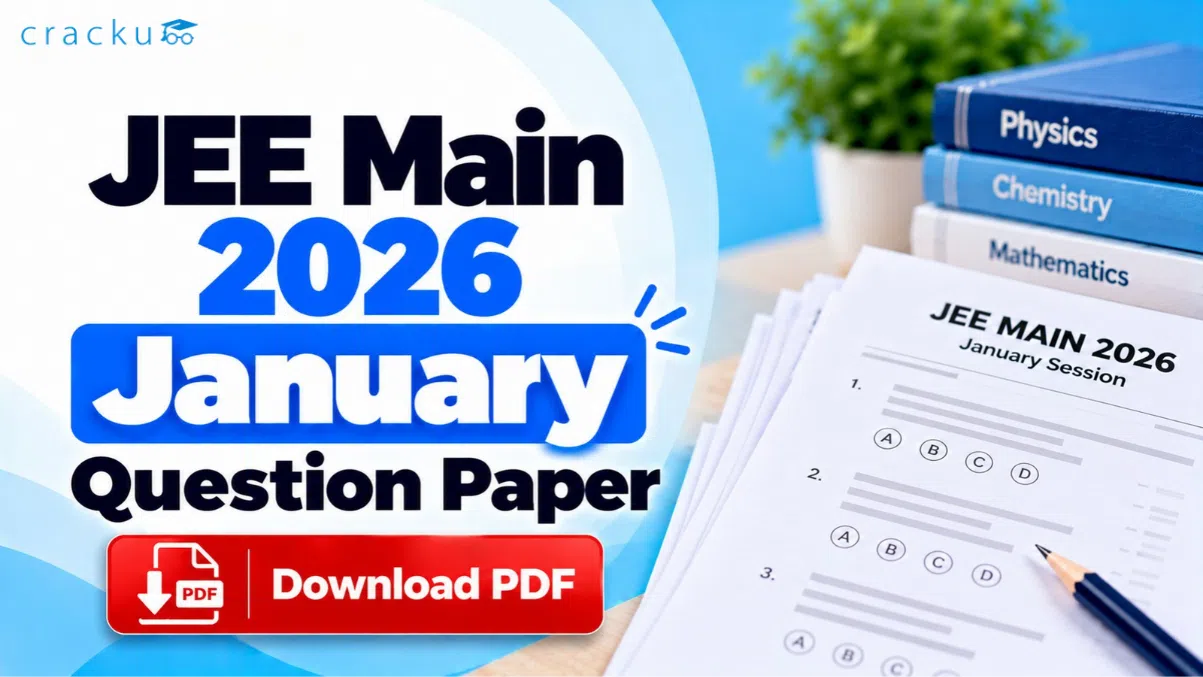
JEE Main 2026 January Question Paper
Download the JEE Main 2026 January Question Paper PDFs with detailed explanations and video solutions for every question, or attempt the papers as tests on Cracku. The January session covered ten B.E./B.Tech. shifts, with two shifts each on January 21, 22, 23, 24 and 28, 2026.
These Session 1 papers help you understand the question format, assess your preparation and practise managing time across Physics, Chemistry and Mathematics. Solve a paper before checking its solutions to identify what you can do independently.
According to the NTA information bulletin, Paper 1 follows the pattern below:
| Particular | Details |
|---|---|
| Examination | JEE Main 2026 Session 1 |
| Paper covered | Paper 1: B.E./B.Tech. |
| Examination mode | Computer-based test |
| Subjects | Physics, Chemistry and Mathematics |
| Questions per subject | 20 MCQs + 5 numerical-value questions |
| Total questions | 75 |
| Maximum marks | 300 |
| Standard duration | 180 minutes |
| Correct answer | +4 marks |
| Incorrect answer | −1 mark in both question types |
| Unanswered question | 0 marks |
Use the same marking scheme during practice. Avoid checking notes midway, and keep enough time to review answers before submitting your attempt.
JEE Main 2026 January Question Paper PDF
The JEE Main 2026 January Question Paper PDF collection below covers all ten Paper 1 shifts. Each Cracku PDF includes explanations and video solutions for every question. Choose the PDF for offline practice or the test link for an online attempt.
Begin with one paper and complete it without opening the solutions. Afterwards, check incorrect and skipped questions. Watch the video explanation when you need help understanding the approach, then solve the question again independently.
For broader practice, include JEE Mains previous papers from other years. This helps you become familiar with different ways of testing the same concept.
Also Check: JEE Main 2026 April Question Paper PDF with Video Solutions
JEE Main 2026 January Question Paper Analysis
JEE Main 2026 January Question Paper analysis should help you understand your performance across subjects. Review accuracy, time spent and the reasons behind incorrect or skipped answers.
Use the following framework when reviewing a completed paper:
| Subject | What to Analyse | Revision Focus |
|---|---|---|
| Physics | Concept selection, formulas, units and calculations | Strengthen concepts and numerical accuracy |
| Chemistry | Recall, reactions, reasoning and numerical methods | Review facts and practise their application |
| Mathematics | Approach, calculation steps and time required | Improve method selection and execution |
Separate mistakes into concept gaps, calculation errors, misreading and poor question selection. For example, knowing the formula but substituting the wrong value needs a different correction from not knowing how to start.
Use JEE Study Material to revise the specific concepts highlighted by your mistakes. Review slow correct answers too, as an unnecessarily lengthy method can leave less time for other questions.
JEE Main 2026 January Question Paper Difficulty Level
The difficulty you experience while solving a JEE Main 2026 January Question Paper depends on your concept knowledge, familiarity with question types and calculation speed. Assess both the reasoning involved and the time required.
The categories below are a practice guide for reviewing your attempt, rather than an official shift ranking.
| Category | Question Characteristics | Suggested Approach |
|---|---|---|
| Easy | Familiar concepts and straightforward steps | Solve accurately and check basic errors |
| Moderate | Additional reasoning or several calculations | Choose a clear method and monitor time |
| Difficult | Unfamiliar applications or combined concepts | Return after completing manageable questions |
A lengthy question may require faster execution rather than more conceptual study. A short question can still be challenging if you have not understood the principle behind it.
After revision, attempt a Free JEE Mains mock test to check whether you can apply what you learnt under timed conditions.
How to Identify Important Topics from JEE Main 2026 January Papers?
Identify important topics by comparing chapter frequency across January shifts and combining it with your own performance. Avoid deciding your revision priorities from a single paper.
- Tag questions: Note the chapter and specific concept tested.
- Compare shifts: Count topic appearances across the papers you complete.
- Track accuracy: Record correct, incorrect and skipped questions by chapter.
- Prioritise revision: Address recurring topics where your understanding is weak.
- Check improvement: Practise fresh JEE Questions from revised topics.
For example, repeated mistakes in one chapter suggest that focused revision should come before another full-paper attempt. If your answers are accurate but slow, practise solving similar questions more efficiently.
Use the January papers as part of your JEE Mains 2026 Question paper practice, alongside the April papers. Compare recurring concepts while keeping the official syllabus as your coverage checklist. Past appearances do not guarantee future questions.
Benefits of Solving JEE Main 2026 January Question Papers
Solving the January papers gives you practice with actual examination questions and helps you make more specific preparation decisions.
Understand question formats: Become familiar with MCQs and numerical-value questions through direct practice.
Improve question selection: Learn which questions to attempt immediately and which to revisit later.
Manage time better: Identify subjects or question types that consume too much time during your attempt.
Make revision focused: Use your error log to choose what to study next instead of revising every chapter equally.
Learn from solutions: Cracku’s explanations and video solutions help you understand the steps behind each answer and compare methods.
Reduce repeated errors: Re-solving missed questions helps you check whether you have corrected the underlying mistake.
Complete one paper, review it carefully and revise your weak areas before moving to the next. Consistent analysis makes each practice attempt more useful.
JEE Main 2026 January Question Paper: Conclusion
The JEE Main 2026 January Question Paper PDFs help you practise actual Session 1 questions across Physics, Chemistry and Mathematics. With ten shifts available as downloadable PDFs and online tests, you can assess your preparation under timed conditions. Review the detailed explanations and video solutions after each attempt to understand mistakes, compare approaches and identify topics that need more work.
Use each paper to decide what to revise next. Track incorrect, skipped and slow correct answers, strengthen weak concepts and re-solve missed questions without help. Combine these January papers with JEE Mains previous papers from other sessions and a Free JEE Mains mock test to check your progress. Regular practice followed by careful analysis can help improve accuracy, time management and question selection.