91- 6303239042



 Group
Group
 Group
Group


 Preferred Source

 Google Discover
IOQM Syllabus 2026
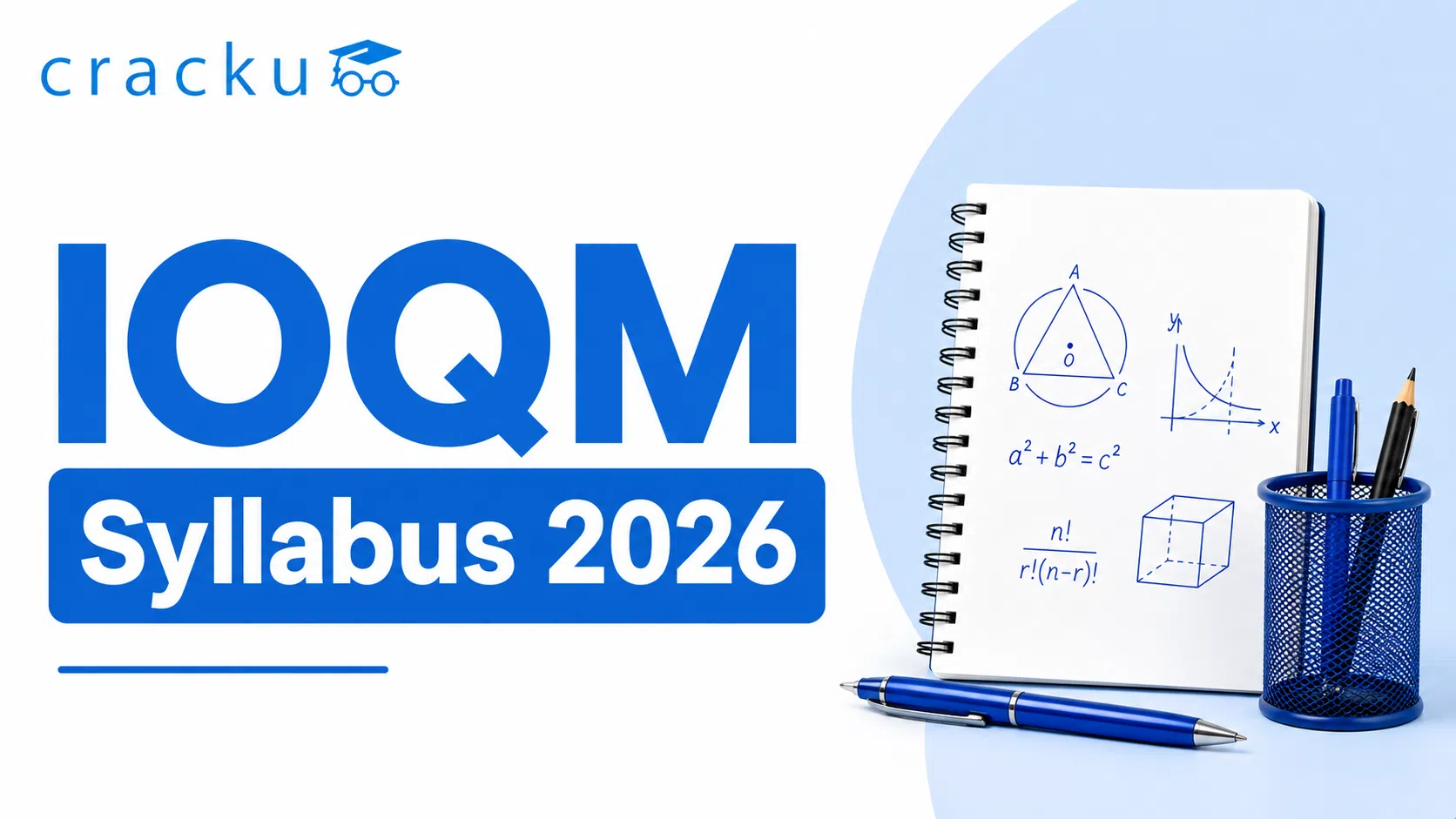
The IOQM Syllabus 2026 provides students with a clear roadmap for preparing for the Indian Olympiad Qualifier in Mathematics. Unlike regular school examinations, IOQM focuses more on mathematical reasoning, logical thinking, and the ability to solve unfamiliar problems than on direct application of formulas. Understanding the syllabus helps students identify the important concepts they need to master and plan their preparation effectively.
The exam covers fundamental topics from areas such as number theory, algebra, geometry, combinatorics, and arithmetic. However, students should also develop strong problem-solving skills, as questions often require creative approaches and multiple steps of reasoning. Knowing the IOQM Syllabus 2026 early allows aspirants to organise their study schedule, practise relevant problems, and gradually build the confidence needed to tackle Olympiad-level mathematics.
IOQM Syllabus 2026 PDF
The IOQM (Indian Olympiad Qualifier in Mathematics) syllabus focuses on developing students’ mathematical reasoning, problem-solving ability, and logical thinking. The syllabus covers key concepts from Number Theory, Algebra, Combinatorics, and Geometry, with an emphasis on applying concepts creatively rather than relying on routine formulas.
The questions are designed to test conceptual understanding and the ability to approach unfamiliar mathematical problems using logical and innovative methods.
IOQM Important Topics 2026
For IOQM 2026, students should focus on four major areas: Algebra, Number Theory, Geometry and Combinatorics. The official IOQM guidance emphasises conceptual understanding, logical reasoning and creative problem-solving rather than routine formula application.
Subject | Important Topics for IOQM 2026 |
Number Theory | Divisibility, GCD & Euclidean Algorithm, Prime Numbers, Fundamental Theorem of Arithmetic, Congruences, Linear Congruences, Chinese Remainder Theorem, Fermat’s Little Theorem, Wilson’s Theorem, Euler’s φ-function, Pythagorean Triples, Diophantine Equations |
Algebra | Polynomials, Factorisation, Theory of Equations, Inequalities, AP/GP/HP, Indices, Systems of Linear Equations, Binomial Theorem, Binomial Coefficients, Complex Numbers, Sequences, Functional Equations |
Geometry | Triangles, Quadrilaterals, Circles, Euclidean Constructions, Similarity, Congruence, Areas, Concurrency & Collinearity, Ceva’s Theorem, Menelaus’ Theorem, Trigonometric Identities, Sine & Cosine Rules, Coordinate Geometry, Vectors |
Combinatorics | Basic Counting & Enumeration, Permutations & Combinations, Pigeonhole Principle, Recursion, Invariants, Elementary Graph |
How to Prepare for the IOQM 2026
Preparing for IOQM requires more than memorising formulas. The exam focuses on logical reasoning, creativity and mathematical problem-solving across Number Theory, Algebra, Geometry and Combinatorics.
- Understand the Syllabus: Start by covering the four core areas: Number Theory, Algebra, Geometry and Combinatorics.
- Build Strong Fundamentals: Focus on understanding concepts and theorems rather than simply memorising formulas.
- Learn Olympiad Techniques: Practice methods such as mathematical induction, contradiction, invariants, the pigeonhole principle and modular arithmetic.
- Solve Previous-Year Papers: Regularly practice previous IOQM and RMO-level questions to understand the exam pattern and difficulty.
- Practice Daily: Dedicate around 1–2 hours every day to focused problem-solving.
- Analyze Your Mistakes: Maintain a mistake notebook and record the concepts or approaches you struggled with.
- Increase Difficulty Gradually: Start with basic Olympiad problems and progressively move towards more challenging questions.
Also Read: IOQM Exam Date 2026, Schedule, Eligibility, Guidelines
IOQM Syllabus 2026 vs School Mathematics Syllabus
IOQM is based largely on foundational school mathematics, but the level of thinking and problem-solving is significantly different. The official IOQM guidance highlights Number Theory, Geometry, Algebra and Combinatorics, with an emphasis on logical reasoning and creativity rather than routine formula application.
Aspect | School Mathematics | IOQM 2026 |
Main Focus | Learning concepts, formulas and standard methods | Logical reasoning, creativity and problem-solving |
Number Theory | Basic divisibility, HCF/LCM, primes, number systems | Divisibility, congruences, Diophantine equations, prime numbers and deeper number-theoretic reasoning |
Algebra | Equations, polynomials, identities, sequences and standard algebraic manipulation | Advanced problem-solving using algebraic identities, inequalities, polynomials, equations and creative techniques |
Geometry | Lines, angles, triangles, circles, coordinate geometry | Deeper Euclidean geometry, constructions, similarity, circles, configurations and multi-step reasoning |
Combinatorics | Basic counting, permutations and combinations | Counting strategies, pigeonhole principle, recursion, invariants and logical arrangements |
Calculus | Introduced in higher secondary mathematics | Not part of the IOQM syllabus |
Statistics | Commonly included in school mathematics | Excluded from IOQM |
Question Style | Usually direct application of concepts and formulas | Non-routine and unfamiliar problems requiring creative approaches |
Formula Dependence | Relatively high | Relatively low; understanding and reasoning are more important |
Difficulty | Progresses according to the school curriculum | Can go beyond routine school-level questions even when the underlying concept is familiar |
Best Books and Resources for IOQM 2026 Preparation
Choosing the right books and study resources can make IOQM preparation more structured and effective. Along with books, solving an IOQM previous year paper is essential for understanding the question style and difficulty level. Students should practise multiple previous year papers under timed conditions and analyse their mistakes after each attempt. Official past papers are available through the Mathematical Olympiad resources, making them a valuable part of preparation.
Resource | Best For | Level |
Challenge and Thrill of Pre-College Mathematics — V. Krishnamurthy et al. | Strong overall foundation, especially Geometry and Olympiad-style thinking | Beginner to Intermediate |
An Excursion in Mathematics — Bhaskaracharya Pratishthana | Algebra, Number Theory, Geometry and Combinatorics | Intermediate |
Problem Primer for Olympiads — C. R. Pranesachar et al. | Building problem-solving skills through topic-wise problems | Beginner to Intermediate |
Elementary Number Theory — David M. Burton | Divisibility, primes, congruences and Number Theory | Intermediate |
Problem Solving Strategies — Arthur Engel | Advanced problem-solving techniques and creative approaches | Advanced |
Mathematical Circles — Fomin et al. | Developing mathematical intuition and creative thinking | Beginner to Intermediate |
Previous IOQM/RMO Papers | Understanding actual exam style and practising under exam conditions | All levels |
HBCSE Official Syllabus & Resources | Official syllabus, recommended books and previous papers | All levels |
IOQM Syllabus 2026: Conclusion
The IOQM Syllabus 2026 covers Number Theory, Algebra, Geometry and Combinatorics, but success requires more than completing individual topics. Students must learn how to connect concepts, reason logically and approach unfamiliar problems creatively. Downloading the syllabus PDF can help aspirants organise these topics and build a practical preparation plan.
Consistent problem-solving, previous-year paper practice and detailed mistake analysis can gradually improve Olympiad-level mathematical ability. Begin with fundamental questions before moving towards advanced problems, use reliable books and resources, and focus on understanding each solution instead of memorising methods.
.webp)