
 Group
Group
 Group
Group


 Preferred Source

 Google Discover
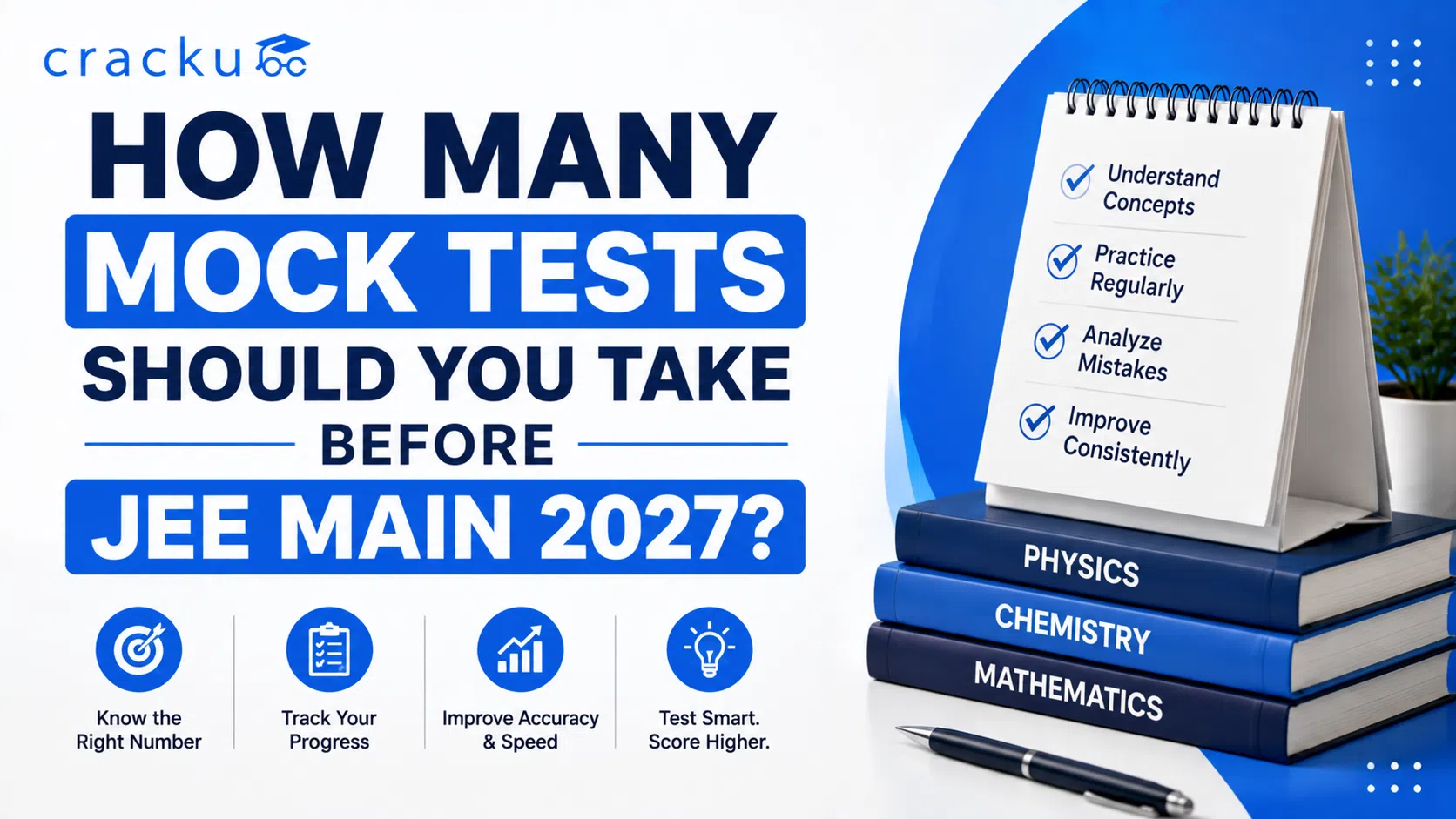
How Many Mock Tests Should You Take Before JEE Main 2027?
Preparing for an entrance exam like JEE can feel like a long game. Books build concepts, but tests show how well those concepts actually work. JEE Mains Mock Tests help you understand your speed, accuracy, and decision-making under pressure. That is why every JEE aspirant should include them in the study plan. As JEE Mains 2027 is underway, one question keeps popping up. How many mock tests are actually enough before the exam? It's not just about the number its also about your understanding, analysis, and improvement.
Why Mock Tests Are Essential for JEE Main 2027 Preparation
Your score depends on more than subject knowledge. The real challenge is solving questions within three hours without losing focus. That is where mock tests make a difference.
Every full-length test builds exam stamina. It also helps you understand how the actual paper feels.
Here is why they matter:
- Improve speed without sacrificing accuracy.
- Build confidence before the real exam.
- Reduce exam-day nervousness.
- Help identify weak chapters early.
- Improve time management across all three subjects.
- Develop a practical attempt strategy.
The latest NTA pattern follows the Computer-Based Test format. Each paper contains 75 questions from Physics, Chemistry, and Mathematics.
- Correct answers carry +4 marks, while incorrect MCQs carry -1 mark.
Practising under the same pattern makes the actual exam feel familiar instead of stressful.
Exam Component | Details |
Mode | Computer Based Test (CBT) |
Duration | 3 Hours |
Total Questions | 75 |
Subjects | Physics, Chemistry, Mathematics |
Correct Answer | +4 Marks |
Wrong MCQ | -1 Mark |
Unattempted | 0 Marks |
A good test platform also provides subject-wise accuracy, time spent on each question, and detailed solutions. These insights help improve every upcoming test instead of repeating the same mistakes.
How Many Mock Tests Should Beginners Attempt?
There is no magic number that works for everyone. The right approach depends on how close the exam is and how strong your preparation feels.
Most students preparing for JEE Mains 2027 benefit from attempting around 20 to 25 full-length mock tests before the exam. The focus should always remain on learning from each test.
Preparation Phase | Recommended Frequency | Main Focus |
6–12 months before the exam | 1 mock every week | Find concept gaps |
3–6 months before the exam | 2 mocks every week | Improve accuracy and speed |
Final 4–6 weeks | 3 mocks every week | Build stamina and final strategy |
Do not rush into daily mocks during the early months. First, complete important topics using quality JEE study material. Strong concepts make every mock more meaningful.
Previous year papers also deserve equal attention. Solve one JEE Main PYQ paper as a timed test whenever possible. It gives a realistic understanding of question trends and difficulty.
The goal is simple. Every new mock should feel slightly better than the previous one.
How to Analyse Every Mock Test Effectively
Attempting a paper is only half the job. The real improvement begins after clicking the submit button.
Many toppers spend almost the same amount of time analysing their paper as they spend writing it.
Follow this process after every test.
Step 1: Review the score report
Start with the overall report instead of checking only the marks.
Look at:
- Subject-wise accuracy
- Time spent per question
- Correct and incorrect attempts
- Overall percentile estimate
These numbers reveal where marks disappeared.
Step 2: Check every wrong answer
Read every solution carefully. Do not stop after finding the correct option. Understand why the chosen answer was wrong. This way you can remember the concepts well.
One repeated mistake can easily cost several marks in the final exam.
Step 3: Group your mistakes
Create three simple categories.
Mistake Type | Next Action |
Concept error | Revise the chapter |
Calculation mistake | Practise similar sums |
Time management issue | Change attempt strategy |
This method makes revision much more focused.
Step 4: Revise weak chapters
Do not reopen the entire syllabus. Spend time only on chapters where mistakes happened repeatedly.
A good JEE Question Bank helps strengthen those specific topics before the next test.
Step 5: Attempt another mock
Never end the cycle with analysis. The next test shows whether the corrections actually worked.
Small improvements every week often create a huge difference by exam time.
Also Read: JEE Main 2027 Preparation Strategy with Study Timeline
Common Mistakes Students Make While Taking Mock Tests
Mock tests help only when used correctly. Many students unknowingly reduce their effectiveness through simple mistakes.
Here are the most common ones.
Mistake | Why It Hurts | Better Approach |
Checking only the score | Weak areas remain hidden | Analyse the complete report |
Skipping difficult questions forever | Important topics stay weak | Revise and solve them later |
Taking random breaks | Reduces exam stamina | Complete all three hours continuously |
Attempting too many mocks | Less revision time | Balance testing with revision |
Ignoring solutions | Same mistakes return | Read every explanation carefully |
Another common mistake is comparing JEE mock test scores with friends after every test.
Instead, compare today's performance to last week's. That shows real progress.
Many students also panic after one poor score. A low score is not failure. It simply highlights what needs attention next.
Conclusion
Mock tests are not just practice papers; they are one of the most important tools for improving your JEE Main 2027 performance. The right number of tests depends on your preparation level. Still, a balanced approach of around 20–25 full-length mocks with proper analysis can significantly improve your accuracy, speed, and confidence before the exam.
The biggest advantage comes from learning after every test. Instead of focusing only on marks, analyze your mistakes, revise weak chapters, and improve your attempt strategy. A well-planned mock test routine combined with strong concepts and regular revision can help you perform better and stay ahead in your JEE Main 2027 Preparation journey.