JEE WhatsApp Group



Electromagnetic Waves JEE Notes: Important Concepts
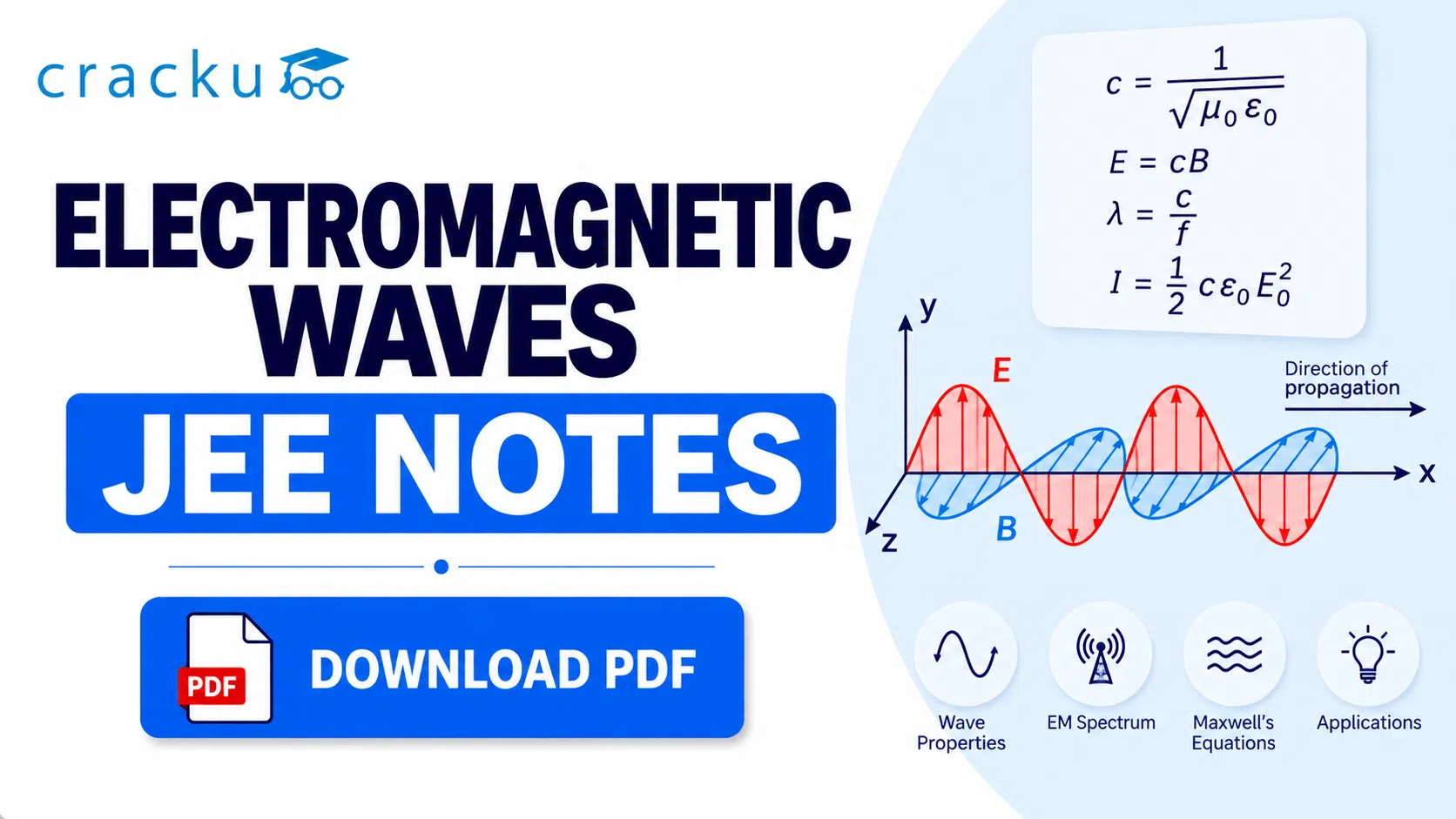
Electromagnetic (EM) wave: a self-propagating combination of time-varying electric field $$\mathbf E$$ and magnetic field $$\mathbf B$$ produced whenever a charge accelerates. Both fields are:
- Mutually perpendicular and also perpendicular to the direction of wave travel (transverse nature).
- In perfect phase: the maxima and minima occur at the same instant and place.
- Linked by $$\dfrac{E_0}{B_0}=c$$ in free space, where $$c=3.00\times10^{8}\ \text{m s}^{-1}$$ is constant for all frequencies.
Wave parameters: frequency $$f$$ (or angular frequency $$\omega=2\pi f$$), wavelength $$\lambda$$, wave number $$k=2\pi/\lambda$$, and speed $$v$$. In a non-conducting medium of refractive index $$n$$, $$v=\dfrac{c}{n}$$.
How EM waves arise
- An alternating current in an antenna makes electrons oscillate.
- Oscillating charge ⇒ time-varying electric field.
- Faraday-Lenz law: time-varying electric field induces magnetic field.
- Ampere-Maxwell law: time-varying magnetic field in turn regenerates electric field.
- The coupled fields detach from the source and travel outward as a wave.
Free-space wave equation
Starting from Maxwell equations (shown in the next section) one obtains identical wave equations:
$$\nabla^2 \mathbf E=\dfrac{1}{c^2}\dfrac{\partial^2 \mathbf E}{\partial t^2},\qquad \nabla^2 \mathbf B=\dfrac{1}{c^2}\dfrac{\partial^2 \mathbf B}{\partial t^2}.$$
General solution for a plane wave propagating along the +x axis:
$$\mathbf E=\hat y E_0\sin(kx-\omega t),\qquad \mathbf B=\hat z B_0\sin(kx-\omega t).$$
Relationship between field vectors
- Magnitude relation: $$E_0 = cB_0$$.
- Direction relation: $$\mathbf E\times \mathbf B$$ gives the direction of propagation.
Polarisation
If $$\mathbf E$$ vibrates in one fixed plane the wave is linearly polarised. EM waves from antennas are usually polarised; thermal radiation is generally unpolarised.
Maxwell’s Equations and Displacement Current
Integral form in free space (no free charge $$\rho=0$$, no free current $$\mathbf J=0$$)
| Law | Equation | Key point for JEE |
|---|---|---|
| Gauss law (Electric) | $$\oint \mathbf E\cdot d\mathbf S=\dfrac{q_{\rm encl}}{\varepsilon_0}=0$$ | Shows field lines are continuous: no net charge in radiation zone. |
| Gauss law (Magnetic) | $$\oint \mathbf B\cdot d\mathbf S=0$$ | No magnetic monopole ⇒ magnetic field lines are closed. |
| Faraday–Lenz | $$\oint \mathbf E\cdot d\mathbf l=-\dfrac{d\Phi_B}{dt}$$ | Time-varying $$B$$ creates electric field. |
| Ampere–Maxwell | $$\oint \mathbf B\cdot d\mathbf l=\mu_0\Big(I_{\rm encl}+\varepsilon_0\dfrac{d\Phi_E}{dt}\Big)$$ | Displacement current $$I_D=\varepsilon_0\dfrac{d\Phi_E}{dt}$$ repairs continuity in capacitors. |
Displacement current example
Parallel-plate capacitor, plate area $$A=40 \text{ cm}^2$$. Potential difference $$V=V_0\sin\omega t$$, with $$V_0=100\ \text{V},\; \omega=10^4\ \text{s}^{-1}$$ and separation $$d=2\ \text{mm}$$.
Find peak displacement current between the plates.
Capacitance $$C=\dfrac{\varepsilon_0 A}{d}= \dfrac{8.85\times10^{-12}\times4.0\times10^{-3}}{2\times10^{-3}}=1.77\times10^{-11}\ \text{F}$$.
Charge $$q=CV$$ ⇒ $$I_D=\dfrac{dq}{dt}=C\dfrac{dV}{dt}=C V_0\omega\cos\omega t$$.
Peak value $$I_{D0}=C V_0 \omega =1.77\times10^{-11}\times100\times10^{4}=1.77\times10^{-5}\ \text{A}$$.
Answer: $$1.8\times10^{-5}\ \text{A}$$.
For additional practice of similar capacitor-based numericals you can browse the solved archive under JEE Questions.
Speed of electromagnetic waves in a material
$$v=\dfrac{1}{\sqrt{\mu\varepsilon}}.$$
- For free space $$\mu_0=4\pi\times10^{-7}\ \text{H m}^{-1},\;\varepsilon_0=8.85\times10^{-12}\ \text{F m}^{-1}$$ ⇒ $$c=3.00\times10^{8}\ \text{m s}^{-1}$$.
- Relative speed $$v=\dfrac{c}{\sqrt{\mu_r\varepsilon_r}}=\dfrac{c}{n}$$ when $$\mu_r\approx1$$ (non-magnetic media).
Energy, Momentum and Radiation Pressure of EM Waves
Energy density
Electric part: $$u_E=\dfrac{1}{2}\varepsilon_0 E^2$$, magnetic part: $$u_B=\dfrac{1}{2}\dfrac{B^2}{\mu_0}$$. For a plane wave $$u_E=u_B$$, so total $$u=u_E+u_B=\varepsilon_0 E^2=\dfrac{B^2}{\mu_0}$$.
Poynting vector
$$\mathbf S=\dfrac{1}{\mu_0}\mathbf E\times \mathbf B$$
|$$\mathbf S$$| equals instantaneous power per unit area (W m-2). For a sinusoidal wave the average value over one cycle is
$$\langle S\rangle =\dfrac{1}{2}\varepsilon_0 c E_0^2=\dfrac{1}{2}\dfrac{c}{\mu_0}B_0^2.$$
Intensity
In JEE problems intensity is almost always the time-average Poynting magnitude. Remember $$I\propto E_0^2$$.
Momentum of radiation
- Energy flux $$\langle S\rangle$$ corresponds to momentum flux $$\dfrac{\langle S\rangle}{c}$$.
- Radiation pressure $$P_{\rm rad}=\dfrac{I}{c}$$ for complete absorption and $$P_{\rm rad}=\dfrac{2I}{c}$$ for perfect reflection.
Worked example: Solar sail
A reflective sail of area $$50\ \text{m}^2$$ is placed perpendicular to sunlight of intensity $$I=1.36\times10^{3}\ \text{W m}^{-2}$$.
Find the force on the sail.
Radiation pressure $$P=\dfrac{2I}{c}= \dfrac{2(1.36\times10^{3})}{3.00\times10^{8}}=9.07\times10^{-6}\ \text{N m}^{-2}$$.
Force $$F=PA=9.07\times10^{-6}\times50=4.54\times10^{-4}\ \text{N}$$.
Answer: $$4.5\times10^{-4}\ \text{N}$$.
If you struggle with Poynting-vector algebra review the PDF inside our JEE Formula Sheets – it lists every step in one page.
Electromagnetic Spectrum and Practical Sources
Regions to remember
| Region | Frequency (Hz) | Wavelength (m) | Common source | Typical use |
|---|---|---|---|---|
| Radio | 104–108 | 104–1 | LC antenna, transmitter coil | Broadcast, navigation |
| Microwave | 108–1011 | 1–10-3 | Klystron, magnetron | Radar, microwave oven |
| Infra-red | 1011–4×10¹⁴ | 10-3–7×10⁻⁷ | Hot bodies, LED | Remote control, heat therapy |
| Visible | 4×10¹⁴–7.5×10¹⁴ | 7×10⁻⁷–4×10⁻⁷ | Sun, incandescent lamp | Sight! |
| Ultra-violet | 7.5×10¹⁴–1017 | 4×10⁻⁷–3×10⁻⁹ | Electric arc, mercury lamp | Sterilisation, eye testing |
| X-ray | 1017–1020 | 3×10⁻⁹–3×10-12 | Coolidge tube | Imaging, crystallography |
| Gamma | >1020 | <3×10-12 | Radioactive nuclei | Cancer treatment, food irradiation |
Detecting wavelength in the lab
Expect JEE to ask for order of magnitude identify-the-region or the correct source/detector pairing. Learn the one most distinctive fact for each band, e.g. microwaves use magnetron/klystron.
Need structured practice across the spectrum? The live batch inside JEE Mains Online Coaching includes a micro-quiz after every lecture so you memorise the list mechanically.
Important Formulas and Results at a Glance
| Concept | Formula | Comments / Units |
|---|---|---|
| Speed in medium | $$v=\dfrac{1}{\sqrt{\mu\varepsilon}}$$ | $$v=c/n$$ if $$\mu_r\approx1$$. |
| Relation of amplitudes | $$E_0=cB_0$$ | Free space. |
| Wave number | $$k=\dfrac{2\pi}{\lambda}$$ | rad m-1 |
| Angular frequency | $$\omega=2\pi f$$ | rad s-1 |
| Energy density | $$u=\varepsilon_0 E^2=\dfrac{B^2}{\mu_0}$$ | J m-3 |
| Average intensity | $$I=\langle S\rangle=\dfrac{1}{2}\varepsilon_0 c E_0^2$$ | W m-2 |
| Radiation pressure | $$P_{\rm abs}=\dfrac{I}{c},\; P_{\rm refl}=\dfrac{2I}{c}$$ | For normal incidence. |
| Displacement current | $$I_D=\varepsilon_0\dfrac{d\Phi_E}{dt}$$ | Ampere-Maxwell term. |
| Intrinisic impedance of free space | $$Z_0=\sqrt{\dfrac{\mu_0}{\varepsilon_0}}\approx 377\ \Omega$$ | Often asked in Advanced. |
$$c=\dfrac{1}{\sqrt{\mu_0\varepsilon_0}}=3.00\times10^{8}\ \text{m s}^{-1},\qquad \varepsilon_0=8.85\times 10^{-12}\ \text{F m}^{-1},\qquad \mu_0=4\pi\times10^{-7}\ \text{H m}^{-1}.$$
Print this table and tape it above your study desk. After you can reproduce every line without looking, switch to mixed-topic problems from JEE Mains Previous Papers to check retention.
JEE Important Points, Common Mistakes and Quick Revision
- Phase lag confusion: Electric and magnetic fields are not out of phase; they reach maxima simultaneously. Many objective options hide this trap.
- Direction of $$\mathbf B$$ in a plane wave: Use right-hand rule $$\mathbf E\times \mathbf B$$; reverse sign if travelling in negative x direction.
- Capacitor displacement current: In a charging capacitor $$I_C = I_D$$ always. Do not zero the magnetic field just because the region is “vacuum”.
- Radiation pressure factor 2: For reflection, momentum change doubles. JEE loves to flip absorption vs reflection quietly in the last line.
- Spectrum order: Frequency increases Radio → Gamma. Learn three anchor wavelengths: 1 m (end of radio), 700 nm (red light), 0.1 nm (hard X-ray).
- Intrinsic impedance: $$Z_0\approx377\ \Omega$$ could appear as a numerical match option.
- Units check: Energy density in J m-3, intensity in W m-2, pressure in N m-2 – dividing intensity by c gives correct pressure dimension.
- Advanced-level links: Combined questions may tie Poynting vector to RLC antenna length. Keep antenna fundamentals from the Communication chapter handy.
Once you review these pitfalls, rapid-fire 20 MCQs in a row. If you need a graded set that escalates, download the booklet in JEE Advanced Previous Papers and filter to Electromagnetic Waves.
.webp)