91- 6303239042


 Group
Group
 Group
Group


 Preferred Source

 Google Discover
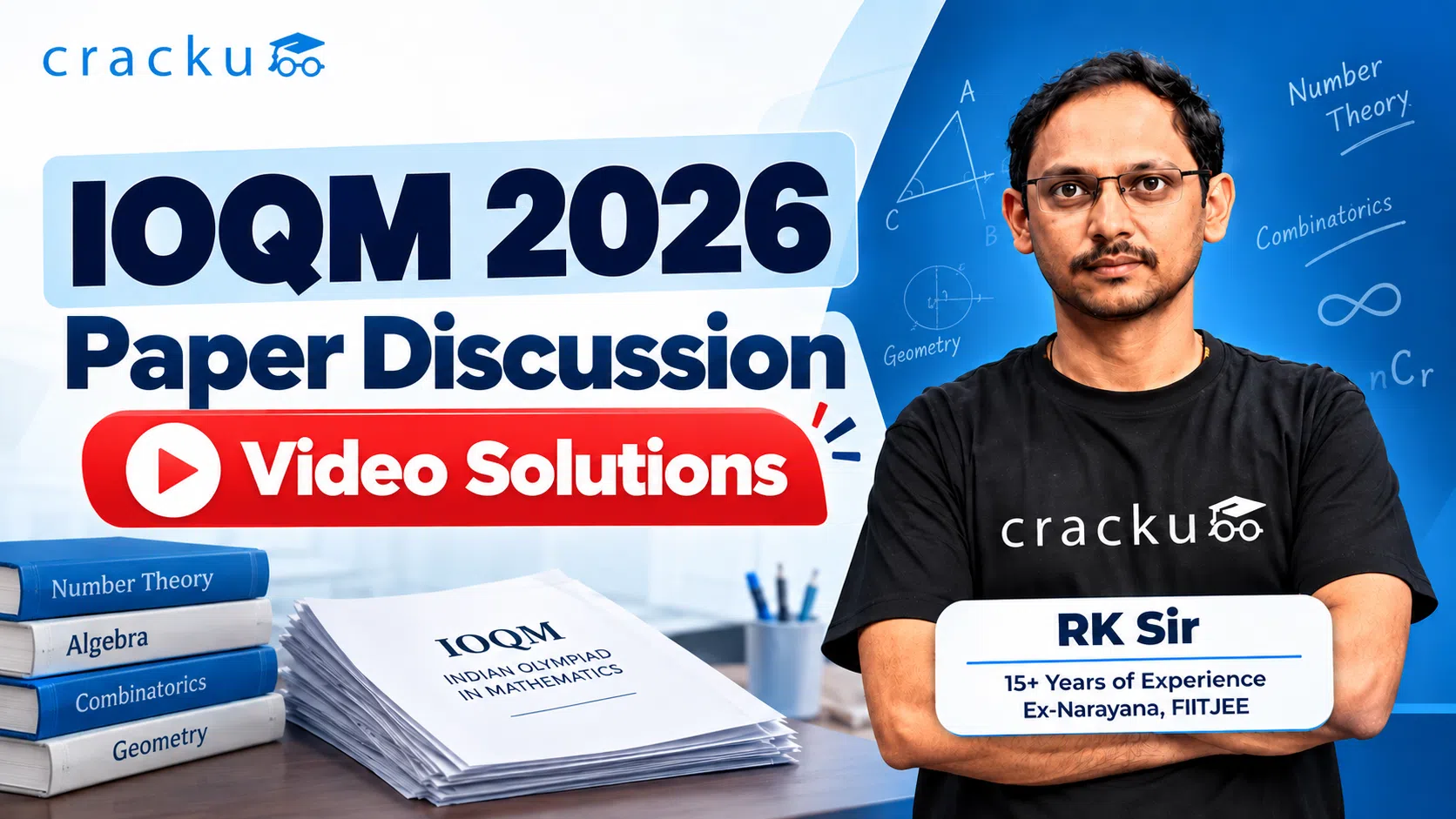
IOQM 2026 Paper Discussion
The IOQM 2026 Paper Discussion by Cracku covers step-by-step solutions to all questions asked in the examination. It helps you check your approach, understand difficult problems and identify the concepts that need further practice.
IOQM 2026 was conducted on 6 September 2026. Cracku’s analysis assesses the paper as moderate to difficult, with questions testing mathematical understanding across number theory, combinatorics, geometry and algebra. You can access the IOQM 2026 Question Paper to follow the discussion and revisit your attempts.
The session is conducted by Radha Krishna Bandaru, Head of JEE Mathematics at Cracku. He holds a Master’s degree in Applied Mathematics from the University of Hyderabad and has over 15 years of experience preparing students for JEE and Mathematical Olympiads.
Keep the paper and a notebook ready before watching. For every problem, record where your reasoning stopped and what helped you move forward. This makes the session useful beyond checking final answers.
IOQM 2026 Question-Wise Step-by-Step Solutions
Watch Cracku’s complete question-wise discussion below to understand the solutions and compare them with your exam-day methods.
Pause the video before each explanation and attempt the question yourself. Once the solution begins, identify the key observation rather than simply copying the calculations. Ask yourself why that observation works and whether you could recognise it in another problem.
Apply the marking scheme separately to each question group:
| Question Numbers | Marks per Correct Answer | Maximum Marks |
|---|---|---|
| 1–10 | 2 | 20 |
| 11–20 | 3 | 30 |
| 21–30 | 5 | 50 |
| Total | — | 100 |
Incorrect and unanswered questions receive zero marks, with no negative marking. For example, six correct answers in the first group, four in the second and two in the third give 12 + 12 + 10 = 34 marks.
Check the response you actually submitted, especially when your rough work contains multiple answers. Also verify what the question requested: a digit sum or remainder may differ from the number calculated during the solution.
After watching, close your notes and solve the question again. Being able to reproduce the reasoning independently is a better measure of understanding than recognising the explanation.
Also Read: IOQM 2026 Answer Key PDF with Explanations, Download Now
IOQM 2026 Paper Difficulty Level Analysis
The IOQM 2026 paper was moderate to difficult overall, with a mix of straightforward questions and problems requiring deeper mathematical reasoning. Recognising patterns, interpreting restrictions and choosing an efficient approach were important for managing time.
The difficulty varied across the three question groups:
| Question Group | Difficulty Level | Main Challenges |
|---|---|---|
| Questions 1–10 | Easy to moderate | Digit properties, remainders and restricted counting |
| Questions 11–20 | Moderate, with some difficult questions | Sequence patterns, polynomial relationships and polygon problems |
| Questions 21–30 | Moderate to difficult | Algebraic casework, counting restrictions and geometric constructions |
Number theory and combinatorics had the largest share of questions. The following distribution groups each question by its primary concept; some problems involved overlapping topics.
| Topic | Number of Questions |
|---|---|
| Number Theory | 9 |
| Combinatorics | 9 |
| Geometry | 7 |
| Algebra | 5 |
| Total | 30 |
Problems involving remainders, reversed digits and chessboard colouring offered relatively accessible scoring opportunities. Questions involving geometric constructions and multiple counting cases required more careful reasoning.
Question number alone was not a reliable indicator of difficulty. Some later questions had short solutions once the key observation was identified. While reviewing your performance, check whether you lost marks because of conceptual gaps, calculation errors or spending too much time on a difficult question.
Also Read: IOQM 2026 Question Paper PDF with Solutions, Download Now
How to Use the IOQM 2026 Paper for Future Preparation
Use the paper to build a revision plan around your mistakes. The IOQM Syllabus should guide your coverage, while your performance should determine which concepts need immediate attention. Avoid deciding next year’s priorities solely from one paper’s topic distribution.
Follow these steps after completing the discussion:
- Group your mistakes: Separate conceptual gaps, missed conditions, calculation errors and poor question selection.
- Revise the relevant concept: Return to basic examples if you cannot explain why a solution works.
- Practise a related problem: Change the numbers or restrictions to check whether you understood the method.
- Reattempt after a gap: Solve difficult questions again after several days without the video.
- Review under timed conditions: Use an unseen previous paper to test whether your approach has improved.
Keep a short error log:
| Difficulty Faced | Useful Follow-Up |
|---|---|
| Counting an outcome twice | Define cases clearly and check for overlap |
| Missing a geometry relationship | Redraw the figure and mark all given conditions |
| Lengthy calculations | Look for symmetry, factorisation or repeating patterns |
| Getting stuck too long | Practise moving on and returning later |
Write one takeaway for each reviewed question. For example, record the condition you overlooked or the observation that simplified the work. These notes are easier to revise than copied solutions.
Measure progress through independent solving, accuracy and better decisions about where to spend time.
IOQM Expected Cutoff 2026
The IOQM Expected Cutoff 2026 varies by region and category. The ranges below provide an initial reference for students assessing their chances of qualifying for RMO. These figures are indicative; the final cutoffs will depend on the 2026 score distribution and applicable selection rules.
Selected ranges are listed below, in marks out of 100:
| Region | Category A | Category B | Additional Girls’ Quota |
|---|---|---|---|
| Delhi | 32–42 | 44–54 | 30–40 |
| Uttar Pradesh | 22–32 | 31–41 | 20–30 |
| Mumbai | 23–33 | 34–44 | 20–30 |
| Rajasthan | 29–39 | 38–48 | 28–38 |
| Telangana | 38–48 | 41–51 | 37–47 |
| Karnataka | 27–37 | 37–47 | 25–35 |
Category A covers Classes 8–11, while Category B covers Class 12. The additional girls’ quota applies to Category A.
Scoring 10 marks meets the minimum score requirement for consideration but does not guarantee RMO qualification. Final selection depends on the applicable regional and category rules.
Compare your score with the correct region, and treat these ranges as guidance. Actual cutoffs may fall outside them. Continue preparing while awaiting the official selection list.
Also Read: IOQM Cutoff 2026: Region-Wise Expected Cutoffs, Check Now
IOQM 2026 Paper Discussion: Conclusion
The IOQM 2026 Paper Discussion helps you review all 30 questions, understand step-by-step solutions and identify where your approach needs improvement. Use the question-wise explanations and paper difficulty analysis to recognise useful methods across number theory, combinatorics, geometry and algebra. Focus on understanding the reasoning behind each solution and applying it independently.
After reviewing the IOQM 2026 question paper, turn your mistakes into a focused revision plan. Revisit weak concepts, practise related problems and reattempt challenging questions without referring to the video. Use the IOQM expected cutoff 2026 as an indicative reference while awaiting official selection updates, and continue building accuracy through regular, timed practice