
 Group
Group
 Group
Group


 Preferred Source

 Google Discover
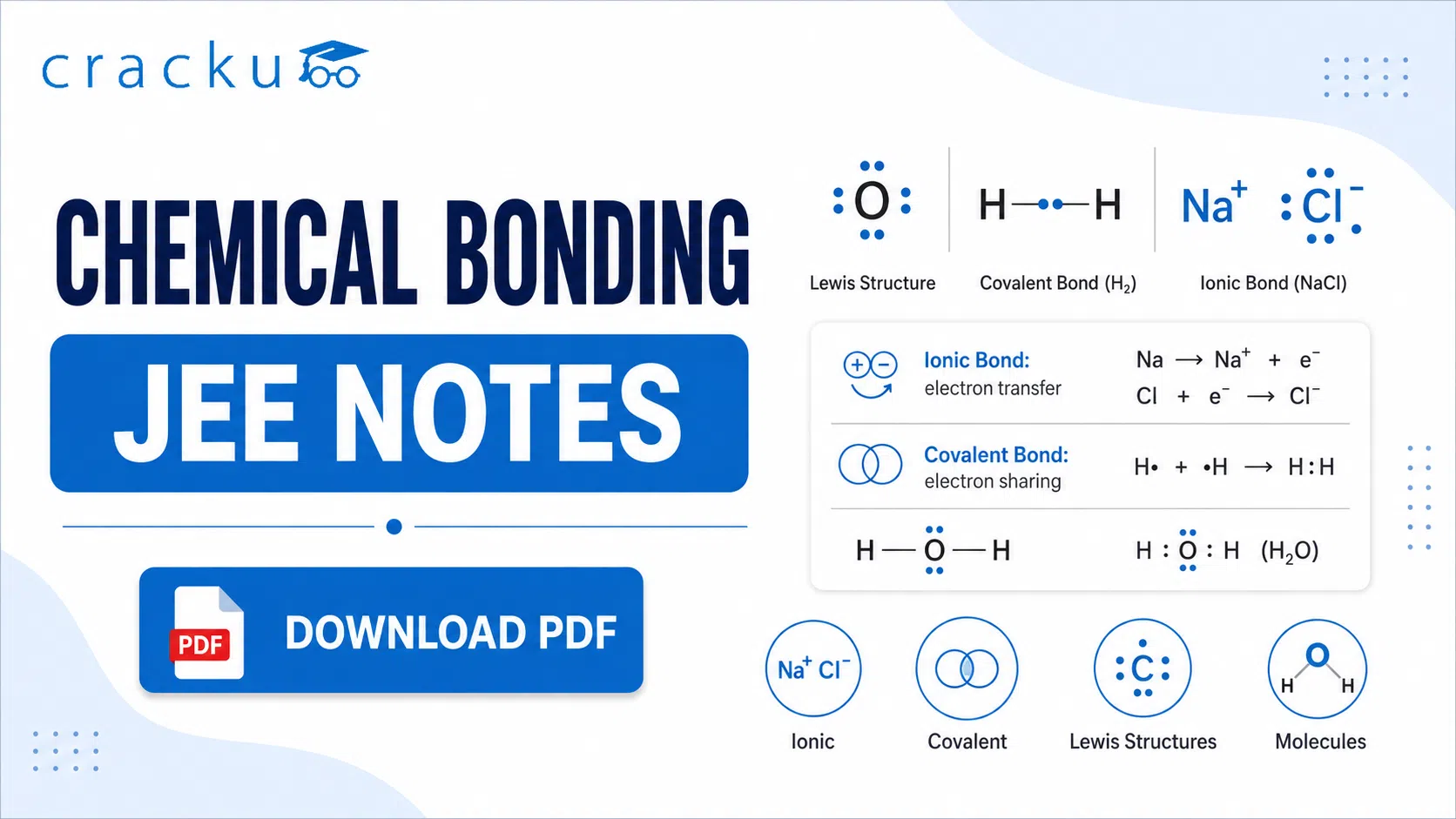
Chemical Bonding and Molecular Structure is one of the highest-weightage chapters in JEE Chemistry and builds the foundation for coordination compounds, organic reaction mechanisms and solid state chemistry. Atoms form bonds because bonding provides stability by lowering their energy through electron transfer, sharing or pooling. Practising JEE questions on Chemical Bonding helps students apply concepts such as octet rule, Lewis structures, VSEPR theory, hybridization, molecular orbital theory and bond order in exam-level problems. These Chemical Bonding JEE notes cover octet rule, ionic and covalent bonding, lattice energy, Lewis structures, resonance, coordinate bonds and important bonding concepts for quick JEE revision.
Chemical Bonding JEE Notes: Octet Rule and Ionic Bonding
The Octet Rule
Kossel and Lewis proposed the octet rule in 1916 after observing that noble gases are highly stable and rarely react. This stability is due to their completely filled outermost shell.
Octet rule: Atoms gain, lose or share electrons to achieve eight electrons in their valence shell and attain the electronic configuration of the nearest noble gas.
For example:
- Sodium loses one electron to form Na⁺.
- Chlorine gains one electron to form Cl⁻.
- Both achieve noble gas configurations.
Exceptions to Octet Rule
Although the octet rule explains bonding in many molecules, several compounds do not follow it.
| Exception | Meaning | Examples |
|---|---|---|
| Incomplete octet | Central atom has fewer than 8 electrons | BF₃, BeCl₂ |
| Expanded octet | Central atom has more than 8 electrons | PCl₅, SF₆ |
| Odd electron species | Total number of valence electrons is odd | NO, NO₂ |
Important: Expanded octet is possible mainly for elements of Period 3 and beyond because additional orbitals are available.
Ionic Bonding and Lattice Energy
Ionic Bond
An ionic bond is formed by complete transfer of electrons from one atom to another. The atom losing electrons becomes a positively charged ion called a cation, while the atom gaining electrons becomes a negatively charged ion called an anion.
The electrostatic attraction between these oppositely charged ions forms the ionic bond.
Example: Formation of NaCl:
- Na → Na⁺ + e⁻
- Cl + e⁻ → Cl⁻
- Na⁺ and Cl⁻ combine to form NaCl.
Conditions Favouring Ionic Bond Formation
- Low ionisation energy: Metals should lose electrons easily.
- High electron affinity: Non-metals should readily accept electrons.
- Large electronegativity difference: A difference above approximately 1.7 favours ionic bonding.
Lattice Energy
Ionic compounds form three-dimensional crystal structures called lattices. The strength of attraction between ions in this lattice is measured by lattice energy.
Lattice energy: The energy released when one mole of an ionic solid is formed from its constituent gaseous ions.
$$U\propto\frac{q^+\times q^-}{r^+ + r^-}$$
Lattice energy increases when:
- The charge on ions increases.
- The size of ions decreases.
- The distance between ions decreases.
Example: MgO has higher lattice energy than NaCl because Mg²⁺ and O²⁻ have higher charges compared to Na⁺ and Cl⁻.
Born-Haber Cycle
The Born-Haber cycle applies Hess's law to calculate lattice energy indirectly by dividing ionic compound formation into different measurable steps.
For NaCl formation:
| Step | Process | Energy |
|---|---|---|
| Sublimation | Na(s) → Na(g) | +ΔHsub |
| Ionisation | Na(g) → Na⁺(g)+e⁻ | +IE |
| Dissociation | ½Cl₂(g) → Cl(g) | +½ΔHdiss |
| Electron affinity | Cl(g)+e⁻→Cl⁻(g) | −EA |
| Lattice formation | Na⁺(g)+Cl⁻(g)→NaCl(s) | −U |
The Born-Haber equation is:
$$\Delta H_f=\Delta H_{sub}+IE+\frac12\Delta H_{diss}-EA-U$$
Worked example: Calculate lattice energy of NaCl when:
- ΔHf = −411 kJ/mol
- ΔHsub = 108 kJ/mol
- IE = 496 kJ/mol
- ½ΔHdiss = 121 kJ/mol
- EA = 349 kJ/mol
Using:
$$U=\Delta H_{sub}+IE+\frac12\Delta H_{diss}-EA-\Delta H_f$$
$$U=108+496+121-349+411$$
$$U=787\,kJ/mol$$
Covalent Bonding, Lewis Structures and Resonance
Covalent Bond
A covalent bond is formed when two atoms share electron pairs. It generally occurs between non-metal atoms having similar electronegativities.
| Bond Type | Shared Electron Pairs | Example |
|---|---|---|
| Single bond | 1 pair | H−H |
| Double bond | 2 pairs | O=O |
| Triple bond | 3 pairs | N≡N |
Bond strength:
Triple bond > Double bond > Single bond
Bond length:
Triple bond < Double bond < Single bond
Lewis Structures
Lewis structures represent the arrangement of valence electrons in molecules. Bonding pairs are shown as lines and lone pairs are shown as dots.
Steps to draw Lewis structures:
- Count total valence electrons.
- Add electrons for negative charge and remove electrons for positive charge.
- Select the least electronegative atom as the central atom.
- Hydrogen is always placed at the terminal position.
- Create single bonds between atoms.
- Complete octets of surrounding atoms first.
- If the central atom lacks an octet, convert lone pairs into multiple bonds.
Formal Charge
Formal charge helps identify the most stable Lewis structure when multiple structures are possible.
$$Formal\ Charge=V-L-\frac{B}{2}$$
Where:
- V = valence electrons of free atom
- L = lone pair electrons
- B = bonding electrons
The most stable Lewis structure generally has formal charges closest to zero.
Worked example: Formal charge on carbon in CO.
For carbon:
V = 4
L = 2
B = 6
Therefore:
$$FC=4-2-\frac{6}{2}$$
FC = −1
Coordinate Bond
In a coordinate bond, both electrons of the shared pair are donated by the same atom.
The atom donating the electron pair is called the donor, while the atom accepting it is called the acceptor.
Examples:
- NH₄⁺ formation from NH₃ and H⁺
- H₃O⁺ formation
- BF₃·NH₃ complex
Resonance
Sometimes a single Lewis structure cannot explain the actual structure of a molecule. In such cases, multiple valid Lewis structures contribute to form a resonance hybrid.
Resonance: The actual structure of a molecule is a weighted average of two or more valid structures that differ only in electron arrangement.
Important points:
- Resonance structures are not real structures that interchange.
- The molecule exists as one stable resonance hybrid.
- Greater resonance generally increases stability.
- Atom positions remain unchanged; only electrons shift.
VSEPR Theory and Molecular Shapes
Valence Shell Electron Pair Repulsion (VSEPR) Theory
VSEPR theory was proposed by Gillespie and Nyholm to predict the shapes of molecules based on the repulsion between electron pairs present in the valence shell of the central atom.
The main idea of VSEPR theory is:
Electron pairs arrange themselves as far apart as possible to minimize repulsion and increase stability.
Order of Repulsion Between Electron Pairs
The repulsion strength follows:
Lone pair–lone pair > Lone pair–bond pair > Bond pair–bond pair
Lone pairs occupy more space because they are attracted only towards one nucleus, whereas bonding pairs are shared between two atoms.
Effect of Lone Pair on Bond Angle
- More lone pairs on the central atom decrease bond angle.
- Lone pairs require more space than bonding pairs.
- Bond angles decrease as repulsion increases.
Example:
| Molecule | Lone Pairs | Bond Angle |
|---|---|---|
| CH₄ | 0 | 109.5° |
| NH₃ | 1 | 107° |
| H₂O | 2 | 104.5° |
Important Molecular Shapes Using VSEPR Theory
| Molecule | Hybridization | Shape | Bond Angle |
|---|---|---|---|
| BeCl₂ | sp | Linear | 180° |
| BF₃ | sp² | Trigonal planar | 120° |
| CH₄ | sp³ | Tetrahedral | 109.5° |
| NH₃ | sp³ | Trigonal pyramidal | 107° |
| H₂O | sp³ | Bent | 104.5° |
| PCl₅ | sp³d | Trigonal bipyramidal | 90°,120° |
| SF₆ | sp³d² | Octahedral | 90° |
JEE tip: To predict molecular shape:
- Count total electron pairs around the central atom.
- Identify lone pairs.
- Arrange electron pairs according to minimum repulsion.
- Remove lone pairs mentally to obtain molecular geometry.
Hybridization and Molecular Geometry
Concept of Hybridization
Hybridization is the mixing of atomic orbitals of similar energy to form new equivalent orbitals called hybrid orbitals.
Hybrid orbitals determine the geometry and bonding characteristics of molecules.
| Hybridization | Number of Hybrid Orbitals | Geometry | Example |
|---|---|---|---|
| sp | 2 | Linear | BeCl₂, CO₂ |
| sp² | 3 | Trigonal planar | BF₃, C₂H₄ |
| sp³ | 4 | Tetrahedral | CH₄ |
| sp³d | 5 | Trigonal bipyramidal | PCl₅ |
| sp³d² | 6 | Octahedral | SF₆ |
Shortcut to Find Hybridization
The steric number of the central atom determines hybridization.
$$Steric\ Number = Number\ of\ sigma\ bonds + Number\ of\ lone\ pairs$$
| Steric Number | Hybridization |
|---|---|
| 2 | sp |
| 3 | sp² |
| 4 | sp³ |
| 5 | sp³d |
| 6 | sp³d² |
Worked example: Find hybridization of NH₃.
Nitrogen has:
- 3 sigma bonds with hydrogen
- 1 lone pair
Steric number:
$$=3+1=4$$
Therefore:
Hybridization = sp³
Dipole Moment and Polarity
Dipole Moment
Dipole moment measures the polarity of a bond or molecule. It depends on the magnitude of charge separation and distance between charges.
$$\mu=q\times r$$
where:
- q = magnitude of charge
- r = distance between charges
The unit of dipole moment is Debye (D).
Factors Affecting Molecular Polarity
- Difference in electronegativity between atoms.
- Shape and symmetry of molecule.
- Direction of individual bond dipoles.
Important examples:
| Molecule | Shape | Polarity |
|---|---|---|
| CO₂ | Linear | Non-polar |
| BF₃ | Trigonal planar | Non-polar |
| H₂O | Bent | Polar |
| NH₃ | Trigonal pyramidal | Polar |
JEE tip: Symmetrical molecules often have zero dipole moment because individual bond moments cancel each other.
Hydrogen Bonding
Hydrogen bonding is a strong intermolecular attraction between hydrogen attached to a highly electronegative atom and another electronegative atom containing a lone pair.
Hydrogen bonding occurs mainly when hydrogen is bonded with:
- Fluorine (F)
- Oxygen (O)
- Nitrogen (N)
Types of Hydrogen Bonding
| Type | Meaning | Example |
|---|---|---|
| Intermolecular hydrogen bonding | Occurs between different molecules | H₂O, HF |
| Intramolecular hydrogen bonding | Occurs within the same molecule | o-nitrophenol |
Effects of hydrogen bonding:
- Higher boiling point.
- Greater viscosity.
- Higher solubility in water.
- Association of molecules.
Example: Water has a higher boiling point than H₂S because of strong hydrogen bonding between water molecules.
Fajan's Rules
Fajan's rules explain the covalent character present in ionic compounds.
According to Fajan's rule, covalent character increases when:
- The cation is small.
- The cation has high positive charge.
- The anion is large.
- The anion is highly polarizable.
Example:
LiI has more covalent character than LiF because iodide ion is larger and more easily polarized.
| Compound | Covalent Character |
|---|---|
| LiF | Least |
| LiCl | Higher |
| LiBr | Higher |
| LiI | Highest |
VSEPR Theory and Molecular Shapes
Valence Shell Electron Pair Repulsion (VSEPR) Theory
VSEPR theory was proposed by Gillespie and Nyholm to predict the shapes of molecules based on the repulsion between electron pairs present in the valence shell of the central atom.
The main idea of VSEPR theory is:
Electron pairs arrange themselves as far apart as possible to minimize repulsion and increase stability.
Order of Repulsion Between Electron Pairs
The repulsion strength follows:
Lone pair–lone pair > Lone pair–bond pair > Bond pair–bond pair
Lone pairs occupy more space because they are attracted only towards one nucleus, whereas bonding pairs are shared between two atoms.
Effect of Lone Pair on Bond Angle
- More lone pairs on the central atom decrease bond angle.
- Lone pairs require more space than bonding pairs.
- Bond angles decrease as repulsion increases.
Example:
| Molecule | Lone Pairs | Bond Angle |
|---|---|---|
| CH₄ | 0 | 109.5° |
| NH₃ | 1 | 107° |
| H₂O | 2 | 104.5° |
Important Molecular Shapes Using VSEPR Theory
| Molecule | Hybridization | Shape | Bond Angle |
|---|---|---|---|
| BeCl₂ | sp | Linear | 180° |
| BF₃ | sp² | Trigonal planar | 120° |
| CH₄ | sp³ | Tetrahedral | 109.5° |
| NH₃ | sp³ | Trigonal pyramidal | 107° |
| H₂O | sp³ | Bent | 104.5° |
| PCl₅ | sp³d | Trigonal bipyramidal | 90°,120° |
| SF₆ | sp³d² | Octahedral | 90° |
JEE tip: To predict molecular shape:
- Count total electron pairs around the central atom.
- Identify lone pairs.
- Arrange electron pairs according to minimum repulsion.
- Remove lone pairs mentally to obtain molecular geometry.
Hybridization and Molecular Geometry
Concept of Hybridization
Hybridization is the mixing of atomic orbitals of similar energy to form new equivalent orbitals called hybrid orbitals.
Hybrid orbitals determine the geometry and bonding characteristics of molecules.
| Hybridization | Number of Hybrid Orbitals | Geometry | Example |
|---|---|---|---|
| sp | 2 | Linear | BeCl₂, CO₂ |
| sp² | 3 | Trigonal planar | BF₃, C₂H₄ |
| sp³ | 4 | Tetrahedral | CH₄ |
| sp³d | 5 | Trigonal bipyramidal | PCl₅ |
| sp³d² | 6 | Octahedral | SF₆ |
Shortcut to Find Hybridization
The steric number of the central atom determines hybridization.
$$Steric\ Number = Number\ of\ sigma\ bonds + Number\ of\ lone\ pairs$$
| Steric Number | Hybridization |
|---|---|
| 2 | sp |
| 3 | sp² |
| 4 | sp³ |
| 5 | sp³d |
| 6 | sp³d² |
Worked example: Find hybridization of NH₃.
Nitrogen has:
- 3 sigma bonds with hydrogen
- 1 lone pair
Steric number:
$$=3+1=4$$
Therefore:
Hybridization = sp³
Dipole Moment and Polarity
Dipole Moment
Dipole moment measures the polarity of a bond or molecule. It depends on the magnitude of charge separation and distance between charges.
$$\mu=q\times r$$
where:
- q = magnitude of charge
- r = distance between charges
The unit of dipole moment is Debye (D).
Factors Affecting Molecular Polarity
- Difference in electronegativity between atoms.
- Shape and symmetry of molecule.
- Direction of individual bond dipoles.
Important examples:
| Molecule | Shape | Polarity |
|---|---|---|
| CO₂ | Linear | Non-polar |
| BF₃ | Trigonal planar | Non-polar |
| H₂O | Bent | Polar |
| NH₃ | Trigonal pyramidal | Polar |
JEE tip: Symmetrical molecules often have zero dipole moment because individual bond moments cancel each other.
Hydrogen Bonding
Hydrogen bonding is a strong intermolecular attraction between hydrogen attached to a highly electronegative atom and another electronegative atom containing a lone pair.
Hydrogen bonding occurs mainly when hydrogen is bonded with:
- Fluorine (F)
- Oxygen (O)
- Nitrogen (N)
Types of Hydrogen Bonding
| Type | Meaning | Example |
|---|---|---|
| Intermolecular hydrogen bonding | Occurs between different molecules | H₂O, HF |
| Intramolecular hydrogen bonding | Occurs within the same molecule | o-nitrophenol |
Effects of hydrogen bonding:
- Higher boiling point.
- Greater viscosity.
- Higher solubility in water.
- Association of molecules.
Example: Water has a higher boiling point than H₂S because of strong hydrogen bonding between water molecules.
Fajan's Rules
Fajan's rules explain the covalent character present in ionic compounds.
According to Fajan's rule, covalent character increases when:
- The cation is small.
- The cation has high positive charge.
- The anion is large.
- The anion is highly polarizable.
Example:
LiI has more covalent character than LiF because iodide ion is larger and more easily polarized.
| Compound | Covalent Character |
|---|---|
| LiF | Least |
| LiCl | Higher |
| LiBr | Higher |
| LiI | Highest |
Molecular Orbital Theory (MOT)
Introduction to Molecular Orbital Theory
Molecular Orbital Theory explains the formation of molecules by combining atomic orbitals to form molecular orbitals. Unlike valence bond theory, MOT considers electrons to be delocalized over the entire molecule.
According to MOT:
- Atomic orbitals combine to form molecular orbitals.
- Electrons in molecular orbitals belong to the entire molecule.
- Molecular orbitals are formed by linear combination of atomic orbitals.
Conditions for Combination of Atomic Orbitals
Atomic orbitals can combine effectively only when:
- They have comparable energies.
- They have proper orientation for overlap.
- Their overlap is significant.
Types of Molecular Orbitals
| Type | Formation | Effect |
|---|---|---|
| Bonding Molecular Orbital | Constructive overlap | Lower energy, increases stability |
| Antibonding Molecular Orbital | Destructive overlap | Higher energy, decreases stability |
Antibonding orbitals are represented by an asterisk (*).
Examples:
- σ1s = bonding molecular orbital
- σ*1s = antibonding molecular orbital
Bond Order and Stability
Bond order gives the strength and stability of a chemical bond. It represents the number of bonds present between two atoms.
$$Bond\ Order=\frac{N_b-N_a}{2}$$
where:
- Nb = Number of electrons in bonding molecular orbitals
- Na = Number of electrons in antibonding molecular orbitals
Interpretation:
- Higher bond order → stronger bond → shorter bond length.
- Lower bond order → weaker bond → longer bond length.
- Bond order zero indicates that molecule does not exist.
| Molecule | Bond Order | Stability |
|---|---|---|
| H₂ | 1 | Stable |
| He₂ | 0 | Unstable |
| N₂ | 3 | Highly stable |
| O₂ | 2 | Stable |
Worked Example: Bond Order of N₂
Electronic configuration of N₂:
$$\sigma_{1s}^{2}\sigma^*_{1s}^{2}\sigma_{2s}^{2}\sigma^*_{2s}^{2} \sigma_{2p_x}^{2}\sigma_{2p_y}^{2}\sigma_{2p_z}^{2}$$
Bonding electrons = 10
Antibonding electrons = 4
$$Bond\ Order=\frac{10-4}{2}$$
Bond Order = 3
This explains why nitrogen has a very strong triple bond.
Molecular Orbital Energy Order
The order of molecular orbital filling depends on the molecule.
For B₂, C₂ and N₂
The order is:
$$ \sigma_{1s} < \sigma^*_{1s} < \sigma_{2s} < \sigma^*_{2s} < \pi_{2p_x} = \pi_{2p_y} < \sigma_{2p_z} $$
For O₂ and F₂
The order is:
$$ \sigma_{1s} < \sigma^*_{1s} < \sigma_{2s} < \sigma^*_{2s} < \sigma_{2p_z} < \pi_{2p_x} = \pi_{2p_y} < \pi^*_{2p_x} = \pi^*_{2p_y} $$
JEE tip: Remember the difference in ordering between N₂ and O₂ because it is frequently tested in bond order and magnetic property questions.
Magnetic Nature of Molecules
The magnetic behaviour of molecules depends on the presence or absence of unpaired electrons.
| Type | Condition | Example |
|---|---|---|
| Paramagnetic | Contains unpaired electrons | O₂ |
| Diamagnetic | All electrons paired | N₂ |
Example: Oxygen molecule is paramagnetic because it contains two unpaired electrons in antibonding π* orbitals.
Important Chemical Bonding Comparisons
| Property | Increasing Order |
|---|---|
| Bond strength | Single < Double < Triple |
| Bond length | Triple < Double < Single |
| Repulsion strength | Bond pair-bond pair < Lone pair-bond pair < Lone pair-lone pair |
| Polarity | Depends on electronegativity difference and symmetry |
Chemical Bonding Formula Sheet at a Glance
| Concept | Formula / Rule |
|---|---|
| Lattice energy dependence | $$U\propto\frac{q^+q^-}{r^++r^-}$$ |
| Formal charge | $$FC=V-L-\frac{B}{2}$$ |
| Dipole moment | $$\mu=q\times r$$ |
| Steric number | Sigma bonds + lone pairs |
| Hybridization determination | SN = 2 → sp SN = 3 → sp² SN = 4 → sp³ SN = 5 → sp³d SN = 6 → sp³d² |
| Bond order (MOT) | $$\frac{N_b-N_a}{2}$$ |
JEE Important Points, Common Mistakes and Quick Revision
Points JEE Repeatedly Tests
- Atoms form bonds to achieve lower energy and greater stability.
- Octet rule explains many compounds but has exceptions like BF₃, PCl₅ and SF₆.
- Lattice energy increases with higher ionic charge and smaller ionic size.
- Lewis structures are used to represent bonding and lone pairs.
- Formal charge helps identify the most stable Lewis structure.
- Resonance increases stability by delocalization of electrons.
- Lone pairs have greater repulsion than bond pairs.
- Hybridization depends on steric number.
- Symmetric molecules generally have zero dipole moment.
- Hydrogen bonding increases boiling point and intermolecular attraction.
- Bond order determines bond strength and bond length.
- Unpaired electrons decide paramagnetic behaviour.
Common Mistakes to Avoid
- Applying octet rule blindly. Many molecules like BF₃ and SF₆ are exceptions.
- Confusing bonding and antibonding electrons. Only their difference is used in bond order calculation.
- Forgetting lone pairs while predicting molecular shape. Lone pairs strongly affect bond angles.
- Assuming every polar bond creates a polar molecule. Molecular symmetry decides overall polarity.
- Using wrong hybridization. Always calculate steric number first.
- Ignoring resonance structures. The actual molecule is a resonance hybrid.
- Confusing paramagnetic and diamagnetic molecules. Only unpaired electrons create paramagnetism.
Quick Revision Notes for Chemical Bonding
- Chemical bonds form to achieve stability.
- Octet rule explains electron arrangement but has exceptions.
- Ionic bonding involves electron transfer.
- Covalent bonding involves electron sharing.
- Lattice energy depends on ionic charge and size.
- Formal charge: $$FC=V-L-\frac{B}{2}$$
- VSEPR theory predicts molecular geometry.
- Lone pair repulsion: LP-LP > LP-BP > BP-BP
- Hybridization depends on steric number.
- Dipole moment: $$\mu=q\times r$$
- Hydrogen bonding occurs mainly with F, O and N.
- Bond order: $$\frac{N_b-N_a}{2}$$
- Paramagnetic molecules contain unpaired electrons.
Problem-solving routine: Start Chemical Bonding questions by identifying the type of bond involved—ionic, covalent or coordinate. Draw Lewis structures, calculate formal charge when required and use VSEPR theory to predict geometry. For molecular orbital problems, determine electron configuration before finding bond order and magnetic behaviour. Use a JEE formula sheet during revision to quickly recall hybridization rules, bond order formulas, dipole moment relations and important Chemical Bonding concepts.
.webp)