
 Group
Group
 Group
Group


 Preferred Source

 Google Discover
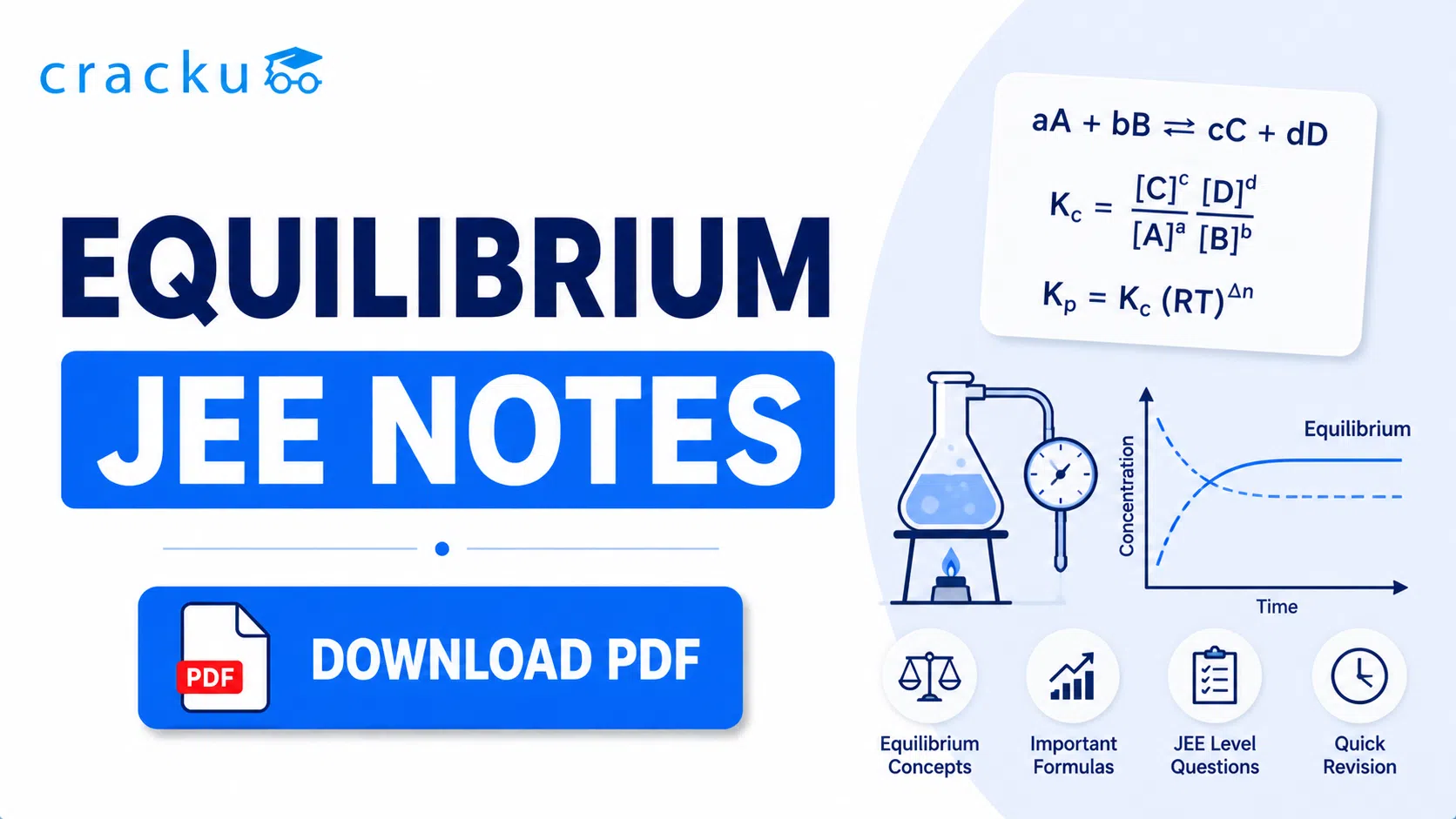
Most reactions never run to completion. At some point the forward and reverse reactions proceed at the same rate, concentrations stop changing, and the system sits at chemical equilibrium. The chapter then splits in two, covering molecular equilibria first and ionic equilibria in solution second. These Equilibrium JEE notes cover Kc and Kp, the reaction quotient, Le Chatelier's principle, degree of dissociation, pH, weak acids and bases, buffers, the common ion effect, solubility product and salt hydrolysis, in a format built for fast revision. These Equilibrium JEE notes can be used with JEE questions for additional practice.
Equilibrium JEE Notes: Important Concepts and the Equilibrium Constant
Reversible Reactions and Dynamic Equilibrium
Irreversible reaction: proceeds in one direction only until the reactants are used up, such as the burning of wood.
Reversible reaction: proceeds in both directions at once, written with a double arrow, A + B ⇌ C + D.
In a reversible reaction the forward process starts fast, with plenty of reactant, and slows as reactant is consumed. The reverse starts at zero, with no product yet, and speeds up as product builds. Eventually the two rates meet.
Dynamic equilibrium: the state where the forward and reverse rates are equal. Concentrations hold steady, but both reactions carry on, which is why it is called dynamic rather than static.
Note: at equilibrium the concentrations are constant but not necessarily equal. How much of each species is present depends on the equilibrium constant.
Law of Mass Action and Kc
Guldberg and Waage's law of mass action states that the rate of a reaction is proportional to the product of the active masses of the reactants, each raised to its stoichiometric coefficient.
For the general reaction aA + bB ⇌ cC + dD:
K_c = [C]ᶜ[D]ᵈ / [A]ᵃ[B]ᵇ
Here [X] is the molar concentration at equilibrium. Three points govern its use: Kc is constant at a given temperature, it changes only with temperature and never with concentration or pressure, and pure solids and pure liquids are left out of the expression because their activity is 1.
Worked example: write Kc for CaCO₃(s) ⇌ CaO(s) + CO₂(g).
Both CaCO₃ and CaO are pure solids and are excluded, leaving Kc = [CO₂]. At a given temperature, then, the equilibrium concentration of CO₂ above the solids is fixed.
Equilibrium Constant in Terms of Pressure
For gaseous reactions, partial pressures are often more convenient than concentrations. For aA(g) + bB(g) ⇌ cC(g) + dD(g):
\(K_p = \frac{P_C^cP_D^d}{P_A^aP_B^b}\)
K_p = K_c(RT) ^{ Δng}
where \Delta n_g = (c + d) − (a + b) is the change in moles of gas and R = 0.0821 L·atm/(mol·K). It follows that Kp = Kc when \Delta n_g = 0, Kp > Kc when \Delta n_g > 0, and Kp < Kc when \Delta n_g < 0.
Worked example: for N₂(g) + 3H₂(g) ⇌ 2NH₃(g), Kc = 0.5 at 400 K. Find Kp.
\Delta n_g = 2 − (1 + 3) = −2 Kp = Kc(RT) to the power \Delta n_g = 0.5 × (0.0821 × 400)⁻² = 0.5 × (32.84)⁻² = 0.5 × (1/1078.5) = 4.64 × 10⁻⁴
Manipulating Equilibrium Constants
| Change to the reaction New constant | |
|---|---|
| Reversed | K' = 1/K |
| Multiplied by n | K' = Kⁿ |
| Divided by n | K' = the n-th root of K |
| Two reactions added | K' = K₁ × K₂ |
Reaction Quotient (Q)
Q uses the same expression as K but with the current concentrations, which need not be equilibrium values. Comparing the two says which way the reaction will run.
| Comparison What happens | |
|---|---|
| Q < K | Reaction proceeds forward, forming more product |
| Q = K | System is at equilibrium |
| Q > K | Reaction proceeds backward, forming more reactant |
Worked example: for H₂(g) + I₂(g) ⇌ 2HI(g), Kc = 54.3 at 698 K. If [H₂] = 0.1, [I₂] = 0.2 and [HI] = 0.4 M, predict the direction.
Qc = [HI]²/([H₂][I₂]) = (0.4)²/[(0.1)(0.2)] = 0.16/0.02 = 8 Since Qc = 8 is less than Kc = 54.3, the reaction runs forward to make more HI.
Le Chatelier's Principle and Degree of Dissociation
Le Chatelier's Principle
If a system at equilibrium is disturbed by a change in concentration, pressure or temperature, it shifts in the direction that counteracts the change and settles at a new equilibrium.
| Change applied Shift direction Effect on K | ||
|---|---|---|
| Add reactant | Forward, toward products | No change |
| Remove product | Forward, toward products | No change |
| Add product | Backward, toward reactants | No change |
| Increase pressure | Toward fewer moles of gas | No change |
| Decrease pressure | Toward more moles of gas | No change |
| Increase temperature (exothermic) | Backward | K decreases |
| Increase temperature (endothermic) | Forward | K increases |
| Add catalyst | No shift | No change |
| Add inert gas at constant volume | No shift | No change |
Note: a catalyst does not shift the position of equilibrium. It speeds the forward and reverse reactions equally, so the system arrives at the same equilibrium faster. Temperature is the only factor that actually changes the value of K.
Worked example: for N₂(g) + 3H₂(g) ⇌ 2NH₃(g) with \Delta H = −92.4 kJ, an exothermic reaction, predict the effect of three changes.
(a) Increasing pressure: \Delta n_g = 2 − 4 = −2, so the equilibrium shifts forward, toward fewer moles of gas, producing more NH₃. (b) Increasing temperature: the reaction is exothermic, so the equilibrium shifts backward, producing less NH₃, and K decreases. (c) Adding N₂: the equilibrium shifts forward to consume the added N₂.
Degree of Dissociation
Degree of dissociation (α): the fraction of a substance that has dissociated at equilibrium, running from 0 for no dissociation to 1 for complete dissociation.
For A(g) ⇌ 2B(g), starting with a moles of A in volume V:
- Moles at equilibrium: A = a(1 − α) and B = 2aα
- Total moles = a(1 + α)
- Kc = [B]²/[A] = (2aα/V)²/[a(1 − α)/V] = 4aα²/[V(1 − α)]
Worked example: PCl₅ dissociates as PCl₅(g) ⇌ PCl₃(g) + Cl₂(g). One mole of PCl₅ is placed in a 1 L container and the degree of dissociation is 0.2. Find Kc.
| Stage PCl₅ PCl₃ Cl₂ | |||
|---|---|---|---|
| Initial (mol) | 1 | 0 | 0 |
| Change | −0.2 | +0.2 | +0.2 |
| Equilibrium (mol) | 0.8 | 0.2 | 0.2 |
Kc = [PCl₃][Cl₂]/[PCl₅] = (0.2)(0.2)/0.8 = 0.04/0.8 = 0.05
The ICE table is the reliable route through every dissociation problem, and with V = 1 L the equilibrium moles double as concentrations.
Ionic Equilibrium: Acids, Bases, pH and pOH
Ionic equilibrium deals with equilibria involving ions in aqueous solution, covering acids, bases and sparingly soluble salts.
Theories of Acids and Bases
Three definitions, each broader than the last.
| Theory Acid Base | ||
|---|---|---|
| Arrhenius | Gives H⁺ in water | Gives OH⁻ in water |
| Brønsted-Lowry | Proton (H⁺) donor | Proton (H⁺) acceptor |
| Lewis | Electron pair acceptor | Electron pair donor |
An Arrhenius acid produces H⁺ (or H₃O⁺) in water, as HCl does. An Arrhenius base produces OH⁻, as NaOH does.
In Brønsted-Lowry theory every acid has a conjugate base, what remains after it donates a proton, and every base has a conjugate acid, what forms after it accepts one.
Lewis acids accept an electron pair, such as BF₃, AlCl₃, H⁺ and metal ions like Fe³⁺. Lewis bases donate one, such as NH₃, H₂O, OH⁻ and Cl⁻.
Worked example: identify the conjugate acid-base pairs in NH₃ + H₂O ⇌ NH₄⁺ + OH⁻.
NH₃ accepts a proton, so it is a base, and its conjugate acid is NH₄⁺. H₂O donates a proton, so it is an acid, and its conjugate base is OH⁻. The pairs are NH₃/NH₄⁺ and H₂O/OH⁻.
JEE tip: the Lewis definition is the broadest, since every Arrhenius acid or base is also Brønsted-Lowry, and every Brønsted-Lowry species fits under Lewis theory. When a question asks which species is a Lewis acid, look for the electron-deficient one.
Ionic Product of Water, pH and pOH
Pure water ionizes slightly, H₂O(l) ⇌ H⁺(aq) + OH⁻(aq), and this self-ionization underpins the whole pH scale.
K_w = [H⁺][OH⁻] = 1.0 × 10⁻¹⁴ at 25 °C, and in pure water [H⁺] = [OH⁻] = 1.0 × 10⁻⁷ M
| Quantity Definition | |
|---|---|
| pH | pH = −log[H⁺] |
| pOH | pOH = −log[OH⁻] |
| Relation at 25 °C | pH + pOH = pKw = 14 |
A pH below 7 is acidic, exactly 7 is neutral, and above 7 is basic.
Worked example: find the pH of 0.01 M HCl.
HCl is a strong acid and ionizes completely, so [H⁺] = 0.01 = 10⁻² M. pH = −log(10⁻²) = 2, strongly acidic.
Worked example: find the pH of 0.1 M NaOH.
NaOH is a strong base, so [OH⁻] = 0.1 = 10⁻¹ M. pOH = −log(10⁻¹) = 1 pH = 14 − pOH = 14 − 1 = 13
Weak Acids and Bases, Buffers and the Common Ion Effect
Strong acids such as HCl, HNO₃ and H₂SO₄, and strong bases such as NaOH and KOH, ionize completely. Weak acids such as CH₃COOH and HF, and weak bases such as NH₃ and the amines, only partly ionize and settle into an equilibrium.
Ionization Constants
For a weak acid HA ⇌ H⁺ + A⁻, with initial concentration c and degree of ionization α:
| Quantity Expression | |
|---|---|
| Ionization constant | Ka = [H⁺][A⁻]/[HA] |
| In terms of c and α | Ka = cα·cα/[c(1 − α)] = cα²/(1 − α) |
| When α is very small | Ka ≈ cα², so α ≈ √(Ka/c) and [H⁺] = cα = √(Ka·c) |
For a weak base B + H₂O ⇌ BH⁺ + OH⁻, the mirror results are Kb = [BH⁺][OH⁻]/[B], with Kb ≈ cα² and [OH⁻] = √(Kb·c) when α is small.
For a conjugate acid-base pair:
K_a × K_b = K_w = 10⁻¹⁴, and pK_a + pK_b = pK_w = 14
Worked example: find the pH of 0.1 M acetic acid, given Ka = 1.8 × 10⁻⁵.
[H⁺] = √(Ka·c) = √(1.8 × 10⁻⁵ × 0.1) = √(1.8 × 10⁻⁶) = 1.34 × 10⁻³ M pH = −log(1.34 × 10⁻³) = 3 − log 1.34 = 3 − 0.127 = 2.87 Checking the assumption: α = [H⁺]/c = 1.34 × 10⁻³/0.1 = 0.0134, or 1.34%, so treating α as very small was valid.
JEE tip: Ostwald's dilution law, Ka = cα²/(1 − α), has a consequence worth internalising. On dilution c falls, so α increases, meaning more ionization, yet [H⁺] = cα decreases, so the pH creeps toward 7. Questions test that pairing constantly.
Buffer Solutions
A buffer resists pH change when small amounts of acid or base are added. It contains a weak acid with its conjugate base, or a weak base with its conjugate acid. Blood, held near pH 7.4, is the standard biological example.
- Acidic buffer: weak acid plus its salt with a strong base, such as CH₃COOH with CH₃COONa, giving pH below 7.
- Basic buffer: weak base plus its salt with a strong acid, such as NH₃ with NH₄Cl, giving pH above 7.
The Henderson-Hasselbalch equation gives the pH directly:
Acidic buffer: pH = pK_a + log([Salt]/[Acid]) = pK_a + log([A⁻]/[HA])
Basic buffer: pOH = pK_b + log([Salt]/[Base]) = pK_b + log([BH⁺]/[B])
Worked example: calculate the pH of a buffer containing 0.1 M CH₃COOH and 0.1 M CH₃COONa, with pKa = 4.74.
pH = pKa + log([Salt]/[Acid]) = 4.74 + log(0.1/0.1) = 4.74 + log 1 = 4.74 + 0 = 4.74 When salt and acid concentrations are equal, the pH is simply the pKa of the acid.
Worked example: a buffer contains 0.2 M NH₃ and 0.3 M NH₄Cl, with Kb = 1.8 × 10⁻⁵. Find the pH.
pKb = −log(1.8 × 10⁻⁵) = 5 − log 1.8 = 5 − 0.26 = 4.74 pOH = 4.74 + log(0.3/0.2) = 4.74 + log 1.5 = 4.74 + 0.176 = 4.92 pH = 14 − 4.92 = 9.08
Common Ion Effect
Common ion effect: the suppression of the ionization of a weak electrolyte by adding a strong electrolyte that supplies an ion already present.
Worked example: what happens to the ionization of CH₃COOH when CH₃COONa is added?
CH₃COOH ⇌ CH₃COO⁻ + H⁺ The added CH₃COONa supplies extra CH₃COO⁻ ions, so by Le Chatelier's principle the equilibrium shifts left, the ionization of CH₃COOH drops, [H⁺] falls and the pH rises.
Solubility Product and Hydrolysis of Salts
Solubility Product
Salts such as AgCl, BaSO₄ and PbI₂ are almost insoluble, but even these dissolve to a tiny extent, setting up an equilibrium between the solid and its dissolved ions.
Solubility product (Ksp): the equilibrium constant for the dissolution of a sparingly soluble salt. For AxBy(s) ⇌ xAʸ⁺(aq) + yBˣ⁻(aq), Ksp = [Aʸ⁺]ˣ[Bˣ⁻]ʸ.
With molar solubility s, the ion concentrations are [Aʸ⁺] = xs and [Bˣ⁻] = ys, giving:
K_{sp} = (xs)ˣ(ys)ʸ = xˣ · yʸ · s⁽ˣ⁺ʸ⁾
| Salt type Example Ksp Solubility | |||
|---|---|---|---|
| AB | AgCl, BaSO₄ | s² | s = √Ksp |
| AB₂ | PbCl₂, CaF₂ | 4s³ | s = ∛(Ksp/4) |
| A₂B | Ag₂CrO₄ | 4s³ | s = ∛(Ksp/4) |
| AB₃ | Al(OH)₃ | 27s⁴ | s = ∜(Ksp/27) |
Predicting Precipitation
The ionic product (IP) is built the same way as Ksp but from the actual ion concentrations rather than equilibrium ones.
| Comparison Meaning | |
|---|---|
| IP < Ksp | Unsaturated, no precipitate |
| IP = Ksp | Saturated, at equilibrium |
| IP > Ksp | Supersaturated, precipitation occurs |
Worked example: Ksp of AgCl is 1.8 × 10⁻¹⁰. Find its molar solubility in pure water and in 0.1 M NaCl.
In pure water, AgCl ⇌ Ag⁺ + Cl⁻ gives Ksp = s × s = s². s = √(1.8 × 10⁻¹⁰) = 1.34 × 10⁻⁵ M
In 0.1 M NaCl, the common ion effect applies. Since s is tiny, [Cl⁻] = 0.1 + s ≈ 0.1 M. Ksp = s × 0.1 = 1.8 × 10⁻¹⁰ s = 1.8 × 10⁻⁹ M
The solubility falls by a factor of roughly 7500, purely from the common ion.
Hydrolysis of Salts
A dissolved salt does not always give a neutral solution. If it comes from a weak acid or a weak base, the ions react with water, which is hydrolysis, and the solution turns acidic or basic.
| Salt type Example pH | ||
|---|---|---|
| Strong acid with strong base | NaCl | 7, neutral |
| Strong acid with weak base | NH₄Cl | Below 7, acidic |
| Weak acid with strong base | CH₃COONa | Above 7, basic |
| Weak acid with weak base | CH₃COONH₄ | Depends on Ka against Kb |
| Salt of pH formula | |
|---|---|
| Weak acid and strong base, such as CH₃COONa | pH = 7 + ½pKa + ½log c |
| Strong acid and weak base, such as NH₄Cl | pH = 7 − ½pKb − ½log c |
| Weak acid and weak base, such as CH₃COONH₄ | pH = 7 + ½pKa − ½pKb, independent of concentration |
Worked example: find the pH of 0.1 M sodium acetate, given that the pKa of CH₃COOH is 4.74.
This is a salt of a weak acid with a strong base. pH = 7 + ½(4.74) + ½log(0.1) = 7 + 2.37 + ½(−1) = 7 + 2.37 − 0.5 = 8.87 The solution is basic because the acetate ion hydrolyses.
Equilibrium Formula Sheet and JEE Important Points
Formulas at a Glance using JEE formula sheet
| Quantity or situation Formula | |
|---|---|
| Equilibrium constant | Kc = [C]ᶜ[D]ᵈ/[A]ᵃ[B]ᵇ, solids and pure liquids excluded |
| Pressure constant | Kp = (Pc)ᶜ(Pd)ᵈ/(Pa)ᵃ(Pb)ᵇ |
| Relation between them | Kp = Kc(RT) raised to Δng, with Δng from gases only |
| Reversed reaction | K' = 1/K |
| Reaction multiplied by n | K' = Kⁿ |
| Reactions added | K' = K₁ × K₂ |
| Reaction quotient | Q < K forward, Q = K equilibrium, Q > K backward |
| Degree of dissociation, A ⇌ 2B | Kc = 4aα²/[V(1 − α)] |
| Ionic product of water | Kw = [H⁺][OH⁻] = 10⁻¹⁴ at 25 °C |
| pH and pOH | pH = −log[H⁺], pOH = −log[OH⁻], pH + pOH = 14 |
| Weak acid | Ka = cα²/(1 − α), and [H⁺] = √(Ka·c) when α is small |
| Weak base | Kb ≈ cα², and [OH⁻] = √(Kb·c) |
| Conjugate pair | Ka × Kb = Kw, pKa + pKb = 14 |
| Acidic buffer | pH = pKa + log([Salt]/[Acid]) |
| Basic buffer | pOH = pKb + log([Salt]/[Base]) |
| Solubility product | Ksp = [Aʸ⁺]ˣ[Bˣ⁻]ʸ = xˣ · yʸ · s⁽ˣ⁺ʸ⁾ |
| Precipitation test | IP > Ksp means a precipitate forms |
| Salt of weak acid, strong base | pH = 7 + ½pKa + ½log c |
| Salt of strong acid, weak base | pH = 7 − ½pKb − ½log c |
| Salt of weak acid, weak base | pH = 7 + ½pKa − ½pKb |
Link to thermodynamics: this chapter joins Chemical Thermodynamics through ΔG° = −RT ln K. A large negative ΔG° means a large K with products favoured, and the reverse holds too, so equilibrium positions can be predicted straight from thermodynamic data.
Common Mistakes to Avoid
- Including solids and pure liquids in K. Their activity is 1, so CaCO₃ and CaO never appear in the expression.
- Counting non-gaseous species in \Delta n_g. Only gas moles matter in Kp = Kc(RT) raised to \Delta n_g.
- Thinking a catalyst shifts equilibrium. It changes only how fast equilibrium arrives, never where it lies.
- Assuming any change alters K. Temperature alone changes K, while concentration and pressure changes only shift the position.
- Expecting an inert gas at constant volume to do something. It changes no partial pressure, so nothing shifts.
- Reversing a reaction without inverting K, or scaling one without raising K to the matching power.
- Confusing Q with K. Q uses current concentrations, and comparing it against K is what predicts the direction.
- Using the α approximation when α is not small. Check afterwards, as the acetic acid example does, since a value above roughly 5% needs the full quadratic.
- Mixing up the dilution result. On dilution α rises but [H⁺] falls, and the two moving in opposite directions is the whole point.
- Forgetting the common ion effect on solubility. A shared ion suppresses dissolution sharply, dropping AgCl solubility by thousands of times.
Quick Revision Notes for Equilibrium
- Equilibrium is dynamic: rates equal, concentrations constant, both reactions still running.
- Kc uses concentrations, Kp uses partial pressures, and Kp = Kc(RT) raised to \Delta n_g.
- K depends on temperature only. Pure solids and liquids are omitted.
- Q against K gives the direction: below K means forward, above K means backward.
- Le Chatelier: the system opposes whatever you do to it. Pressure pushes toward fewer gas moles, and heating pushes an exothermic reaction backward.
- A catalyst speeds arrival at equilibrium without moving it.
- Ostwald: Ka = cα²/(1 − α), so dilution raises α but lowers [H⁺].
- Kw = 10⁻¹⁴, pH + pOH = 14, and Ka × Kb = Kw for a conjugate pair.
- Weak acid: [H⁺] = √(Ka·c). Weak base: [OH⁻] = √(Kb·c).
- Buffer: pH = pKa + log([Salt]/[Acid]), so equal concentrations give pH = pKa.
- Ksp for AB is s², for AB₂ and A₂B it is 4s³, and for AB₃ it is 27s⁴.
- Precipitation happens when IP exceeds Ksp.
- Salt hydrolysis: weak acid with strong base gives a basic solution, strong acid with weak base gives an acidic one.
For extra practice after revising these concepts, work through to test your understanding of equilibrium concepts.