JEE WhatsApp Group



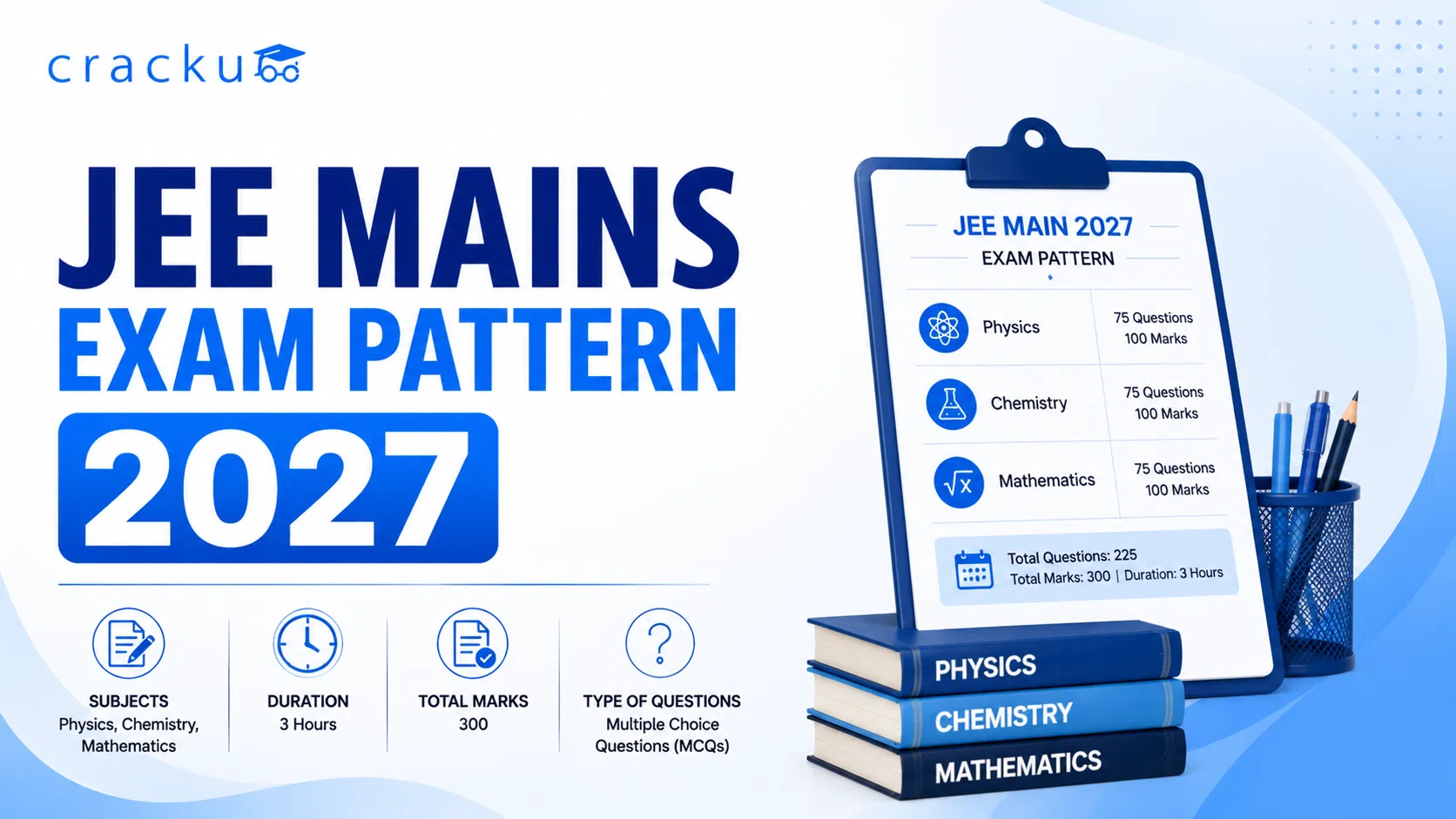
JEE Main 2027 is expected to follow the same exam pattern as JEE Main 2025 and 2026, conducted by the National Testing Agency (NTA) across three distinct papers: Paper 1 for B.E./B.Tech, Paper 2A for B.Arch, and Paper 2B for B.Planning. The exam is held in Computer-Based Test (CBT) mode, except for the Drawing section of Paper 2A, which remains offline. The most significant structural change in recent cycles, the removal of optional questions in Section B, is expected to continue unchanged for 2027. This guide covers the complete paper-wise structure, marking scheme, total marks, duration, negative marking rules, and the key changes introduced over recent exam cycles.
JEE Mains Exam Pattern 2027
The table below summarises the core structural parameters of the JEE Main 2027 exam pattern. These are based on the consistent framework followed in JEE Main 2025 and 2026; the official confirmation will come with the NTA notification expected in October to November 2026.
Parameter | Detail |
|---|---|
Conducting Body | National Testing Agency (NTA) |
Official Website | jeemain.nta.ac.in |
Exam Mode | Computer-Based Test (CBT) for all papers, except the Drawing section of Paper 2A which is offline (pen and paper) |
Number of Papers | 3: Paper 1 (B.E./B.Tech), Paper 2A (B.Arch), Paper 2B (B.Planning) |
Number of Sessions | 2 per year: Session 1 (January 2027) and Session 2 (April 2027) |
Section B Question Format | Compulsory Numerical Value Questions (NVQ) only; the earlier choose-5-from-10 option remains discontinued |
Languages Available | 13 languages, including English, Hindi, and 11 regional languages |
Total Marks (Paper 1) | 300 marks |
Total Marks (Paper 2A and 2B) | 400 marks each |
Tie-Breaking Policy (Paper 1) | Resolved through a strict 8-step hierarchy based on subject percentiles and incorrect-to-correct question ratios. Age and application number have been completely discarded. If a tie persists after all filters, candidates are awarded the same identical rank. |
Once you are familiar with the pattern, the fastest way to internalise it is through practice. Cracku's JEE Questions lets you attempt Section A and Section B style questions exactly as they appear in the real exam, so the format feels familiar on exam day.
Also Read- JEE Main Syllabus 2027 PDF, Weightage, Important Topics
JEE Mains Paper-Wise Exam Pattern
Each of the three JEE Main papers tests a different combination of subjects and skills, and serves a different admission pathway: Paper 1 for engineering, Paper 2A for architecture, and Paper 2B for planning. Candidates may register for one paper or a combination, in the same or different sessions. The table below breaks down sections, question types, total questions, marks, and duration for each paper.
Paper | Sections | Question Type | Total Questions | Total Marks | Duration |
|---|---|---|---|---|---|
Paper 1 (B.E./B.Tech) | Physics, Chemistry, Mathematics | Section A: MCQ; Section B: NVQ (compulsory) | 75 (25 per subject: 20 MCQ + 5 NVQ) | 300 | 3 hours |
Paper 2A (B.Arch) | Mathematics, Aptitude, Drawing | Mathematics and Aptitude: CBT (MCQ + NVQ); Drawing: offline, pen and paper | 77 | 400 | 3 hours |
Paper 2B (B.Planning) | Mathematics, Aptitude, Planning | Fully CBT; MCQ and NVQ across all three sections | 100 | 400 | 3 hours |
Paper 2A's unique structure: Unlike Paper 1 and Paper 2B, Paper 2A combines a CBT-based Mathematics and Aptitude test with an offline, pen-and-paper Drawing test. The Drawing section evaluates artistic and spatial visualisation skills and is assessed subjectively by examiners, unlike the objectively scored MCQ and NVQ sections.
Also Read: JEE Mains 2027, Exam Dates, Registration & Eligibility Criteria
JEE Mains Marking Scheme 2027
The JEE Main marking scheme follows a consistent +4 for correct, -1 for incorrect structure across nearly all sections, with one notable exception: the Drawing section of Paper 2A, which is evaluated subjectively and carries no negative marking. Numerical Value Questions, which previously had no negative marking, now follow the same -1 penalty as MCQs across all papers. The table below details the marking scheme section by section.
Question Type | Correct Answer | Incorrect Answer | Unattempted |
|---|---|---|---|
Section A (MCQ) — all papers | +4 | -1 | 0 |
Section B (NVQ) — Paper 1, and Mathematics in Paper 2A/2B | +4 | -1 | 0 |
Aptitude Section (Paper 2A and 2B) | +4 | -1 | 0 |
Planning Section (Paper 2B) | +4 | -1 | 0 |
Drawing Section (Paper 2A only) | Evaluated out of 100 marks based on examiner assessment | No negative marking | Not applicable |
Because all questions in Section B are now compulsory and carry negative marking, candidates can no longer use NVQs as a low-risk scoring opportunity the way they could when 10 questions were offered with only 5 to be answered. Accuracy in numerical value questions now matters exactly as much as accuracy in MCQs.
Also Read: JEE Mains Exam Date 2027, Registration, Schedule & Result
JEE Main Total Marks, Duration & Exam Mode
Total marks and exam duration differ across the three papers. Paper 1 carries 300 marks; Paper 2A and Paper 2B each carry 400 marks due to their additional Aptitude and Drawing or Planning sections. Standard duration is 3 hours per paper, extended to 4 hours for PwD candidates and to 3.5 hours for candidates attempting both Paper 2A and Paper 2B in the same session. The table below summarises total marks and duration across all scenarios.
Paper | Total Marks | Duration (Standard) | Duration (PwD Candidates) | Duration (Both 2A and 2B) |
|---|---|---|---|---|
Paper 1 (B.E./B.Tech) | 300 | 3 hours | 4 hours | Not applicable |
Paper 2A (B.Arch) | 400 | 3 hours | 4 hours | 3.5 hours (if both 2A and 2B attempted) |
Paper 2B (B.Planning) | 400 | 3 hours | 4 hours | 3.5 hours (if both 2A and 2B attempted) |
Exam mode summary: Paper 1 is entirely computer-based. Paper 2A is computer-based for Mathematics and Aptitude but offline for the Drawing section, which requires physical sketching on provided sheets. Paper 2B is entirely computer-based across all three of its sections: Mathematics, Aptitude, and Planning.
Also Read: JEE Mains Eligibility Criteria 2027, Qualification Criteria, Attempts
Negative Marking Rules in JEE Main
Negative marking applies uniformly to every objectively scored question type in JEE Main, with the Drawing section of Paper 2A being the sole exception. Understanding exactly when marks are deducted, and when they are not, is essential for attempt strategy. The table below lists every scoring scenario a candidate may encounter.
Scenario | Marks Awarded |
|---|---|
MCQ answered correctly | +4 |
MCQ answered incorrectly | -1 |
NVQ (numerical value) answered correctly | +4 |
NVQ (numerical value) answered incorrectly | -1 |
Question left unattempted | 0 (no penalty) |
Drawing section, Paper 2A (subjective evaluation) | No negative marking; marks awarded out of 100 based on examiner assessment |
Strategic implication: Since unattempted questions carry zero penalty while incorrect answers cost 1 mark, guessing without any elimination of options is statistically unfavourable across a full paper. Candidates should only attempt a question if they can eliminate at least 2 of the 4 options with reasonable confidence, or have arrived at the numerical answer through calculation rather than estimation. If managing negative marking under time pressure feels difficult, structured practice helps. Cracku's JEE Online Coaching includes timed mock sessions and personalised feedback to help you build an attempt strategy that minimises careless negative marking.
Important Changes in the JEE Main Exam Pattern
The JEE Main exam pattern has undergone several structural revisions since the pandemic-era format that temporarily allowed optional questions in Section B. The table below summarises the most significant changes that are expected to remain in effect for JEE Main 2027, based on their continuation through the 2025 and 2026 cycles.
Change | What It Means | Since When |
|---|---|---|
Section B made fully compulsory | All 5 NVQs per subject must be attempted; the earlier option of choosing any 5 from 10 questions has been permanently removed | Continued from the 2025 pattern revision; applies to JEE Main 2027 |
Tie-breaking policy revised | Both age and application number have been completely discarded as tie-breakers; ties are now resolved through an 8-step hierarchy based on subject-wise marks and accuracy ratios, with candidates who remain tied after all 8 steps assigned the exact same All India Rank | Introduced for recent cycles; expected to continue for JEE Main 2027 |
Total question count reduced | Paper 1 moved from a 90-question paper (75 to attempt) to a fixed 75-question paper where all questions are mandatory | Effective from the 2025 pattern revision onward |
Negative marking extended to NVQs | Numerical Value Questions, which previously carried no negative marking, now carry the standard -1 penalty for incorrect answers across all papers | Effective from the 2025 pattern revision onward |
Planning section negative marking added | The Planning section of Paper 2B now follows the same +4/-1 marking scheme as other sections, removing its earlier no-negative-marking status | Effective from the 2025 pattern revision onward |
Full tie-breaking hierarchy: When two or more candidates obtain the exact same overall NTA percentile score in Paper 1, NTA applies a fixed 8-step hierarchy based on subject percentiles and accuracy ratios to resolve the tie. Both age and application number have been completely discarded as tie-breaking criteria; this is a common point of confusion, since older JEE Main cycles did use age as a tie-breaker. If candidates remain tied after all 8 steps, they are assigned the exact same All India Rank. The complete sequence is listed below.
Step | Tie-Breaking Criterion |
|---|---|
1 | Higher NTA Score in Mathematics |
2 | Higher NTA Score in Physics |
3 | Higher NTA Score in Chemistry |
4 | Lower ratio of incorrect to correct answers, across all subjects combined |
5 | Lower ratio of incorrect to correct answers in Mathematics |
6 | Lower ratio of incorrect to correct answers in Physics |
7 | Lower ratio of incorrect to correct answers in Chemistry |
8 | Final resolution: candidates who remain tied after all the above steps are assigned the exact same All India Rank (AIR); age and application number are not used at any stage |
What has NOT changed: The core subject structure (Physics, Chemistry, Mathematics for Paper 1), the two-session-per-year format, the CBT mode for all sections except Drawing, and the overall total marks for each paper have remained stable across the last several cycles. Candidates preparing for JEE Main 2027 should expect continuity in the fundamental exam structure, with only minor procedural updates likely in the official notification.
JEE Mains Exam Pattern 2027: Conclusion
The JEE Mains Exam Pattern 2027 is expected to continue with the same structure followed in recent exam cycles. Students should prepare for Paper 1 with 75 compulsory questions from Physics, Chemistry, and Mathematics, along with a +4 and -1 marking scheme. Since Section B Numerical Value Questions are now compulsory and also carry negative marking, accuracy is just as important as speed.
Before starting full-length mock tests, students must clearly understand the paper-wise structure, total marks, duration, negative marking rules, and tie-breaking process. A clear understanding of the JEE Main 2027 exam pattern helps aspirants plan their attempts better, reduce careless mistakes, and build a stronger exam strategy for both January and April sessions.
.webp)