JEE WhatsApp Group



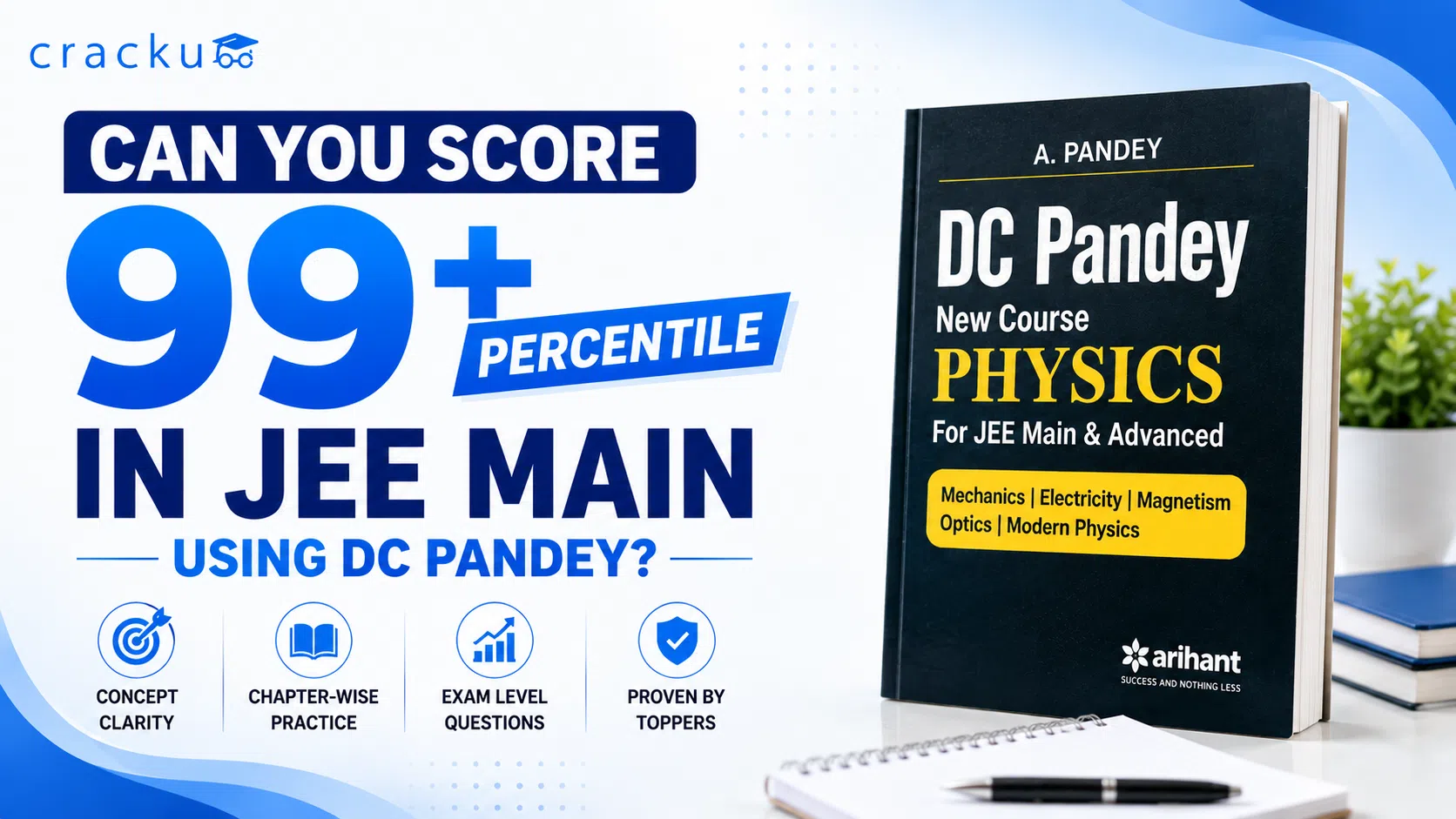
Can You Score 99+ Percentile in JEE Main Using DC Pandey?
Preparing for JEE Main demands disciplined, structured practice in Physics, Chemistry, and Mathematics. Understanding Physics by D.C. Pandey is one of the most widely referred Physics resources among JEE aspirants, recommended consistently by toppers, mentors, and coaching faculty. The book is organised into 5 volumes that build conceptual clarity through modular theory, followed by graded exercises aligned with both JEE Main and JEE Advanced question patterns. This article examines whether DC Pandey alone can realistically support a 99+ percentile outcome in JEE Main, and how to use it correctly if it forms part of your preparation.
Is DC Pandey Enough for JEE Main 2027?
DC Pandey is used by lakhs of aspirants every year and is widely regarded as one of the most reliable Physics resources for JEE Main. It builds conceptual understanding while offering a strong volume of numerical and application-based questions. For Physics specifically, DC Pandey paired with NCERT as a conceptual reference is sufficient for most aspirants targeting a strong JEE Main score.
An important distinction for Chemistry: NCERT plays a very different role for Chemistry than it does for Physics. While NCERT serves mainly as a conceptual reference for Physics, it is the core, non-negotiable textbook for Inorganic and Organic Chemistry. A significant share of JEE Main Chemistry questions are drawn directly from NCERT lines, facts, and reactions. No reference book, including DC Pandey, substitutes for a thorough, repeated reading of NCERT Chemistry.
For Physics, DC Pandey's graded difficulty structure, which moves from concept to application to exam-level problems, makes it largely self-sufficient when paired with NCERT. It covers the JEE Main Physics syllabus in accessible language, which makes it usable across a wide range of preparation levels.
Also Read: DC Pandey vs HC Verma, Which One You Should Choose?
Who Should Use DC Pandey for JEE Main?
DC Pandey is a beginner-friendly Physics resource, but beginner-friendly does not mean it requires no prior preparation at all. Students should have a basic working understanding of vectors and elementary calculus, typically covered in early Class 11, before starting the book. Without this minimal groundwork, even DC Pandey's clearer explanations can feel disconnected. Once that baseline is in place, the book is suitable for students at very different stages of preparation, from those just beginning structured study to those refining advanced topics.
The table below outlines how DC Pandey serves students at different stages of their JEE Main preparation journey.
Stage of Preparation | How DC Pandey Helps at This Stage |
|---|---|
Already covered basics from NCERT | Builds application speed and exposes the student to a wider variety of problem types beyond what NCERT offers |
Covered major topics but lack practice depth | Provides graded exercises that move from concept-level to JEE Main-level difficulty, closing the gap NCERT leaves open |
Need conceptual clarity | Explains topics with worked examples that bridge the jump from NCERT theory to exam-style problems |
Comfortable with NCERT theory but weak on problem-solving | Builds problem-solving depth that NCERT does not provide, since NCERT is concept-complete but exercise-light |
Want both foundation and advanced practice in one place | Offers a single resource covering both introductory and higher-difficulty questions, reducing the need to juggle multiple books early on |
Struggling with limited practice volume from NCERT alone | Supplies a much larger question bank at a difficulty level closer to the actual JEE Main paper |
Also Read: JEE Physics Books 2026, Check Topic-wise Preparation Books
How to Use DC Pandey to Score 99+ Percentile in JEE Main
Owning DC Pandey is not the same as using it effectively. The way a student engages with the book matters far more than simply working through all five volumes cover to cover. After learning the theory for a topic, move directly to solving questions rather than re-reading passively; understanding is tested, not absorbed. Prepare short notes for genuinely complex topics so revision later does not require re-deriving everything from scratch. Practice consistently, ideally daily, rather than in occasional long sessions.
• Learn the theory first by reading carefully, then move to solving questions
- Prepare short, topic-wise notes for genuinely complex concepts
- Solve exercises consistently, ideally every day, rather than in irregular bursts
- Use DC Pandey for mixed, multi-concept question practice once individual topics feel solid
- Solve the exercises thoroughly once; star or bookmark the questions you get wrong or find tricky, and revisit only those marked questions 2 to 3 times during revision
- Prioritise NTA JEE Main Past Year Questions from 2019 to 2026 alongside DC Pandey's Level 1 exercises, and read the JEE Advanced section for additional depth on harder concepts
On repeated solving: A common but counterproductive piece of advice is to solve every question in the book several times before the exam. This wastes scarce preparation time on problems you have already mastered. A more efficient approach is to solve each exercise thoroughly once, mark the questions that genuinely gave you trouble, and revisit only those flagged questions during revision. Past Year Questions deserve more weight than book exercises in the final months, since they reflect the actual pattern, phrasing, and difficulty calibration the exam uses.
Also Read: JEE Books 2026, Subject-wise Books for Mains & Advanced
What Additional Books and Resources Should You Use Alongside DC Pandey?
Not every well-known Physics book is a good fit for JEE Main preparation specifically. Some are calibrated for JEE Advanced's higher difficulty ceiling, some are built around different exams entirely, and some are board-exam oriented rather than competitive-exam oriented. Adding too many resources also creates its own problem: divided attention across multiple books, each only partially completed, tends to produce weaker results than mastering fewer, well-chosen ones. The table below lists resources that are genuinely well-suited to a JEE Main 99+ percentile target.
Author / Resource | Book or Resource Name | Role in JEE Main Preparation |
|---|---|---|
HC Verma | Concepts of Physics (Volumes 1 and 2) | Highly recommended alongside DC Pandey for building absolute conceptual clarity, particularly in Mechanics and Electromagnetism |
NTA / Official Sources | JEE Main Past Year Questions (2019 to 2026) | Mandatory. The single most reliable resource for understanding the current exam pattern, question framing, and difficulty trends |
Coaching Institute Material | Modules from reputable coaching institutes | Useful for targeted, time-bound practice sheets and Daily Practice Problems (DPPs) that simulate exam conditions |
Resources to avoid for a JEE Main-specific target: Books calibrated for JEE Advanced's most difficult problem sets, such as Irodov's Problems in General Physics, are not an efficient use of time for a JEE Main-focused 99+ percentile goal; they are built for a smaller pool of top JEE Advanced rankers facing a different difficulty ceiling. Books written for NEET, board exams, or general foreign undergraduate physics courses are calibrated for different syllabi, question styles, or depth, and pulling from them dilutes focused JEE Main preparation rather than strengthening it. For maximum efficiency, work through one core reference at a time rather than spreading effort across many.
Also Read: How to Choose the Right JEE Foundation Course for Your Child?
Common Mistakes Students Make While Solving DC Pandey
Most students do not lack effort; they lack an efficient process. Recognising these common mistakes early can save significant preparation time over the course of a JEE Main cycle. The table below outlines the most frequent errors and the more effective alternative for each.
Common Mistake | What to Do Instead |
|---|---|
Attempting the most difficult questions before mastering the basics | Solve foundational questions first to build genuine understanding, then progress to advanced problems |
Solving questions without revising the underlying concept first | Revise the relevant theory or formula derivation before attempting a fresh set of problems |
Jumping straight to problems without internalising concepts | Follow the sequence of concepts first, problems second; skipping this order creates shallow, exam-fragile understanding |
Checking the solution at the first sign of difficulty | Attempt the problem fully on your own first; struggling productively is part of how understanding develops |
Memorising formulas without understanding their derivation | Understand where a formula comes from before committing it to memory; this makes recall more reliable under exam pressure |
Solving too few questions per topic | Increase the volume of practice per topic rather than moving on after just one or two questions |
Repeating only your own errors without reviewing common error patterns | Review frequently made mistakes across topics, not just the ones you personally made, to anticipate exam traps |
Can You Score 99+ Percentile in JEE Main Using DC Pandey: Conclusion
DC Pandey is one of the most useful Physics books for JEE Main preparation because it gives students a strong mix of theory, solved examples, and graded practice questions. For JEE Main 2027 aspirants, it can be a highly effective resource when used with a clear study plan. Students should first understand the concept, then solve exercises, mark difficult questions, and revise those weak areas regularly instead of repeating every question again and again.
However, DC Pandey alone is not enough for the complete JEE Main preparation because the exam includes Physics, Chemistry, and Mathematics. For Physics, it should be combined with NCERT, JEE Main previous year questions, and mock tests. For Chemistry, NCERT remains extremely important, especially for Inorganic and Organic Chemistry. A focused combination of DC Pandey, NCERT, PYQs, HC Verma for clarity, and regular mocks can help students prepare smartly for a 99+ percentile score.
.webp)