91- 6303239042
What is the row number which has the least sum of numbers placed in that row?
Backspace
789
456
123
0.-
Clear All
789
456
123
0.-
Clear All
Sign in
Please select an account to continue using cracku.in
↓ →
 CAT WhatsApp Group
The numbers 1, 2, 3, 4, 5, 6, 7, 8, 9, and 10 are placed in ten slots of the following grid based on the conditions below.
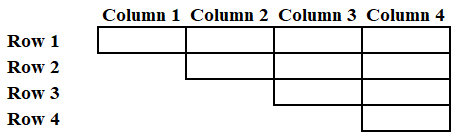
1. Numbers in any row appear in an increasing order from left to right.
2. Numbers in any column appear in a decreasing order from top to bottom.
3. 1 is placed either in the same row or in the same column as 10.
4. Neither 2 nor 3 is placed in the same row or in the same column as 10.
5. Neither 7 nor 8 is placed in the same row or in the same column as 9.
6. 4 and 6 are placed in the same row.
What is the row number which has the least sum of numbers placed in that row?
We are given that the numbers keep increasing from left to right (clue 1), and the number keeps decreasing from top to bottom (clue 2)
The key takeaway from this is that 10 must be placed in Row 1, column 4, as placing it anywhere else would mean that the number above it, or right to it, must be greater than 10, which is not an option.
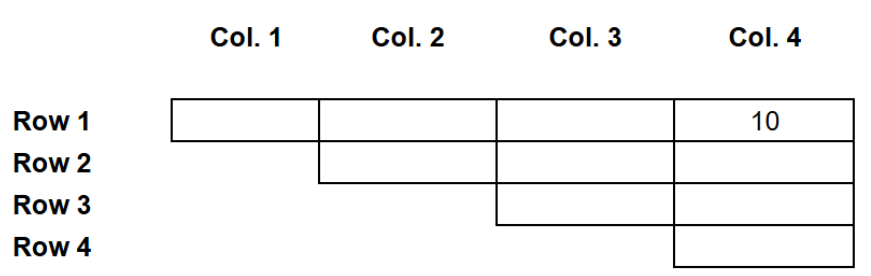
Clue 3 says that one is either in the same row or the same column as 10.
The same logic that we used for 10 applies for 1; it must be either in Row 1, column 1, or Row 4, column 4; we don't know which one yet.
We are given that 2 and 3 are not in the same column or row as 10, meaning that they must occupy two spots from (Row 2, Col. 2), (Row 2, Col. 3), and (Row 3, Col. 3)
2 and 3 must be present in Row 2, column 2 or Row 3, column 3, as there is no number smaller than it to be in the cell left to it.
Clue 6 says that 4 and 6 are in the same row; this can be rows 1, 2, or 3.
Clue 5 is a good starting point.
Once we found the position of 10, the only positions possible for 9 are R1C3 or R2C4
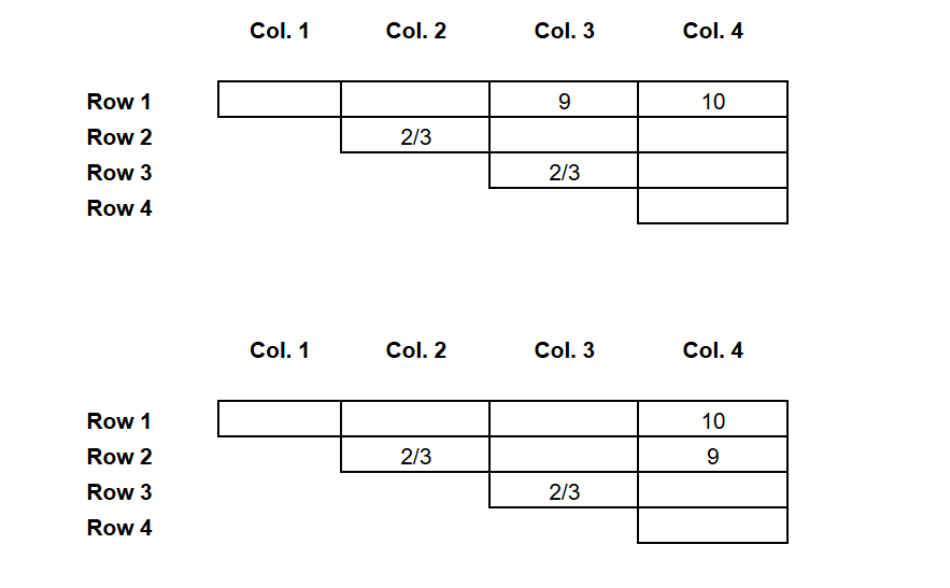
If 9 is placed in R2C4, 7 and 8 must be placed in row 1.
Clue 6 says that 4 and 6 are in the same row, but with 7 and 8 in row 1, no rows are left with two spaces. Hence, 9 can not be in R2C4, and the arrangement must be:
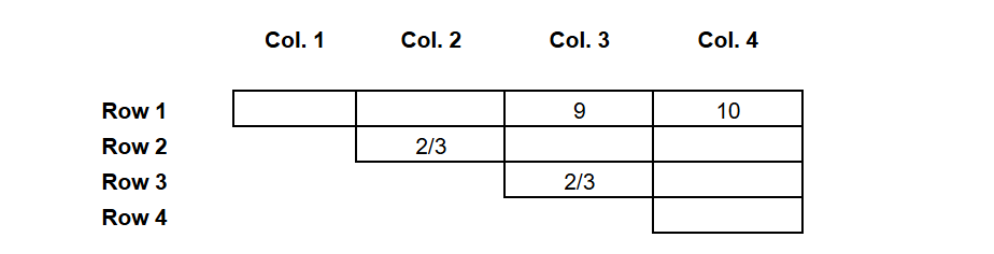
7 and 8 must be in column 4, occupying R3C4 and R2C4, respectively.
Hence, 4, 6 must be in row 1:
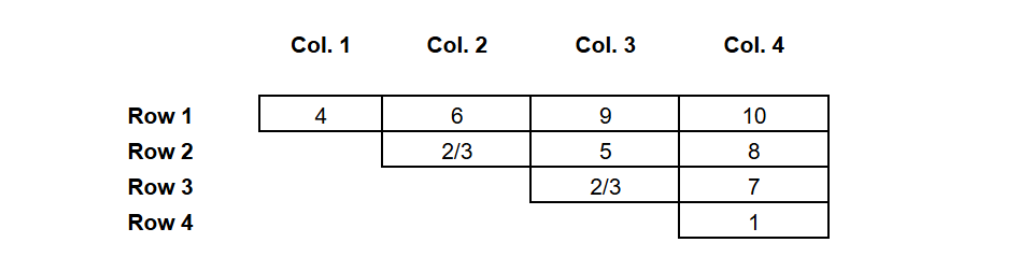
The lowest sum is of the 4th row.
Therefore, is the correct answer.
Which of the following statements MUST be true?
I. 10 is placed in a slot in Row 1.
II. 1 is placed in a slot in Row 4.
We are given that the numbers keep increasing from left to right (clue 1), and the number keeps decreasing from top to bottom (clue 2)
The key takeaway from this is that 10 must be placed in Row 1, column 4, as placing it anywhere else would mean that the number above it, or right to it, must be greater than 10, which is not an option.
Clue 3 says that one is either in the same row or the same column as 10.
The same logic that we used for 10 applies for 1; it must be either in Row 1, column 1, or Row 4, column 4; we don't know which one yet.
We are given that 2 and 3 are not in the same column or row as 10, meaning that they must occupy two spots from (Row 2, Col. 2), (Row 2, Col. 3), and (Row 3, Col. 3)
2 and 3 must be present in Row 2, column 2 or Row 3, column 3, as there is no number smaller than it to be in the cell left to it.
Clue 6 says that 4 and 6 are in the same row; this can be rows 1, 2, or 3.
Clue 5 is a good starting point.
Once we found the position of 10, the only positions possible for 9 are R1C3 or R2C4
If 9 is placed in R2C4, 7 and 8 must be placed in row 1.
Clue 6 says that 4 and 6 are in the same row, but with 7 and 8 in row 1, no rows are left with two spaces. Hence, 9 can not be in R2C4, and the arrangement must be:
7 and 8 must be in column 4, occupying R3C4 and R2C4, respectively.
Hence, 4, 6 must be in row 1:
We can see that the positions 10 and 1 are fixed and agree with the given statements.
Both the statements are true.
Therefore, Option A is the correct answer.
Which of the following statements MUST be true?
I. 2 is placed in a slot in Column 2.
II. 3 is placed in a slot in Column 3.
We are given that the numbers keep increasing from left to right (clue 1), and the number keeps decreasing from top to bottom (clue 2)
The key takeaway from this is that 10 must be placed in Row 1, column 4, as placing it anywhere else would mean that the number above it, or right to it, must be greater than 10, which is not an option.
Clue 3 says that one is either in the same row or the same column as 10.
The same logic that we used for 10 applies for 1; it must be either in Row 1, column 1, or Row 4, column 4; we don't know which one yet.
We are given that 2 and 3 are not in the same column or row as 10, meaning that they must occupy two spots from (Row 2, Col. 2), (Row 2, Col. 3), and (Row 3, Col. 3)
2 and 3 must be present in Row 2, column 2 or Row 3, column 3, as there is no number smaller than it to be in the cell left to it.
Clue 6 says that 4 and 6 are in the same row; this can be rows 1, 2, or 3.
Clue 5 is a good starting point.
Once we found the position of 10, the only positions possible for 9 are R1C3 or R2C4
If 9 is placed in R2C4, 7 and 8 must be placed in row 1.
Clue 6 says that 4 and 6 are in the same row, but with 7 and 8 in row 1, no rows are left with two spaces. Hence, 9 can not be in R2C4, and the arrangement must be:
7 and 8 must be in column 4, occupying R3C4 and R2C4, respectively.
Hence, 4, 6 must be in row 1:
Positions 2 and 3 can be switched.
Either of them can be in column 2 or 3
Neither of the statements is necessarily true.
Therefore, Option C is the correct answer.
For how many slots in the grid, placement of numbers CANNOT be determined with certainty?
We are given that the numbers keep increasing from left to right (clue 1), and the number keeps decreasing from top to bottom (clue 2)
The key takeaway from this is that 10 must be placed in Row 1, column 4, as placing it anywhere else would mean that the number above it, or right to it, must be greater than 10, which is not an option.
Clue 3 says that one is either in the same row or the same column as 10.
The same logic that we used for 10 applies for 1; it must be either in Row 1, column 1, or Row 4, column 4; we don't know which one yet.
We are given that 2 and 3 are not in the same column or row as 10, meaning that they must occupy two spots from (Row 2, Col. 2), (Row 2, Col. 3), and (Row 3, Col. 3)
2 and 3 must be present in Row 2, column 2 or Row 3, column 3, as there is no number smaller than it to be in the cell left to it.
Clue 6 says that 4 and 6 are in the same row; this can be rows 1, 2, or 3.
Clue 5 is a good starting point.
Once we found the position of 10, the only positions possible for 9 are R1C3 or R2C4
If 9 is placed in R2C4, 7 and 8 must be placed in row 1.
Clue 6 says that 4 and 6 are in the same row, but with 7 and 8 in row 1, no rows are left with two spaces. Hence, 9 can not be in R2C4, and the arrangement must be:
7 and 8 must be in column 4, occupying R3C4 and R2C4, respectively.
Hence, 4, 6 must be in row 1:
Placements of all the numbers except 2 and 3 can be determined.
Therefore, 2 is the correct answer.
What is the sum of the numbers placed in Column 4?
We are given that the numbers keep increasing from left to right (clue 1), and the number keeps decreasing from top to bottom (clue 2)
The key takeaway from this is that 10 must be placed in Row 1, column 4, as placing it anywhere else would mean that the number above it, or right to it, must be greater than 10, which is not an option.
Clue 3 says that one is either in the same row or the same column as 10.
The same logic that we used for 10 applies for 1; it must be either in Row 1, column 1, or Row 4, column 4; we don't know which one yet.
We are given that 2 and 3 are not in the same column or row as 10, meaning that they must occupy two spots from (Row 2, Col. 2), (Row 2, Col. 3), and (Row 3, Col. 3)
2 and 3 must be present in Row 2, column 2 or Row 3, column 3, as there is no number smaller than it to be in the cell left to it.
Clue 6 says that 4 and 6 are in the same row; this can be rows 1, 2, or 3.
Clue 5 is a good starting point.
Once we found the position of 10, the only positions possible for 9 are R1C3 or R2C4
If 9 is placed in R2C4, 7 and 8 must be placed in row 1.
Clue 6 says that 4 and 6 are in the same row, but with 7 and 8 in row 1, no rows are left with two spaces. Hence, 9 can not be in R2C4, and the arrangement must be:
7 and 8 must be in column 4, occupying R3C4 and R2C4, respectively.
Hence, 4, 6 must be in row 1:
The sum of numbers in the 4th column is 10+8+7+1 = 26
Therefore, 26 is the correct answer.
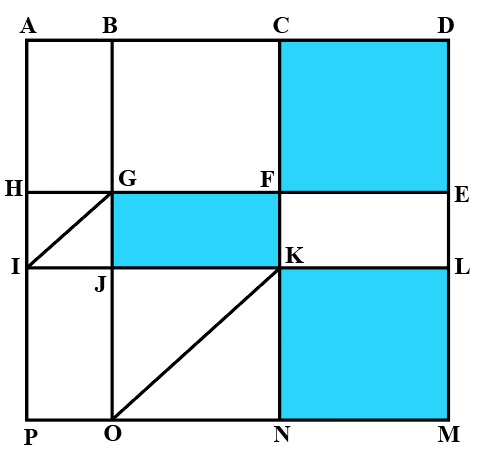
The above is a schematic diagram of walkways (indicated by all the straight-lines) and lakes (3 of them, each in the shape of rectangles - shaded in the diagram) of a gated area. Different points on the walkway are indicated by letters (A through P) with distances being OP = 150 m, ON = MN = 300 m, ML = 400 m, EL = 200 m, DE = 400 m.
The following additional information about the facilities in the area is known.
1. The only entry/exit point is at C.
2. There are many residences within the gated area; all of them are located on the path AH and ML with four of them being at A, H, M, and L.
3. The post office is located at P and the bank is located at B.
One resident whose house is located at L, needs to visit the post office as well as the bank. What is the minimum distance (in m) he has to walk starting from his residence and returning to his residence after visiting both the post office and the bank?
The first thing to realise here is the lengths of the paths.
KN should be equal to LM, giving the length of KO using Pythagoras theorem as 500m
Similarly, the length of HJ=OP=150m and length of GJ=EL=200m, giving the length of HG as 250 m
The shortest path from L to B and then to P (or the other way around would involve) using these hypotenuses as much as possible instead of the two adjacent sides. The shortest can be visualised as shown below or multitude of others variations, as there are multiple ways that would make one travel the shortest distance)
The below figure is the simplest one for visualisation.
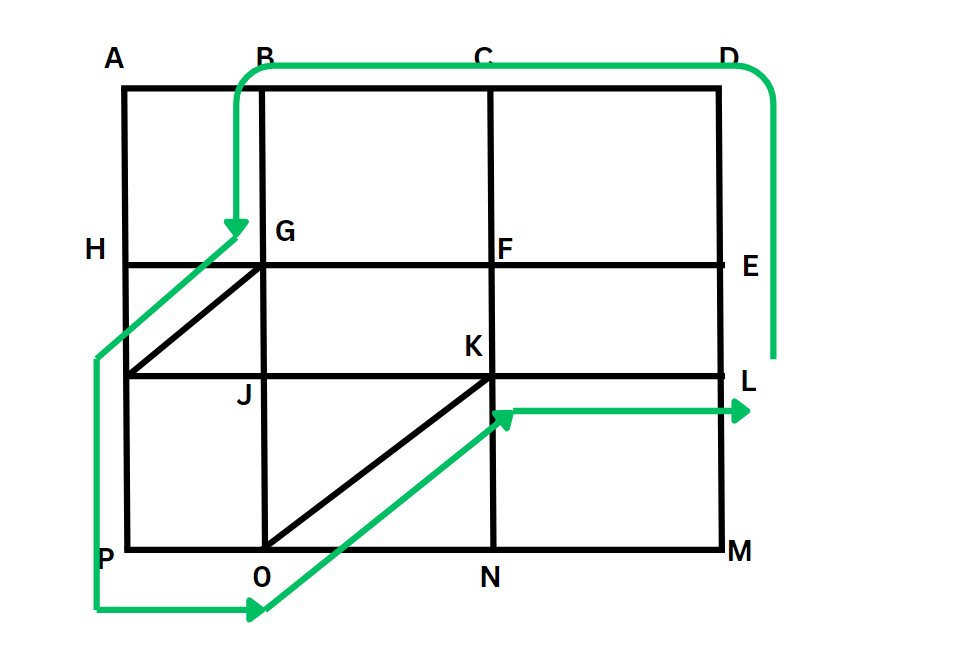
Other possible paths are L-E-F-C-.. and following the same path.
The shortest distance in each of these instance would be LE+ED+DC+CB+BG+GI+IP+PO+OK+KL
Which would be 200+400+300+300+400+250+400+150+500+300 = 3200
Therefore, Option B is the correct answer.
One person enters the gated area and decides to walk as much as possible before leaving the area without walking along any path more than once and always walking next to one of the lakes. Note that he may cross a point multiple times. How much distance (in m) will he walk within the gated area?
Since we can only walk along the side of lakes, that drastically reduces the paths we can take.
The diagram below shows the path with the maximum distance travelled.
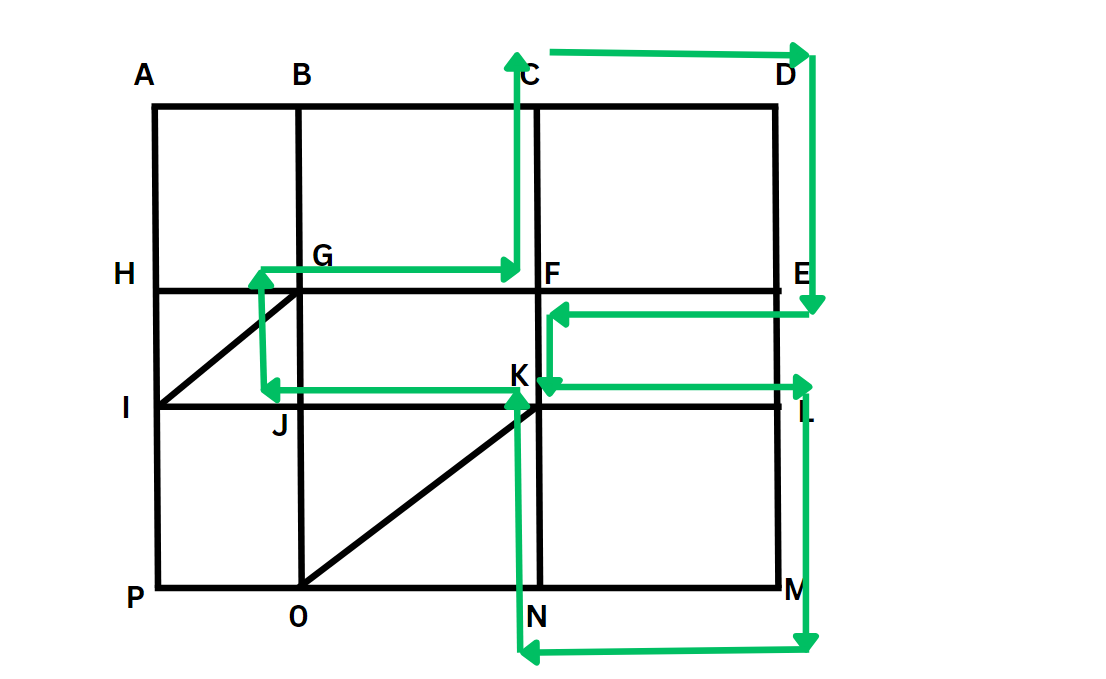
The path is CD-DE-EF-FK-KL-LM-MN-NK-KJ-JG-GF-FC
(the reverse of this path is also valid)
We can either manually add the lengths or use shorter methods to note that in the path we travel walkways of length 400 m 4 times (DE, LM, KN, EF), walkways of length 300m 6 times (CD, EF, KL, MN, KJ, GF) and walkways of length 200 m 2 times (FK, JG)
Giving the total length to be 1600+1800+400 = 3800
Therefore, Option C is the correct answer.
One resident takes a walk within the gated area starting from A and returning to A without going through any point (other than A) more than once. What is the maximum distance (in m) she can walk in this way?
Counter to the first question, we should minimize the use of those hypotenuse walkways as they reduce the distance we travel.
The longest possible route would include then travelling through the edges of the rectangles and sqaures, and not touch any point more than once.
Best case scenario would be us touching each point exactly once.
This can be visualized as:
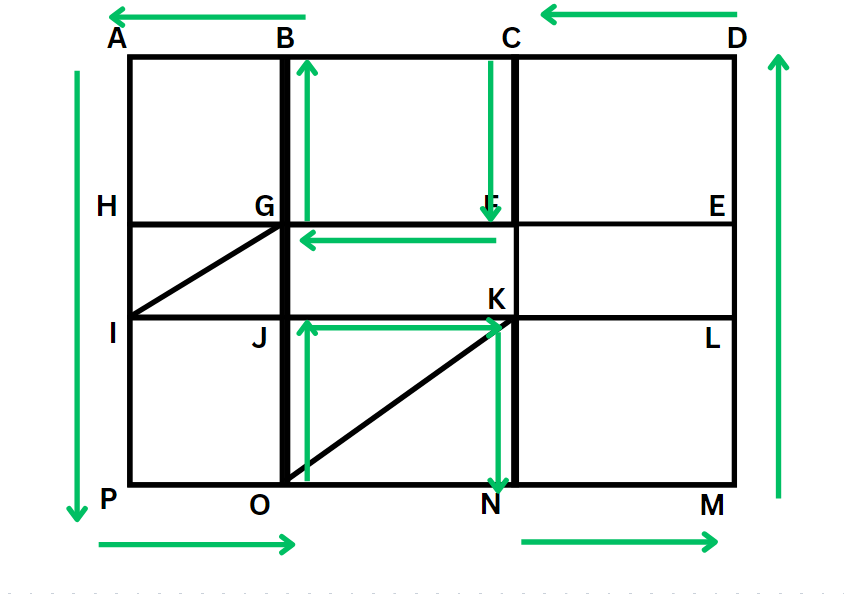
Where we do not use any of the hypotenuse and cross through each gate exactly once.
The total distance would be:
AH+HI+ IP = 400+200+400 = 1000
DE+EL+LM = 400+200+400 = 1000
PO+JK+NM = 150+300+300 = 750
DC+FG+BA = 150+300+300 = 750
JO+KN = 400+400 = 800
CF+GB = 400+400 = 800
Adding up to: 5100m
Therefore, 5100 is the correct answer.
Visitors coming for morning walks are allowed to enter as long as they do not pass by any of the residences and do not cross any point (except C) more than once. What is the maximum distance (in m) that such a visitor can walk within the gated area?
Similar to the previous question, we should try to avoid the hypotenuse
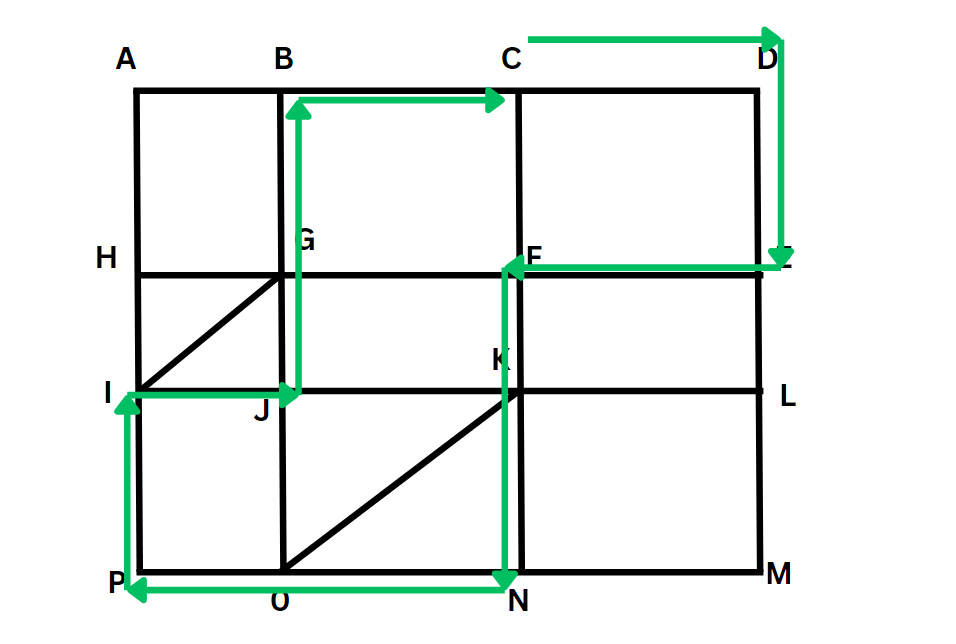
The total path distance would be 300(CD) + 400(DE) + 300(EF) + 200(FK) + 400(KN) + 300(NO) + 150(OP) + 400(PI) + 150(IJ) + 200(JG) + 400(GB) + 300(BC)
Adding up to 3,500 meters
Therefore, 3500 is the correct answer.
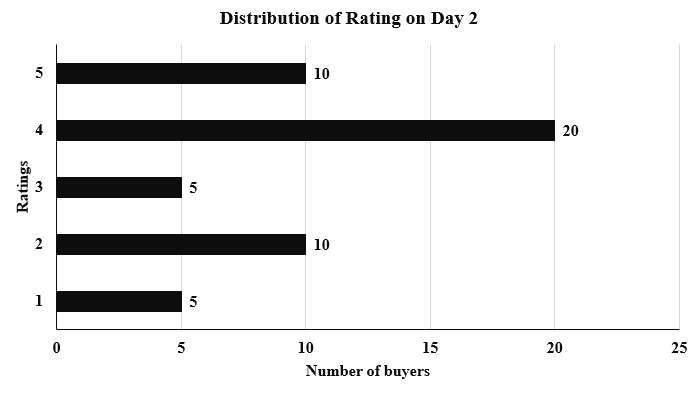
An online e-commerce firm receives daily integer product ratings from 1 through 5 given by buyers. The daily average is the average of the ratings given on that day. The cumulative average is the average of all ratings given on or before that day. The rating system began on Day 1, and the cumulative averages were 3 and 3.1 at the end of Day 1 and Day 2, respectively. The distribution of ratings on Day 2 is given in the figure below.
The following information is known about ratings on Day 3.
1. 100 buyers gave product ratings on Day 3.
2. The modes of the product ratings were 4 and 5.
3. The numbers of buyers giving each product rating are non-zero multiples of 10.
4. The same number of buyers gave product ratings of 1 and 2, and that number is half the number of buyers who gave a rating of 3.
How many buyers gave ratings on Day 1?
From the given chart, we can find the average rating on day 2:
$$\frac{\left(5\times\ 1\right)+\left(10\times\ 2\right)+\left(5\times\ 3\right)+\left(20\times\ 4\right)+\left(10\times\ 5\right)}{5+10+5+20+10}=\frac{170}{50}=3.4$$
We are given the cumulative average of day 1 and day 2 as 3.1, and the average at the end of day 1 is 3.
Let's take the number of ratings received on day 1 as $$x$$; using this overall average and the average on day 2, we get the equation:
$$\frac{3x+\left(50\times\ 3.4\right)}{x+50}=3.1$$
$$3x+170=3.1x+155$$
$$15\ =\ 0.1x$$
$$x=150$$
Therefore, the number of ratings received on day 1 is 150.
What is the daily average rating of Day 3?
We are given that on day 3, a total of 100 ratings came in
The modes were 4 and 5, meaning that an equal number of 4 and 5 ratings came in; let it be 10b (since we are given that all ratings were non-zero multiples of 10)
Let's take the number of 1 and 2 ratings as 10a each, giving the number of 3 ratings as 20a
Adding all of these up: 10a+10a+20a+10b+10b = 100
40a+20b = 100
2a+b = 5
The only integer combination for a and b, without them being zero, is a being 1 and b being 3 or a=2 and b=1
But taking b as 1 would make 3 as the mode rating, so we can not consider the latter case.
We are giving 10 - 1 ratings, 10 - 2 ratings, 20 - 3 ratings, 30 - 4 ratings, and 30 - 5 ratings.
The average would be $$\frac{\left(10\times\ 1\right)+\left(10\times\ 2\right)+\left(20\times\ 3\right)+\left(30\times\ 4\right)+\left(30\times\ 5\right)}{100}=\frac{360}{100}=3.6$$
Therefore, Option A is the correct answer.
What is the median of all ratings given on Day 3?
As deduced in the previous question, there were 10 1 ratings, 10 2 ratings, 20 3 ratings, 30 4 ratings, and 30 5 ratings.
The median would be the 50th and 51st ratings' average when arranged in ascending/descending order.
Both of which would be 4
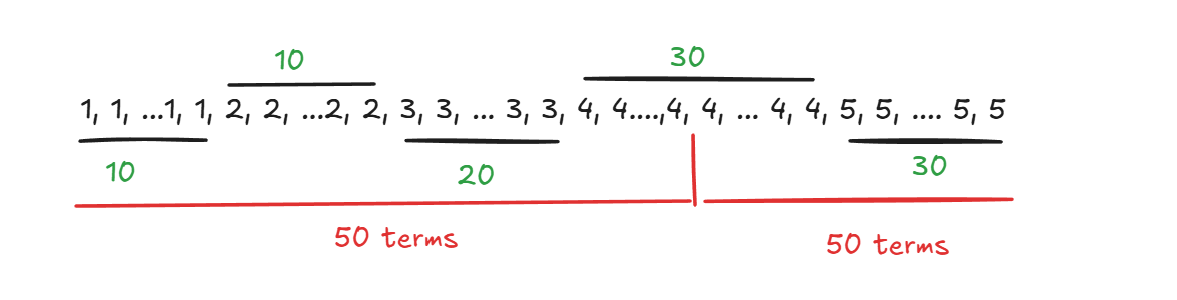
Therefore, 4 is the correct answer
Which of the following is true about the cumulative average ratings of Day 2 and Day 3?
The cumulative average rating at the end of day 3 would be $$\frac{\left(3.1\times\ 200\right)+\left(3.6\times\ 100\right)}{200+100}$$
[the cumulative average rating on day 2= 3.1
Number of ratings received by day 2= 200]
$$\frac{360+620}{300}=\frac{980}{300}=3.266$$
The increase in the cumulative average from day 2 to day 3 can be calculated as $$\frac{3.266-3.1}{3.1}\times\ 100\approx\ 5.34$$
Which aligns with the statement given in option C.
Therefore, Option C is the correct answer.
The two plots below give the following information about six firms A, B, C, D, E, and F for 2019 and 2023.
PAT: The firm’s profits after taxes in Rs. crores,
ES: The firm’s employee strength, that is the number of employees in the firm, and
PRD: The percentage of the firm’s PAT that they spend on Research and Development (R&D).
In the plots, the horizontal and vertical coordinates of point representing each firm gives their ES and PAT values respectively. The PRD values of each firm are proportional to the areas around the points representing each firm. The areas are comparable between the two plots, i.e., equal areas in the two plots represent the same PRD values for the two years.
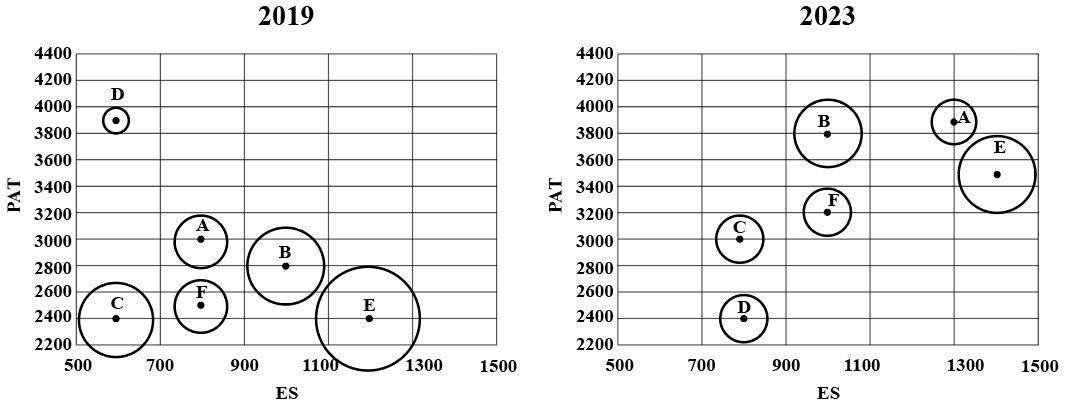
Assume that the annual rate of growth in PAT over the previous year (ARG) remained constant over the years for each of the six firms. Which among the firms A, B, C, and E had the highest ARG?
Since we are given that the annual growth rate should be taken as constant, we can simply compare the ratio changes in the firm's PAT in 2019 and 2023 and compare them.
Firm A: 3000 to 3900; an increase of 900, giving the growth rate to be $$\frac{900}{3000}=\frac{3}{10}=0.3$$
Firm C: 2400 to 3000; an increase of 600, giving the growth rate to be $$\frac{600}{2400}=\frac{1}{4}=0.25$$
Firm E: 2400 to 3500; an increase of 1100, giving the growth rate to be $$\frac{1100}{2400}=\frac{11}{24}\approx\ 0.45$$
Firm B: 2800 to 3800; an increase of 1000, giving the growth to be $$\frac{1000}{2800}=\frac{5}{14}\approx\ 0.35$$
We can see that of the given ratios, the growth rate is highest for firm E (closest to 0.5). Therefore, the highest ARG, among the given options, will be for firm E.
Therefore, Option C is the correct answer.
The ratio of the amount of money spent by Firm C on R&D in 2019 to that in 2023 is closest to
This can be a little difficult to solve since the bubbles are not closed within a fixed boundary, but in such instances, we should approximate the most visible cases.
Like the bubble of C in 2019 is almost 3 units vertically long in diameter, while that in 2023 is 2 units long.
The ratio of the amount spend on R&D on 2019 to 2024 would be given by: $$\frac{2400\pi\left(1.5\right)^2\ }{3000\pi\ \left(1\right)^2}=\frac{8}{10}\times\ \frac{9}{4}=9:5$$
Which is option D.
Which among the firms A, C, E, and F had the maximum PAT per employee in 2023?
The Pat per employee for the firm in 2023 will be:
Firm E:$$\frac{3500}{1400}=\frac{35}{14}=\frac{5}{2}$$
Firm A: $$\frac{3900}{1300}=3$$
Firm F: $$\frac{3200}{1000}=3.2$$
Firm C: $$\frac{3000}{800}=\frac{15}{4}=3.75$$
The value if maximum for firm C, therefore, Option D is the correct answer.
Which among the firms C, D, E, and F had the least amount of R&D spending per employee in 2023?
We calculated the PAT per employee for F, C and E in the last question, using that information and calculating the PAT per employee for firm D to be $$\frac{2400}{800}=3$$
For firms F, C and D, we can see that the area is the same hence the only factor to consider is PAT per employee
F is 3.2, C is 3.75, and D is 3
This leaves D as the minimum.
Comparing E and D (taking the proportionality constant as k)
E has PAT per employee as 2.5 with a radius of 1.5 units, the PRD value per employee would be $$\frac{5}{2}k\pi\ \left(\frac{3}{2}\right)^2=k\pi\ \times\ \frac{5\times\ 9}{8}$$
D has PAT per employee as 3, with a radius of 1 unit.the PRD value per employee would be $$3k\pi\ \left(1\right)^2=3k\pi\ $$
We can see that the value would be greater for E, therefore firm D will have the lowest R&D spending per employee in 2023
Therefore, Option B is the correct answer.
Eight gymnastics players numbered 1 through 8 underwent a training camp where they were coached by three coaches - Xena, Yuki, and Zara. Each coach trained at least two players. Yuki trained only even numbered players, while Zara trained only odd numbered players. After the camp, the coaches evaluated the players and gave integer ratings to the respective players trained by them on a scale of 1 to 7, with 1 being the lowest rating and 7 the highest.
The following additional information is known.
1. Xena trained more players than Yuki.
2. Player-1 and Player-4 were trained by the same coach, while the coaches who trained Player-2, Player-3 and Player-5 were all different.
3. Player-5 and Player-7 were trained by the same coach and got the same rating. All other players got a unique rating.
4. The average of the ratings of all the players was 4.
5. Player-2 got the highest rating.
6. The average of the ratings of the players trained by Yuki was twice that of the players trained by Xena and two more than that of the players trained by Zara.
7. Player-4's rating was double of Player-8's and less than Player-5's.
What best can be concluded about the number of players coached by Zara?
We are told that each coach had at least two players. Clue 1 says that Xena trained more people than Yuki.
It must be the case that Yuki trained only two people. If Yuki had trained three, then Xena would have trained at least four players, leaving only one for Zara.
Hence, Yuki trained two people.
Coming to the scores given to the players themselves:
We are given that only 5 and 7 received a sam rating; everyone else received a distinct rating.
We are also given their average to be 4 (clue 4), giving the sum of all the scores they got to be 32
The sum of all numbers from 1 to 7 would be $$\frac{8}{2}\times\ 7=28$$, hence the repeated score must be 32-28 = 4
Thus, the score of 5 and 7 was 4
Clue 5 says that player 2 got the highest score, which is 7
Clue 7 says that player 4 got a score double that of player 8 but less than player 5; the only possibility is player 4 getting 2 and player 8 getting 1.

Now, considering clues 2, 3 and 6:
We are given the same coach trained in 5 and 7. And 2, 3, and 5 were trained by different coaches, with 1 and 4 being trained by the same coach.
Cheer 6 informs us about the average number of players the coaches train.
We know that Yuki trained only two players.
Let's take the average score of Yuki's players to be x
The average of Xena's players would be x/2, and that of Zara's players would be x-2
The total score of Yuki's players would be 2x.
The total score of Xena's players would be 3x/2 or 2x.
The total score of Zara's players would be 3x-6 or 2x-4
We have two cases to consider:

Let's say Xena and Zara had three players each.
The total score of Yuki's players would be 2x.
The total score of Xena's players would be 3x/2.
The total score of Zara's players would be 3x-6.
The sum of all these scores would be $$\frac{13x}{2}-6$$ which should be equal to 32
This would give us the value of x as $$\frac{13x}{2}=38$$
Which would give a non-integral value of 2s, that is, the sum of Yuki's player's score.
Hence, this must not be the case.
The other possibility:

The total score of Yuki's players would be 2x.
The total score of Xena's players would be 2x.
The total score of Zara's players would be 2x-4.
The sum of all these scores would be 6x-4, which should be equal to 32
This would give the value of x as 6
Hence, the sum of all of Yuki's players would be 12
The sum of all of Xena's players would be 12
The sum of all of Zara's players would be 8
Yuki has only two players whose scores add up to 12; the only combination possible is scores 7+5, where seven were scored by player 2. Hence, player two must be under Yuki.
Zara got a total of 8 scores, with 7 and 5 gone. The combinations that could get this score are 2+6 and 4+4
The score of 2 is obtained by player 4, which must come with player 1
It is possible that 1 could have gotten a score 6
But then we run into a contradiction: players 3 and 5 would end up under the same coach.
Hence, Zara must have gotten 8 through 4+4 with players 5 and 7.
All the remaining scores must be with Xena, adding up to 12, which is the case.
4 and 1 must be present together, and 3 must be present in Xena as well, giving us the arrangement.

We can see that Zara had two players.
Therefore, Option B is the correct answer.
What was the rating of Player-7?
We are told that each coach had at least two players. Clue 1 says that Xena trained more people than Yuki.
It must be the case that Yuki trained only two people. If Yuki had trained three, then Xena would have trained at least four players, leaving only one for Zara.
Hence, Yuki trained two people.
Coming to the scores given to the players themselves:
We are given that only 5 and 7 received a sam rating; everyone else received a distinct rating.
We are also given their average to be 4 (clue 4), giving the sum of all the scores they got to be 32
The sum of all numbers from 1 to 7 would be $$\frac{8}{2}\times\ 7=28$$, hence the repeated score must be 32-28 = 4
Thus, the score of 5 and 7 was 4
Clue 5 says that player 2 got the highest score, which is 7
Clue 7 says that player 4 got a score double that of player 8 but less than player 5; the only possibility is player 4 getting 2 and player 8 getting 1.
Now, considering clues 2, 3 and 6:
We are given the same coach trained in 5 and 7. And 2, 3, and 5 were trained by different coaches, with 1 and 4 being trained by the same coach.
Cheer 6 informs us about the average number of players the coaches train.
We know that Yuki trained only two players.
Let's take the average score of Yuki's players to be x
The average of Xena's players would be x/2, and that of Zara's players would be x-2
The total score of Yuki's players would be 2x.
The total score of Xena's players would be 3x/2 or 2x.
The total score of Zara's players would be 3x-6 or 2x-4
We have two cases to consider:
Let's say Xena and Zara had three players each.
The total score of Yuki's players would be 2x.
The total score of Xena's players would be 3x/2.
The total score of Zara's players would be 3x-6.
The sum of all these scores would be $$\frac{13x}{2}-6$$ which should be equal to 32
This would give us the value of x as $$\frac{13x}{2}=38$$
Which would give a non-integral value of 2s, that is, the sum of Yuki's player's score.
Hence, this must not be the case.
The other possibility:
The total score of Yuki's players would be 2x.
The total score of Xena's players would be 2x.
The total score of Zara's players would be 2x-4.
The sum of all these scores would be 6x-4, which should be equal to 32
This would give the value of x as 6
Hence, the sum of all of Yuki's players would be 12
The sum of all of Xena's players would be 12
The sum of all of Zara's players would be 8
Yuki has only two players whose scores add up to 12; the only combination possible is scores 7+5, where seven were scored by player 2. Hence, player two must be under Yuki.
Zara got a total of 8 scores, with 7 and 5 gone. The combinations that could get this score are 2+6 and 4+4
The score of 2 is obtained by player 4, which must come with player 1
It is possible that 1 could have gotten a score 6
But then we run into a contradiction: players 3 and 5 would end up under the same coach.
Hence, Zara must have gotten 8 through 4+4 with players 5 and 7.
All the remaining scores must be with Xena, adding up to 12, which is the case.
4 and 1 must be present together, and 3 must be present in Xena as well, giving us the arrangement.
Score of player 7 was 4
Therefore, 4 is the correct answer.
What was the rating of Player-6?
We are told that each coach had at least two players. Clue 1 says that Xena trained more people than Yuki.
It must be the case that Yuki trained only two people. If Yuki had trained three, then Xena would have trained at least four players, leaving only one for Zara.
Hence, Yuki trained two people.
Coming to the scores given to the players themselves:
We are given that only 5 and 7 received a sam rating; everyone else received a distinct rating.
We are also given their average to be 4 (clue 4), giving the sum of all the scores they got to be 32
The sum of all numbers from 1 to 7 would be $$\frac{8}{2}\times\ 7=28$$, hence the repeated score must be 32-28 = 4
Thus, the score of 5 and 7 was 4
Clue 5 says that player 2 got the highest score, which is 7
Clue 7 says that player 4 got a score double that of player 8 but less than player 5; the only possibility is player 4 getting 2 and player 8 getting 1.
Now, considering clues 2, 3 and 6:
We are given the same coach trained in 5 and 7. And 2, 3, and 5 were trained by different coaches, with 1 and 4 being trained by the same coach.
Cheer 6 informs us about the average number of players the coaches train.
We know that Yuki trained only two players.
Let's take the average score of Yuki's players to be x
The average of Xena's players would be x/2, and that of Zara's players would be x-2
The total score of Yuki's players would be 2x.
The total score of Xena's players would be 3x/2 or 2x.
The total score of Zara's players would be 3x-6 or 2x-4
We have two cases to consider:
Let's say Xena and Zara had three players each.
The total score of Yuki's players would be 2x.
The total score of Xena's players would be 3x/2.
The total score of Zara's players would be 3x-6.
The sum of all these scores would be $$\frac{13x}{2}-6$$ which should be equal to 32
This would give us the value of x as $$\frac{13x}{2}=38$$
Which would give a non-integral value of 2s, that is, the sum of Yuki's player's score.
Hence, this must not be the case.
The other possibility:
The total score of Yuki's players would be 2x.
The total score of Xena's players would be 2x.
The total score of Zara's players would be 2x-4.
The sum of all these scores would be 6x-4, which should be equal to 32
This would give the value of x as 6
Hence, the sum of all of Yuki's players would be 12
The sum of all of Xena's players would be 12
The sum of all of Zara's players would be 8
Yuki has only two players whose scores add up to 12; the only combination possible is scores 7+5, where seven were scored by player 2. Hence, player two must be under Yuki.
Zara got a total of 8 scores, with 7 and 5 gone. The combinations that could get this score are 2+6 and 4+4
The score of 2 is obtained by player 4, which must come with player 1
It is possible that 1 could have gotten a score 6
But then we run into a contradiction: players 3 and 5 would end up under the same coach.
Hence, Zara must have gotten 8 through 4+4 with players 5 and 7.
All the remaining scores must be with Xena, adding up to 12, which is the case.
4 and 1 must be present together, and 3 must be present in Xena as well, giving us the arrangement.
The rating of player 6 was 5
Therefore, 5 is the correct answer.
For how many players the ratings can be determined with certainty?
We are told that each coach had at least two players. Clue 1 says that Xena trained more people than Yuki.
It must be the case that Yuki trained only two people. If Yuki had trained three, then Xena would have trained at least four players, leaving only one for Zara.
Hence, Yuki trained two people.
Coming to the scores given to the players themselves:
We are given that only 5 and 7 received a sam rating; everyone else received a distinct rating.
We are also given their average to be 4 (clue 4), giving the sum of all the scores they got to be 32
The sum of all numbers from 1 to 7 would be $$\frac{8}{2}\times\ 7=28$$, hence the repeated score must be 32-28 = 4
Thus, the score of 5 and 7 was 4
Clue 5 says that player 2 got the highest score, which is 7
Clue 7 says that player 4 got a score double that of player 8 but less than player 5; the only possibility is player 4 getting 2 and player 8 getting 1.
Now, considering clues 2, 3 and 6:
We are given the same coach trained in 5 and 7. And 2, 3, and 5 were trained by different coaches, with 1 and 4 being trained by the same coach.
Cheer 6 informs us about the average number of players the coaches train.
We know that Yuki trained only two players.
Let's take the average score of Yuki's players to be x
The average of Xena's players would be x/2, and that of Zara's players would be x-2
The total score of Yuki's players would be 2x.
The total score of Xena's players would be 3x/2 or 2x.
The total score of Zara's players would be 3x-6 or 2x-4
We have two cases to consider:
Let's say Xena and Zara had three players each.
The total score of Yuki's players would be 2x.
The total score of Xena's players would be 3x/2.
The total score of Zara's players would be 3x-6.
The sum of all these scores would be $$\frac{13x}{2}-6$$ which should be equal to 32
This would give us the value of x as $$\frac{13x}{2}=38$$
Which would give a non-integral value of 2s, that is, the sum of Yuki's player's score.
Hence, this must not be the case.
The other possibility:
The total score of Yuki's players would be 2x.
The total score of Xena's players would be 2x.
The total score of Zara's players would be 2x-4.
The sum of all these scores would be 6x-4, which should be equal to 32
This would give the value of x as 6
Hence, the sum of all of Yuki's players would be 12
The sum of all of Xena's players would be 12
The sum of all of Zara's players would be 8
Yuki has only two players whose scores add up to 12; the only combination possible is scores 7+5, where seven were scored by player 2. Hence, player two must be under Yuki.
Zara got a total of 8 scores, with 7 and 5 gone. The combinations that could get this score are 2+6 and 4+4
The score of 2 is obtained by player 4, which must come with player 1
It is possible that 1 could have gotten a score 6
But then we run into a contradiction: players 3 and 5 would end up under the same coach.
Hence, Zara must have gotten 8 through 4+4 with players 5 and 7.
All the remaining scores must be with Xena, adding up to 12, which is the case.
4 and 1 must be present together, and 3 must be present in Xena as well, giving us the arrangement.
We can determine the ratings of all the players except 1 and 3
Therefore, 6 is the correct answer.
Who all were the players trained by Xena?
We are told that each coach had at least two players. Clue 1 says that Xena trained more people than Yuki.
It must be the case that Yuki trained only two people. If Yuki had trained three, then Xena would have trained at least four players, leaving only one for Zara.
Hence, Yuki trained two people.
Coming to the scores given to the players themselves:
We are given that only 5 and 7 received a sam rating; everyone else received a distinct rating.
We are also given their average to be 4 (clue 4), giving the sum of all the scores they got to be 32
The sum of all numbers from 1 to 7 would be $$\frac{8}{2}\times\ 7=28$$, hence the repeated score must be 32-28 = 4
Thus, the score of 5 and 7 was 4
Clue 5 says that player 2 got the highest score, which is 7
Clue 7 says that player 4 got a score double that of player 8 but less than player 5; the only possibility is player 4 getting 2 and player 8 getting 1.
Now, considering clues 2, 3 and 6:
We are given the same coach trained in 5 and 7. And 2, 3, and 5 were trained by different coaches, with 1 and 4 being trained by the same coach.
Cheer 6 informs us about the average number of players the coaches train.
We know that Yuki trained only two players.
Let's take the average score of Yuki's players to be x
The average of Xena's players would be x/2, and that of Zara's players would be x-2
The total score of Yuki's players would be 2x.
The total score of Xena's players would be 3x/2 or 2x.
The total score of Zara's players would be 3x-6 or 2x-4
We have two cases to consider:
Let's say Xena and Zara had three players each.
The total score of Yuki's players would be 2x.
The total score of Xena's players would be 3x/2.
The total score of Zara's players would be 3x-6.
The sum of all these scores would be $$\frac{13x}{2}-6$$ which should be equal to 32
This would give us the value of x as $$\frac{13x}{2}=38$$
Which would give a non-integral value of 2s, that is, the sum of Yuki's player's score.
Hence, this must not be the case.
The other possibility:
The total score of Yuki's players would be 2x.
The total score of Xena's players would be 2x.
The total score of Zara's players would be 2x-4.
The sum of all these scores would be 6x-4, which should be equal to 32
This would give the value of x as 6
Hence, the sum of all of Yuki's players would be 12
The sum of all of Xena's players would be 12
The sum of all of Zara's players would be 8
Yuki has only two players whose scores add up to 12; the only combination possible is scores 7+5, where seven were scored by player 2. Hence, player two must be under Yuki.
Zara got a total of 8 scores, with 7 and 5 gone. The combinations that could get this score are 2+6 and 4+4
The score of 2 is obtained by player 4, which must come with player 1
It is possible that 1 could have gotten a score 6
But then we run into a contradiction: players 3 and 5 would end up under the same coach.
Hence, Zara must have gotten 8 through 4+4 with players 5 and 7.
All the remaining scores must be with Xena, adding up to 12, which is the case.
4 and 1 must be present together, and 3 must be present in Xena as well, giving us the arrangement.
Xena coached players numbered 1, 3, 4 and 8
Therefore, Option B is the correct answer.
Start your IIM journey with the right preparation and crack CAT 2026.

Educational materials for CAT preparation
 Share
Share