91- 6303239042
Six words are given below:
I. Cacophonic
II. Cacographic
III. Calamitous
IV. Catastrophic
V. Contraindicative
VI. Cataclysmic
Which of the above words have similar meanings?
Sign in
Please select an account to continue using cracku.in
↓ →
Six words are given below:
I. Cacophonic
II. Cacographic
III. Calamitous
IV. Catastrophic
V. Contraindicative
VI. Cataclysmic
Which of the above words have similar meanings?
Cacophonic - harsh or jarring sound
Cacographic - bad handwriting or unreadable
Calamitous - involving calamity, disastrous
Catastrophic - high damage or suffering
Contraindicative - advising not to do something
Cataclysmic - disastrous, tragic
III, IV and VI have similar meanings.
Answer is option D.
Read the four sentences given below:
i. He is the most ______ of the speakers to address us today.
ii. The belief in ______ justice is the essence of his talk.
iii. This hall would have been full but for the _____ rain.
iv. Many in the audience have achieved _____ in their respective fields.
Which of the following sequence of words would most appropriately fit the blanks ?
All the options have the same four words in different parts of speech. So, let us look at the meanings of these words.
'Eminent' means a famous and respected person within a particular sphere.
'Eminence' is the noun for 'eminent'.
'Imminent' means the state or fact of being about to happen.
'Immanent, means inherent.
By looking at the given sentence, we can see that the first blank should have 'eminent' because it is used as an adjective for a person. Also, the second blank should have 'immanent' as it is defining justice. Similarly, as per the context, the third and the fourth blank should have 'imminent' and 'eminence' respectively.
Hence, option C is the correct answer.
The first and the last sentences of the paragraph are numbered 1 & 6. The others, labeled as P, Q,R and S, are given below:
1. The world of cinema is indeed a strange one and baffles many a critic.
P. But there are incorrigible optimists who see a bright future.
Q. The pundits still predict doom and they insist that it is the end of the road for cinema.
R. At the temples of the box office, fortunes are made and unmade.
S. The world of cinema has, they say, its own attraction.
6. Perhaps a positive outlook is not unwarranted. A doomsday approach is far too fatal at this stage.
Which of the following combinations given below is the most logically ordered?
Q-P forms a pair as the predictions of "doom" in Q are countered by the "optimists" mentioned in P.
Sentence S cannot be the first sentence among the four, as it also begins with "the world of cinema"; however, it makes the perfect concluding statement. Additionally, sentence R could follow sentence 1, expanding on why it is strange by mentioning that here, fortunes are made and unmade.
Therefore, R-Q-P forms a block and S forms a concluding statement.
Hence, the answer is option C.

Which of the following is not a term of ‘disapproval’?
infantile - immature, childish
charlatan - who pretend to have expert knowledge or skill
imbecile - stupid person, fool
awful - bad, unpleasant
childlike - quality of innocence
While "infantile," "charlatan," "imbecile," and "awful" all carry negative or disapproving connotations, "childlike" has a more neutral or even positive meaning, often referring to innocence rather than something negative. Therefore, Option D is the correct answer.
Read the following sentences and choose the option that best arranges them in a logical order.
I. It is certainly true that the critics - those persons whom the dictionary describes as “skilled in judging the qualities or merits of some class of things, especially of literary or artistic work” - have long harboured murderous thoughts about the conditions of drama, but their ineffectuality as public executioners is legendary.
II. But not close enough, it would seem, for this “marriage” constitutes the case of an absolute desire encountering a relative compliance.
III. The reviewers, by contrast, come close to being the most loyal and effective allies the commercial theatre could possibly desire.
IV. Perhaps the greatest irony in a situation bursting with ironies is the reiterated idea that the critics are killing the theatre.
V. We all know that when theatre people or members of the public refer to the critics, they nearly always mean the reviewers.
1-3-2 forms a logical sequence since 1 talks about the critics and 3 about the reviewers. Statement 3 states that reviewers "come close to being the most loyal and effective allies", and 1 starts with saying "But not close enough"
The only option that has this sequence is B and is hence, the answer.
In the traditions of many religions throughout the world (including Judaeo - Christian beliefs), there has long been a sustained belief that the Universe as we know it today did not exist forever in the past, and that there was a spontaneous act which gave birth to all that has been, and all that will be. In other words, the Universe itself has not been eternal as our senses might indicate at first glance, …
Which of the following options can meaningfully complete the above sentence?
Option A best completes the above sentence. The paragraph discusses the idea that the Universe had a beginning and was not eternal. The most meaningful completion should logically follow this idea. Saying that it has a "limited lifespan after its creation" fits naturally as it continues the thought about the Universe having a starting point.
Option B contradicts the first part of the sentence and is therefore eliminated.
Option C introduces a subjective assertion about religious beliefs being correct, which is not the focus of the passage.
Options D and E are vague and do not relate to anything in the passage and are hence, eliminated.
.webp)
It is a curious historical fact that modern quantum mechanics began with two quite different mathematical formulations: the Schrödinger equation and Heisenberg's matrix algebra. The two, apparently dissimilar, approaches were proved to be mathematically equivalent.
Which of the following sentences would most meaningfully follow the above paragraph?
The paragraph mentions how modern quantum mechanics began with two different mathematical equations, namely Schroedinger's and Heisenberg's, and were eventually proved mathematically equivalent.
Thus, the next sentence must follow this train of thought and mention that these two concepts are equivalent.
Option A: It is already mentioned in the paragraph and won't be repeated.
Option B: It mentions how the two approaches complemented each other and were synthesised in Dirac's theory. Hence, it is the correct option.
Option C: It says how Feynman's formulations combine Heisenberg's and Leibniz's research and do not mention Schroedinger. Hence, this is eliminated.
Option D: It talks about things that are outside the scope of the paragraph.
Option E: This is untrue as per the paragraph.
Hence, the answer is option B.
Ranu is an ordinary sportsperson. In the last two university sprint events, her performances in the heats were pathetic. Which of the following, if true, weakens the above argument the most?
Option A: Since this statement is in line with the author's argument, this is not the correct option.
Option B: If this is true, then this will weaken the author's argument as this will drag out Ranu from the ordinary person category. Thus, this is the correct option.
Option C: This statement will strengthen the author's argument. This is not the correct option.
Option D. This statement is irrelevant to the author's position. This is not the correct option.
Option E: If true, this will also weaken the author's argument, but since option B weakens the author's argument most, this is not the correct option.
Thus, the correct option is B.
Identify the correct sequence of words would most that aptly fit the blanks in the following passage.
It is _____ (i) _____ that the accused had _____ (ii) _____ _____ (iii) _____ from all criminal activities by adopting the _____ (iv) ____ _ of a sanyasi. However, despite repeated requests from the counsel for prosecution, the court has _____ (v) _____ a lie detector to ascertain the truth.
Option B cannot be the answer as forged is not the correct word to be used in this context. Option A and D cannot be the court can't prescribe.
demeanour - outward behaviour or bearing
deportment - the way persons stands or walks, manners
In the given context, demeanour is the most appropriate word.
Answer is option C.

In the following pages, I shall demonstrate that there is a psychological technique which makes it possible to interpret dreams, and that on the application of this technique, every dream will reveal itself as a psychological structure, full of significance, and one which may be assigned a specific place in the psychic activities of the walking state, Further, I shall endeavour to elucidate the processes the nature of the psychic forces whose conflict or cooperation is responsible for our dreams. This done, my investigation will terminate, as it will have reached the point where the problem of the dream merges into more comprehensive problems, and to solve these we must have recourse to material of a different kind.
Which of the followings would be closest to the ideas expreses in the first two sentences of the above passages?
The passage discusses how dreams, which are overt effects (observable experiences), can be interpreted using a psychological technique to reveal their deeper, hidden covert causes (underlying psychological structures and unconscious processes)
The phrase "every dream will reveal itself as a psychological structure, full of significance" suggests that an external dream has an internal meaning. Therefore, the idea that "overt effects can have covert causes" best aligns with the passage. Thus, the correct option is E.
Read the following statements carefully:
Statement 1 : If you want to understand the causes that existed in the past, look at the results as they are manifested in the present.
Statement 2 : Murali did not work as hard as his friends but had secured 1st rank in the examination
Which of the following options is correct with respect to the above two statements?
Statement 1 says that by looking at the results, we can get to the causes.
However, in statement 2, by looking at the results, we cannot negate statement 1 as there are multiple other reasons as aptitude, luck, e.t.c which has not been mentioned in the statement. So the partial information cannot state that statements are contradictory. Statement 1 can still be true even if statement 2 is valid.
Hence, option E is the correct answer.
Analyse the following passage and provide appropriate answers for questions that follow.
The understanding that the brain has areas of specialization has brought with it the tendency to teach in ways that reflect these specialized functions. For example, research concerning the specialized functions of the left and right hemispheres has led to left and right hemisphere teaching. Recent research suggests that such an approach neither reflects how the brain learns, nor how it functions once learning has occurred. To the contrary, in most ‘higher vertebrates’ brain systems interact together as a whole brain with the external world. Learning is about making connections within the brain and between the brain and outside world.
What does this mean? Until recently, the idea that the neural basis for learning resided in connections between neurons remained a speculation. Now, there is direct evidence that when learning occurs, neuro - chemical communication between neurons is facilitated, and less input is required to activate established connections over time. This evidence also indicates that learning creates connections between not only adjacent neurons but also between distant neurons, and that connections are made from simple circuits to complex ones and from complex circuits to simple ones
As connections are formed among adjacent neurons to form circuits, connections also begin to form with neurons in other regions of the brain that are associated with visual, tactile, and even olfactory information related to the sound of the word. Meaning is attributed to ‘sounds of words’ because of these connections. Some of the brain sites for these other neurons are far from the neural circuits that correspond to the component sounds of the words; they include sites in other areas of the left hemisphere and even sites in the right hemisphere. The whole complex of interconnected neurons that are activated by the word is called a neural network.
In early stages of learning, neural circuits are activated piecemeal, incompletely, and weakly. It is like getting a glimpse of a partially exposed and blurry picture. With more experience, practice, and exposure, the picture becomes clearer and more detailed. As the exposure is repeated, less input is needed to activate the entire network. With time, activation and recognition become relatively automatic, and the learner can direct her attention to other parts of the task. This also explains why learning takes time. Time is needed to establish new neural networks and connections between networks. This suggests that the neural mechanism for learning is essentially the same as the products of learning. Learning is a process that establishes new connections among networks. The newly acquired skills or knowledge are nothing but formation of neutral circuits and networks.
It can be inferred that, for a nursery student, learning will ...
The author says, "In early stages of learning, neural circuits are activated piecemeal".
Hence, option A will be the answer.
Options B, C, D and E are not discussed in the passage and are thus, rejected.

Read the following statements and answer the question that follows.
I. The two hemispheres of the brain are responsible for learning autonomously.
II. Simultaneous activation of circuits can take place in different areas of the brain.
III. There are specific regions of the brain associated with sight, touch and smell.
IV. The brain receives inputs from multiple external sources.
V. Learning is not the result of connections between neurons.
Which of the above statements are consistent with ideas expressed in the passage?
Statements (II) and (III) are discussed in the third paragraph of the passage and can be inferred.
Statements (I) and (V) contradict the points discussed in the passage.
Statement (IV) is not discussed.
Hence, the answer is option B.
Which of the following proverbs best describes the passage?
Option D goes against the message of the passage and is rejected.
Options A, B and C do not relate to the topic discussed in the passage and can be rejected.
Option E describes the main idea of the passage that neural connections are made strong the more you repeat an activity.
Hence, the answer is option E.
A father and son aged 60 and 25 respectively, have been learning paragliding for quite some time. Based on the passage above, which of the following would be true?
The last paragraph states that " Learning is a process that establishes new connections among networks."
Since the father has had more life experiences, he might already have developed some neural circuits that are indirectly relevant to paragliding. This could make it easier for him to form the necessary neural connections for learning paragliding. Thus, Option B is the correct answer.
Option A: The passage does not state that younger individuals always learn more.
Option C: This assumes that youth is always an advantage, which is not supported by the passage.
Option D: If both started at 15, their progress would depend on practice, not just age.
Option E: The passage does not suggest that everyone learns at the same rate.

Analyse the following passage and provide appropriate answers for questions that follow.
Certain variants of key behavioural genes, “risk allele” make people more vulnerable to certain mood, psychiatric, or personality disorders. An allele is any of the variants of a gene that takes more than one form. A risk allele, then, is simply a gene variant that increases your likelihood of developing a problem.
Researchers have identified a dozen - odd gene variants that can increase a person’s susceptibility to depression, anxiety and antisocial, sociopathic, or violent behaviours, and other problems - if, and only if, the person carrying the variant suffers a traumatic or stressful childhood or faces particularly trying experiences later in life. This hypothesis, often called the “stress diathesis” or “genetic vulnerability” model, has come to saturate psychiatry and behavioural science.
Recently, however, an alternate hypothesis has emerged from this one and is turning it inside out. This new model suggests that it’s a mistake to understand these “risk” genes only as liabilities. According to this new thinking, these “bad genes” can create dysfunctions in unfavourable contexts - but they can also enhance function in favourable contexts. The genetic sensitivities to negative experience that the vulnerability hypothesis has identified, it follows, are just the downside of a bigger phenomenon: a heightened genetic sensitivity to all experience.
This hypothesis has been anticipated by Swedish folk wisdom which has long spoken of “dandelion” children. These dandelion children - equivalent to our “normal” or “healthy” children, with “resilient” genes - do pretty well almost anywhere, whether raised in the equivalent of a sidewalk crack or well - tended garden. There are also “orchid” children, who will wilt if ignored or maltreated but bloom spectacularly with greenhouse care. According to this orchid hypothesis, risk becomes possibility; vulnerability becomes plasticity and responsiveness. Gene variants generally considered misfortunes can instead now be understood as highly leveraged evolutionary bets, with both high risks and high potential rewards.
In this view, having both dandelion and orchid kids greatly raises a family’s (and a species’) chance of succeeding, over time and in any given environment. The behavioural diversity provided by these two different types of temperament also supplies precisely what a smart, strong species needs if it is to spread across and dominate a changing world. The many dandelions in a population provide an underlying stability. The less - numerous orchids, meanwhile, may falter in some environments but can excel in those that suit them. And even when they lead troubled early lives, some of the resulting heightened responses to adversity that can be problematic in everyday life - increased novelty - seeking, restlessness of attention, elevated risk - taking, or aggression - can prove advantageous in certain challenging situations: wars, social strife of many kinds, and migrations to new environments. Together, the steady dandelions and the mercurial orchids offer an adaptive flexibility that neither can provide alone. Together, they open a path to otherwise unreachable individual and collective achievements.
The passage suggests ‘orchids’:
The passage says that "orchid" kids can thrive under certain conditions. The author says that risk becomes possibility and vulnerability becomes plasticity and responsiveness.
The author did not mention whether the orchids were insufficient in number. Hence, option A is rejected.
Option B talks about literal orchids which are not mentioned. Hence, it is also rejected.
Option C is rejected as the author says that both orchids and dandelions both have different advantages and risks. The orchids being weaker than dandelions is not mentioned.
Option D : In the passage, orchids are described as being able to "bloom spectacularly with greenhouse care." The greenhouse metaphor here suggests that orchids need special, nurturing, and controlled conditions to thrive. In this sense, the phrase "greenhouse care" could be interpreted metaphorically as a kind of environment where the external pressures are minimized, similar to "anaesthetised conditions" in which an environment is softened and controlled for the orchid's growth.
Option E is rejected as it says that orchids are "always" too delicate to survive, making it an extreme point.
Hence, the answer is option D.
Which of the following statements correctly echoes the author’s view?
Option A goes against the author's views as the author stated that these people flourish under certain conditions.
Option B is rejected as it is not mentioned in the passage.
Option C is rejected as in such an environment, orchids might become anti-social and sociopathic.
Option D contains a view shared by the author and thus, will be the answer.
Option E is rejected as genes alone are not responsible, but the environment plays a huge factor too.
Hence, the answer is option D.
The word ‘diathesis’ means:
'Diathesis' means a tendency to suffer from a particular medical condition.
Hence, option A is the correct answer.

Mr. Good and Mr. Evil were batch - mates during the college. Five years after graduating, Mr.Evil was put behind bars for financial fraud while Mr. Good was running a successful NGO, working for orphans. Mr. Good was raised in a protective environment while Mr. Evil was a self - made man. Based on the above information, which of the following statements is definitely correct ?
According to the passage, there are two requirements to determine a child typology: genes and environment.
The given excerpt only talks about the environment that the two batch mates grew in and does not mention anything about their genes. Hence, it is not possible to classify them.
The answer is option E.
Analyse the following passage and provide appropriate answers for questions that follow.
Alone – he was alone again – again condemned to silence – again face to face with nothingness! Alone! – never again to see the face, never again to hear the voice of the only human being who united him to earth! Was not Faria’s fate the better, after all – to solve the problem of life at its source, even at the risk of horrible suffering? The idea of suicide, which his friend had driven away and kept away by his cheerful presence, now hovered like a phantom over the abbe’s dead body.
“If I could die,” he said, “I should go where he goes, and should assuredly find him again. But how to die? It is very easy,” he went on with a smile; “I will remain here, rush on the first person that opens the door, strangle him, and then they will guillotine me.” But excessive grief is like a storm at sea, where the frail bark is tossed from the depths to the top of the wave. Dantes recoiled from the idea of so infamous a death, and passed suddenly from despair to an ardent desire for life and liberty.
“Die? Oh, no,” he exclaimed – “not die now, after having lived and suffered so long and so much! Die? yes, had I died years ago; but now to die would be, indeed, to give way to the sarcasm of destiny. No, I want to live; I shall struggle to the very last; I will yet win back the happiness of which I have been deprived. Before I die I must not forget that I have my executioners to punish, and perhaps, too, who knows, some friends to reward. Yet they will forget me here, and I shall die in my dungeon like Faria, ” As he said this, he became silent and gazed straight before him like one overwhelmed with a strange and amazing thought. Suddenly he arose, lifted his hand to his brow as if his brain were giddy, paced twice or thrice round the dungeon, and then paused abruptly by the bed.
“Just God!” he muttered, “whence comes this thought? Is it from thee? Since none but the dead pass freely from this dungeon, let me take the place of the dead!” Without giving himself time to reconsider his decision, and , indeed, that he might not allow his thoughts to be distracted from his desperate resolution, he bent over the appalling shroud, opened it with the knife which Faria had made, drew the corpse from the sack, and bore it along the tunnel to his own chamber, laid it on his couch, tied around its head the rag he wore at night around his own, covered it with his counterpane, once again kissed the ice - cold brow, and tried vainly to close the resisting eyes, which glared horribly, turned the head towards the wall, so that the jailer might, when he brought the evening meal, believe that he was asleep, as was his frequent custom; entered the tunnel again, drew the bed against the wall, returned to the other cell,
took from the hiding – place the needle and thread, flung off his rags, that they might feel only naked flesh beneath the coarse canvas, and getting inside the sack, placed himself in the posture in which the dead body had been laid, and sewed up the mouth of the sack from the inside.
How was the protagonist planning to resolve his problem?
The last line of the passage says, " and getting inside the sack, placed himself in the posture in which the dead body had been laid, and sewed up the mouth of the sack from the inside."
Thus, the protagonist planned to exchange places with a corpse.
Hence, the answer is option E.
Which one of the following options is nearest in meaning to that implied by the phrase ‘sarcasm of destiny’ in this passage?
Options C and E are rejected as they do not talk about destiny.
Option D is rejected as the protagonist is not in a position to mock destiny.
Option A comes close to the meaning but is extreme to be the answer in the context of the passage.
Hence, the answer is option B.

Among the options given below, which phrase specifically captures the change of mood of the protagonist?
The protagonist begins in a state of deep despair, contemplating suicide as an escape. However, as the passage progresses, he comes up with a daring and risky plan — to take the place of the dead body and escape his prison. This shift from a dark, depressed state to a bold, almost reckless plan fits best with option C- "Depression to daring.".

Which of the above ‘related words’ on the right - hand side are correctly matched with ‘words’ on the left - hand side?
Counterpane - a bedspread
Dungeon - a strong underground prison cell, especially in a castle
Guillotine - to execute
Shroud - a length of cloth or an enveloping garment in which a dead person is wrapped for burial
Hence, option A is the correct answer.
Analyse the following passage and provide appropriate answers for questions that follow.
Creative thinking can be used by management teams to produce actions that will potentially increase innovation and identify opportunities. Brainstorming is one technique that can enhance creativity. Brainstorming is usually regarded as a method to be used with groups of people. Although, it can be employed with individuals, the benefit of involving a group is that one person’s idea can help to stimulate even more ideas by other group members.
Underlying brainstorm is the idea that people’s creativity is restricted because they tend to reject ideas at too early a stage. This can be because they may be imposing imaginary constraints on a problem or making false assumptions. Alternatively, they may be unable to see a problem from multiple perspectives or they may be stereotyping problems and possible solutions and hence failing to see their wider potential. Involvement of people with different perspectives enriches the idea generation.
Pick the option that best captures the relationship between the two paragraphs above.
The first paragraph introduces brainstorming as a technique to foster creativity and innovation, particularly when used in groups.
The second paragraph explains why brainstorming works effectively in groups by highlighting the potential limitations of individual creativity and how involving multiple perspectives can enhance the idea generation process. This serves as an explanation of why brainstorming is beneficial, supporting the technique described earlier.
Therefore, option E is the correct answer.

Which of the following options would be closest to the main argument in the second paragraph above?
The second paragraph emphasizes the value of involving multiple perspectives in the creative process. It suggests that diverse viewpoints help overcome individual limitations, such as false assumptions or a narrow view of problems.
Option D reflects this idea by suggesting that inputs from various departments can contribute to idea generation, much like how brainstorming benefits from diverse perspectives in the group setting described in the passage.
The other options are not analogous to the idea presented in the passage. Therefore, Option D is the correct answer.
Analyse the following passage and provide appropriate answers for questions that follow.
For private goods, competitive markets ensure efficiency despite the decentralized nature of the information about individual’s tastes and firm technologies. Implicitly, market competition solved adverse selection problems and the fixed - price contracts associated with exogenous prices solve moral hazard problems. However, markets fail for pure public goods and public intervention is thus needed. In this case, the mechanisms used for those collective decisions must solve the incentive problem of acquiring the private information that agents have about their references for public goods. Voting mechanisms are particular incentive mechanisms without any monetary transfers for which the same question of strategic voting, i.e., not voting according to the true preferences, can be raised. For private goods, increasing returns to scale create a situation of natural monopoly far away from the world of competitive markets. When the monopoly has private information about its cost or demand, its regulation by a regulatory commission becomes a principal - agent problem.
(Note: Public goods are those in which individuals cannot be excluded from use and where use by one individual does not reduce availability to others, while an individual can be excluded in case of private goods.)
For which of the following goods, can markets not be efficient?
According to the passage, competitive markets ensure efficiency for private goods, and private goods are those from which an individual can be excluded.
Among the options, only Air is an entity that is freely available and from which people cannot be excluded.
Thus, it is a public good. All other options are private goods for which markets can be efficient.
Hence, the answer is option C.
Which of the following cannot be concluded from the above paragraph?
Option A is the correct answer.
The passage discusses the role of public intervention when markets fail, particularly in the case of pure public goods and natural monopolies. However, it does not suggest that public intervention is always the panacea for all market failures.It mainly highlights that public intervention is necessary in some cases (like public goods and monopolies) but does not claim it is a one-size-fits-all solution.
Option B can be concluded from the line, "market competition solved adverse selection problems and the fixed - price contracts associated with exogenous prices solve moral hazard problems."
Option C can be concluded from the line, "Voting mechanisms are particular incentive mechanisms without any monetary transfers."
Options D and E can be concluded from the line, "When the monopoly has private information about its cost or demand, its regulation by a regulatory commission becomes a principal - agent problem."

Read the following statement carefully:
Statement 1: In India factories dump their waste in the nearby water bodies.
Statement 2: Government is thinking of granting tax benefits to factories which adopt eco - friendly practices.
Which of the following options best captures the relationships between Statement 1 and Statement 2?
Water bodies are public good and contaminating them is a market failure.
Statement 2 is a remedy of the problem mentioned in the first statement.
Hence, option C is the correct answer.
Answer questions on the basis of information given in the following case.
The Disciplinary Committee of Nation Political Party (NPP) is meeting today to decide on the future of two of their party members, Mr. Loyal and his son Mr. Prodigal. Mr. Prodigal is the prime accused in the brutal murder of Mr. Victim, an opposition party leader. Mr. Prodigal is in police custody and his appeal for bail has got rejected. Mr. Loyal claims that his son is innocent and Mr. Victim’s death was the result of internal rivalry in the opposition party. Though Mr. Loyal is not accused in this case, his weakness for his son is well known. The media is blaming him for influencing key witnesses to protect his son. Severe criticism of his father - son duo, both by the media and some social activists, is damaging the image of the party. However, Mr. Loyal has significant followers within the party and is considered an asset to the party. Any harsh
decision against Mr. Loyal would adversely affect the future of NPP and could even lead to a split in the party. This would benefit the opposition.
Which of the following actions would adversely affect both NPP and Mr. Loyal, the most?
The passage says that Mr Loyal has significant followers within the party and any severe action against Mr Loyal will adversely affect the NPP.
Among the options, C would cause the most damage to the NPP as it could lead to a split in the party or may even lead to many followers of Mr Loyal leaving the party.
A and E will not cause much damage to the party.
Options B and D will create some animosity between Mr Loyal and NPP, but not as much as expelling Mr Loyal.
Hence, the answer is option C.
At the Disciplinary Committee meeting, members came up with the following suggestions. Which of the following suggestions would harm the party, the least?
Here we have to select a suggestion which will not only keep Mr Loyal on the good side of the party but also ensures that the party's name stays clean among the public.
Options B and E are rejected as they may lead to a split among the members of the party.
Option A will harm the image of the party among the public.
Option C is a neutral move but is not strong enough to help the party's image.
Option D is the best choice as it shows that the party is taking strong action. At the same time, it ensures that Mr Loyal stays on the good side of the party.
Hence, the answer is option D.
Mr. Opportunist, a veteran member of NPP, stakes his claims to be nominated as an NPP candidate in the upcoming election. Mr. Opportunist presented the following arguments in favour of his candidature to the NPP Executive Committee.
I. Mr. Loyal’s candidature in the upcoming election will adversely impact NPP’s chances. Hence, the party should not nominate him.
II. The party should call a press conference to disown Mr. Loyal. This would enhance the party’s image.
III. The party would not be able to take any strong disciplinary action against Mr. Loyal, if he gets re - elected.
IV. I have a lot of goodwill and significant followers in the constituency,
V. None of my close relatives are into active politics.
Which of the following combinations would best strengthen the claim of Mr.Opportunist?
Statement (V) is unrelated to the topic and will not help the case of Mr Opportunist.
Statements (II) and (III) are against Mr Loyal, which may harm Mr Opportunists' case as Mr Loyal is an important member with a significant following.
Statements (I) and (IV) together will help Mr Opportunist's case as they mention the harm that Mr Loyal's nomination may cause to the party and also why he is the best fit for the same.
Hence, the answer is option B.
The Disciplinary Committee has decided to suspend Mr. Loyal from the party because they felt he was influencing the judicial process. However, Mr. Loyal feels that the committee is biased and he is being framed. Now, election has been announced. The last time. Mr. Loyal had won with a majority on account of his good work.
Which of the following options is most likely to resurrect Mr. Loyal’s immediate political career?
We have to choose an option which will help Mr Loyal's immediate political career.
Options B, C and E do not help Mr Loyal's immediate career.
Option D is a bad choice as it is mentioned that his chances of winning are low. Thus, it might not help his career much.
Option A is the best choice for Mr Loyal as he will still have a backing of a major party and as it is mentioned that his chances of winning are high, it is the best choice for his career.
Hence, the answer is option A.
Answer questions on the basis of information given in the following case.
Bright Engineering College (BEC) has listed 20 elective courses for the next term and students have to choose any 7 of them. Simran, a student of BEC, notices that there are three categories of electives: Job - oriented (J), Quantitative - oriented (Q) and Grade - oriented (G). Among these 20 electives, some electives are both Job and Grade - oriented but are not Quantitative - oriented (JG type). QJ type electives are both job and Quantitative - oriented but are not Grade - oriented and QG type electives are both Quantitative and Grade - oriented but are not Job - oriented. Simran also notes that the total number of QJ type electives is 2 less than QG type electives. Similarly, the total number of QG type electives is 2 less than JG type and there is only 1 common elective (JQG) across three categories. Furthermore, the number of only Quantitative - oriented electives is same as only Job - oriented electives, but less than the number of only Grade - oriented electives. Each elective has at least one registration and there is at least one elective in each category, or combinations of categories.
On her way back Simran met her friend Raj and shared the above information. Raj is preparing for XAT and is only interested in Grade - oriented (G) electives. He wanted to know the number of G - type electives being offered. Simran replied, “You have all the information. Calculate the number of G - type electives yourself. It would help your XAT preparation”. Raj calculates correctly and says that there can be _______ possible answers. Which of the following options would b est fit the blank above?
From the given information we draw the below Venn diagram:

GIven, the total number of electives are 20 and b>a.
also, x>2
Let the total number of G type electives be 'g'.
g=b+2x+3
so, 2a+b+3x+1=20 => 2a+b+3x=19.
Case 1: if x=3 => 2a+b=10
so, (a,b) can be (1,8),(2,6),(3,4) and g will be 17,15,13 respectively
Case 2: if x=4 => 2a+b=7
so, (a,b) can be (1,3),(2,3) and g will be 16,14 respectively
Case 2: if x=5 => 2a+b=4
so, (a,b) can be (1,2) and g will be 13.
.'. The values that 'g' can take are 13,14,15,16,17
So, 5 is the correct answer.
Simran prefers J - type electives and wants to avoid Q - type electives. She noted that the number of only J - type electives is 3. Raj’s preference is G - type electives followed by Q - type electives. However, they want to take as many common electives as possible. What is the maximum number of electives that can be common between them, without compromising their preferences?
From the given information we draw the below Venn diagram:
b>a
Number of only J type electives is 3 => a=3
2a+b+3x=19 but since a=3; b+3x=13
we have to maximise x but b>3 => b=4 and x=3.
.'.the maximum number of electives that can be common between them=x+2=5.
Vijay and Raj want to avoid each other. Vijay is interested in J - type electives and wants to avoid Q - type electives. Raj’s preference is G - type electives followed by Q - type electives. Raj noted that the number of only G - type electives is 2. Is there a possibility that they would not share any common electives(s)?
From the given information, we can draw the venn diagram as follows.

The total number of electives = 20
b + 2a + 3x + 1 = 20
b + 2a + 3x = 19
We are given that only G-type electives is 2. Thus, b = 2.
Since a < b, the only possible value of a = 1.
Thus, 2 + 2(1) + 3x = 19
x = 5
Thus, the venn diagram becomes.
.png)
Vijay is interested in J and wants to avoid Q. Thus, he can participate in J and JG subjects.
Raj is interested in G followed by Q. Thus, he can participate in G, Q, and GQ electives.
Since there is no common region between the interests of Vijay and Raj, there is a possibility of them avoiding each other.
Hence, the answer is option A.
Answer questions on the basis of information given in the following case.
Mr. Dipangshu Barua, a young IT professional, came early to office to assist his boss in the preparation for an important client presentation. When be switched on his computer, he saw an email from Mr. Patel. The email was as follows:
Dear Mr. Barua,
This email serves as a follow - up of my conversation with you on December 1, 2014. I have already conveyed need for improvement in your behaviour as desired as desired by your project leader and colleagues. They are yet to notice any visible improvements. I am apprehensive that your failure to act may warrant further action leading to dismissal. I will continue to monitor and assess your performance over the next three months to determine whether improvements meet the expectations. At the same time, I would like to re - affirm that you are very valuable for our organization.
Best Wishes,
Mr. A. Patel
HR Director
Initially, the e - mail distracted Dipangshu but he decided to focus on the job. Which of the following options might best explain his decision to do so?
It is given that he wants to focus on his job. This infers that he is prioritising his work and doesn't want to neglect the same. He also came to the office early to assist in the presentation. All these indicate that he is very particular about his job and doesn't want to complicate things.
The answer is option E.
The scheduled presentation went off smoothly. Back in his cabin, Dipangshu read Mr. Patel’s e - mail once more and pondered over it. During the last meeting he tried hard to put forward his explanation but Mr. Patel had not allowed him to speak. Dipangshu was thinking of meeting Mr. Patel once again but was doubtful that would help. Incidentally, he had a job offer from a start - up with a comparable salary. If Dipangshu was to join the new job, he had to accept the offer within the next two weeks. However, he cannot think of a life without a job. Dipangshu was confused!
Which of the following options would be the best move for Dipangshu?
As he doesn't want to become jobless, options B, C and D are not the right actions to be followed. Among the remaining options, option E is the appropriate one.
The answer is option E.
After a couple of weeks, Mr. Patel came to know that Dipangshu’s project leader Mr. John, a very competent senior executive, may have wil fully influenced his team members to file a wrong complaint against Dipangshu. Mr. John may have done it because Dipangshu has refused to tow John’s line. Mr. Patel also came to know that Dipangshu was thinking of quitting this job. He felt regretful about his letter to Dipangshu. He wanted to resolve the complicated situation. He was contemplating following five actions in his mind.
I. Talk to Mr. John about Dipangshu and convey to him that losing a bright employee would cost the organization dearly.
II. Catch up with Mr. John during coffee break and convey that Dipangshu has a very good track record.
III. Chat with Dipangshu during coffee break.
IV. Catch up with Dipangshu during coffee break and convey that the organization values him.
V. Arrange a meeting among Mr. John, Dipangshu and himself to sort out the difference.
Which of the following is the best sequence of actions for resolving the problem?
To solve the issue, Mr.Patil should talk to Mr.John and Dipangshu individually and later arrange a meeting together to sort out the differences.
Correct order: I, IV, V
The answer is option D.
Answer questions on the basis of information given in the following case.
A few years back Mr. Arbit and Mr. Boring started an oil refinery business. Their annual earing is currently just 50,000 million rupees. They are now exploring various options to improve the business. Mr. Xanadu, a salesperson from Innovative Technology Solutions (ITS), is trying to sell a new oil refinery technology to Mr. Arbit and Mr. Boring. This technology could potentially enhance their annual earning to 150,000 million rupees within a year. But they have to make one - time investment of 100,000 million rupees to implement the technology. If the technology is not successful, the investment would be lost. Mr. Arbit and Mr. Boring are discussing about possible risks of the investment.
Mr. Arbit is enthusiastic about this investment idea but Mr. Boring is a little sceptical. This impasse makes them approach a consultant. The consultant makes some observations. Which of the following observations, made by the consultant, might reduce Mr. Arbit’s enthusiasm for the new investment idea?
Options B and C increase the enthusiasm. Options D and E neither increases nor decrease the enthusiasm. Among the given options, option A is the appropriate one. Option A to some extent will decrease the enthusiasm of Mr. Arbit.
The answer is option A.
In order to sell the technology to Mr. Arbit and Mr. Boring, Mr. Xanadu is thinking of five possible sales pitches. Which of the following sales pitches would reduce uncertainties the most for Mr. Arbit and Mr. Boring?
Options A, B, and E doesn't clear the possibility of technological failure. Option C states that the chances of success are high, and option D states that the team is working, but we are not sure if it is a success. Therefore, option C is the appropriate one.
The answer is option C.
Mr. Arbit and Mr. Boring did not invest in the new technology, but the new technology is a big success. Repentant, they are now estimating the additional amount they would have earned ( i.e. forgone earnings) had they invested in the new technology. However, the two owners differed on expected lifespan of the new technology. Mr. Arbit expected lifespan to be 5 years, whereas, Mr. Boring expected it to be 2 years. After the technology gets out - dated, the earnings from the business would drop back to 50,000 million rupees. What would be the difference between two expected foregone earnings after 5 years of the technology investment, if yearly earnings are deposited in a bank @10%, compounded annually?
Note: Forgone Earnings = (Earnings from business with new technology) - (Earnings from business without new technology)
As the earnings from business without new technology will be same in both the cases, calculating the difference of earnings from business with new technology will be the answer.
Difference in forgone earnings = $$1,50,000\left(\left(1.1\right)^4+\left(1.1\right)^3+\left(1.1\right)^2+\left(1.1\right)^1+1\right)-50,000\left(\left(1.1\right)^2+\left(1.1\right)+1\right)-1,50,000\left(\left(1.1\right)^4+\left(1.1\right)^3\right)$$
= 331000
The answer is option B.
Answer questions on the basis of information given in the following case.
Life saving Pharmaceuticals ( LSP) is India - based Pharmaceuticals Company. Their business mostly revolves around a couple of generic drugs and a few patented drugs. LSP operates in 30 odd countries and more than 50% of their sales volume is from outside India.
If more than 50% of their sales volume is from generic drugs, which of the following options is definitely correct?
(Note : All percentages figures are with respect to total sales volume)
Option D is the correct answer. Let us examine the choices individually:
Option A: [Incorrect] [If the sales volume of patented drugs in India is 43%, the sales volume of generic drugs in India will be less than 43%.]
We can create the following 2*2 matrix to process the data [note: text in red = given information; text in blue = required value]

It is evident that the sales volume of generic drugs in India will be less than 7% (and not 43%) [For instance, the value cannot be 40% but instead must be below 7%]
Option B: [Incorrect] [If the sales volume of generic drugs in foreign countries is at least 24%, the sales volume of patented drugs in India will be above 24%.]

It is evident that the sales volume of patented drugs in India will be below 24%.
Option C: [Incorrect] [If the sales volume of patented drugs in India is 54%, the sales volume of generic drugs in foreign countries will be above 54%.]
The instructions specify that the sales volume in India is below 50%; therefore, the sales volume of patented drugs in India must also be below 50% (i.e. it cannot take the value specified in the option)
Option D: [Correct] [If the sales volume of patented drugs in India is 29%, the sales volume of generic drugs in foreign countries will be above 29%]

It is evident that the sales volume of generic drugs in foreign countries will be above 29%
Option E: [Incorrect] [If the sales volume of generic drugs in India is at least 60%, the sales volume of patented drugs in foreign countries will be above 60%.]
The instructions specify that the sales volume in India is below 50%; therefore, the sales volume of generic drugs in India must also be below 50% (i.e. it cannot take the value specified in the option)
Mr. Sinha, a senior executive of LSP, observes that their business in India is not vibrant. LSP faces stiff competition from Indian and global players, except in rural areas. Interestingly, most of their sales in the rural area are from cough syrup, used as sedatives by teenagers. Mr. Sinha is planning the following actions to improve business in the long run.
I. Invest in development of new drugs.
II. Increase sales of cough syrup in the rural markets.
III. Try and cut costs.
IV. Recruit more medical representatives in the rural areas.
Which of the following sequences is best arranged in the descending order of appropriateness?
IV doesn't help in expanding business in long run, options D and E are eliminated. It is important to have wide range of products, I is the most appropriate one. Cost cutting also increases the profits. Therefore, I is followed by III. Concentrating on a product which already have good market also increases the profit. Therefore, the order is I, III and II.
The answer is option A.
Mr. Rastogi, HR head of LSP, is contemplating of transferring MR. Jose, from India to their Luxembourg office. Mr. Jose’s wife is also with the HR department of LSP. The couple is expecting their first child within next four months and hence they want to be together. Mr. Rastogi is wondering whether Mr.Jose would accept the transfer. If he doesn’t, Mr. Rastogi would have to send a less competent person for this job as early as possible. The office in Luxembourg is very important for the company’s future. It is at its nascent stage and does not yet have an HR department. Hence, it is not possible to transfer Mrs. Jose to Luxembourg.
Which of the following options would be most appropriate, from the organization’s perspective, to resolve the issue?
It is mentioned that somebody has to be sent to Luxembourg as soon as possible. This implies, options C and E are eliminated. Options A and D are not the best actions to solve the issue. Giving Mrs. Jose option to work from home while in Luxembourg so that she can be with Mr.Jose is the most appropriate one.
The answer is option B.
Mr. Khan used to work as the Vice President of LSP India. However, he had resigned from LSP India for a better job in New York. In the meantime, his wife was promoted to head the HR of LSP India. Mrs. Khan had struggled hard to reach this position and was quite popular and respected within the organization. Mrs. Khan was contemplating whether she should give up her career and join him in New York. Mrs. Khan is considering the following actions:
I. Take a break for the time being and focus on personal life. Given her reputation, she can always get back to the same job, if required.
II. Go to New York, on leave without pay for two months to help Mr. Khan settle down. After that she can come back and resume her responsibility in LSP India.
III. Request Mr. Khan to look for an equivalent job in India.
IV. Resign form LSP India, join Mr. Khan in New York, and look for a similar job there.
V. Request LSP India for a similar position in LSP USA and follow Mr. Khan to New York.
Which of the following sequence of actions can be immediately taken by Mrs. Khan to
maintain her work - life balance?
I, III and IV indicate that giving up work to concentrate on personal life. These are not correct steps to maintain work life balance. II and V are the appropriate steps to maintain work life balance.
The answer is option D.
Answer questions on the basis of information given in the following case.
Mohan’s was a popular fast - food joint at Connaught Place, Delhi. Initially Mohan handled his business alone. His sons, Ram and Kishan, joined the business after graduation from college. Ram was entrepreneurial in nature. Subsequently, another branch of Mohan’s was opened in Panipat. Mohan had chosen Ram to head the Panipat branch. Though Ram increased sales in short time, he had stopped using premium quality organic vegetables, the speciality of Mohan’s. Mohan and Kishan were not happy with his way of doing business.
Now, the foremost challenge for Mohan was to sort out this issue with Ram. Mohan knew that replacing Ram with Kishan was difficult as Kishan did not want to leave Delhi. However, giving a freehand to Ram might have long term negative consequences. Mohan was confused about the future of course of actions.
Mohan sought the help of five consultants, who give the following opinions:
I. Organic vegetables might be a big success at Connaught place but awareness about organic vegetables is low among Panipat customers.
II. The Connaught place model can be implemented in Panipat provided the business is prepared to face the consequences.
III. Many high end restaurants in Panipat use organic vegetables. So, using organic vegetables will not be a differentiating factor.
IV. Selling prices of their dishes in Panipat are significantly lower. Using organic vegetables will bring down profits.
V. Premium quality organic vegetables are not easily available in Panipat.
Which of the following set of options would support Ram’s argument of not using organic vegetables?
Statement I mentions that the awareness about organic vegetables is low in Panipat. Therefore, this supports Ram's argument. Statement II doesn't mention anything about Ram not using premium quality organic vegetables. Statements III, IV and V support Ram's argument for not using organic vegetables.
The answer is option C.
Mohan sought feedback from a few of his businessmen friends, who were familiar with both the branches. Here is what they said:
- Businessman 1 : Customers of Connaught place and Panipat are very different.
- Businessman 2 : Customers in Panipat are extremely happy with Ram’s behaviour.
- Businessman 3 : Panipat branch does not use the same quality of ingredients but maintains good hygiene and taste.
- Businessman 4 : Who knows, tomorrow the customers of Panipat might also appreciate what Connaught place customers appreciate today!
If Mohan thinks all these are valid concerns, which of the following actions would be best for the business?
Since the customers of Panipat are happy with Ram's behaviour, replacing Ram with Kishan will not be a very good idea.
Also, if the hypothesis of Businessman 4 in future somehow becomes a reality, Mohan cannot give Ram full control over the branch.
Since option D aptly captures these concerns and opportunities, it is the correct option.
After discussing with a few customers, Mohan realised that compromising on the quality of ingredients at Panipat branch may not be good idea but at the same time he also realised that Panipat branch had grown fast. He was contemplating following five actions. Which of the following actions would be the best for the future of his business?
Mohan realised that compromising the quality of ingredients at the Panipat branch may not be a good idea. Instead of sending a new person or closing the Panipat branch, Mohan himself is the better option to look after the Panipat branch.
The answer is option B.
Answer questions on the basis of information given in the following case.
MBA entrance examination comprises two types of problems: formula - based problems and application - based problem. From the analysis of past data, Interesting School of Management (ISM) observes that students good at solving application - based problems are entrepreneurial in nature. Coaching institutes for MBA entrance exams train them to spot formula - based problems and answer them correctly, so as to obtain the required overall cut - off percentile. Thus students, in general, shy away from application - based problem and even those with entrepreneurial mind - set target formula - based problems.
Half of a mark is deducted for every wrong answer.
ISM wants more students with entrepreneurial mind - set in the next batch. To achieve this, ISM is considering following proposals:
I. Preparing a question paper of two parts, Parts A and Part B of duration of one hour each. Part A and Part B would consist of formula - based problems and application - based problems, respectively. After taking away Part A, Part B would be distributed. The qualifying cut - off percentile would be calculated on the combined scores of two parts.
II. Preparing a question paper comprising Part A and Part B. While Part A would comprise formula - based problems, Part B would comprise application - based problems, each having a separate qualifying cut - off percentile.
III. Assigning one mark for formula - based problems and two marks for application based problems as an incentive for attempting application - based problems.
IV. Allotting one mark for formula - based problems and three marks for application - based problem, without mentioning this is the question paper.
Which of the following proposal (or combination of proposals) is likely to identify students with best entrepreneurial mind - set?
I doesn't help because we cannot calculate the sectional cutoff and cannot identify the students with the best entrepreneurial mindset. II helps calculate sectional cutoffs and further helps identify the required students. III encourages students to attempt application-based questions as they carry high weightage. IV doesn't help because if students don't know, they start solving formulae-based questions as usual.
The answer is option D.
ISM conducts a common entrance examination every year. This year, the question paper would comprise 60 questions with an equal mix of formula - based problems and application - based problems. All questions would carry equal marks. Balaji is appearing for the examination. Before, appearing for the examination he gets the following information from coaching institutes:
I. Application - oriented problems take more time to solve in an examination hall.
II. Chances of silly mistakes would be low in application - based problems.
III. ISM would assist the students with bank loans to start a new venture.
IV. Options are generally con fusing for formula - based problems.
V.‘Practice makes a man perfect’ can apply only to formula - based problems.
VI. Students get very good campus jobs.
Based on above information, which of the following options would help him to be better
prepared for the examination?
In this question, we should consider the points that help Balaji score better in the examination. Statements III and VI discuss the benefits of joining the college and don't mention any point related to the exam, while statements I, II, IV and V would help in Balaji's preparation.
The answer is option E.
Answer question on the basis of information given in the following case.
Innovative Institute of Business (IIB) has decided to be the first green campus in India. IIB Administration has advised all campus residents to reduce carbon footprints. IIB faculty members did a brainstorming and came up with the following suggestions:
I. Replacing electricity source for street lights with solar panels.
II. Replacing the existing buildings with environment friendly buildings.
III. Organizing a seminar on ‘Towards a Sustainable Future’ involving all students, staff, and experts from around the country.
IV. Introducing a compulsory course on sustainability to increase awareness among students.
V. Conducting an initial energy audit to explore where IIB can reduce carbon footprints.
Which of the following options would be the most preferred sequence of actions to reduce carbon footprints on campus?
We need to identify opportunities first and then implement them accordingly. Therefore, order is V, I, II.
The answer is option C.
What is the sum of the following series?
-64, -66, -68,............., -100
The series is an A.P. with common difference, $$d = -66 - (-64) = -2$$
First term, $$a = -64$$ and last term $$a_n = -100$$
nth term of the series, $$a_n = a + (n - 1) d$$
=> $$-100 = -64 + (n - 1) (-2)$$
=> $$n - 1 = \frac{-36}{-2} = 18$$
=> $$n = 18 + 1 = 19$$
$$\therefore$$ Sum = $$\frac{n}{2} (a + a_n)$$
= $$\frac{19}{2} \times (-64 -100) = \frac{19}{2} \times (-164)$$
= $$19 \times (-82) = -1558$$
A solid metal cylinder of 10 cm height and 14 cm diameter is melted and re - cast into two cones in the proportion of 3 : 4 (volume), keeping the height 10 cm. What would be the percentage change in the flat surface area before and after?
Volume of Cylinder = $$\pi r^2 h = \pi \times 7^2 \times 10 = 490\pi$$
Now, The solid metal cylinder is re-cast into two cones in the proportion 3 : 4 i.e. the volumes of cone 1 and cone 2 is
$$210 \pi$$ and $$280 \pi$$ respectively.
So, flat Surface area of cylinder before melting = $$2 \pi r^2 = 2 \pi \times 7^2 = 98 \pi$$
Volume of cone 1 = $$\frac{1}{3} \pi r_1^2 h = 210 \pi$$
=> $$r_1^2 = \frac{210 \times 3}{10} = 63$$
Volume of cone 2 = $$\frac{1}{3} \pi r_2^2 h = 280 \pi$$
=> $$r_2^2 = \frac{280 \times 3}{10} = 84$$
Flat surface area of cones = $$\pi r_1^2 + \pi r_2^2$$
= $$\pi (63 + 84) = 147 \pi$$
$$\therefore$$ Percentage change in surface area = $$\frac{147 \pi - 98 \pi}{98 \pi} \times 100$$
= $$\frac{1}{2} \times 100 = 50 \%$$
The Maximum Retail Price (MRP) of a product is 55% above its manufacturing cost. The product is sold through a retailer, who earns 23% profit on his purchase price. What is the profit percentage (expressed in nearest integer) for the manufacturer who sells his product to the retailer? The retailer gives 10% discount on MRP.
Let Manufacturing Cost of the product = $$Rs. 100$$
=> Maximum Retail Price(MRP) = $$100 + \frac{55}{100} \times 100 = Rs. 155$$
Retailer gives 10% discount on MRP
=> Retailer's selling price = $$155 - \frac{10}{100} \times 155 = Rs. 139.5$$
It is given that the retailer earned 23% profit on his purchase price, say $$Rs. x$$
=> $$\frac{123 x}{100} = 139.5$$
=> $$x = \frac{13950}{123} = 113.41$$
Now, the purchase price of retailer = $$x$$ = selling price of Manufacturer
$$\therefore$$ Profit earned by Manufacturer = $$113.41 - 100 = 13.41$$
$$\approx 13 \%$$
Ramesh plans to order a birthday gift for his friend from an online retailer. However, the birthday coincides with the festival season during which there is a huge demand for buying online goods and hence deliveries are often delayed. He estimates that the probability of receiving the gift, in time, from the retailers A, B, C and D would be 0.6, 0.8, 0.9 and 0.5 respectively.
Playing safe, he orders from all four retailers simultaneously. What would be the probability that his friend would receive the gift in time?
The probability that his friend receives the gift in time will be when his friend receives even one gift.
That can be calculated as the probability of his friend receiving at least one gift.
The probability that none of the retailers sends in time = $$(1 - 0.6) \times (1 - 0.8) \times (1 - 0.9) \times (1 - 0.5)$$
= $$0.4 \times 0.2 \times 0.1 \times 0.5 = 0.004$$
$$\therefore$$ Probability of his receiving at least one gift = $$1 - 0.004 = 0.996$$
The figure below has been obtained by folding a rectangle. The total area of the figure (as visible) is 144 square meters. Had the rectangle not been folded, the current overlapping part would have been a square. What would have been the total area of the original unfolded rectangle?
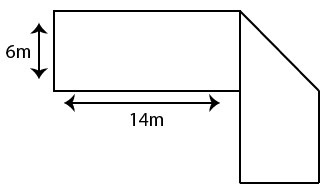

Area of given figure = 144 sq meter
It is given that BCE becomes square when we will unfold it, so to find the complete area of the figure shown as dotted after unfolding we need to add the area of triangle BCE.
Thus, BC = CE = 6 m
=> Area of $$\triangle$$ BCE = $$\frac{1}{2} \times 6 \times 6 = 18$$ sq meter
$$\therefore$$ Final area of whole figure = 144 + 18 = 162 square meter.
Find the equation of the graph shown below.

When x = -3, y = -10
This is satisfied only in option D.
Hence, option D is the correct answer.
Product M is produced by mixing chemical X and chemical Y in the ratio of 5 : 4. Chemical X is prepared by mixing two raw materials, A and B, in the ratio of 1 : 3. Chemical Y is prepared by mixing raw materials, B and C, in the ratio of 2 : 1. Then the final mixture is prepared by mixing 864 units of product M with water. If the concentration of the raw material B in the final mixture is 50%, how much water had been added to product M?
Let the quantities of the chemicals X and Y, mixed to produce product M be $$5c$$ and $$4c$$ respectively.
X is prepared by mixing A and B in the ratio = 1 : 3
=> Quantity of B in X = $$\frac{3}{4} \times 5c = \frac{15 c}{4}$$
Y is prepared by mixing B and C in the ratio = 2 : 1
Quantity of B in Y = $$\frac{2}{3} \times 4c = \frac{8 c}{3}$$
Quantity of B in M = $$\frac{15 c}{4} + \frac{8 c}{3} = \frac{77 c}{12}$$
Now, 864 units of M was mixed with water to prepare the final mixture.
=> Total quantity of M = $$9c = 864$$ => $$c = \frac{864}{9} = 96$$
Concentration of raw material B in the final mixture is 50 %
=> Quantity of final mixture = $$\frac{100}{50} \times \frac{77}{12} \times 96 = 1232$$
$$\therefore$$ Quantity of water added to M = $$1232 - 864 = 368$$ units
A circular road is constructed outside a square field. The perimeter of the square field is 200 ft. If the width of the road is 7√2 ft. and cost of construction is Rs. 100 per sq.ft. Find the lowest possible cost to construct 50% of the total road.

Perimeter of square ABCD = 200 ft
=> AB = $$\frac{200}{4} = 50$$ ft
=> $$DB = \sqrt{50^2 + 50^2} = 50 \sqrt{2}$$ ft
=> $$BO = r = \frac{50 \sqrt{2}}{2} = 25 \sqrt{2}$$ ft
Width of the road = BX = $$7 \sqrt{2}$$ ft
=> $$BX = R = 25 \sqrt{2} + 7 \sqrt{2} = 32 \sqrt{2}$$
Area of bigger circle = $$\pi R^2 = \pi (32 \sqrt{2})^2 = 2048 \pi$$ sq. ft
Area of smaller circle = $$\pi r^2 = \pi (25 \sqrt{2})^2 = 1250 \pi$$ sq. ft
=> Area of road = $$2048 \pi - 1250 \pi = 798 \times \frac{22}{7} = 2508$$ sq. ft
But we have to calculate cost of construction of 50% road.
Required Construction = $$\frac{2508}{2} = 1254$$ sq. ft
$$\therefore$$ Cost of 1254 ft = $$1254 \times 100 = Rs. 1,25,400$$
In the diagram below, CD = BF = 10 units and ∠CED = ∠BAF = 30°. What would be the area of triangle AED? (Note: Diagram below may not be proportional to scale.)


In $$\triangle$$ ABF
=> $$tan 30 = \frac{BF}{AB}$$
=> $$\frac{1}{\sqrt{3}} = \frac{10}{AB}$$
=> $$AB = 10 \sqrt{3}$$
Similarly, $$ED = 10 \sqrt{3}$$
Also, $$\angle ECD = \angle BCF = 60$$ (Vertically opposite angles)
In $$\triangle$$ BCF
=> $$tan 60 = \frac{BF}{BC}$$
=> $$\sqrt{3} = \frac{10}{BC}$$
=> $$BC = \frac{10}{\sqrt{3}}$$
=> Height = $$AD = AB + BC + CD = 10 \sqrt{3} + \frac{10}{\sqrt{3}} + 10 = \frac{40 + 10 \sqrt{3}}{\sqrt{3}}$$
$$\therefore area (\triangle AED) = \frac{1}{2} \times AD \times ED$$
= $$\frac{1}{2} \times \frac{40 + 10 \sqrt{3}}{\sqrt{3}} \times 10 \sqrt{3}$$
= $$50 (\sqrt{3} + 4)$$
Two diagonals of a parallelogram intersect each other at coordinates (17.5, 23.5). Two adjacent points of the parallelogram are (5.5, 7.5) and (13.5, 16). Find the lengths of the diagonals.

Using distance formula,
$$CX = \sqrt{(17.5 - 5.5)^2 + (23.5 - 7.5)^2} = \sqrt{12^2 + 16^2}$$
= $$\sqrt{144 + 256} = \sqrt{400} = 20$$
=> $$AC = 2 \times CX = 40$$
$$BX = \sqrt{(17.5 - 13.5)^2 + (23.5 - 16)^2} = \sqrt{4^2 + 7.5^2}$$
= $$\sqrt{16 + 56.25} = \sqrt{72.25} = 8.5$$
=> $$BD = 2 \times BX = 17$$
If $$f(x^2 - 1) = x^4 - 7x^2 + k_1$$ and $$f(x^3 - 2) = x^6 - 9x^3 +k_2$$ then the value of $$(k_2 - k_1)$$ is
$$f(x^2 - 1) = x^4 - 7x^2 + k_1$$
Put $$x^2 = 1$$ to make it 0
=> $$f(0) = (1)^2 - 7(1) + k_1 = k_1 - 6$$ --------(i)
Also, $$f(x^3 - 2) = x^6 - 9x^3 +k_2$$
Put $$x^3 = 2$$
=> $$f(0) = (2)^2 - 9(2) + k_2 = k_2 - 14$$ -----------(ii)
Equating (i) & (ii), we get :
=> $$k_1 - 6 = k_2 - 14$$
=> $$k_2 - k_1 = 14 - 6 = 8$$
In the beginning of the year 2004, a person invests some amount in a bank. In the beginning of 2007, the accumulated interest is Rs. 10,000 and in the beginning of 2010, the accumulated interest becomes Rs. 25,000. The interest rate is compounded annually and the annual interest rate is fixed. The principal amount is:
Let the principal amount = $$P$$ and rate of interest = $$r \%$$
Interest accumulated from 2004 to 2007 is Rs.10,000 and from 2004 to 2010 is Rs.25,000
Using, $$C.I. = P[(1 + \frac{R}{100})^T - 1]$$
=> $$P[(1 + \frac{r}{100})^3 - 1] = 10,000$$ ----------Eqn(I)
and $$P[(1 + \frac{r}{100})^6 - 1] = 25,000$$ -----------Eqn(II)
Dividing eqn(II) from (I), we get :
=> $$\frac{P[(1 + \frac{r}{100})^6 - 1]}{P[(1 + \frac{r}{100})^3 - 1]} = \frac{5}{2}$$
Let $$(1 + \frac{r}{100})^3 = x$$
=> $$\frac{x^2 - 1}{x - 1} = \frac{5}{2}$$
=> $$2x^2 - 5x + 3 = 0$$
=> $$(2x - 3) (x - 1) = 0$$
=> $$x = \frac{3}{2} , 1$$ $$(x \neq 1)$$ because then, r = 0
=> $$(1 + \frac{r}{100})^3 = \frac{3}{2}$$
Substituting it in eqn(I)
=> $$P[\frac{3}{2} - 1] = 10,000$$
=> $$P = 10,000 \times 2 = 20,000$$
The tax rates for various income slabs are given below.

There are 15 persons working in an organization. Out of them, 3 to 5 persons are falling in each of the income slabs mentioned above. Which of the following is the correct tax range of the 15 persons? (E.g. If one is earning Rs. 2000, the tax would be:
500 × 0 + 1500 ×0.05)
Minimum tax paid would be = (15*0)+(6*1500*0.05)+(3*3000*0.10)= 450+900 = 1350
Maximum tax paid will be = (15*0) + (12*1500*0.05) + (9*3000*0.10) +(5*5000*0.15) = 0+900+2700+3750 = 7350
Since we have approximate the value so the actual minimum tax will be greater than 1350 and actual maximum tax will be less than 7350
If a, b, c and d are four different positive integers selected from 1 to 25, then the highest possible value of ((a + b) + (c +d ))/((a + b) + (c - d)) would be:
Expression : $$\frac{a + b + c + d}{a + b + c - d}$$
To maximize the above expression, we have to minimize the denominator
Minimum value of the denominator = 1
So we can make $$a + b + c = 26$$ and $$d = 25$$ (as maximizing d will give denominator the least value).
So required maximum value = $$\frac{a + b + c + d}{a + b + c - d}$$
= $$\frac{26 + 25}{26 - 25} = 51$$
An ascending series of numbers satisfies the following conditions:
i. When divided by 3, 4, 5 or 6, the numbers leave a remainder of 2.
Ii. When divided by 11, the numbers leave no remainder.
The 6th number in this series will be:
L.C.M. of 3,4,5,6 = 60
Number is of the form = $$60 k_1 + 2$$ -------------(i)
When divided by 11, it leaves 0 remainder so number will also be of the form = $$11 k_2$$ ---------(ii)
Hence equating (i) and (ii), we get,
$$60k_1 + 2 = 11k_2$$
$$60k_1 - 11k_2 = -2$$ or $$11k_2 - 60k_1 = 2$$ -----------(iii)
It means $$60k_1$$ will leave remainder 9 when divide by 11.
Lets consider values for 60k1, if k1=1, 60k1=60, reminder is 60mod11=5
120mod11 will be 5+5=10, 180mod11 will be 5+5+5=15, since 15>11, reminder will be 15-11=4
240mod11 reminder will be 4+5=9
$$\therefore$$ By remainder root $$\frac{4 k_1}{11}$$ should leave remainder as 9 or -2
=> Possible values of $$K_1 = 4, 15, 26, 37, 48, 59$$ (As 11 and 60 are co-prime)
$$\therefore$$ Required value = $$60 \times 59 + 2 = 3540 + 2 = 3542$$
Alternatively,
L.C.M. of 3,4,5,6 = 60
As the number 60k+2 is divisible by 11, 60k leaves a reminder of 9
60mod11=5, 120mod11=10, 180mod11=4, 240mod11=9
Hence the first number where both conditions are satisfied as 242.
As 60 and 11 are co-prime, the next number where this is true is 242+60*11
Hence, the numbers are in the form 242+660k
For 6th number, k=5 => 3300+242=3542
In an examination, two types of questions are asked: one mark questions and two marks questions. For each wrong answer, of one mark question, the deduction is 1/4 of a mark and for each wrong answer, of two marks question, the deduction is 1/3 of a mark.
Moreover, 1/2 of a mark is deducted for any unanswered question. The question paper has 10 one mark questions and 10 two marks questions. In the examination, students got all possible marks between 25 and 30 and every student had different marks. What would be the rank of a student, who scores a total of 27.5 marks?
It is evident that, 1 wrong 2 marks question would result in 2.33 deduction from the total (As negative in 2 marks question is 1/3 of a mark)
1 wrong of 1 mark question lead to deduction of 1.25 marks
1 unattempted of 1 mark question lead to deduction of 1.5 marks
1 unattempted of 2 marks question lead to deduction of 3 marks

$$\therefore$$ Rank of student who scores 27.5 = 5
For a positive integer x, define f(x) such that f(x + a) = f(a × x), where a is an integer and f(1) = 4. If the value of f(1003) = k, then the value of ‘k’ will be:
Expression : $$f (x + a) = f (a \times x)$$
Also, $$f(1) = 4$$
Now, $$f(1003) = f(1002 + 1) = f(1002 \times 1) = f(1002)$$
Similarly, $$f(1002) = f(1001) = f(1000) = ......... = f(1) = 4$$
$$\therefore f(1003) = k = 4$$
Devanand’s house is 50 km West of Pradeep’s house. On Sunday morning, at 10 a.m., they leave their respective houses.
Under which of the following scenarios, the minimum distance between the two would be 40 km?
Scenario I: Devanand walks East at a constant speed of 3 km per hour and Pradeep walks South at a constant speed of 4 km per hour.
Scenario II: Devanand walks South at a constant speed of 3 km per hour and Pradeep walks East at a constant speed of 4 km per hour.
Scenario III: Devanand walks West at a constant speed of 4 km per hour and Pradeep walks East at a constant speed of 3 km per hour.
Scenario I : Devanand's position after $$t$$ hours is $$(50 - 3t)$$ km west of Pradeep's house, while Pradeep's position is $$4t$$ km south of his own house.
If $$d$$ is the distance between them, then
=> $$d^2 = (50 - 3t)^2 + (4t)^2$$
=> $$d^2 = 2500 - 300t + 25t^2$$
=> $$d^2 = 25 (t^2 - 12t + 36) + 1600$$
=> $$d^2 = 25 (t - 6)^2 + 1600$$
Thus, minimum distance is 40 km after 6 hours.
Thus, scenario I is possible
Scenario II & III are not possible as minimum distance in that case would be 50 km as after that distance will keep on increasing between the two.
The median of 11 different positive integers is 15 and seven of those 11 integers are 8, 12, 20, 6, 14, 22, and 13.
Statement I: The difference between the averages of four largest integers and four smallest integers is 13.25.
Statement II: The average of all the 11 integers is 16.
Which of the following statements would be sufficient to find the largest possible integer of these numbers?
Median of 11 integers is 15, => In ascending order 6th integer = 15
=> Numbers = 6,8,12,13,14,15,20,22
Statement I : Average of four smallest = 6 + 8 + 12 + 13
= $$\frac{39}{4} = 9.75$$
It is given that, avg of 4 largest - avg of 4 smallest = 13.25
=> Average of 4 largest = 13.25 + 9.75 = 23
=> Sum of 4 largest numbers = 23 * 4 = 92
So, we can easily allocate other three numbers different minimum values but more than 15 and maximize the remaining one value
Thus, statement I is sufficient.
Statement II : Sum of 11 integers = 11 * 16 = 176
Sum of given 8 integers = 6+8+12+13+14+15+20+22 = 110
Sum of remaining numbers = 176 - 110 = 66
So, we can easily allocate other three numbers different minimum values but more than 15 and maximize the remaining one value
Thus, statement II is sufficient.
$$\therefore$$ Either statement I or II is sufficient.
The parallel sides of a trapezoid ABCD are in the ratio of 4 : 5. ABCD is divided into an isosceles triangle ABP and a parallelogram PBCD (as shown below). ABCD has a perimeter equal to 1120 meters and PBCD has a perimeter equal to 1000 meters. Find Sin$$\angle$$ABC, given 2$$\angle$$DAB = $$\angle$$BCD.
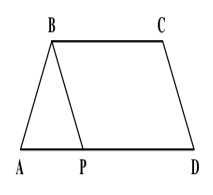
AB + BC + CD + AD = 1120 ------------Eqn(I)
PB + BC + CD + PD = 1000 -------------Eqn(II)
Subtracting eqn(II) from (I), we get :
=> AB - PB + (AD - PD) = 120
=> AB - PB + AP = 120
=> AB + AP = 120 + PB
Now, if AB = PB, => AP = 120
=> AD = 600 and BC = 480, then AB + PB + CD = 40, which is not possible (We know that BC = PD. If BC = PD = 480, then BC+PD = 960. PB + BC + CD + PD = 1000.
=> PB+CD = 40. Therefore, AB + PB+CD should be greater than 40).
Similarly, AB = AP is also not possible. Thus $$AP = BP$$

=> $$\angle ABC = x + (180 - 2x) = (180 - x)$$
=> $$sin \angle ABC = sin (180 - x) = sin x$$
Also, perimeter of PBCD = $$10y = 1000$$ => $$y = 100$$
and perimeter of ABCD = $$AB + 10y = 1120$$ => $$AB = 120$$
Applying cosine rule in $$\triangle$$ ABP
=> $$cos x = \frac{(AB)^2 + (AP)^2 - (BP)^2}{2 AB AP}$$
=> $$cos x = \frac{(120)^2 + (100)^2 - (100)^2}{2 \times 120 \times 100}$$
=> $$cos x = \frac{120}{200} = \frac{3}{5}$$
$$\therefore sin x = \sqrt{1 - (\frac{3}{5})^2} = \sqrt{1 - \frac{9}{25}}$$
= $$\sqrt{\frac{16}{25}} = \frac{4}{5}$$
A three - digit number has digits in strictly descending order and divisible by 10. By changing the places of the digits a new three - digit number is constructed in such a way that the new number is divisible by 10. The difference between the original number and the new number is divisible by 40. How many numbers will satisfy all these conditions?
Since the three digit number is divisible by 10, then the unit's digit is 0
Let the three digit number = $$a b 0$$
After the digits are interchanged, the new number is also divisible by 10, thus only a and b are interchanged.
=> New number = $$b a 0$$
Difference between number is divisible by 40
=> $$(100a + 10b) - (100b + 10a) = 40 k$$ (k is constant)
=> $$90a - 90b = 90 (a - b) = 40 k$$
=> k = $$\frac{9\left(a-b\right)}{4}$$
Since k is a natural number (a-b) should be a multiple of 4
If a = 9 , the values of b that satisfies the given equation are 1,5
If a = 8 , the value of b that satisfies the given equation is 4
If a = 7 , the values of b that satisfies the given equation is 3
If a = 6 , the values of b that satisfies the given equation is 2
If a = 5 , the values of b that satisfies the given equation is 1
The number could be = 510,620,730,840,950, 910
Thus, there are 6 numbers that satisfy these conditions.
The centre of a circle inside a triangle is at a distance of 625 cm from each of the vertices of the triangle. If the diameter of the circle is 350 cm and the circle is touching only two sides of the triangle, find the area of the triangle.

If a point is equidistant from all 3 vertices, it has to be the circumcentre. The given circle with centre S is concentric and touches two sides.
As S is equidistant from 2 of the sides (say AB and AC), => It lies on angle bisector of $$\angle A$$.
=> $$\triangle ABC$$ is isosceles with AB = AC
Radius of the circle = RS = SQ = 175 cm and SA = SB = SC = 625 cm
=> $$AR = \sqrt{625^2 - 175^2} = 600$$
Let SP = x
=> $$(BP)^2 = (BA)^2 - (AP)^2 = (BS)^2 - (SP)^2$$
=> $$1200^2 - (625 + x)^2 = 625^2 - x^2$$
=>$$1200^2 - 625^2 - x^2 - 2*625x = 625^2 - x^2$$
=> $$1200^2 - 2 * 625^2 = 1250x$$
=> $$x = \frac{658750}{1250} = 527$$
=> $$BP = \sqrt{625^2 - 527^2} = 336$$
$$\therefore$$ ar $$(\triangle ABC)$$ = $$\triangle ASB + \triangle ASC + \triangle SBC$$
= $$(600 \times 175) + (600 \times 175) + (527 \times 336)$$
= $$105000 + 105000 + 177072 = 387072$$
If the last 6 digits of [(M)! - (N)!] are 999000, which of the following option is not possible for (M) × (M - N)? Both (M) and (N) are positive integers and M > N. (M)! is factorial M.
None of the answers given are correct. The reasoning is as given below.
999000 is a multiple of 8 but not of 16. If N! is a multiple of 16, M! would also be a multiple of 16 and hence M!-N! would be a multiple of 16.
Hence, as M!-N! = 999000, it would imply that N! is a multiple of 8 and not of 16. Therefore, N is either 4 or 5. So, N! is either 24 or 120. So, it would imply that M! is either 999024 or 999120. Both of which are not factorials for any natural number.
Hence, the given question is wrong.
A person is standing at a distance of 1800 meters facing a giant clock at the top of a tower. At 5.00 p.m., he can see the tip of the minute hand of the clock at 30 degree elevation from his eye - level. Immediately, the person starts walking towards the tower. At 5.10 pm., the person noticed that the tip of the minute hand made an angle of 60 degrees with respect to his eye - level. Using three - dimensional vision, find the speed at which the person is walking. The length of the minutes hand is 200√3 meters (√3 = 1.732).

Let O be the centre of the clock. Let the person's eye be at A and the tip of minute hand at 5.00 p.m. is at P and at 5.10 p.m. at Q
AM = 1800 m and OP = OQ = $$200\sqrt{3}$$ m
In $$\triangle$$ APM
=> $$tan 30 = \frac{PM}{AM}$$
=> $$\frac{1}{\sqrt{3}} = \frac{PM}{1800}$$
=> $$PM = \frac{1800}{\sqrt{3}} = 600 \sqrt{3}$$
=> $$OM = PM - OP = 600 \sqrt{3} - 200 \sqrt{3} = 400 \sqrt{3}$$
In $$\triangle$$ OBM
=> $$tan 60 = \frac{OM}{BM}$$
=> $$\sqrt{3} = \frac{400 \sqrt{3}}{BM}$$
=> $$BM = 400$$ m
=> $$AB = AM - BM = 1800 - 400 = 1400$$ m
Time taken to reach B from A = 10 minutes = 600 sec
$$\therefore$$ Speed of the person = $$\frac{1400}{600} = \frac{7}{3}$$ m/s
= $$(\frac{7}{3} \times \frac{18}{5})$$ km/hr = $$8.4$$ km/hr
Three pipes are connected to an inverted cone, with its base at the top. Two inlet pipes, A and B, are connected to the top of the cone and can fill the empty in 8 hours and 12 hours, respectively. The outlet pipe C, connected to the bottom, can empty a filled cone in 4 hours. When the cone is completely filled with water, all three pipes are opened. Two of the three pipes remain open for 20 hours continuously and the third pipe remains open for a lesser time. As a result, the height of the water inside the cone comes down to 50%. Which of the following options would be possible?
Height of cone comes down to 50%, => it becomes $$\frac{1}{2}$$
=> Volume would become $$\frac{1}{8}$$ as radius will also become half by similar triangles.
Let the capacity of cone = 24 litres
Volume of water run-off = $$24 - \frac{1}{8} \times 24 = 21$$ litres
Volume of water left in the cone = $$ \frac{1}{8} \times 24 = 3$$ litres
Pipe A's efficiency = $$\frac{24}{8} = 3$$ litres/hr
Pipe B's efficiency = $$\frac{24}{12} = 2$$ litres/hr
Pipe C's efficiency = $$\frac{24}{-4} = -6$$ litres/hr
All will run 19 hours simultaneously (going by the options)
=> Net effect = $$(3 + 2 - 6) \times 19 = -19$$ litres
This means that after 19 hours, 19 litres of water has been removed, we need to remove 2 more litres as per the requirement. Thus, C will definitely run for another hour.
If we run A and C together for the 20th hour, net effect = $$(3 - 6) \times 1 = -3$$ litres
Run B for 30 minutes => $$2 \times \frac{1}{2} = 1$$ litres
$$\therefore$$ Volume of water removed = $$-19 -3 + 1 = -21$$ litres
Thus, Pipe B was open for 19 hours 30 minutes.
Answer the questions on the basis of information given below.
As a part of employee improvement programs, every year an organization conducts a survey on three factors: 1. Number of days (in integers) of training undergone, 2. Amount of bonus (in lacs) received by an employee and 3. Employee effectiveness score (on the scale of 1 to 10). Survey results for last two years are given below for the same seven employees.


In Survey 1, what was the average bonus earned by employees who underwent training for more than 17 days?

By using graphs 2A and 3A, we get the above table.
For employees 4 and 5, the training days is more than 17.
Average of the bonus of 4, 5 = $$\ \frac{\ 21+18}{2}$$= 19.5
D is the correct answer.
Identify the number of employees whose employee effectiveness score was higher than 7 in Survey 1, but whose bonus was lower than 20 lacs in Survey 2.

Using graphs 1 and 3A, we get the above table.
The effective score of the employees is greater than 7 for employees 1, 4, 5, 7.
Among them, the bonus is less than 20 lakhs for 4, 7.
A is the correct answer.
From Survey 1 to Survey 2, how many employees underwent more days of training but their annual bonus decreased?
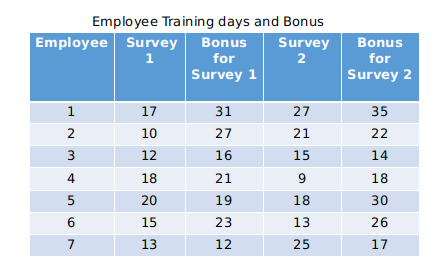
By using the data in 2A and 3A, we get the above table.
From the above table, it is clear that for the employees 1, 2, 3, 7 the number of training days increased from Survey 1 to 2.
Out of them for the employees 2, 3 the annual bonus decreased.
B is the correct answer.
From Survey 1 to Survey 2: for how many employees training days increased along with an increase of employee effective score by at least 1.0 rating?

from the above table, it is clear that for the employees 1, 2, 3, 7 the number of training days increased from Survey 1 to Survey 2.
Out of which for the employees 2, 3 the effective score increased by at least 1.0
A is the correct answer.
Answer the questions on the basis of information given below.
Twitter allows its users to post/share and read short messages known as tweets. Tweets can be of three types – Positive Tweets (in support), Negative Tweets (against) and Neutral Tweets. The following table presents the Number of Votes and Tweets received by certain political parties.
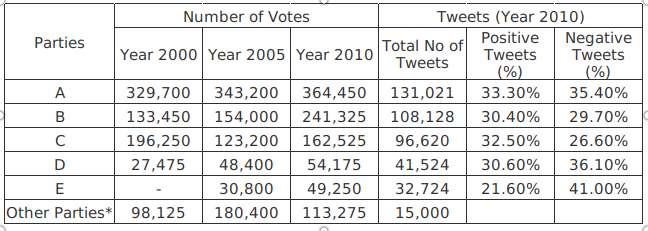
* Any party which has secured less than 2% of the total votes falls under ‘Other Parties’ category. For example, Party E secured less than 2% of total votes, in the year 2000.
Note: If the vote share (%age of total votes) of a party changes from 15% to 40%, gain in vote share would be 25% (= 40%, – 15%).
Which of the following options correctly arranges the political parties in descending order of gain in vote share from the year 2005 to the year 2010?

From the above table, it is clear that the decreasing order of gain of vote share = BCEDA
D is the correct answer.
Which of the following parties received maximum number of “neutral tweets” in the year 2010?
Using the data in the table, we can calculate the number of neutral votes for each party as follows:
Party B: 108128 * (100 - 30.4 - 29.7)/100 = 43143
Party C: 96620 * (100 - 32.50 - 26.60)/100 = 39517
Party D: 41524 * (100 - 30.60 - 36.10)/100 = 13827
Party E: 32724 * (100 - 21.60 - 41) /100 = 12239
Thus, we can see that Party B has the maximum number of neutral votes.
Hence, option A is the correct answer.
Between 2000 and 2010, in terms of gain in vote share which of the following cannot
be a possible value (approximated to one decimal place) for any party?
The table representing the Vote share of parties in the years 2000 and 2010 is as follows.
.png)
From the table, we can see that 2 and 7.5 are possible values.
Party E’s votes in 2000 are less than 2% of the total votes as given in the question. Thus, the Gain in vote share will be between 3 and 5%.
Thus, only 2.5% is the option that is not possible.
Hence, option B is the answer.
In 2010, which of the following options has maximum difference between the vote share and tweet share?
The table representing the Vote share and Tweet share in the year 2010 is as follows:
.png)
The table shows that the maximum difference between the vote share and tweet share is for “Other” parties.
Hence, option E is the correct answer.
Which of the following statements is closely associated with Boko Haram ?
Where is Taxila located?
Form which of the following space stations was Mangalyaan launched?
Which of the following statements is right?
‘Hudhud’, the name of recent cyclone, is associated with:
Which of the following is the correct list of sports persons awarded gold medal at Incheon Asian games?
As per 2011 census, which is the second most urbanized State in India (in percentage terms)?
Christine Lagarde is:
Consider the following cricketers:
i. A Kumble
ii. CA Walsh
iii. GD McGrath
iv. SM Pollock
v. Wasim Akram
Arrange the above cricketers in descending order of test wickets taken:
Consider the following nations:
i. Bangladesh
ii. Brazil
iii. India
iv. Indonesia
v. Philippines
Arrange the above cricketers in descending order of rice production:
Consider the following Tennis Grand Slam:
i. Australian Open
ii. French Open
iii. US Open
iv. Wimble don
Arrange the above Grand Slam in the order of the occurrence in a calendar year:
Consider the following dynasties:
i. Chola Dynasty
ii. Chalukya Dynasty
iii. Hoysala Dynasty
iv. Pala Dynasty
v. Pallava Dynasty
vi. Kushana Dynasty
Arrange the above dynasties in chronological order:
Which of the following parties had contested the maximum number of seats in the 2014 Indian General Election?
Which is following set of cities/regions is associated with Indian Super League (ISL) teams?
Consider the following list of some Countries and Capitals:

Match the countries with their capitals:
The capital of Guyana is Georgetown.
The capital of Uzbekistan is Tashkent.
The capital of Estonia is Tallinn.
The capital of Guinea is Conarky
The capital of Timor-Leste is Dili.
Hence, option B is the correct answer.
Which of the following statements is correct about Union Budget 2014?
How many smart cities have been announced in India?
What is “Qualified Institutional Placement”?
What is “Quantitative Easing”?
What is a “Bachpan Bachao Andholan”?
Which of the following authors has not been awarded Pulitzer prize?
Consider the following names:
i. Cadbury
ii. GarlicBread
iii. Honeycomb
iv. KitKat
v. Lollipop
Which of the following options lists all the correct names of Android operating system?
Which of the following Indian movies did not get nominated for ‘Academy Awards’ in the ‘Best Foreign Language Film’ Category?
Which of the following cities is least likely to experience a cyclonic disturbance?
Which of the following towns is not associated with coal/lignite mining?
Four possible industrial belts are given below:
i. Bengaluru - Coimbatore - Madurai
ii. Mumbai - Pune
iii. Ahmedabad - Vadodara
iv. Hugli - Region
Which of the above are well know industrial belts (regions) in India?
Consider the following statements related to Ukraine:
i. It supplies gas to Russia.
ii. Russia sells gas to Ukraine.
iii. Sochi is not located in Ukraine.
iv. In a referendum, people of Crimea decided to be a part of Ukraine.
v. Simferopol is the Capital of Crimea.
Which of the following options contains wrong statement(s) related to Ukraine?
Consider the following statements about the Syrian crisis:
i. It was initially related to Arab Spring.
ii. Many Syrian refugees flee to Jordan and Lebanon.
iii. Bashar Al Assad is involved in Syria crisis.
iv. There has been a single party political government in Syria for over a decade.
v. Syrian crisis is not related to Tunisia.
Which of the following options does not contain false statement pertaining to Syrian crisis?
Consider the following statements related to Brazil:
i. Brazil’s GDP is higher than Italy’s GDP.
ii. Dilma Rouseff was elected as President of Brazil.
iii. Maracana stadium hosted world cup football final.
iv. Of all of Brazil’s neighbours, Argentina has the longest border.
v. Real is the currency of Brazil.
Which of the following options does not contain false statement (s) related to Brazil?
Which of the following options correctly lists all the dignitaries, who visited India in 2014?
Start your IIM journey with the right preparation and crack CAT 2026.

Educational materials for CAT preparation
 Share
Share