 91- 6303239042
According to the passage, Wolfgang became interested in music because
Sign in
Please select an account to continue using cracku.in
↓ →
Study the passages below and answer the questions that follow each Passage.
Passage I:
The composer Wolfgang Amadeus Mozart’s remarkable musical talent was apparent even before most children can sing a simple nursery rhyme. Wolfgang’s older sister Maria Anna (who the family called Nannerl) was learning the clavier, an early keyboard instrument, when her three-year-old brother took an interest in playing. As Nannerl later recalled, Wolfgang “often spent much time at the clavier picking out thirds , which he was always striking, and his pleasure showed that it sounded good.” Their father Leopold, an assistant concertmaster at the Salzburg Court, recognized his children’s unique gifts and soon devoted himself to their musical education.
Born in Salzburg, Austria, on January 27, 1756, Wolfgang had composed his first original work by age five. Leopold planned to take Nannerl and Wolfgang on tour to play before the European courts. Their first venture was to nearby Munich where the children played for Maximillian III Joseph, elector of Bavaria. Leopold soon set his sights on the capital of the Hapsburg Empire, Vienna. On their way to Vienna, the family stopped in Linz, where Wolfgang gave his first public concert. By this time, Wolfgang was not only a skilled harpsichord player, but he had also mastered the violin. The audience at Linz was amazed by the six-year-old, and word of his genius soon traveled to Vienna. In a much attended concert, the Mozart children appeared at the Schonbrunn Palace on October 13, 1762. They completely attracted the emperor and empress.
Following this success, Leopold received a lot of invitations for the children to play, for a fee. Leopold seized the opportunity and booked as many concerts as possible at courts throughout Europe. A concert could last three hours, and the children played at least two per a day. Today, Leopold might be considered the worst kind of stage parent, but at the time, it was not uncommon for prodigies to make extensive concert tours. Even so, it was an exhausting schedule for a child who was just past the age of needing an afternoon nap.
According to the passage, Wolfgang became interested in music because
The passage states: "Wolfgang's older sister Maria Anna was learning the clavier... when her three-year-old brother took an interest in playing."
This suggests that his initial interest in music was sparked by seeing his sister learning the instrument. This aligns with option C.
Option A: The passage does not suggest that he grew interested in music because their father thought it would be profitable.
Option B: Although naturally talented, the passage suggests that he became interested in music when he saw his sister learning to play the instrument.
Option D: Although he came from a musical family, the passage does not indicate that he developed an interest in music because of it.
What was the consequence of Wolfgang’s first public appearance?
Option B is the correct answer.
The passage states: "The audience at Linz was amazed by the six-year-old, and word of his genius soon traveled to Vienna."
From this, we can infer that Wolfgang’s first public concert in Linz led to people talking about his musical abilities, which then reached Vienna, which is the capital. Option B captures this point.
Option A: This event happened later, but it was not the direct consequence of their first public appearance.
Option C: Leopold had already planned for the family to go to Vienna before Wolfgang’s first public performance in Linz. The Linz concert did not cause this decision. We can infer this from : "Leopold soon set his sights on the capital of the Hapsburg Empire, Vienna. On their way to Vienna, the family stopped in Linz, where Wolfgang gave his first public concert."
Option D: The invitations to play came after their performance in Vienna, not directly after the first public appearance in Linz.
Each of the following statements about Wolfgang Mozart is directly supported by the passage except ________.
Option D is the correct answer. The passage mentions that Wolfgang mastered the violin but does not state that he preferred it over other instruments.
Option A: The passage states that Leopold "recognized his children’s unique gifts and soon devoted himself to their musical education." Therefore, their father was instrumental in shaping their career.
Option B: The passage mentions that Maria Anna (Nannerl) learned the clavier before Wolfgang and played concerts with him across Europe, showing her musical talent.
Option C: The passage explains that Wolfgang started composing at age five, went to concerts from age six, and constantly travelled and performed. So, we can say that his childhood was devoted to his musical career.

According to the Passage, during Wolfgang's early years child prodigies were
Option B is the correct answer.
The passage states: "Today, Leopold might be considered the worst kind of stage parent, but at the time, it was not uncommon for prodigies to make extensive concert tours."
This means that during Wolfgang's early years, it was normal for child prodigies to travel extensively for performances.
Option A: The passage does not mention that child prodigies were rare.
Option C: The passage mentions that Wolfgang played two concerts a day, each lasting up to three hours, but it does not mean it was an expected norm.
Option D: The passage states that Wolfgang and his sister played for European courts, but this was also not an expected norm for all child prodigies.
Based on the information found in the paasage,Mozart can be described as
Option A is the correct answer.
The passage suggests that he was a child prodigy: His musical talent was evident at age three when he showed an interest in playing the clavier. By age five, he had already composed his first original work. By age six, he had mastered the harpsichord and violin and performed publicly, astonishing audiences.
Option B: The passage does not suggest that Mozart was a workaholic
Option C: The passage focuses on his early years and his talent but does not claim that he was the greatest composer of 18th century
Option D: The passage does not state that Wolfgang was a victim of his father's ambition. Rather, it talks about his talent and ability to compose and perform at a young age.
Study the passages below and answer the questions that follow each Passage.
Passage II:
Saving energy means saving money. Homeowners and renters Know this basic fact, but they often don’t know what kinds of adjustments they can make in their homes and apartments that will result in savings. For those willing to spend some time and money, to reap long-term energy savings, an energy audit is the way to go. An energy auditor will come.into your home and assess its energy efficiency. The auditor will pinpoint areas of your home that use the most energy and offer solutions to lower your energy use and costs.Trained energy auditors know what to look for and can locate a variety of flaws that maybe resulting in energy inefficiency, including inadequate insulation, construction flaws, and uneven heat distribution. There are(quicker and less costly measures that can be taken as well. One way to save money is to replace incandescent lights with fluorescents. This can result in a savings of more than 50% on your monthly lighting costs. When it’s time to replace old appliances, it’s wise to spend a bit more for an energy-efficient model, and be sure that you are taking advantage of energy-saving settings already on your current refrigerator, dishwasher, washing machine, or dryer. Windows provide another opportunity to cut your energy costs. Caulk old windows that might be leaky to prevent drafts, and choose double - paned windows if you’re building an addition or replacing old windows. Most.areas-of your home or apartment offer opportunities to save energy and money. The results are significant and are well worth the effort.
Which two main organizational schemes can be identified in this passage?
Throughout the paragraph, the author goes over topics by mentioning the potential causes and effects. This can be seen all over as he first mentions the energy savings, which can be done using an energy auditor. He then talks about the impact of lights, the energy leakage caused by incandescent lamps, and how fluorescent lights can counter that. Similarly, he talks about replacing energy appliances with energy-efficient ones and taking advantage of energy-saving settings. He then talks about the energy leakage caused by windows and how that can be countered with double-panned ones. We can see a recurring theme of cause and effect.

Which of the following ideas is NOT included in the passage?
Option A: It is said that replacing incandescent with fluorescent can reduce over 50% of your energy bill. Hence, this is true.
Option B: It is mentioned that windows are another way of saving energy, and double-panned windows can save costs. Hence, this is true.
Option D: The energy auditor may point out energy wastage, and some of the easiest ways to start saving energy are by switching to more energy-efficient models and taking advantage of energy-saving settings already on your current refrigerator, dishwasher, washing machine, or dryer. Hence, this is true.
Option C is the answer, as this is not mentioned.
Which of the following best expresses the main idea of this passage?
The central idea of the passage stems from the fact that an energy auditor can point out several different possibilities to save and conserve energy. The small intricate changes they can undertake, such as switching light bulbs, windows or different energy-efficient appliances or settings. All this points towards the fact that homeowners or renters are not aware of the several different ways to save energy.
According to the following passage , Which of the following would an energy auditor Not do?
From the following excerpt of the paragraph,
"An energy auditor will come. Into your home and assess its energy efficiency. The auditor will pinpoint areas of your home that use the most energy and offer solutions to reduce energy use and costs.Trained energy auditors know what to look for and can locate a variety of flaws that may result in energy inefficiency, including inadequate insulation, construction flaws, and uneven heat distribution."
We can directly eliminate Options A, B and C. While D is mentioned, the auditor will find a variety of flaws that might be affecting energy consumption, and nowhere in the paragraph does it state that the auditor will fix it. Hence, D is the option that the auditor will not do.

According to the passage, double panned windows
It is given that double-panned windows are energy efficient. It is not stated that the heating cost will be reduced by 50%.
Choose the word which is opposite in meaning of the underlined word.
Nourishing food is a necessity both for a pregnant mother and a baby.
The word "nourishing" refers to food that provides essential nutrients and promotes health. In this context, the opposite of this would be "poor" (Option B) - to describe food that lacks nutritional value or is insufficient for maintaining health. The remaining options are a poor fit. For example, "unhygienic" (Option A) refers to cleanliness, not nutritional value. Similarly, "undercooked" (Option C) refers to the preparation of food, not its nutritional quality. Option D is also incorrect since "heavy" could refer to the feeling of fullness or perhaps even the density of food rather than its nutritional content.
A feeling of brotherhood should be propagated amongst the masses.
Propagated in the given sentences would mean to spread or promote.
Among the options disseminated would be a synonym of propagated rather than opposite.
Dissipated means to scatter, which, although it carries a negative tone, still carries the same sense of spreading the feeling of brotherhood.
Crushed means to completely destroy something, and while this, too, would fit the context, it is not the opposite of propagating.
Suppresses would be the accurate opposite here, implying a stop or trying to stop the spread of this ideology of brotherhood.
Therefore, Option B is the correct answer.

We must realise the futility of wars.
Option B is the correct answer.
Futility means uselessness or the state of being pointless. Its opposite in meaning is usefulness, which is option B.
The other options suggest meanings that are somewhat opposite but not the exact opposite of what futility means.
His punctuality and regularity propitiates everyone with whom he deals
Option C is the correct answer.
Propitiate means to win or regain the favour of (a god, spirit, or person) by doing something that pleases them.
The opposite of this would be something that causes anger or displeasure, which is option C: "Enrages." This means to make someone very angry.
While "depresses" refers to making someone feel sad or down, it doesn’t directly oppose the idea of "propitiates," which is about winning goodwill or favour.
The words "excites" and "appeases" does not have an opposite meaning of the given word.
The problem of dowry in our country has assumed gargantuan proportions
Option A is the correct answer.
"Gargantuan," means extremely large or enormous.
The opposite of this is "Negligible", meaning something so small or insignificant that it can be ignored.
Option B: Bearable implies something that is tolerable or manageable, which is not opposite to"gargantuan," which is about size or scale.
Option C: Minute means something very small, but this is not the extreme opposite of something enormous like "gargantuan."
Option D: Minimal means the smallest amount, which is not the exact opposite of "gargantuan."

Choose the word which is nearest in meaning to the underlined word.
We arrived safely at the quay and went ashore.
Option B is the correct answer.
"Quay" refers to a structure built on the shore of a harbour where ships dock to load and unload cargo or passengers. Option B) "Wharf" is the word most similar in meaning to "quay." A wharf is similar to a quay, serving as a dock or platform along the shore for ships.
Option A: Peninsula is a landmass surrounded by water on most sides but still connected to the mainland. It doesn’t relate to the meaning of quay.
Option C: Target means an object or goal aimed at, which has no relation to the meaning of quay.
Option D: An island is a piece of land surrounded by water, which is unrelated to a quay.
Editors are known to be pernickety about grammar.
Option C is the correct answer.
Pernickety means to place too much emphasis on trivial or minor details; fussy. The word nearest in meaning to this would be option C, Fussy, meaning being overly picky or meticulous about things.
Option A: Spiteful means showing malice or ill-will, which is unrelated to being meticulous.
Option B: This doesn't capture the specific meaning of being overly concerned with trivial details like "pernickety" does.
Option D: This means lacking knowledge or awareness, which is the opposite of being meticulous or particular.
I rather like the quaint little house at the end of the street.
Option D is the correct answer.
"Quaint" refers to something that is attractively unusual or distinctive in a charming or odd way, which aligns with "unusual."
Option A: A "quaint" house might be old, but the word implies distinctiveness rather than being old.
Option B: "Quiet" refers to calm or peace, which is not what " quaint" implies.
Option C: "Haunted" refers to a place with the presence of ghosts, which does not mean "quaint."
Some of the discoveries of modem science are simply marvellous.
The correct answer is c) amazing because "marvellous" in this context conveys a sense of wonder or astonishment, which "amazing" directly aligns with. The other options focus on deserving praise (a, b, d) rather than focusing on the feeling of awe.
The football coach had a sympathetic presence, albeit a commanding one.
The word "albeit" means "although" or "even though." Typically, it is used to introduce a contrasting idea. In this sentence, it indicates that the football coach had a sympathetic presence, even though he was also commanding; thus, two distinct sentiments are emphasised.
Hence, Option A is the correct choice.
Choose the option which best expresses the meaning of the underlined idiom/phrase in the sentence.
His father advised him to be fair and square in his dealings lest he should fall into trouble.
Fair and square means doing things honestly and being straightforward with them.
Hence, the answer is Upright.
He burnt his fingers by interfering in his neighbour's affairs.
The idiom "burnt his fingers" means to suffer negative consequences or get into trouble as a result of meddling or interfering in something that one should not have. In this context, it refers to the person facing trouble due to interfering in his neighbour's affairs. Hence, Option D is the correct choice.
He is temporarily in charge of the company and is trying to feather his nest.
The idiom feather their own nest means to enrich oneself by using one's influence or position or with other people's money. The option that best captures this idea is option C.
Option A suggests improving the company's reputation, which is not related to personal gain.
Option B refers to managing the company, but it’s not about self-interest.
Option D means changing or expanding the company's offerings, which is not related to personal enrichment.
He was in a brown study and did not seem to catch my point.
The idiom "in a brown study" means to be deeply absorbed in thought, often to the point of being unaware of one's surroundings or inattentive. Hence, "absent-minded" (Option C) best captures the meaning of the phrase.
Option B ("absorbed in reading") seems like a close contender, but the idiom "in a brown study" typically refers to being preoccupied with one's own thoughts rather than just focusing on 'reading.'
The class could not keep a straight face on hearing the strange pronounciation of the new teacher.
Keep a straight face in this context would be to be professional and not show emotions.
The correct replacement here would be option A, remain serious which best fits the context of children breaking their tone on the wrong pronunciation.
Therefore, Option A is the correct answer.
Fill in the blank.
They were disspointed to see the armed guards.It ......... them from doing anything disruptive
From the sentence, it can be understood that the presence of armed guards stopped the subject of the sentence from doing anything (which they wanted to do presumably).
Inspired, and encouraged would suggest that the subjects went ahead and did the disruptive things, which is opposite to what the sentence suggests.
Irritated would also not fit since "It irritated them from doing anything" would not b grammatically correct.
Prevented would best fit, showing that the presence of the armed guards prevented anything disruptive from happening.
Therefore, Option B is the correct answer.
The ...... politician thought that all bureaucrats should be polite to him.
The sentence can be understood as an ironic remark on the politician, saying that he expects others to be polite towards him. This would make sense if the adjective showed him not to be polite towards them.
Docile and Civilised would both show the politician in a good light, which would not fit the ironic tone of the sentence.
Merciless would mean cruel, which although fits the ironic tone is not the most suitable among the options.
Insolent means someone rude and arrogant. This would be the best fit, showing the politician to be rude towards others and still expecting others to be polite towards him.
Therefore, Option A is the correct answer.
Paula was ..... a child, accepting with out a question, every thing she was told.
Option A: Reticent is someone who does not reveal one's own thoughts and feelings; while this might relate to the part about Paula not questioning, this does
Option B: Taciturn is a person who is reserved in speech and says little. Although this would fit with the part about Paula not questioning, this does not reflect her tendency to believe everything she was told.
Option C: Recalcitrant means someone who has an uncooperative attitude and hence would be the exact opposite of what is needed in the sentence.
Option D: Credulous refers to someone always ready to believe in things. This would be the most apt word for Paula as described in the sentence.
Therefore, Option D is the correct answer.
The route between the two cities has always been known to wind its .......... way through steep mountain passes and coarse terrain.
From the sentence, we see that the adjective should present the "way" that is able to navigate through steep mountain passes and coarse terrain.
We can eliminate easy and smooth since they present the way to be easy to traverse, while the sentence suggests otherwise
Elusive would mean something that is difficult to catch or find which does not fit the given context.
Tortuous means something that has a lot of twists and turns and is complex. This would best fit as an adjective to the path wind will have to take to cover the difficult terrains.
Therefore, Option D is the correct answer.
As there were not enough seats to ........... so many people at the venue of the address, they had to put up a big tent outside.
The sentence is talking about the instance where the number of seats were insufficient. While entertain and welcome both can be used to talk about the number of seats, the sentences talks from a more managerial perspective.
Ascertain means to confirm something, which does not it the context here.
Accommodate would be the given context where it would mean space for lodging or making room for the people at the venue.
Therefore, Option D is the correct answer.
Choose the order of the sentences marked A, B, C and D to form a Logical paragraph.
A. Its aim was to remove from dance, any external associations, so that the dancers could concentrate on pure movement and pure pattern.
B. Abstract dance was the name of a specific style of ballet, devised in the 1920s and developed at the bahaus.
C. Ballroom dancing, for example, is concerned with the pleasure the movement and pattern-making give to the dancers, and not with some external 'programme.'
D. In the wider sense, a great deal of dance is ‘abstract’.
Here, Sentence B clearly defines what abstract dance is, when it was devised, and where it was developed. This appears to serve as a foundation for the rest of the paragraph, such that we move from a specific topic to a broader subject. Sentence A naturally follows because it expands on what abstract dance aimed to achieve. It explains that abstract dance sought to remove external associations so that dancers could focus purely on movement and patterns. This is a direct elaboration of what was introduced in B. In an exam setting, this understanding should allow us to eliminate Options C and D. Furthermore, since Sentence C does not directly flow from A, we can discard the arrangement DBAC in Option A.
Regardless of the above arrangements, we observe that sentences D and C can be linked. Sentence D presents a new perspective: it generalizes the idea of abstraction in dance. It says that abstract dance isn’t just limited to the points in B and A - many forms of dance can be considered 'abstract'. This smoothly connects the specific point in B-A to a wider context. To make this earlier point clearer, we can now add an example to illustrate how abstraction applies beyond ballet. This is where Sentence C comes in: it provides a real-world example of a dance form (ballroom dancing) that aligns with the idea of abstraction.
Hence, Option B presents the best arrangement: BADC.
A. In those countries where the ideals of liberty and equality have received the greatest devotion, and particularly in America, the political constitution has been framed with the precise object of making impossible too great a concentration of power.
B. A philosophy that emphasizes the likeness of all men will be averse from recognizing those exceptional qualities in any individual which place him so clearly above his fellows that he may justly claim to lead and influence them.
C. A different though related strand of thought is equalitarian.
D. Further, when circumstances make it necessary for a particular individual to display qualities of leadership in a very high degree, his position is under constant and bitter attack on the score of dictatorship, and it is necessary for him to conceal his qualities, consciously, behind a facade of ‘ordinariness’.
Here, the only sentence that seems to present a broad idea linking the remaining statements is C. It introduces an overarching theme: {"A different though related strand of thought is equalitarian."} This sets the stage for discussing equalitarian ideals and their implications.
Sentences A, B and D can also be linked together - the block A-B-D appears to form a cause-and-effect chain: A (preventing power concentration) → B (philosophical aversion to exceptionalism) → D (societal backlash against leaders). We can further flesh out the reasoning as follows -
Sentence A provides a real-world example of the aforementioned equalitarian ideals in action: {"In those countries where the ideals of liberty and equality have received the greatest devotion [...] the political constitution has been framed [...] to make impossible too great a concentration of power." Here, A directly connects to C by showing how equalitarian principles shape political systems (e.g., America’s constitution). Sentence B then explains why such systems exist philosophically: {"A philosophy that emphasizes the likeness of all men will be averse from recognizing those exceptional qualities in any individual [...]."} This answers the question: Why do equalitarian societies design systems to prevent power concentration? B justifies the political structure described in A by highlighting the philosophical aversion to exceptional leaders.
Sentence D illustrates the consequence of this philosophy for leaders: {"When circumstances make it necessary for a particular individual to display qualities of leadership [...] his position is under constant and bitter attack [...]."} Thus, D builds on B by showing how the suppression of exceptionalism (explained in B) leads to societal suspicion of strong leaders, reinforcing A’s point about preventing power concentration.
Hence, we can make a strong case for the arrangement C-A-B-D (Option B).
A. It has removed many of the material obstacles to the pursuit of the good life from the majority of mankind in those countries at a high level of technical development.
B. But it has exposed us to new dangers, not the obvious dangers of new weapons of destruction, but the much more serious ones of a purely materialist view of life.
C. The growth of science and technology has conferred obvious and immense benefits upon the community.
D. It has also, as we too often forget, made possible new and daring adventures of the mind.
The best arrangement here would be CADB. The reasoning is that Sentence C starts with the big picture: it introduces the general theme of scientific and technological benefits. We then zoom into specific examples (A & D) by mentioning the benefits - first in material improvements (Sentence A), then in intellectual advancements (Sentence D). To finally sum up the discussion, we introduce a counterpoint (Sentence B) where we present a critical viewpoint by highlighting the potential negative consequences.
Hence, Option A is the correct choice.
A. There are manifest dangers in the persuasive aspect of leadership.
B. It is alarming, for example, to reflect how great a part the power to speak well has acquired in an age of broadcasting.
C. It is quite possible for men to feel that they are freely giving their allegiance to a leader, when actually they are simply slaves of his techniques of propaganda.
D. At its lowest, the technique of persuasion may involve all those devices of suggestion and propaganda that are so freely available to the unscrupulous in a scientific age.
A preliminary assessment of the given statements suggests that Sentence A would serve as an apt introduction. It sets the stage by alerting the reader to a significant issue - the inherent dangers involved in persuasive leadership. The remaining sentences seem to build on this theme.
Sentence D is a viable follow-up to A. After establishing the concern in A, D delves deeper into what makes persuasive leadership dangerous. It explains the mechanics behind the danger by highlighting how persuasion can devolve into manipulative techniques ("suggestion and propaganda") that are especially accessible in modern, scientifically advanced times.
We can further link B to D: B brings in a concrete 'example' that modern communication (broadcasting) has amplified the power of persuasive speech. The example reinforces the previous point by illustrating a specific arena where persuasive techniques are especially potent.
Finally, Sentence C ties the discussion together by demonstrating the consequence of the persuasive tactics outlined in the previous sentences. It warns that despite the appearance of free choice, people can be subtly manipulated - becoming unwitting subjects to propaganda. This conclusion leaves us with a clear understanding of the stakes involved, as initially introduced in A.
Thus, we obtain a coherent paragraph with the arrangement A-D-B-C (Option D).
A. The leader should possess high Intelligence.
B. The reasons for this frequent neglect of intelligence as a prerequisite of leadership are complex.
C. It is certainly true to say that this is more commonly underrated than any other aspect of leadership.
D. There is first, a general misunderstanding of such a phrase as 'of very high intelligence.'
We observe that Sentence A would serve as a proper opening among the given statements. This is mainly because it presents the core argument - the importance of intelligence for leadership. The rest of the discussion revolves around this idea. Sentence C then functions as a follow-up clarification: after asserting that leaders should have high intelligence, C introduces the idea that intelligence, despite its importance, is often underrated relative to other leadership qualities. This builds directly on A by elaborating on the paradox: even though intelligence is crucial, it is not given the due emphasis in leadership discussions.
Sentence B then picks up that thought (of intelligence being underrated) by suggesting why this critical trait is likely neglected. It indicates that complex factors are likely at play and in this way, it sets the stage for discussing this complexity subsequently. In this context, Sentence D offers one specific reason for this neglect - a misinterpretation of what “high intelligence” truly means. This sentence elaborates on one of the “complex reasons” mentioned in B, thus neatly concluding the logical progression of ideas.
Hence, the best arrangement here would be A-C-B-D (Option B).
For each of the following questions, a part or the whole of the original sentence has been underlined. You have to find the best way of writing the underlined part of the sentence.
The matter was referred back to expert committee since the solution to the problem was different from the one proposed earlier.
Though the provided sentences have an awkward structure, we note two inconsistencies that could help us determine the likely answer. Firstly, the word "back" is redundant because "referred" already implies something is being directed again or being sent to a previous or appropriate authority. So, "referred to" is correct. Secondly, the correct phrase is "different from" when comparing two things. "Different than" is less formal and often considered incorrect in standard English. These points help us zero in on Option B as the correct choice.
Completing the physical examination, the tonsils were found to be diseased.
Here, we observe that only Option C corrects the dangling modifier in the original sentence. The original sentence implies that the tonsils were completing the physical examination, which is illogical. Option C clarifies that the physical examination was completed by someone (perhaps a doctor), and then the tonsils were found to be diseased; this makes the sentence grammatically correct and logically clear. Option B also suffers the same issue as the original sentence (the structure in Option A): it suggests that the tonsils completed the physical exam. On the other hand, Option D has an awkward and unclear structure - the subordinate clause has an incorrect verb form.
Hence, Option C is the correct choice.
Reared in a village where computers and the internet were objects of curiosity, Purty today hardly gives a thought to the immense possibilities that the internet revolution has thrown open to him.
In its current form (Option A), the sentence seems grammatically correct and conveys the intended meaning. It clearly states that the person was raised in a village where computers and the internet were considered objects of curiosity.
Contrarily, the remaining choices are either awkwardly phrased or unidiomatic. For example, in Option B, "reared up" is not a standard phrase, and "curious to know that" changes the meaning of the original sentence. Option C has a tense error: it uses "are" instead of "were," which is inconsistent with the past tense of the sentence. Additionally, "being reared" is less concise and slightly odd. Option D is incorrect because "an object of curiousness" is not idiomatic.
Hence, Option A is the correct choice.
In the attempt to destroy them, with completeness, the Indian team has launched a coordinated attack on the opposing team.
Here, Option C provides the most concise and grammatically correct version of the sentence. This is because it avoids the awkwardness of "with completeness" and uses the more natural phrase "completely." Additionally, "in an attempt" is a more idiomatic and polished phrasing compared to "in the attempt."
Balancing a home delivery pizza with one hand and gripping a six-pack carton of Coke with another, the young boy Vijay paused in front of the guard room of the building.
The primary issue with the original sentence: when referring to two hands, the correct phrase would be "with the other," not "with another." This is because "another" implies an additional, unspecified hand, which is illogical since humans only have two hands. Only Option D corrects this error. Furthermore, D simplifies and presents a more straightforward version of "a six-pack carton of Coke" by replacing it with "a pack of six Cokes."
Aside from the obvious issue with using "another," the remaining choices are rife with grammatical errors and unidiomatic phrases. Option B, for instance, can be eliminated because the phrase "having gripped" creates an unnecessary tense shift; "balancing" and "gripping" should be in the same continuous form for parallelism. Similarly, in Option C, the use of the phrase "having a balance of" is unnatural and awkward.
Hence, Option D is the best choice.
Seven hundred twenty sweets were distributed equally amongst children, in such a way that number of sweets received by each child is 20% of the total numberof children. How many sweets did each child receive?
Total number of sweets distributed = 720
Let total children = 100x
Number of sweets received by each child = 20% of 100x = 20x
Total number of sweets = 100x * 20x = 720
$$x^2 = 0.36$$
x = 0.6
Total number of sweets did each child receive = 20x = 12
15% of the people eligible to vote are between 18 and 25 years of age. In an election, 75% of those eligible to vote, who are between 18 and 25, actually voted. In that election, the number of persons between 18 and 25, who actually voted was what percent of those eligible to vote?
Let eligible voters = 100x
Eligible voters between 18 and 25 years of age = 15% of 100x = 15x
Eligible voters between 18 and 25 years of age who actually voted = 75% of 15x = 11.25x
Required percent = $$\frac{11.25x}{100x} * 100 = 11.25$$%
What is the sum of the total surface areas of all the cubes formed when a cuboid of size 5.2m $$\times$$ 13m $$\times$$ 39m is cut completely into the least possible number of cubes, all of which arg identical?
HCF of sides of cuboid = 2.6
So, side of each cube = 2.6 m
Least number of cubes formed = $$\frac{5.2 * 13 * 39}{2.6 * 2.6 * 2.6} = 150$$
Total surface area of each = $$6 * 2.6^2 = 40.56 m^2$$
Sum of total surface area of all the cubes = 150 * 40.56 = 6084 $$m^2$$
A tank of capacity 1000 cubic centimeter is being filled with water by 3 pipes A, B and C. The areas of cross-section of the pipes A, B and C are“in the ratio 3: 2: 4. Water is flowing through each of these pipes at a different rate in cm/min.twas found that the time taken to fill the tank which was initially empty by the pipes A, B and individually is 20 minutes, 50 minutes and 25 minutes respectively. Find the ratio of the-rates of flow of water through the pipes A and C.
Let us say that the cross section areas of A, B, and C are 3a, 2a, and 4a.
Now, assume that the water flows at the rate of x, y, and z per min for each of the pipes respectively.
The amount of water flowing through the pipes (per min) shall be: 3ax, 2ay, 4az
Now, the time taken by each of them to fill the tank is 20 min, 50 min, and 25 min.
This means, 3ax$$\times\ $$20 = 4az$$\times\ $$25, or 100:60, or 5:3
Three men, four women and six children can complete a work in seven days. A woman does double the work a man does and a-child does half the work a man does. How many women alone can complete the work in 7 days?
According to the question:
Total work = (3M + 4W + 6C) * 7
Now,
A woman does double the work a man does, So, the ratio of efficiency of a man to that of a woman = 1: 2
M: W = 1: 2
2M = W .......... (1)
A child does half the work a man does. So, the ratio of efficiency of a man to that of child = 2: 1
M: C = 2: 1
M = 2C ....... (2)
From (1) and (2):
4C = W ....... (3)
Let the required number of women = 'x'
Now,
(3M + 4W + 6C) * 7 = (xW) * 7
From (1) and (3):
1.5W + 4W + 1.5W = xW
7W = xW
x = 7
A can do a piece of work in 36 days, B in 54 days and C in 72 days. All the three began the work together but A and B left 8 days and 12 days before the completion of the work respectively. How many days in all did C put in till the entire work was finished?
Let total time taken to complete the work = 'x' days
C work for 'x' days.
A left 8 days before the completion of the work. So, A works for 'x - 8' days
B left 12 days before the completion of the work. So, B works for 'x - 12' days
Now,
$$\frac{x - 8}{36} + \frac{x - 12}{54} + \frac{x}{72} = 1$$
$$\frac{6(x - 8) + 4(x - 12) + 3x}{216} = 1$$
6x - 48 + 4x - 48 + 3x = 216
x = 24
Hence, C works for total 24 days.
In a group of 5 boys the $$2^{nd}$$ boy is twice as efficient as the $$1^{st}$$ boy. The $$3^{rd}$$ boy is twice as efficient as the $$2^{nd}$$boy and so on. All of them working together will take 5 days to complete a job. How much extra time will the $$2^{nd}$$ and $$4^{th}$$ boys take working together as compared to the $$5^{th}$$ boy working alone to complete the same job approximately
Ratio of efficiency of $$1^{st}$$ boy to $$2^{nd}$$ boy = 1: 2
Ratio of efficiency of $$2^{nd}$$ boy to $$3^{rd}$$ boy = 1: 2
And so on...
So ratio of efficiency of $$1^{st}$$, $$2^{nd}$$, $$3^{rd}$$, $$4^{th}$$ and $$5^{th}$$tboy = 1: 2: 4: 8: 16
Let unit of work done by $$1^{st}$$, $$2^{nd}$$, $$3^{rd}$$, $$4^{th}$$ and $$5^{th}$$boy is 1, 2, 4, 8 and 16 respectively.
Since, job is completed by all the five boys together in 5 days. Hence,total work = 5 * (1 + 2 + 4 + 8 + 16) = 155
Time taken by $$2^{nd}$$ and $$4^{th}$$ boys together to do the work = $$\frac{155}{2 + 8} = 15.5$$ days
Time taken by $$5^{th}$$ boy alone to do the work = $$\frac{155}{16}$$ days
Required diffrence = 15.5 - $$\frac{155}{16} = \frac{93}{16} = 5.8125$$ days = 6 days (Approx)
How many hours will Atul , Shiva, Sapan take to finish their assignment together if Atul alone can do it in six hours more , Shiva alone do it in one hour more ,and Sapan alone in twice the time?
Let time taken by Atul, Shiva and Sapan together to finish the work = 'x' hours
Time taken by Atul alone to finish the work = (x + 6) years
Time taken by Shiva alone to finish the work = (x + 1) years
Time taken by Sapan alone to finish the work = 2x years
Now,
$$\frac{1}{x + 6} + \frac{1}{x + 1} + \frac{1}{2x} = \frac{1}{x}$$
$$x = \frac{2}{3}$$ hours
C can empty it in 60 hours .Pipes A and B were Kept open simultaneously for 12 hours . when person reached the tank when it should have been full , he obeserved the pipe c also remained open by mistake for these 12 hours .He immediately closed it . In what time will the tank get full after C is closed
Pipes A and B together can fill the tank in 12 hours and C alone can empty the tank in 60 hours.
So, part of tank emptied by pipe C in 12 hours = $$\frac{12}{60} = \frac{1}{5}$$
Now, this $$\frac{1}{5}^{th}$$ part of the tank will be filled by pipes A and B together in $$\frac{1}{5} * 12 = 2.4$$ hours
A large water tank gets filled from two pipes $$T_1$$ and $$T_2$$. $$T_1$$ alone can fill it in 50 minutes, while $$T_2$$ alone can fill it in one hour. If on any day $$T_2$$ starts working only after $$T_1$$ has been used for filling half the tank, then the time taken to fill the tank will be
Time taken by $$T_1 and T_2$$ together to fill the tank = $$\frac{1}{\frac{1}{50} + \frac{1}{60}} \frac{300}{11}$$ minutes
Time taken by $$T_1 and T_2$$ together to fill half the tank = $$\frac{300}{2 * 11} = \frac{150}{11}$$ minutes
Time takne by $$T_1$$ alone to fill half the tank = $$\frac{50}{2} = 25$$ minutes
Total time taken to fill the tank completely = 25 + $$\frac{150}{11}$$ minutes
A tap takes 8 seconds to fill a jar and 6 minutes to fill a.drum. Rahul has to fill the drum with the jar. First he fills the jar and then brings it to the drum and pours the water into the drum. The time taken to bring the jar from the tap to the drum is 10 seconds. Unfortunately, the jar develops a leak, which can empty the full jar in 40 seconds. Assuming the time taken to return to the tap is negligible, what will be the minimum total time required by Rahul to fill the drum?
Let the capacity of Jar and Drum is 8 and 360 respectively.
Quantity of water filled in Jar in 1 second = 1
It takes 40 seconds by the hole to empty the Jar completely.
So. effective time taken to fill the jar = $$\frac{1}{\frac{1}{8} - \frac{1}{40}}$$ = 10 seconds.
It takes 10 seconds to bring the Jar to the drum. So, quantity of water in Jar emptied in 10 seconds = $$8 * \frac{10}{40} = 2$$
Quantity of water poured into Drum by Jar = 6
Total time taken to pour this 6 unit of water = Time taken to fill the Jar + Time taken to bring the Jar to the Drum = 10 + 10 = 20 seconds
Number of time Jar is used to fill the drum = $$\frac{Capacity of drum}{Quanttiy of water filled by jar in one go} = \frac{360}{6} = 60 times$$
Total time taken to fill the drum = 60 * 20 = 1200 seconds = 20 minutes
A company manufactures two products X and Y. One unit of X requires three units of material A and two units of material B while one unit of Y requires two units of material A and five units of material B. If 25 units of each product were to be produced, calculate the requirement of material B. If 25 units of each product were to be produced calculate the requirement of material B.
One unit of X requires two units of material B, then 25 unit of X will require = 2 * 25 = 50 units of material B
One unit of Y requires five units of material B, then 25 unit of Y will require = 5 * 25 = 125 units of material B
Total requirement of material B = 50 + 125 = 175
Three containers X, Y and Z have capacities of 10, 20 and 30 litres respectively. X, which is empty is filled with water from Y. Y is then filled with the wine from Z. X is now emptied into Z. The entire operation is repeated. What would be the strength of wine in the container Z?
Table given shows the operations given:
Operations |
Containers X (Water: Wine) |
Container Y (Water: Wine) |
Containers Z (Water: Wine) |
Initially |
0 |
Water = 20 |
30 (Wine) |
X is completely filled by Y |
Water = 10 |
Water = 10 |
30 |
Y is completely filled by Z |
Water = 10 |
Water = 10 Wine = 10 |
20 |
X is poured into Z |
0 |
Water = 10 Wine = 10 |
10: 20 |
X is completely filled by Y |
Water = 5 Wine = 5 |
Water = 5 Wine = 5 |
10: 20 |
Y is completely filled by Z |
Water = 5 Wine = 5 |
Water= 5 + $$\frac{10}{3} = \frac{25}{3}$$ |
Water= 10 - $$\frac{10}{3} = \frac{20}{3}$$ |
X is poured into Z |
0 |
Water = $$\frac{25}{3}$$ |
Water = $$\frac{20}{3} + 5 = \frac{35}{3}$$ |
Total quantity in container Z = $$\frac{35}{3} + \frac{55}{3} = 30$$
Required percent = $$\frac{\frac{55}{3}}{30} * 100$$ = 61% (Approx)
A milk man diluted milk to an extent of 25% of the original volume of pure milk with water and priced it same as the cost price of milk. Part of the water evaporated and the volume was reduced to $$\frac{23}{25}th$$ of the diluted volume. The profit percent to the milk man is
Let original quantity of pure milk = 100x
Let cost price of '100x' litres of pure milk = 100
Amount of water added = 25% of 100x = 25x
Total quantity of mixture = 100x + 25x = 125x
Total quantity of mixture after evaporation = $$125x * \frac{23}{25} = 115x$$
Selling price of '115x' litres of mixture = Cost price of '115x' litres of pure milk = 115x
Profit amount = 115x - 100x = 15x
Profit % = $$\frac{15x}{100x} * 100$$ = 15%
The Percentage volume of alcohol in three solutions M, N, O form a geometric progression in that order. If we mix first , second , third solution in the volume of ratio of 2 : 3 : 4, we obatin a solution containing 32% alchohol . If we mix them in the ratio 3 : 2 : 1 by volume, we obatain a solution containing 22% of alcohol. What is the percentage of Alcohol in M?
Let percent of alcohal in mixture M, N and O mixture is 'a', 'ar' and 'a$$r^2$$' respectively.
Now,
$$\frac{2a + 3ar + 4ar^2}{2 + 3 + 4} = 32$$
$$a(2 + 3r + 4r^2) = 288$$ .......... (1)
$$\frac{3a + 2ar + ar^2}{3 + 2 + 1} = 22$$
$$a(3 + 2r + r^2) = 132$$ .......... (2)
From (1) and (2):
$$\frac{a(2 + 3r + 4r^2)}{a(3 + 2r + r^2)} = \frac{288}{132} \frac{24}{11}$$
$$4r^2 - 3r - 10 = 0$$
r = 2
From equation (1):
$$a(2 + 6 + 16) = 288$$
a = 12
Ppercentage of Alcohol in M = a = 12%
The content in the beakers A and B are 90 litres of milk and 90 litres of water respectively .Now 30 litres of milk is taken from A and put in to the beaker B after throughly mixing 12 litres of mixure is taken from B and put in to the beaker A.what is the percentage of water in beaker A?
The ratio of milk to water in beaker B after mixing 30 litres of milk from beaker A to beaker = 30: 90 = 1: 3
The remaining quantity of milk in beaker = 90 - 30 = 60 litres
Quantity of milk in beaker A when 12 litres of mixture from beaker B is mixed in beaker = $$60 + 12\frac{1}{4}$$ = 60 + 3 = 63 litres
Quantity of water in beaker A when 12 litres of mixture from beaker B is mixed in beaker = $$12\frac{3}{4}$$ = 9 litres
Total quantity of mixture in beaker A = 63 + 9 = 72 litres
Required percent = $$\frac{9}{72} * 100$$ = 12.5%
Three Friends Kamal , Vishal, Shaan divide ₹1105 amongst them in such a way that ₹10 ,₹20, ₹15 are removed from the sums that kamal,vikhs and shan received respectively ,then the share of the sums that they got will be in the ratio of 11:18:24.How much did shan receive ?
Let amount with Kamal, Vishal and Shaan after removing the amount is '11x', '18x' and '24x' respectively.
Now,
Total amount = (11x + 10) + (18x + 20) + (24x + 15) = 1105
53x = 1060
x = 20
Amount received by Shaan = (24x + 15) = Rs.495
At the beginning of a term, the ratio of the number of boys in a school under 15 years to those over 15 years age was 5: 4. At the end of term,the ratio was 7:8 as of 20 boys had reached the age of 15 years during the term. Find the total number of‘Boys in the school, given that no boy left or was admitted during the term.
Let initial number of boys under 15 years and over 15 years are '5x' and '4x' respectively.
Now,
$$\frac{5x - 20}{4x + 20} = \frac{7}{8}$$
40x - 160 = 28x + 140
12x = 300
x = 25
Total boys in the exam = 5x + 4x = 9x = 225
Lalit purchased two triangular plots, each of which had exactly two sides of length 100 m. Find the maximum possible difference of the perimeter of two plots, if it is known that neither of the two plots is less than 4800 sq. m in area.
Since two sides of triangles are 100 m each.
Now, the third side of triangle must be greater than '0' and less than '200'.
The Minimum length of the third side when the area is greater than or equal to 4800 = 120 m
The maximum length of the third side when the area is greater than or equal to 4800 = 160 m
Now, Difference between perimeter of two triangle = Difference between length of third side = 160 - 120 = 40 m
There are two right pyramids with a soni The two pyramids are similar in shape. The height of the first pyramid is 30m and the height of the smaller is 22.5 m. 36 men take 32 days to build the first pyramid. How many dayswould 54 rs of the sameefficiency take to build the second pyramid?
Since, total work done $$\propto$$ Volume of pyramids $$\propto side^3$$
Total work done to built pyramids = Total men working * Days take
Let days taken by 54 men to build the second pyramid = N
Now,
$$\frac{36 * 32}{54 * N} = \frac{30^3}{22.5^3} = \frac{4^3}{3^3}$$
$$N = \frac{36 * 32 * 27}{64 * 54}$$
N = 9 days
Two persons A and B are at P and Q,respectively. A walks at ‘V’ km/h and B is 2 km/h faster than A, starting simultaneously from where they stand.If they walk towards each other,they meet in 72 minutes.If they walk in the same direction the faster over takes the slower in 6 hours .What are their respective speeds in km/h?
Speed of A = V
Speed of B = V + 2
Let the distance between points P and Q = D
Now,
$$\frac{D}{V + (V + 2)} = \frac{72}{60} = 1.2$$
D = 1.2(2V + 2)
D = 2.4V + 2.4 .......... (1)
$$\frac{D}{(V + 2) - V} = 6$$
D = 12 ......... (2)
From (1) and (2):
12 = 2.4V + 2.4
V = 4
Speed of A = V = 4 km/h
Speed of B = V + 2 = 6 km/h
Two trains starting all the same time from two stations 240 km apart and going in opposite directions cross each other at a distance of 160 km from one of the stations. What is the ratio of their speeds?
Distance between two stations = 240 km
Their meeting point is 160 km from one of the stations.
So, one train travels 160 km and other train travels 240 - 160 = 80 km.
Since, distance travelled by one train is double of the distance travelled by another train at the same time.
Hence, the ratio of speed will be = 2: 1 or 1: 2
It takes eight hours for a 600 km journey, if 120 km is done by train and the rest by car. He takes 20 minutes more, if 200 km is done by the train and the rest by car .The ratio Speed of the train to that of the car is
Let speed of train and car is 'x' and 'y' respectively.
According to the quetsion:
$$\frac{120}{x} + \frac{480}{y} = 8$$ .......... (1)
$$\frac{200}{x} + \frac{400}{y} = 8 + \frac{20}{60} = \frac{25}{3}$$ .......... (2)
From (1) and (2):
x = 60 and y = 80
Required ratio = x: y = 60: 80 = 3: 4
A person has to cover a distance of 6 km in 45 minutes .If he covers half of the distance in two-third of the total time to cover the remaining distance in the remaining time, his speed must be
Remaining distance = $$\frac{6}{2}$$ = 3 km
Remaining time = $$45 * \frac{1}{3}$$ = 15 minutes
Required speed = $$\frac{3}{15} * 60$$ = 12 km/h
An automobile financier claims to be lending money at simple interest, but he includes the interest every 4 months for calculating the principal, if he is charging an interest of 12%, then the effective rate of interest is approximately
Let principle amount = 1000
SI for first 4 months = $$\frac{1000 * 12 * 1}{100 * 4}$$ = 30
SI for second 4 months = $$\frac{1030 * 12 * 1}{100 * 4}$$ = 30.9
SI for third 4 months = $$\frac{1060.9 * 12 * 1}{100 * 4}$$ = 31.827
SI for last 4 months = $$\frac{1092.727 * 12 * 1}{100 * 4}$$ = 32.78181
Total amount at the end of 1 year = 1092.727 + 32.78181 = 1125.50881
Effective interest = $$\frac{1125.50881 - 1000}{10}$$ = 12.55% = 12.5% (Approx)
A borrowed ₹4800 from B at 9% per annum simple interest for 3 years. He then added some more money to the borrowed sum and lent it to C for the same period at 12% per annum simple interest. If A gains ₹720 in the whole transaction, how much money did he add from his side?
Total amount of interest given by A to B = $$\frac{4800 * 9 * 3}{100}$$ = Rs.1296
Let extra amount added by A = X
Total amount of interest received by A to C = $$\frac{(4800 + X) * 12 * 3}{100}$$ = (1728 + 0.36X)
Now,
(1728 + 0.36X) - 1296 = 720
0.36X = 288
X = 800
Hence, extra amount added = Rs.800
If the rate of interest be 5% per annum for first year, 8 % per annum for second year and 12% percent per annum for third year, then the compound interest of ₹ 8000 for 3 years will be
Total amount of interest at the end of 3 years = 8000 * 1.05 * 1.08 * 1.12 - 8000
= 10160.64 - 8000
= Rs.2160.64
A man borrows ₹5000 from a bank at 8% per annum compound interest. At the end of every year, he pays ₹1000 as a part payment of loan and-interest. How much does he still owe to the bank after three such installments?
Total amount left at the end of 1 year = $$5000 + \frac{5000 * 8 * 1}{100} - 1000$$ = Rs.4400
Total amount left at the end of 2 year = $$4400 + \frac{4400 * 8 * 1}{100} - 1000$$ = Rs.3752
Total amount left at the end of 3 year = $$3752 + \frac{3752 * 8 * 1}{100} - 1000$$ = Rs.3052.16
A solid cylinder of lead 8 m and 2 m radius is melted and recast into a cone of radius 1.5 m. What is the height of the cone?
Let the height of cone = 'h' cm
Volume of cylinder = Volume of cone
$$\pi * 2^2 * 8 = \frac{1}{3} * \pi * 1.5^2 * h$$
3 * 4 * 8 = 1.5 * 1.5 * h
h = 42.67 m
A repost consists of 20 sheets each off 55 lines and each such line consists of 65 characters. This report is reduced onto sheets each of 65 lines such that each line consists: of 70 characters. The percentage reduction in number of sheets is closer to
Total character in 20 sheets of 55 lines each = 20 * 55 * 65
Let the number of sheets after reductio = N
According to the question:
20 * 55 * 65 = N * 65 * 70
N = $$\frac{110}{7} = 15.7 pages = 16 pages$$
Reduction in number of sheets = 20 - 16 = 4 pages
Required percent = $$\frac{4}{20} * 100 = 20$$%
Out of the total production of iron from hematite, an ore of Iron, 20% of the ore gets wasted, and out of the remaming iron, only 25% is pure iron. If the pure iron obtained if a year from a mine of hematite Was 80,000 kg then the quantity of hematite mined from that mine in the year is?
Let the quantity of hematite mined from the mine in a year = 100x
Wasted ore = 20% of 100x = 20x
Pure iron = 25% of (100x - 20x) = 20x = 80000
x = 4000
Hence, quantity of hematite mined from the mine in a year = 100x = 400000 kg
An express train without its rake can go 24 km an hour, and the speed is diminished by a quantity that varies as the square root of the number wagons attached .If it is known that it is four wagons its speed is 20 km/hthe greatest number of wagons with which the engine can just move is
Speed of train without wagons = 24 km/h
Reduction in speed with 'n' wagons $$\propto \sqrt{n}$$
Reduction in speed with 'n' wagons $$= k\sqrt{n}$$
Speed of train with 4 wagons = 20 = 24 $$-k\sqrt{4}$$
2k = 4
k = 2
Now,
Consider the case when the speed of train is zero.
$$24 - 2\sqrt{n} = 0$$
$$24 = 2\sqrt{n}$$
$$12 = \sqrt{n}$$
$$n = 12^2$$
n = 144
Hence, total number of wagons will be 143 when the train cna just move.
They are six boxes are numbered 1, 2, 3, 4, 5, 6. Each box is to be filled with either red or green balls in such a way that at least one box containing green balls are consecutively numbered .The total number of days in which these can be done is
Case 1: Total ways when one box contains one green ball = {1}. {2}, {3}, {4}, {5}, {6} = 6 ways
Case 2: Total ways when two boxes contain one green ball = {1, 2}, {2, 3}, {3, 4}, {4, 5}, {5, 6} = 5 ways
Case 3: Total ways when three boxes contain one green ball = {1, 2, 3}, {2, 3, 4}, {3, 4, 5}, {4, 5, 6} = 4 ways
Case 4: Total ways when four boxes contain one green ball = {1, 2, 3, 4}, {2, 3, 4, 5}, {3, 4, 5, 6} = 3 ways
Case 5: Total ways when five boxes contain one green ball = {1, 2, 3, 4, 5}, {2, 3, 4, 5, 6} = 2 ways
Case 5: Total ways when all the six boxes contain one green ball = {1, 2, 3, 4, 5, 6} = 1 way
Tota; ways = 6 + 5 + 4 + 3 + 2 + 1 = 21
'N’ persons stand on the circumference of a circle at distinct points. Each possible pair of persons, not standing next to cach other, sings a two-minute song one pair after the other. If the total time taken for singingis 28 minutes, what is ‘N’?
Since, N persons are standing on the circumference of a circle at distinct points and each possible pair of persons, not standing next to each other, sings a two-minute song one pair after the other.
Total time taken is 28 minutes when each pair sings for 2 minutes, then total time taken will be 14 minutes when each pair sings for 1 minute.
A person standing can't form pair with himself and with his two neighbours. Hence, total possible pairs = N * (N - 3).
This also includes the pair in both clockwise and anticlockwise direction.
Hence, the actual number of pair = $$\frac{[N(N - 3)]}{2} = 14$$
N(N - 3)=28
N = 7
Thirty six identical chairs must be arranged in rows with the same number of chairs in each row. Each row must contain at least three chairs, and there must be at least three rows. A row 1S parallel to the front of the room. How many different arrangements are possible?
Case 1: When there is 3 chairs in each row, then total rows = $$\frac{36}{3} = 12$$ (Valid)
Case 2: When there is 4 chairs in each row, then total rows = $$\frac{36}{4} = 9$$ (Valid)
Case 3: When there is 6 chairs in each row, then total rows = $$\frac{36}{6} = 6$$ (Valid)
Case 4: When there is 9 chairs in each row, then total rows = $$\frac{36}{9} = 4$$ (Valid)
Case 5: When there is 12 chairs in each row, then total rows = $$\frac{36}{12} = 3$$ (Valid)
Hence, total possible arrangements = 5
In an examination, A obtains 10 percent less than the minimum number of marks required for passing. B obtains 11$$\frac{1}{9}$$ percent less than A. C obtains 41$$\frac{3}{17}$$ percent less than the number of marks obtained by A and B together. Does C pass the exam or fail?
Let passing marks in the exam = 90
Marks obtained by A = 90% of 90 = 81
Marks obtained by B = $$(100 - 11\frac{1}{9})$$% of 81 = 72
Marks obtained by A and B together = 81 + 72 = 153
Marks obtained by C = $$(100 - 41\frac{3}{17})$$% of 153= 90
Hence, C will pass the exam
From a well shuffled pack of 52 cards, 3 cards are drawn successively, the first being replaced before the second is drawn and the second being replaced before the third is drawn. The probability that the first is black, the second is diamond and the third is ace.
Since, three cards are drawn successively after replacing the previous one.
Probability of drawing first card which is Black = $$\frac{26C1}{52C1} = \frac{26}{52} = \frac{1}{2}$$
Probability of drawing second card which is Diamond = $$\frac{13C1}{52C1} = \frac{13}{52} = \frac{1}{4}$$
Probability of drawing third card which is Ace= $$\frac{4C1}{52C1} = \frac{4}{52} = \frac{1}{13}$$
Required probability = $$\frac{1}{2} * \frac{1}{4} * \frac{1}{13} = \frac{1}{104}$$
In a class, there are equal number of boys and girls. Two students are selected for a game.If the probabilty that the two students are girls is $$\frac{7}{29}$$,then what is the strength of the class?
Let boys and girls in the class are 'x' each.
Total students = x + x = 2x
Probability of selecting two girls from the class = $$\frac{xC1}{2xC1} = \frac{7/29}$$
$$\frac{[x(x - 1)]}{[2x(x - 1)]} = \frac{7}{29}$$
29(x - 1) = 14(2x - 1)
29x - 29 = 28x - 14
x =15
Strength of class = 2x = 30
Two squares of sizé $$1\times1$$ are selected one after another from an $$8\times8$$ chessboard. The ‘probability that the two squares belong to different rows and different columns, is
First we'll select 1 square out of total 64 squares that means we can't select second square from that row and that column. Now we're left with 7 rows and 7 columns from which we can select another square.
Hence, total square left = 7 * 7 = 49 [From which we can select another square].
Probability to select first square = $$\frac{64C1}{64C1} = 1$$
Probability to select first square = $$\frac{49C1}{63C1} = \frac{49}{63}$$
Required probability = $$1 * \frac{49}{63}$$
$$= \frac{7}{9}$$
Virat was asked to multiply a two-digit number P by a three-digit number Q. But she mistakenly multiplied P by the number formed by writing the digits of Q in the reverse order, there by getting an answer which is 22770 more than the correct answer. What is the minimum possible sum of the digits of Q?
Let's assume the two digit number P as uv=u*10+v
Let's assume the 3 digit number Q as xyz= x*100+y*10+z
The actual multiplication result is uv*xyz=(u*10+v)*( x*100+y*10+z)
But he reversed the digits of Q. So, Q is considered as zyx = z*100+y*10+x
The result of multiplication after this operation is uv*zyx=(u*10+v)*( z*100+y*10+x)
Given the difference between these is 22770.
(u*10+v)*( z*100+y*10+x) - (u*10+v)*( x*100+y*10+z)=22770
Let's assume (u*10+v) as t.
t*( z*100+y*10+x) - t*( x*100+y*10+z)=22770
100zt+10yt+xt-100xt-10yt-zt=22770
99zt-99xt=22770
99(zt-xt)=22770
zt-xt= 230
(z-x)*t=230
z and x are two single digit numbers. So, the difference will also be a single digit number. And t is as two digit number.
Let's check the possible values of these.
230 can be written as 2*115, 5*46, 10*23
2*115: this is not possible because t is not a 3 digit number.
5*46 is possible.
10*23 is not possible because z-x is not a two digit number.
So, the only possible value is z-x=5 and t=46
The question ask the minimum value for sum of digits of Q. The minimum value we can give for z,x is 6,1. And the minimum value of y is 0.
So, the sum is 6+1+0=7
Read the following information carefully to answer these following questions
There are six writers of literature A, B, C, D, E and F. Two belong to the $$17^{th}$$ century, three to the $$19^{th}$$ century and one to the $$20^{th}$$ century. Four were recognized as great poets, three as great novelists and three as great dramatists. One contributed to Bengali, two to Hindi, two to Marathi and one to the Tamil literature. The $$20^{th}$$ century writer wrote poetry only and contributed to Marathi literature and the other Marathi writer contributed to poetry, novel and drama. One Hindi writer, and the only Tamil writer belonged to the $$19^{th}$$ century. The former contributed to poetry and novel while the latter to novel and drama. The Bengali writer belonged to the $$17^{th}$$ century and contributed to poetry only. A belonged to the $$20^{th}$$ century, B wrote drama only, C contributed to Marathi literature, D was a Hindi poet and novelist and belonged to the $$19^{th}$$ century. E also belonged to the $$19^{th}$$ century, and F contributed poetry only.
Writer A contributed to which branch of literature?
Noting down the given information, we get:
Poets: 4, Novelist:3, Dramatists:3
1 Bengali, 2 Hindi, 2 Marathi, 1 Tamil
2 from 17th century, 3 from 19th century and 1 from 20th century.
Looking at the clues, we are given: "The 20th-century writer wrote poetry only and contributed to Marathi literature, and the other Marathi writer contributed to poetry, novel and drama."
We can start with the century as our initial parameter:

One Hindi writer, and the only Tamil writer belonged to the 19th century.
Since we are given that one Hindi writer belonged to the 19th century, the other must be from the 17th century.

The former contributed to poetry and novel while the latter to novel and drama.

The Bengali writer belonged to the 17th century and contributed to poetry only.

This would mean that the last Marathi writer is from the 19th century.
The last two lines tell us that A was a writer from the 20th century.
C was a Marathi writer; hence, it must be the one from the 19th century.

We are given that B wrote Drama only, the only possibility left is that B were the 17th century Hindi writer.

D was the Hindi Poet and novelist, and since E was from 19th century as well, he must be the Tamil novel and drama writer. Leaving F as the Bengali writer.
Looking at their art forms as well, C must be Poet, Novelist and Dramatist, giving the final configuration as:

A contributed to poetry, hence, Option A would be the correct answer.
Who was the Bengali writer among the following?
Noting down the given information, we get:
Poets: 4, Novelist:3, Dramatists:3
1 Bengali, 2 Hindi, 2 Marathi, 1 Tamil
2 from 17th century, 3 from 19th century and 1 from 20th century.
Looking at the clues, we are given: "The 20th-century writer wrote poetry only and contributed to Marathi literature, and the other Marathi writer contributed to poetry, novel and drama."
We can start with the century as our initial parameter:
One Hindi writer, and the only Tamil writer belonged to the 19th century.
Since we are given that one Hindi writer belonged to the 19th century, the other must be from the 17th century.
The former contributed to poetry and novel while the latter to novel and drama.
The Bengali writer belonged to the 17th century and contributed to poetry only.
This would mean that the last Marathi writer is from the 19th century.
The last two lines tell us that A was a writer from the 20th century.
C was a Marathi writer; hence, it must be the one from the 19th century.
We are given that B wrote Drama only, the only possibility left is that B were the 17th century Hindi writer.
D was the Hindi Poet and novelist, and since E was from 19th century as well, he must be the Tamil novel and drama writer. Leaving F as the Bengali writer.
Looking at their art forms as well, C must be Poet, Novelist and Dramatist, giving the final configuration as:
F was the Bengali writer, therefore, Option D is the correct answer.
Writer C contributed to which branch of literature ?
Noting down the given information, we get:
Poets: 4, Novelist:3, Dramatists:3
1 Bengali, 2 Hindi, 2 Marathi, 1 Tamil
2 from 17th century, 3 from 19th century and 1 from 20th century.
Looking at the clues, we are given: "The 20th-century writer wrote poetry only and contributed to Marathi literature, and the other Marathi writer contributed to poetry, novel and drama."
We can start with the century as our initial parameter:
One Hindi writer, and the only Tamil writer belonged to the 19th century.
Since we are given that one Hindi writer belonged to the 19th century, the other must be from the 17th century.
The former contributed to poetry and novel while the latter to novel and drama.
The Bengali writer belonged to the 17th century and contributed to poetry only.
This would mean that the last Marathi writer is from the 19th century.
The last two lines tell us that A was a writer from the 20th century.
C was a Marathi writer; hence, it must be the one from the 19th century.
We are given that B wrote Drama only, the only possibility left is that B were the 17th century Hindi writer.
D was the Hindi Poet and novelist, and since E was from 19th century as well, he must be the Tamil novel and drama writer. Leaving F as the Bengali writer.
Looking at their art forms as well, C must be Poet, Novelist and Dramatist, giving the final configuration as:
C contributed towards all three branches, therefore, Option D is the correct answer.
Writer B contributed to which language
Noting down the given information, we get:
Poets: 4, Novelist:3, Dramatists:3
1 Bengali, 2 Hindi, 2 Marathi, 1 Tamil
2 from 17th century, 3 from 19th century and 1 from 20th century.
Looking at the clues, we are given: "The 20th-century writer wrote poetry only and contributed to Marathi literature, and the other Marathi writer contributed to poetry, novel and drama."
We can start with the century as our initial parameter:
One Hindi writer, and the only Tamil writer belonged to the 19th century.
Since we are given that one Hindi writer belonged to the 19th century, the other must be from the 17th century.
The former contributed to poetry and novel while the latter to novel and drama.
The Bengali writer belonged to the 17th century and contributed to poetry only.
This would mean that the last Marathi writer is from the 19th century.
The last two lines tell us that A was a writer from the 20th century.
C was a Marathi writer; hence, it must be the one from the 19th century.
We are given that B wrote Drama only, the only possibility left is that B were the 17th century Hindi writer.
D was the Hindi Poet and novelist, and since E was from 19th century as well, he must be the Tamil novel and drama writer. Leaving F as the Bengali writer.
Looking at their art forms as well, C must be Poet, Novelist and Dramatist, giving the final configuration as:
B wrote in Hindi, therefore, Option B is the correct answer.
who was the tamil writer among the following?
Noting down the given information, we get:
Poets: 4, Novelist:3, Dramatists:3
1 Bengali, 2 Hindi, 2 Marathi, 1 Tamil
2 from 17th century, 3 from 19th century and 1 from 20th century.
Looking at the clues, we are given: "The 20th-century writer wrote poetry only and contributed to Marathi literature, and the other Marathi writer contributed to poetry, novel and drama."
We can start with the century as our initial parameter:
One Hindi writer, and the only Tamil writer belonged to the 19th century.
Since we are given that one Hindi writer belonged to the 19th century, the other must be from the 17th century.
The former contributed to poetry and novel while the latter to novel and drama.
The Bengali writer belonged to the 17th century and contributed to poetry only.
This would mean that the last Marathi writer is from the 19th century.
The last two lines tell us that A was a writer from the 20th century.
C was a Marathi writer; hence, it must be the one from the 19th century.
We are given that B wrote Drama only, the only possibility left is that B were the 17th century Hindi writer.
D was the Hindi Poet and novelist, and since E was from 19th century as well, he must be the Tamil novel and drama writer. Leaving F as the Bengali writer.
Looking at their art forms as well, C must be Poet, Novelist and Dramatist, giving the final configuration as:
E was the Tamil writer, therefore, Option C is the correct answer.
Study the following information to answer these questions.
An organization consists of 1500 employees. The ratio of males to females is 17 : 13. All the employees work at five different floors named F1, F2, F3, F4 and F5. 28% of females are at floor F1. 18% of the males work at floor F2. One-fifth of the males work at floor-F5. The ratio of females to males at floor F2 is 2 : 3. And 25% of the total numbers of employees are at floor F3. Females working at floor F5 are 60% of the males working at the same floor. 18% of the females are at floor F4, The remaining females are at floor F3. 16% of the males work at floor F1 and the remaining males are working at floor F4
What is the number of males working at floor F3?
It is given that there are 1500 employees.
The ratio of males to females is 17:13, which means the number of males = (17/30)*1500 = 850 and the number of females = 650.
Let us make a table which has floor-wise distribution of males and females.
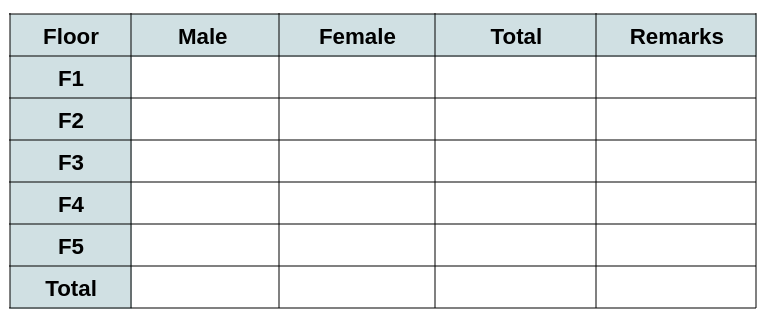
28% of females are at floor F1 = 28% of 650 = 182
18% of the males work at floor F2 = 18% of 850 = 153
One-fifth of the males work at floor F5 = 0.2*850 = 170
The ratio of females to males at floor F2 is 2 : 3, we know that males at F2 = 153
So, females at F2 = 153*(2/3) = 102
25% of the total number of employees are on floor F3 = 1500*0.25 = 375
Let us fill the details in the table.
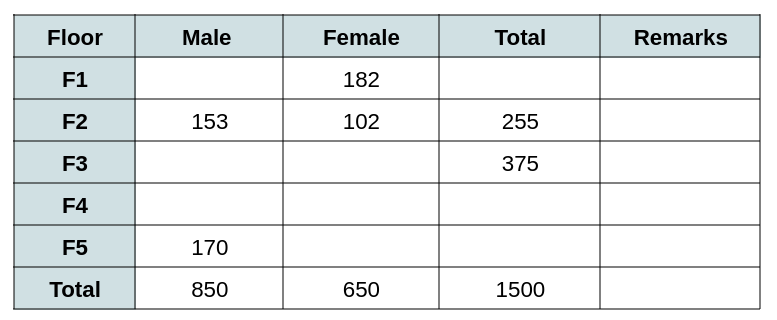
Females working at floor F5 are 60% of the males working at the same floor.
We know that males working at F5 = 170,
So, females working at F5 = 60% of 170 = 102
18% of the females are at floor F4 = 18% of 650 = 117
The remaining females are at floor F3.
16% of the males work at floor F1 = 16% of 850 = 136
The remaining males are working at floor F4.
Let us again fill the table using above clues.
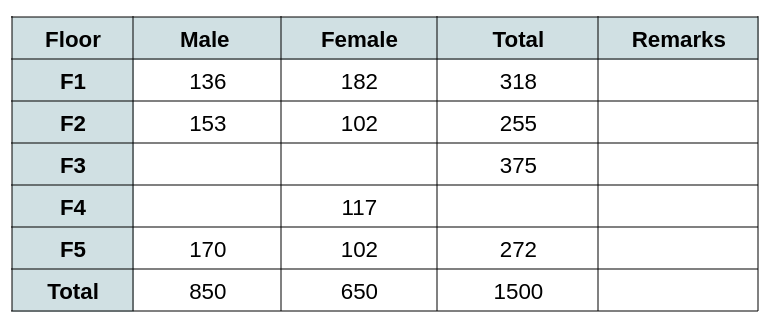
We know there are 650 females from F1 to F5.
Hence, 182+102+F3+117+102 = 650
503+F3 = 650
F3 = 650-503 =147
Also, we know the total number of employees in the building = 1500
Hence, 318+255+375+F4+272 = 1500
1220+F4 = 1500
F4 = 1500-1220 = 280
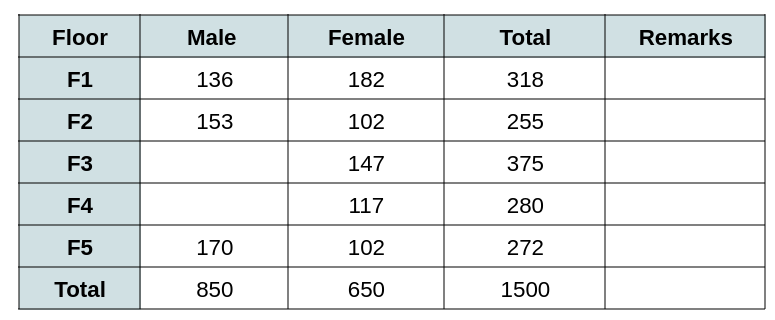
Thus, number of males at F3 = 375-147 = 228
The number of males at F4 = 280-117 = 163
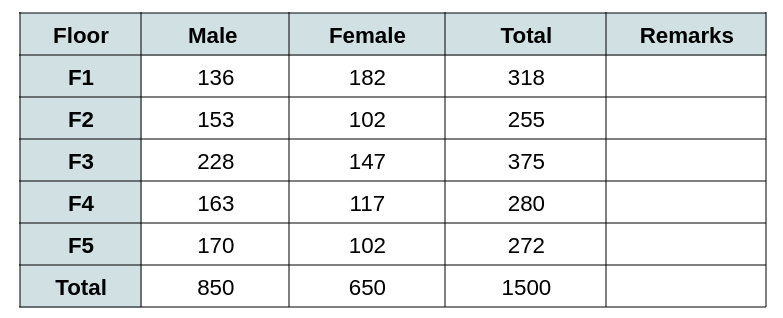
The number of males working at floor F3 = 228
Number of males working at floor F4, form what percent of the number of females working the same floor?
It is given that there are 1500 employees.
The ratio of males to females is 17:13, which means the number of males = (17/30)*1500 = 850 and the number of females = 650.
Let us make a table which has floor-wise distribution of males and females.
28% of females are at floor F1 = 28% of 650 = 182
18% of the males work at floor F2 = 18% of 850 = 153
One-fifth of the males work at floor F5 = 0.2*850 = 170
The ratio of females to males at floor F2 is 2 : 3, we know that males at F2 = 153
So, females at F2 = 153*(2/3) = 102
25% of the total number of employees are on floor F3 = 1500*0.25 = 375
Let us fill the details in the table.
Females working at floor F5 are 60% of the males working at the same floor.
We know that males working at F5 = 170,
So, females working at F5 = 60% of 170 = 102
18% of the females are at floor F4 = 18% of 650 = 117
The remaining females are at floor F3.
16% of the males work at floor F1 = 16% of 850 = 136
The remaining males are working at floor F4.
Let us again fill the table using above clues.
We know there are 650 females from F1 to F5.
Hence, 182+102+F3+117+102 = 650
503+F3 = 650
F3 = 650-503 =147
Also, we know the total number of employees in the building = 1500
Hence, 318+255+375+F4+272 = 1500
1220+F4 = 1500
F4 = 1500-1220 = 280
Thus, number of males at F3 = 375-147 = 228
The number of males at F4 = 280-117 = 163
Number of males working at floor F4, form what percent of the number of females working the same floor.
Females at F4 = 117
Males at F4 = 163
percent of the number of females = (163/117)*100 = 139.32%
What is the number of females working at floor F5?
It is given that there are 1500 employees.
The ratio of males to females is 17:13, which means the number of males = (17/30)*1500 = 850 and the number of females = 650.
Let us make a table which has floor-wise distribution of males and females.
28% of females are at floor F1 = 28% of 650 = 182
18% of the males work at floor F2 = 18% of 850 = 153
One-fifth of the males work at floor F5 = 0.2*850 = 170
The ratio of females to males at floor F2 is 2 : 3, we know that males at F2 = 153
So, females at F2 = 153*(2/3) = 102
25% of the total number of employees are on floor F3 = 1500*0.25 = 375
Let us fill the details in the table.
Females working at floor F5 are 60% of the males working at the same floor.
We know that males working at F5 = 170,
So, females working at F5 = 60% of 170 = 102
18% of the females are at floor F4 = 18% of 650 = 117
The remaining females are at floor F3.
16% of the males work at floor F1 = 16% of 850 = 136
The remaining males are working at floor F4.
Let us again fill the table using above clues.
We know there are 650 females from F1 to F5.
Hence, 182+102+F3+117+102 = 650
503+F3 = 650
F3 = 650-503 =147
Also, we know the total number of employees in the building = 1500
Hence, 318+255+375+F4+272 = 1500
1220+F4 = 1500
F4 = 1500-1220 = 280
Thus, number of males at F3 = 375-147 = 228
The number of males at F4 = 280-117 = 163
The number of females working at floor F5 = 102
Number of males working at floor F1; form approximately what percent of total number of employees in the organisation?
It is given that there are 1500 employees.
The ratio of males to females is 17:13, which means the number of males = (17/30)*1500 = 850 and the number of females = 650.
Let us make a table which has floor-wise distribution of males and females.
28% of females are at floor F1 = 28% of 650 = 182
18% of the males work at floor F2 = 18% of 850 = 153
One-fifth of the males work at floor F5 = 0.2*850 = 170
The ratio of females to males at floor F2 is 2 : 3, we know that males at F2 = 153
So, females at F2 = 153*(2/3) = 102
25% of the total number of employees are on floor F3 = 1500*0.25 = 375
Let us fill the details in the table.
Females working at floor F5 are 60% of the males working at the same floor.
We know that males working at F5 = 170,
So, females working at F5 = 60% of 170 = 102
18% of the females are at floor F4 = 18% of 650 = 117
The remaining females are at floor F3.
16% of the males work at floor F1 = 16% of 850 = 136
The remaining males are working at floor F4.
Let us again fill the table using above clues.
We know there are 650 females from F1 to F5.
Hence, 182+102+F3+117+102 = 650
503+F3 = 650
F3 = 650-503 =147
Also, we know the total number of employees in the building = 1500
Hence, 318+255+375+F4+272 = 1500
1220+F4 = 1500
F4 = 1500-1220 = 280
Thus, number of males at F3 = 375-147 = 228
The number of males at F4 = 280-117 = 163
Number of males working at floor F1; form approximately what percent of total number of employees in the organisation?
Number of males working at floor F1 = 136
Total number of employees = 1500
% of total number of employees = 136/1500 = approx 9%
Study the information to answer these questions.
In a city there are six modes of transport available A, B, C, D, E and F for commuting. Out of a total number of commuters commuting daily in the city, 17171 commute only by A. 7359 commute only by B and 22077 commute only by C. 1471.8 commute only by D, 4906 commute only by E and 7359 commute only by F. 26983 commute by C as well as A , 9812 commute by E as well as A. 12265 commute by C as well as E daily. Assume that there is no overlap between the commuters of different modes (and their combination) of transport.
The total number of commuters commuting by A form ______ percent of the total number of commuters commuting daily.
We are given the following information,
17171 commute only by A
7359 commute only by B
22077 commute only by C
14718 commute only by D
4906 commute only by E
7359 commute only by F
26983 commute by C as well as A
9812 commute by E as well as A
12265 commute by C as well as E
And we are given that there is no further overlap between any two modes of transport.
The total number of people commuting will be: 122650
The number of people using A is: 53966
Percentage-wise, this will be, $$\frac{53966}{122650}\times100=44\%$$
What is the difference in the percentage of commuters commuting by E and that of B and F taken together?
We are given the following information,
17171 commute only by A
7359 commute only by B
22077 commute only by C
14718 commute only by D
4906 commute only by E
7359 commute only by F
26983 commute by C as well as A
9812 commute by E as well as A
12265 commute by C as well as E
And we are given that there is no further overlap between any two modes of transport.
The total number of people commuting will be 122650
Commuters commuting by E is: 26983
Commuters commuting by B and F together: 14718
Their difference is 12265, which is 10% of the total commuters.
The total number of commuters commuting by D and B together form ___ percent of the total number of commuters commuting daily.
We are given the following information,
17171 commute only by A
7359 commute only by B
22077 commute only by C
14718 commute only by D
4906 commute only by E
7359 commute only by F
26983 commute by C as well as A
9812 commute by E as well as A
12265 commute by C as well as E
And we are given that there is no further overlap between any two modes of transport.
The total number of people commuting will be 122650
The number of commuters of B and D together is: 22077
To find the percentage of it, $$\frac{22077}{122650}\times100=18\%$$
A majority commuters in the city use ..... mode of transport.
We are given the following information,
17171 commute only by A
7359 commute only by B
22077 commute only by C
14718 commute only by D
4906 commute only by E
7359 commute only by F
26983 commute by C as well as A
9812 commute by E as well as A
12265 commute by C as well as E
And we are given that there is no further overlap between any two modes of transport.
The total number of people commuting will be 122650
The total number of commuters using A is: 53966
The total number of commuters using C is: 61325
The total number of commuters using B is: 7359
The total number of commuters using D is: 14718
Hence, the answer is Mode C.
The number of commuters commutting by B,D and F taken together form .... percent of the total number of commuters commuting daily by A,C and E taken together ?
We are given the following information,
17171 commute only by A
7359 commute only by B
22077 commute only by C
14718 commute only by D
4906 commute only by E
7359 commute only by F
26983 commute by C as well as A
9812 commute by E as well as A
12265 commute by C as well as E
And we are given that there is no further overlap between any two modes of transport.
The total number of people commuting will be 122650
B, D, F taken together, will be 29436
A, C, E together will be: 93214
The question asks
B,D and F taken together form .... percent of the total number of commuters commuting daily by A,C and E taken together
So, what percent of 93214 equals 29436
$$\frac{29436}{93214}$$
31.5%
Each of the following has an aasertion (A) and a reason (R).Mark answer as
Assertion (A): President of India is the head of the State.
Reason (R): Parliament of India consists of the President, Lok Sabha and Rajya Sabha.
Both A and R are correct. However, R doesn't explain why the president is the head of state.
Assertion (A): Indus valley people knew the art of navigation
Reason (R): Indus Valley seals indicate prevalence of overseas trade.
If someone is involved in overseas trade, they must know the navigation. Hence, A and R are true, and R is the correct explanation of A.
Assertion (A): A person with blood group O is considered a universal recipient
Reason (R): Type O blood does not contain any antigens.
If a blood group has no antigens, it won't trigger an immune response, even if the recipient has a different blood type. Hence, both A and R are true, and R is the correct explanation of A.
In each of these questions, two statements I and II are given. These may have a cause and effect relationship or may have, independent causes or be the effects of independent causes. Read the statements and mark answer as
Statement I:
A mobile phone,if i kept on during an air flight, can actually disrupt the plane’s electronic systems and eventually lead to a crash, a study has revealed. Older planes are most at risk to mobiles, Laptops and iPads.
Statement II:
One case involved a Boeing 747 flying at a height of 4500 feet whose pilot disengaged, by itself. When the flight attendants went through the cabin, they found four passengers using their cell phones. Once these were switched off. the flight carried on without any problem.
S2 describes an incident, the cause of which is electronic devices (phones) and the reason has been mentioned in S1. Hence, S1 is the cause and S2 is the effect.
Statement I:
Indian women don't believe in donating blood. According to the first ever data bank on gender distribution of blood donors, India has only 6 percent blood donations by women.The rest 94% were male donors.
Statement II:
Just twenty five countries in the world collect more than 40% of their blood supplies from female doctors,these include Australia, US, Thailand, Swaziland, Portugal, New Zealand, Mongolia, Zimbabwe, etc
Both statements talk about blood donation, but S1 talks about female donors, and S2 talks about female doctors. However, the gender separation is clear in these two statements, and the same can be said to be the common cause of both the statements.
Statement I:
Six months after Glaxo Smith Kline (GSK) consumer health care India brought in its global oral care brand sensodyne to the Indian market, sensodyne has garneyed a 10% share of the sensitive tooth paste market.
Statement II:
GSK has not only invested heavily in the advertising and promotion of the brand but has contacted 15000 dentist in two months and in keen on building on the sensodyne equity .
S1 talks about Sensodyne gaining a prominent market share, while S2 talks about the change in marketing strategy which has led to an increase in awareness and market share of the toothpaste. Hence, S1 is the effect of S2.
Each of these questions has a statement followed by two conclusions I and II. Consider the statement and the following conclusions. Decide which of the conclusions follows from the statement. Mark answer as
Statement: Parents are prepared to pay any price for an elite education to their children.
Conclusions:
I. All parents these days are very well off.
II. Parents have an obsessive passion for a perfect development of their children through good schooling.
The main statement only talks about parents being ready to pay any price for elite education of their children. However, both conclusions are incorrect.
1. The main statement is generic in nature, and we cannot deduce that all parents are well off.
2. The use of "obsessive" makes this a bit too extreme and, hence, incorrect. The main statement merely talks about parents paying high price for elite education.
Statement: For over three decades ‘A’ has been totally involved in energy conservation, its efficient use and management.
Conclusions:
I. There is a lot of development in the society.
II. Power rates have become cheaper.
The main statement talks about the focused efforts of A in energy conservation.
1. By having a statement on energy conservation, we cannot comment anything on the overall development.
2. Even if energy conservation is being focused upon, power rates might or might not be cheaper.
Statement:
Wind is an inexhaustible source of energy and an aero-generator can convert it into electricity .Thought much has been done in this field, the survey shows that there is vast potential for developing wind as alternative source of Energy.
Conclusions:
I. Energy by wind is comparatively newly emerging field.
II. The energy crisis can be dealt by exploring more in the field of aero-generation.
The main statement talks about the vast potential of wind energy and scope of having it as an alternative source of energy.
1. The conclusion is true because the main statement mentions about the existing vast potential in the domain which is yet to be exploited. Alhtough the statement mentions that much has been done in the field, conclusion is still correct as it uses the word 'comparatively'.
2. This is again true, as the statement mentions that the same can be used as an alternative source of energy, which make sit implicit that the energy crisis can be dealt by this.
In a certain code, TOGETHER is written as RQEGRJCT. In the same code, PAROLE will be written as
1st Letter - Replaced by 2nd letter before it
2nd Letter - Replaced by 2nd letter after it
3rd Letter - Replaced by 2nd letter before it
4th Letter - Replaced by 2nd letter after it
5th Letter - Replaced by 2nd letter before it
6th Letter - Replaced by 2nd letter after it
Hence, the coded word of PAROLE is NCPQJG.
If ’cinto baoli tsi nzro' means ‘her village is Sarurpur’, 'mhi cinto keepi tsi oind’ means 'her first love is literature' and 'oind geit tsi cinto pki ' means 'literature collection is her hobby ', which word would mean "literature"?
’cinto baoli tsi nzro' means ‘her village is Sarurpur’
'mhi cinto keepi tsi oind’ means 'her first love is literature'
'oind geit tsi cinto pki' means 'literature collection is her hobby'
We see that in all three sentences, her and is common, let us try to figure out what is common in three coded sentences.
cinto and tsi, they are either her or is or vice-a-versa.
Now, In the 2nd and 3rd sentences, her, is, and literature is common.
So, the possibility of literature being either cinto and tsi is zero.
Therefore, literature will be coded as oind.
Pointing to a photograph,a woman says ,"this man's sons sister is my mother-in-law ".How is the woman's husband related to man in the photograph ?
Man's son's sister: Man's daughter
Man's daughter is the mother-in-law of this woman, which means the woman's husband is the son of Man's daughter. This, in turn, implies that the woman's husband is the grandson of that Man.
Four girls are sitting on a bench to be photographed. Shikha is to the left of Reena, Manju is to the right of Reena, Rity is between Reena and Manju. Who would be second from the left in the photograph?
Shikha is to the left of Reena, so that could be: Shikha, Reena
Then, Manju is to the right of Reena, so that could be: Shikha, Reena, Manju
Then, Rity is between Reena and Manju, so the final arrangement would be: Shikha, Reena, Rity, Manju.
Therefore, the second from the left would be Reena.
A child is looking for his father. He went 90 m in the East before turning to his right. He went 20 m before turning to his right again to look for his father at his uncle's place 30 m from this point. His father was not there. From there, he went 100 m to the North before meeting his father in a street. How far did the son meet his father from the starting point?
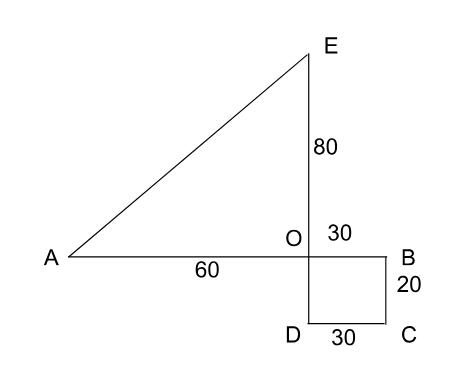
The child starts from point A and he moves 90 m in the east and reaches at B.
Now, from B he takes a right and moves 20 m and reaches at C.
Then, again he takes a right and moves 30 m to reach at D. (Uncle's place)
Now, he moves 100 m north of point D, and reaches at E.
We need to find the distance AE?
From the diagram, we know AEO forms a right-angled triangle.
AO = 60
EO = 80
Thus, $$AE^2=AO^2+EO^2$$
$$AE^2=60^2+80^2$$
AE = 100 m
One morning after sunrise, Reeta and Kavita were talking to each other face to face at Tilak Square. If Kavita's shadow was exactly to the right of Reeta which direction Kavita was facing?
As sun rises from the east, the shadow of Reeta will be in the West Direction.
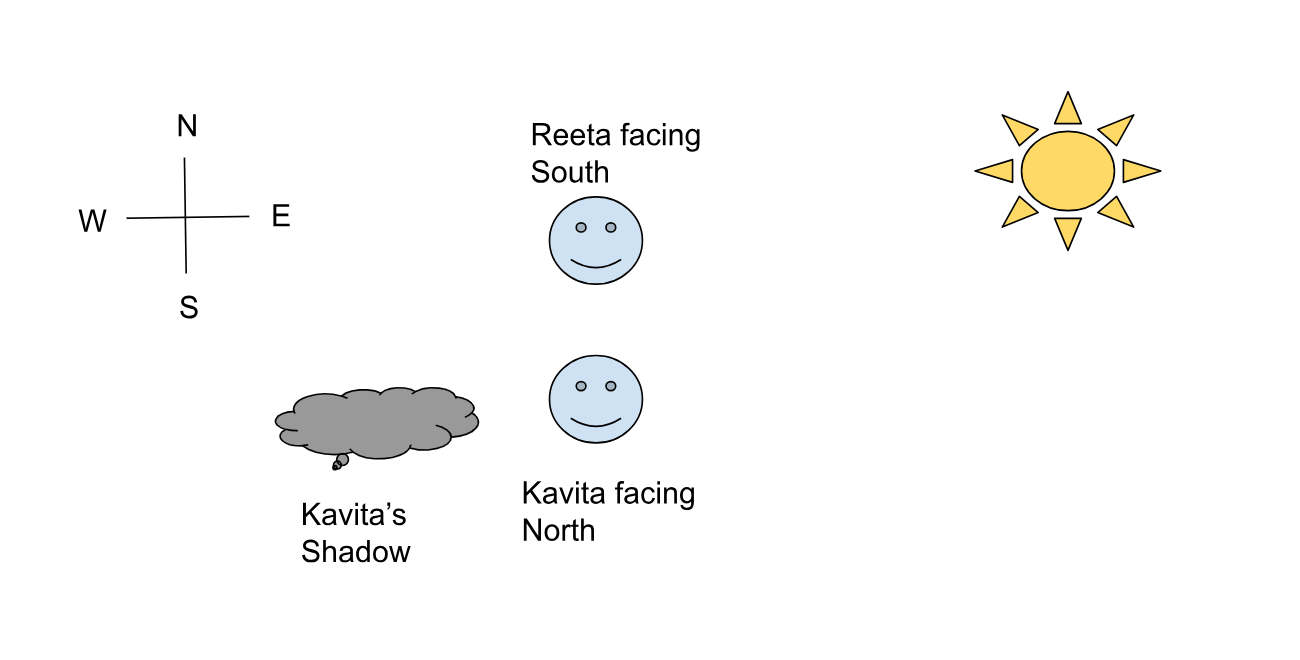
Hence, Kavita faces North.
Nitin was counting down from 32. Sumit was counting upwards, starting from 1, and he was calling out only the odd numbers. What common number would they call out at the same time if they were calling out at the same Speed?
Nithin is counting down from 32, and Sumit is counting up from 1, calling out odd numbers. Given that they call out at the same speed, let us have a column of numbers.
1 32
3 31
5 30
7 29
9 28
11 27
13 26
15 25
17 24
19 23
21 22
23 21
We see that they never call out the same number.
In a class of 60, where girls are twice that of boys, Kamal, a boy, ranked seventeenth from the top. If there are 9 girls ahead of Kamal, how many boys are after him in rank?
Let us say there are X boys, that means there are 2X girls. We know the total number of students is 60.
So, 3X=60, giving us X=20. That means there are 40 girls and 20 boys.
We are told that Kamal ranked 17th from the top, so 16 people ahead of him. Out of these 16, we are told that 9 are girls, meaning the remaining 7 must be boys. So, in the first 17 kids, nine girls and eight boys. The remaining boys will be behind Kamal, the number of them Is 20-8=12 boys.
There are twenty people working in an office. The first group of five works between 8.00 a.m. and 2.00 p.m. The second, group of ten works between 10.00 a.m. and 4.00 p.m. And the third group of five works between 12 noon and 6.00 p.m. There are three computers in the office which all the employees frequently use. During which of the following hours the computers are likely to be used most?
The total number of employees are the most between 12.00 pm - 2.00 pm as all three groups are simultaneously present during that timeframe.
Hence, the computers are most likely to be used during these hours.
At the end of a business conference ,the ten people present all shake hands with each other once .How many hand shakes will therebe altogether
To find the total number of handshakes, we can use the formula for combinations:
$$^nC_2$$ where n is the number of people who shake hands.
For 10 people:
$$^{10}C_2$$ = $$\dfrac{10!}{8!2!}=\ \dfrac{10\times9}{2}$$ = 45
So, there will be 45 handshakes altogether.
In a caravan, in addition to 50 hens, there are 45 goats and 8 camels with some keepers. If the total number of feet is 224 more than the number of heads in the caravan, the number of keepers is .....
Hens have two legs, Goats have four, Camels have four legs, and humans have two legs.
We are told there are 50 hens, which means 100 feet
We are told that there are 45 goats, which means 180 feet
We are told that there are 8 camels, which means 32 feet
Let's say there are X keepers, which means there are 2X feet
The total number of feet will be: 312+2X
The total number of heads will be: 103+X
We are then told that the total number of feet is 224 more than the number of heads.
224+(103+X)=312+2X
327+X=312+2X
X=15
Hence, the number of keepers in the caravan is 15.
Study the following information to answer these questions.
A cube is coloured red on two opposite faces, blue on two adjacent faces and yellow on the two remaining faces. It is then cut into two halves along the plane parallel to the red faces. One piece is then cut into four equal cubes and the other one into 32 equal cubes
How many cubes do not have any coloured face?
Let's take the original side length of the cube to be 2a
Cutting the square parallel to the red faces, would give us:
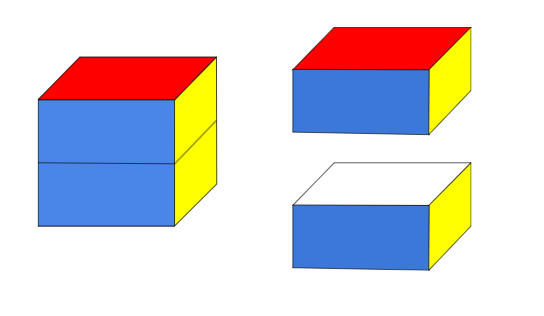
Let's say we cut the upper piece into four equal squares.
The upper piece is a cuboid with dimensions (2a, 2a, a)
To make four cubes we can cut it into equal halves along is height and length.
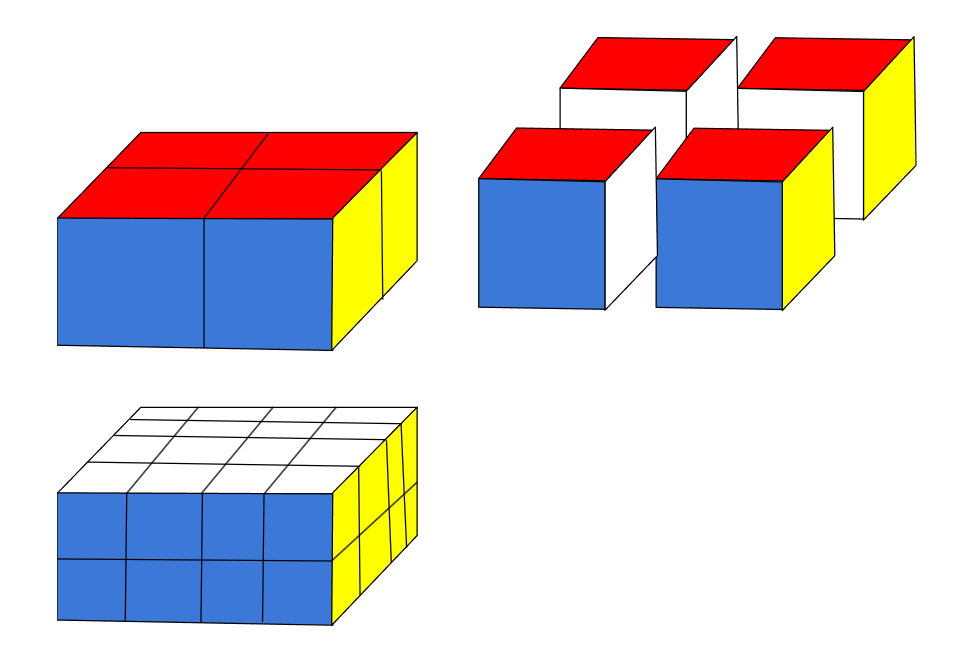
To cut the lower piece into 32 equal pieces, we can put 3 cuts along its length, 3 cuts along its height and breadth
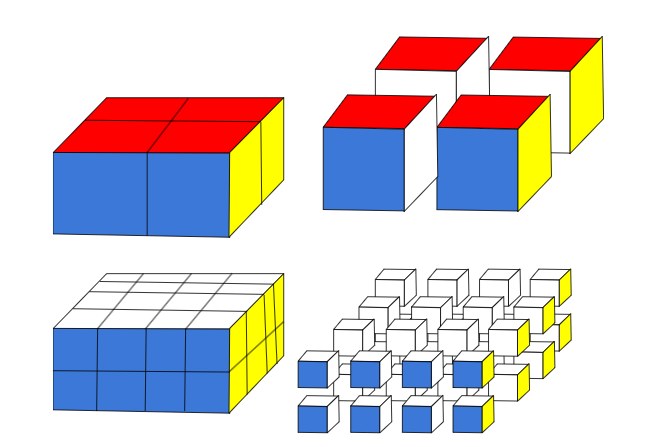
All the cubes from the upper half have at least one face coloured.
In the lower half, the cubes on the bottom, frontleft, and right would have one face coloured.
The only cubes that will not have any face coloured would be the four cubes that form the inner portion of the upper face.
Therefore, 4 is the correct answer.
How many cubes do not have any red face?
Let's take the original side length of the cube to be 2a
Cutting the square parallel to the red faces, would give us:
Let's say we cut the upper piece into four equal squares.
The upper piece is a cuboid with dimensions (2a, 2a, a)
To make four cubes we can cut it into equal halves along is height and length.
To cut the lower piece into 32 equal pieces, we can put 3 cuts along its length, 3 cuts along its height and breadth
We want to see how many of these 36 cubes will not have any red faces.
All the four pieces from the upper half of the original cube will have one red face.
From the lower piece, of the 32 pieces, only the bottom 8 would have a red face, the other 24 would not have any red faces.
Therefore, Option D is the correct answer.
How many cubes have at least two coloured face?
Let's take the original side length of the cube to be 2a
Cutting the square parallel to the red faces, would give us:
Let's say we cut the upper piece into four equal squares.
The upper piece is a cuboid with dimensions (2a, 2a, a)
To make four cubes we can cut it into equal halves along is height and length.
To cut the lower piece into 32 equal pieces, we can put 3 cuts along its length, 3 cuts along its height and breadth
Only the cubes on the outer surface would have two coloured faces.
Of the four cubes from the upper half, all four cubes will have two coloured faces.
Of the 32 cubes, the cubes on the edges are the only ones who would have two colours, giving 16 cubes.
Giving 20 cubes in total.
Therefore, Option A is the correct answer.
The following-questions are based on the following diagram In which the triangle represents female graduates small circle represents self-employed females and the big circle represents self-employed females with bank loan facility.Numbers are shown in the different sections of the diagram.on the basis of these numbers answer the following.

How many female graduates are self-employed?
The intersection of two circles here would be the same as being part of the bigger circle alone.
The first question asks about female graduates who are self-employed.
We need to count only those who are part of the triangle (graduate) and also part of any or both circles(self-employed)
Hence, the number of women matching these criteria would be 7+5+8 = 20
Therefore, Option D is the correct answer.
How many female graduates are not self-employed?
The intersection of two circles here would be the same as being part of the bigger circle alone.
For this, we have to consider the women who are part of the triangle but not part of the circle; this would be only the 4 women who are part of the triangle at the very top of the figure.
Therefore, Option A is the correct answer.
How many non graduate females are self-employed?
The intersection of two circles here would be the same as being part of the bigger circle alone.
Here we have to find the number of females who are self-employed (part of the circles) but not graduates (not part of the triangle)
These females would be 1+2+6+3+9 = 21
Therefore, Option D is the correct answer.
Each Question consist of a problem followed by two statements marked as I and II .Decide whether data in the statements are sufficient to answer the questions . Mark answer as
If no student took test T more than once, how many students took test T?
I. The average(arithmetic mean) of the students’ scores on test T was 72.
II. The sum of the students’ scores on test T was 2,232.
Average = Sum of the scores/ Number of students
=> Number of students = Sum of the scores/Average
Hence both statements are necessary
Last year $$\frac{4}{5}$$ of the applicants for a job on a police force/passed ow the physical examination. If $$\frac{3}{4}$$ of the applicants who passed the physical examination also passed the written examination, how many of the applicants passed both examinations?
I. The number of applicants who did not pass either examination was equal to the number who passed the written examination only.
II. There was a total of 100 applicants.
Let the total number of students = 5x
Number of students who passed physical test = 4x
Number of students who failed physical test = x
Let Number of students who passed the written test = 3x+y
=>Number of students who failed written test = 2x-y
From statement 2, we can say 5x=100 => x=20
From statement 1, we can say 3x-y = 3x+y => y =0
Number of students who passed both examinations =7x= 140
G, P, and S are animal species. What is the average life span, in year, of S?
I. The averagelife span of S is twice that of P and $$\frac{4}{5}$$ that of G.
II. The average life span of G is 30 years longer than that of P and 10 years longer than that of s
1.S=2P; S=(4/5)G; we cannot determine. Insufficient
2.G=P+30 ;G=s+10 >> we cannot determine. Insufficient
1+2
S=(4/5)G and G=S+10
S=(4/5)(S+10)=>(1/5)S=8
S=40
There are exactly 6 teams in league Y. What was the total number of games played by the 6 teams last season?
I. Each team in league X played each of the other teams at least once.
II. No team in league X played more than 7 games.
From the statement I, each team has played at least 5 games with each team once. From the statement II, number of games played by each team is less than or equal to 7. So the teams can play between 5 to 7 games which is not definite.
$$\therefore\ $$We cannot say the exact total number of games played using the given data.
Hence, the correct answer is Option D
A Swimming club that sold only individual and family memberships charged ₹300 for an individual membership. If the club’s total revenue from memberships was ₹480,000, what was the charge for a family membership ?
I. The revenue from individual memberships was $$\frac{1}{4}$$ of the total revenue from memberships.
II.The club sold 1.5 times as many family memberships as individual memberships.
From statement 1, total revenue from individual memberships = 96000 Rs and total revenue from family memberships = 384000 Rs
Number of Individual memberships = 96000/300 = 320
Adding statement 2 , we get number of family memberships = 1.5 x 320 = 480
charge for a family membership = 384000/480 = 800 RS
In each of these questions, two quantities A and B are given compare the two quantities and mark answer as
Soni’s salary, which is greater than ₹10000 is 75 percent of Amit’s salary. Duas salary is 80 percent of Soni’s salary.
A. Amit’s salary
B. Dua’s salary
Let Amit's salary = 100x
Soni's salary = 75x
Duas salary = 0.8*75x = 60x
The total surface area of a cube equals
A. The length of one edge of the cube.
B. 4.5
Since the total surface area of a cube is unknown, the comparison cannot be made between the given quantities.
Hence, the correct answer is Option D
A merchant made a profit of ₹2.75 on the sale price of a sweater that cost the merchant ₹ 12.25
A. The Profit expressed as a percentage of the cost to the merchant.
B. The Profit expressed as a percent of the sale price.
CP = 12.25
SP = 12.25 + 2.75 = 15
The Profit expressed as a percentage of the cost = (SP-CP)/CP * 100 = 22.44%
The Profit expressed as a percent of the sale price = (SP-CP)/SP = 18.33%
There are 28 students in a class all born in 2000.
A. The probability that all their birthdays are in February.
B. The probability that all their birthdays fall on a Friday.
Probabilty that all their birthdays are in February = $$\left(\frac{28}{365}\right)^{28}$$
The probability that all their birthdays fall on a Friday = $$\left(\frac{52}{365}\right)^{28}$$
A is greater
Base on the graph compare A and B.

A. The percent change in premium sales from February to March .
B. The percent change in total sales from January to February.
The per cent change in premium sales from February to March = (10-9)/10 = 1/10
The percent change in total sales from January to February = (16-15)/16 = 1/16
Hence The per cent change in premium sales from February to March is greater
Study the following graph to answer these questions
An ice-cream company prepares three different flavours X, Y and Z. The production of three flavours over a period of six years has been expressed in the bar graph provided below.

For which of the following years, the percentage of rise/fall in production from the previous year is thé maximum for the flavour Y ?
Percentage decrease in 2012 = 1/6
Percentage increase in 2013=1/10
Percentage decrease in 2014=1/11
Percentage increase in 2015 = 1/10
Percentage decrease in 2012 = 1/6 is the highest
For which flavour was the average annual production maximum in the given period?
the average annual production maximum in the given period is nothing but the maximum production
For X it is 300
For Y it is 325
For Z it is 300
Whatis the difference betweeh.the average production of flavour X in 2010, 2011 and 2012 and the average production of flavour Y in 2013, 2014 and 2015?
Average production of flavour X in 2010, 2011 and 2012 = (50+40 +55)/3 = 145/3
average production of flavour Y in 2013, 2014 and 2015 = (55+50+55)/3 = 160/3
Difference = 15/3 = 5 lakhs
Which year shows the highest production of ice-creams?
2010 = 150 lakhs
2012 = 165 lakhs
2014 = 155 lakhs
2015 = 145 lakhs
The. total production of ice-creams in 2014 is what per cent of the total production of ice-cream flavours Y and Zin 2010 and 2012 combined?
Total production of ice-creams in 2014=155
total production of ice-cream flavours Y and Zin 2010 and 2012 combined = 100+110 = 210
155/210 = 73.80%
Study the following table to answer these questions.
The following table gives the number of candidates appeared (App.) and qualified (Qual.) in ABC entrance examination from different zones (I - VI in different years from 2010-2015).

The qualifying percentage from Zone V is maxinium in which of the following years?
The qualifying percentage from Zone V in 2010 = 130/1008 = 12%
The qualifying percentage from Zone V in 2013= 220/1198 = 18%
The qualifying percentage from Zone V in 2014 = 240/1208 =19.86%
The qualifying percentage from Zone V in 2015 = 238/1203 = 19.78%
The total number of qualifying candidates in 2013 is what percentJess than that in 2015
The total number of qualifying candidates in 2013 = 2930
The total number of qualifying candidates in 2015 = 3200
Perentage less = (3200 -2930)/3200 = 8.43%
Ratios between boys and girls for qualified and for appeared from Zone IV in 2013 are 7:3 and 3:2 respectively. What is‘the approximate ratio between the boys qualified and girls appeared?
Number of boys qualified = 7/10 * 500 = 350
Number of girls appeared = 2/5 * 2468 = 987
Ratio = 0.35 which is nearer to 2:13
In which of the following zones is there a continuous increase in the number of students appeared as well as’qualified over the years?
In none of the above zones, there a continuous increase in the number of students appeared as well as’qualified over the years
The numberof students appeared from Zone V in 2012 and 2015_together is approximately what percent less than that from Zone II in 2011 and 2014 together?
The number of students appeared from Zone V in 2012 and 2015 together = 1143+1203 = 2346
The number of students appeared from Zone II in 2011 and 2014 together = 2899+3698 = 6597
The number of students appeared from Zone V in 2012 and 2015 together is approximately = $$\frac{\left(6597-2346\right)}{6597}\cdot100\ =\ 64.4\%$$ less than that from Zone II in 2011 and 2014 together
Study the following graph to answer these Questions.
The following pie-chart gives the percentage of people in a city working in night shifts from various Industries. The bar graph shows the percentage of females from these industries working in night shifts.


What is the approximate average number of females working in night shifts from all the industries together?
It is given that 8% of 40250 are in Sales. Thus number of people in sales = 8% of 40250 = 3220
Also, females in sales are 60%. Number of females in sales = 60% of 3220 = 1932. Thus remaining are males which are 3220 - 1932 = 1288
Similar things can be calculated for other sectors as well and can be obtained as below table:

Approx average number of female = (1932+2254+966+966+1449+5796)/6 = ~2227
The number of females from the gaming industry is what percent of the total number of people working in the night shifts from all the industries together?
It is given that 8% of 40250 are in Sales. Thus number of people in sales = 8% of 40250 = 3220
Also, females in sales are 60%. Number of females in sales = 60% of 3220 = 1932. Thus remaining are males which are 3220 - 1932 = 1288
Similar things can be calculated for other sectors as well and can be obtained as below table:
Required Percentage = $$\frac{1449}{40250}\times\ 100\%\ =\ 3.6\%$$
What is the percentage differenéé-between the number of males and females working in the night shift from these industries?
It is given that 8% of 40250 are in Sales. Thus number of people in sales = 8% of 40250 = 3220
Also, females in sales are 60%. Number of females in sales = 60% of 3220 = 1932. Thus remaining are males which are 3220 - 1932 = 1288
Similar things can be calculated for other sectors as well and can be obtained as below table:
Total number of females = 1932+2254+966+966+1449 = 13363
Total number of males = 40250-13363 = 26887
Difference = 26887-133363 = 13524
Difference as percentage of total employees = $$\frac{13524}{40250}\times\ 100\%\ =\ 33.6\%$$
If the numberof females working in night shift for banking is 3206, while the percentage of females inrest ofthe industries remained unchanged, Then the new percentage of females workingin night shiff will be .......
It is given that 8% of 40250 are in Sales. Thus number of people in sales = 8% of 40250 = 3220
Also, females in sales are 60%. Number of females in sales = 60% of 3220 = 1932. Thus remaining are males which are 3220 - 1932 = 1288
Similar things can be calculated for other sectors as well and can be obtained as below table:
If number of females in banking is = ($$\frac{1932+3206+966+966+1449}{40250}\times\ 100\%\ = 35.5%$$)
Percentage of males workingin night shift is lowest in which of the following industries?
In sales 60% of employees are female which is the highest percentage of females working in a department. So %males in Sales will be least
Study the following graphs to answer these questions
In the year 2015, 17 lakh tonnes of a fruit was produced in a certain State. Is production status in SIX Districts of that State is shown in Pie-chart I. the percentages of total expenditure incurred under different heads for producing this fruit in a District is shown by Pie-chart II.


The monthly expenses for water in District B is more/less than the monthly expenditure for electricity in District A by ...... (The total expenditure is ₹1700 per tonne in a year).
monthly expenses for water in District B = 0.17 x 1700 x 2.56 lakhs = 739.84 lakhs
monthly expenditure for electricity in District A = 0.14 x 1700 x 3.15 lakhs = 749.7 lakhs
monthly expenses for water in District B is less than monthly expenditure for electricity in District A by 986000 rs
The total expenses incurred for the production of fruits in districts E, F and C are in the ratio 3:2:4.The total expenditure per tonne of production fruit in these districts is ₹ 5580.The amount spent towards transport in district F is more/less than that in E is ........
Total production in districts C,E AND F = 3.45 + 1.75 + 1.88 = 7.08 lakh tonnes
Total expenditure = 7.08 x 5580 lakhs = 39506.4 lakhs
Total Expenses in E = 3/9 * 39506.4 = 13168.8 lakhs
Total Expenses in F = 2/9 x 39506.4 = 8779.2 lakhs
amount spent towards transport in district F = 8779.2 x 0.12 = 1053.504 lakhs
amount spent towards transport in district in E = 13168.8 x 0.12 = 1580.256 lakhs
If the expenditure incurred indistrict D is 20% more than that in district B and ₹ 950000 were spent in district B then expenses for labour in district D are
expenditure incurred indistrict D = 950000 x 1.2 = Rs 1140000
expenses for labour in district D = 1140000 x 0.2 = Rs 228000
The profit earned by the sale of the fruit in district F is 25%. The sale price being 10000 per tonne, how money was spent on fertilizers approx.?
Total SP = 10000 x 1.88 lakhs = 18800 lakhs
Total CP = 18800 lakhs/ 1.25 = 15040 lakhs
Money spent on fertilizers = 0.18 x 15040 lakhs = 270720000
The sale price of the vegetable IN District A is ₹ 7000 per tone and that in B is ₹8500 per tonne. A profit of 5% is earned in B and a loss of 5% is registered in A. The amount spent on water in A more/less than that on seeds in B is
Total SP of A = 3.15 x 7000 = 22050lakhs
Total SP of B = 2.56 x8500 = 21760 lakhs
Total CP of A = 22050/0.95 = 23210 lakhs
Total CP of B = 21760/1.05 = 20723 lakhs
amount spent on water in A = 17% of 23210 lakhs = 3945 lakhs
amount spent on seeds in B = 19% of 20723 lakhs = 3937 lakhs
Difference is approximately more by 890000
Study the following graph to answer these question?
Three different finance companies declare a fixed annual rate of interest on the amounts invested with them by investors. The rate of interest offered by these companies may differ from year to year depending on the variation in the economy of the country and the banks' rate of interest. The annual rate of interest offered by the three Companies P, Q, and R over the years are shown by the line graph provided below.

If two different amounts in the ratio 8:9 are invested in Companies P and Q respectively in 2012, then the amounts received after one year as interests from Companies P and Q are respectively in the ratio?
8X was invested in Company P and 9X in Company Q in 2012.
in 2012, P had an interest rate of 6% and Q an interest rate of 4%
We need to find the ratio of interest,
For Company P, it would be 0.06(8X)=0.48X
For Company Q, it would be 0.04(9X)=0.36X
P is to Q ratio will therefore be 4:3
In 2010, a part of ₹30 lakhs was invested in Company P and the rest was invested in Company Q and R for one year. The total interest received was 2.43 lakh. What was the amount invested in Company P?
Let x be the amount invested in P.
Interest = 7.5x/100
=> 3000000 - x is invested in Q and R
Interest = (3000000 - x)9/100
Given, 7.5x/100 + (3000000 - x)9/100 = 243000
Upon solving, x = 13.5 lakhs
An investor invested a sum of ₹ 15 lakh in Company P in 2008 .The total amount received after one year was reinvested in the same company for one more year .The total appreciation received by the investor on his investments was ......
Amount received at the end of 2008 = 15(1+8/100 ) = 1620000
Amount received at the end of 2009 = 1620000(1+10/100)=1782000
The total appreciation received by the investor on his investment = 1782000 - 1500000 = 282000
In which year was the difference between the annual rate of interest offered from Companies P and R the minimum?
In 2008, the difference between the annual rate of interest offered from Companies P and R = 8.5 - 8 =0.5
In 2007, the difference between the annual rate of interest offered from Companies P and R = 9-8 =1
In 2010, the difference between the annual rate of interest offered from Companies P and R = 9-7.5 = 1.5
In 2011, the difference between the annual rate of interest offered from Companies P and R = 8-6.5 = 1.5
The average annual rate of interest offered for the given period is the highest for
The sum of Company P's interest rate for the 7 years is 54
The sum of Company Q's interest rate for the 7 years is 53
The sum of Company R's interest rate for the 7 years is 56.5
Since the overall sum of Cthe ompany's R's interest rates is highest therefor, the average interest rates also will be higher for Company R.
Study the following information to answer these questions.
In a city, there are M1, M2, M3, M4, M5 and M6 modes available for commuting. Out of the total number of commuters commuting daily in a city, 17171 commuters commute only by M1 daily. 7359 commuters commute only by M2 and 22077 commuters commute only by M3. 14718 commuters commute only by M4 and 4906 commuters commute only byM5, 7359 commuters commute only by M6. 26983 commuters commute by M3 as well as M1 daily .9812 commuters commute by M5 as well as M1 daily. 12265 commuters commute by M3 as well as M5 daily.
The total number of commuters commuting by-M1 form what percent of the total number of commuters commuting daily?
We need to find the total number of commuters. Since the initial values are for one mode only, the later values that use two modes are exclusive and not part of those.
To find the total number of commuters, we need to add all the values given:
17171+7359+22077+14718+4906+7359+26983+9812+12265 = 122110
The number of commuters that use M1 would be 17171(M1 only) + 26983 (M1+M3) + 9812 (M1+M5) = 53966
The percentage would be $$\frac{53966}{122110}\times\ 100\approx\ 44$$
Therefore, Option B is the correct answer.
What is the percentage difference in the total number of commuters commuting in M5 and that of M2 and M6 together?
Number of Commuters by M5 would be: 4906+9812+12265 = 26983
Commuters of M2 and M6 together would be 7359+7359 = 14718
The difference would be = 12265
The total number of commuters were 122110
The difference would be approximately 10%.
Therefore, Option D is the correct answer.
The total number of commiters commuting by M4 and M2 together form what percent of the total number of commuters commuting daily?
Commuters of M2+M4 = 7359+14718 = 22077
Total number of commuters: 122110
The percentage would be $$\frac{22077}{122110}\times\ 100\approx\ 18.08$$
Therefore, Option C is the correct answer.
Majority of thé commuters in the city use .......
We can solve this via the options:
Option A: M1 is used by 17171+26983+9812 = 53966
Option B: M2 is used by 7359 commuters only
Option C: M3 is used by 22077+26983+12265 = 61325\
Option D: M4 is used by 14718 commuters only.
Hence, most commuters in the city use M3
Therefore, Option C is the correct answer.
The number of commuters commuting by M2,M4 and M6 form what percent of the total number of the commuters commuting daily by M1 and M3 and M5?
Commuters from M2+M4+M6 = 7359+14718+7359 = 29436
Commuters from M1+M3+M5 = 17171+22077+4906+16983+9812+12265 = 93214
The required percentage would be approximately 31%
Start your IIM journey with the right preparation and crack CAT 2026.

Educational materials for CAT preparation
 Share
Share