Complement
PGDBA 2018 Question Paper
In each of the questions a word has been used in sentences in four different ways. Choose the option corresponding to the sentence in which the usage of the word is incorrect or inappropriate.
Solution
The incorrect usage is in the third sentence: "The economic crisis of that decade had its complement in a political crisis in the next."
Here, "complement" is wrongly used.
The correct word should be something like "counterpart" or "correspondence," as "complement" which means something that completes or enhances, which doesn't fit this context.
Glow
Solution
[Note: This is a previous year's question and seems to have some ambiguity]
Option B is the correct answer as it is inappropriate. Embarrassment typically doesn't lead to a "glow," as it suggests a more negative or awkward emotion. The usage of glow in this sentence is not appropriate.
Option A: In this sentence, "glow" describes a radiant expression of pride. The word "glow" here is appropriate because it implies a positive, warm, and shining emotion, which fits well with pride.
Option C: This is a correct usage. A bonfire emits a warm light, and the word "glow" is used to describe the light that the fire gives off, illuminating its surroundings
Option D: Sullenness refers to a gloomy, ill-tempered, and resentful state of mind or disposition. Here, it should be a "lack of glow' that would indicate sullenness.
Arrange the sentences in the most logical order to form a coherent paragraph. From the given options (A, B, C, D) choose the appropriate sequence.
i. Big Tobacco is doing nothing illegal by producing and marketing cigarettes.
ii. Even so, regulators weighing up how to treat safer alternatives to cigarettes are often too harsh.
iii. No wonder people are cynical when they hear tobacco bosses evangelise about e-cigarettes.
iv. The industry has an inglorious history of lying about the effects of cigarettes on human health.
Solution
(i) sets the foundation by stating that Big Tobacco is not doing anything illegal in producing and marketing cigarettes. This provides a neutral starting point.
(iv) follows by introducing the industry's history of deception, showing why people might distrust tobacco companies.
(iii) builds on this distrust, explaining why people are cynical about tobacco executives promoting e-cigarettes—given their past dishonesty.
(ii) concludes by stating that despite this cynicism, regulators may be overly strict on safer alternatives like e-cigarettes, bringing in a critical viewpoint.
Hence, the correct order is (i), (iv), (iii), (ii)
i. The data came from the UK Biobank, which contains genetic and medical data from half a million people.
ii. Intriguingly, this analysis suggests genetic contributions to intelligence and educational achievement are currently disfavoured by natural selection.
iii. Positive correlation means an association with successful reproduction; negative one means exactly the opposite.
iv. A study just published uses a new statistical method to examine how genetic contributions to certain human traits such as intelligence correlate With how many children a person has.
Solution
First, a study looked at genes and how many kids people have (iv). It used data from a big UK source (i). Then, it explained what a "positive" or "negative" link means in this study (iii). Finally, it shared the interesting finding: genes for being smart seem to be linked to having fewer kids (ii).
i. I am confident that you gentlemen will review without passion the evidence you have heard come to a decision, and restore this defendant to his family.
ii. I'm no idealist to believe firmly in the integrity of our courts and in the jury system that iS no ideal to me, it is a living, working reality.
iii. A court is only as sound as its jury, and a jury is only as sound as the men who make it up.
iv. Gentlemen, a court is no better than each man of you sitting before me on this jury.
Solution
The correct sequence is (ii), (iv), (iii), (i)
This sequence begins with the speaker’s broader belief in the justice system (ii), narrows to the jury’s pivotal role (iv, iii), and ends with a direct call to action (i). While it differs from my earlier suggestion, it still forms a coherent paragraph by moving from a general viewpoint to a specific request, maintaining a persuasive and logical structure.
Hence, the answer is Option A
Read the passage and choose the most appropriate answer for the question that follow.
In my research on leadership transitions, I have observed that career advances require all of us to move way beyond our comfort zones. At the same time, however, they trigger a strong countervailing impulse to protect our identities: When we are unsure of ourselves or our ability to perform well or measure up in a new setting, we often retreat to familiar behaviors and styles.
But my research also demonstrates that the moments that most challenge our sense of self are the ones that can teach us the most about leading effectively. By viewing ourselves as works in progress and evolving our professional identities through trial and error, we can develop a personal style that feels right to us and suits our organizations’ changing needs.
That takes courage, because learning, by definition, starts with unnatural and often superficial behaviors that can make us feel calculating instead of genuine and spontaneous. But the only way to avoid being pigeonholed and ultimately become better leaders is to do the things that a rigidly authentic sense of self would keep us from doing.
The word “authentic” traditionally referred to any work of art that is an original, not a copy. When used to describe leadership, of course, it has other meanings—and they can be problematic. For example, the notion of adhering to one “true self” flies in the face of much research on how people evolve with experience, discovering facets of themselves they would never have unearthed through introspection alone. And being utterly transparent—disclosing every single thought and feeling—is both unrealistic and risky.
From the passage, we can infer that
Solution
The correct answer is: the author believes that authenticity could prevent us from trying out new styles.
The passage explains that sticking too much to your "true self" can stop you from learning and growing as a leader. To become better, you need to step out of your comfort zone and try new ways, even if they feel unnatural at first.
The term "work in progress" in the passage, refers to
Solution
The passage's term "work in progress" refers to the idea that individuals are not fixed in their identities or abilities but can evolve and adapt over time, mainly through new experiences.
The author emphasizes that by viewing ourselves as works in progress and evolving through trial and error, we can develop a leadership style that fits our sense of self and the needs of our organizations.
This aligns with the notion that individuals can change as they encounter new experiences, rather than remaining static or adhering to a single "true self."
Hence, D is the correct answer.
For the author, a leadership transition requires a manager to
Solution
The author’s primary argument is that leadership transitions require managers to step out of their comfort zones, embrace new behaviors, and evolve their identities to meet new demands—best captured by A. Change and adapt to new role requirements. This option reflects the passage’s emphasis on growth and adaptation as essential to navigating transitions effectively. While avoiding being pigeonholed (B) and limiting transparency (C) are mentioned, they are subsidiary to the broader need to adapt. Option D isn’t supported directly.
The most appropriate title for this passage would be
Read the passage and choose appropriate answer for the questions that follow.
Passage:
As rough sleeping rises nationally, the exact scale of the crisis remains hare to capture. The official data shows that in England, rough sleeping has risen for six years in a row, The latest figures estimated that 4,134 people bedded down outside in 2016, up 16%on the previous year. Though London remains the centre of rough sleeping, accounting for 23% of the national total (and in Westminster, with 260 rough sleepers, the highest numberof cases), the rate is increasing much faster outside the capital, in faces such as Brighton, Manchester and Birmingham.
Each winter across the country, council send teams of volunteers to conduct night-time counts of all the rough sleepers in the borough to assess how acute the problem is. Recent counts in the homelessness hotspots of Cambridge and Hackney, east London, reveal how the problem is evolving.
“This is their bedroom you are entering. "Be respectful of that," warned the organiser of the Cambridge count, before teams set out to count rough sleepers in the historic centre in early Friday. For bedroom, read shop doorway, church graveyard, or multi-storey car park - any where in the cold night air where a street sleeper might hope to find a yard or two of dry shelter and, if they are lucky, a degree of privacy.
At 3 am, as the last of the evening's city-centre revellers are going home, the teams set out. This is the time when rough sleepers consider it safe enough and sufficiently quiet to bed down. Dotted along a line of shops on a main shopping street were several people in brightly coloured sleeping bags in doorways, surrounded by the paraphernalia of street life: plastic bags stuffed with belongings, cardboard under sheets to insulate them from the cold, the odd half empty wine bottle.
There are strict definitions of what constitutes a rough sleeper for the purposes people must be sleeping, about to bed down or bedded down on the of mount: doorways, parks, tents, bus shelters, cars, barns, sheds and other places not designed for habitation. Homeless people who are resident in hostels or shelters on the night in question are not counted. The count is not a precise science: bad weather can depress the figures; counters can miss rough sleepers if they are well hidden; regular sleepers may by chance spend the night elsewhere. Good housing support services, too, can have a positive effect in reducing the numbers.
As the main city within a large rural area, and one with good homelessness provision such as hostels, Cambridge has always acted as a magnet for rough sleepers. Relationship breakdown and substance abuse remain important triggers of homelessness. But increasingly other factors have come into play, not least poverty: the lack of affordable housing, high rents and unstable tenancies, housing benefit cuts, and precarious incomes caused by the rise of zero-hours working.
Exactly how bad the problem has got is a matter for debate. Between October and the end of November each year, every English local authority is required to submit snapshot estimates of the number of people sleeping out on a specified night.
The term 'rough sleeping', as used in this passage refers to
Solution
From the context presented, we can understand that the discussion is about people sleeping on the streets and other places, which were not made for people to sleep. This is basically a discussion about homelessness.
Option A is about camping outdoors, which is far from the discussion.
Option B is close, but the sleeping is not happening in shelters, but in places where one is not meant to sleep.
Option C captures the idea most aptly and would be the correct answer.
Option D presents this as something which is far from the idea of rough sleeping as given in the passage.
Therefore, Option C is the correct answer.
According to the author, all of the following are causes of rough sleeping except:
Solution
The author mentions his perspective on the reasons in the lines, "Relationship breakdown and substance abuse remain important triggers of homelessness. But increasingly other factors have come into play, not least poverty: the lack of affordable housing, high rents and unstable tenancies, housing benefit cuts, and precarious incomes caused by the rise of zero-hours working."
Options A, C and D are covered in these.
Revelling (meaning to enjoy oneself in a noisy way) is not one of the causes the author considers a cause of rough sleeping.
Therefore, Option B is the correct answer.
The scale of rough sleeping is difficult to capture because
Solution
The author explicitly mentions: "The count is not a precise science: bad weather can depress the figures; ..."
Which is captured in option D.
Option A is not a reason for difficulty in capturing the scale of rough sleeping.
Option B and C are somewhat implied in the passage, but to show the extent of the problem, just to show how nuanced the issue is and how the actual numbers might not reflect the correct picture.
Ths article primarly focuses on rough sleeping in the city of
Solution
Option B: Westminster is only mentioned once when giving a statistic about the number of rough sleepers.
Option D: Birmingham is mentioned only once, slightly in passing at the end of the first paragraph, when mentioning the increasing rate. Hence, can be eliminated as an option.
Option A and C are close.
Although the discussion is initially about London, as the first paragraph points out, the rate is increasing much faster outside the capital, after which the discussion switches to Cambridge.
The study is also done in Cambridge, making it the most appropriate answer.
The most appropriate tittle for this article is
Solution
Option B: This is a minor comment made by the organiser in Cambridge and does not align with the more prominent theme of the text, making it unsuitable as a title.
Option C: The passage discusses no solutions to the issue, eliminating this option.
Option D: Similar to Option C, the passage does not present a solution.
Leaving Option A as the most appropriate title, dealing with the rough sleepers in England.
Therefore, Option A is the correct answer.
The organisers' warning to be respectful refers to
Solution
The statement, "This is their bedroom you are entering. "Be respectful of that,.." shows that the organiser is asking the team to be respectful of the place, this is where someone sleeps, and a level of privacy should be given to them.
This is most appropriately captured in option B.
The rest of the options are not related to the statement and would not make sense in relation to the organiser's warning to be respectful.
For the following questions answer them individually
A club with x members is organised into four committees according to the following rules:
(i) Each member belongs to exactly two committees.
(ii) Each part of committees has exactly one member in common. Then
Let P. Q, R and S be statements such that
(i) if both P and Q are true then R is false and
(ii) if P is false then S is false
Suppose R is true. Then which of the following necessarily holds?
Solution
Since R is true, then, both P and Q cannot be true together.
Also, using statement (ii), we can draw out the following cases:

Now, evaluating the given options,
only option 4 is true in all the four cases.
Answer the question based on the following information.
Houses numbered 1 to 4 are situated east to west in that order. The houses are each occupied by professorsofa college, namely, Prof.Sinha, Prof.Khanduja, Prof. Saxena and Prof.Kesarwani. They teach different languages: Urdu, Bengali, Gujarati and Sanskrit, and possess different makes of motorcycles each manufactured in a different year. Each of the professors teaches only one subject and owns only one motorcycle. The following additional information is available:
* The owner of the Suzuki motorcycle teaches Gujarati
* Prof. Anshul Sinha has a Honda motorcycle and teaches Urdu
* Prof.Khanduja, who teaches Gujarati, lives in house number 2
* Prof. Saxena teaches Sanskrit and lives in the western-most house
* 2001 model of motorcycle is owned by the professor of Urdu who lives in house number 1
* Prof.Kesarwani owns a BMW motorcycle
Which of the following statements is incorrect?
Solution

Prof. Kesarwani lives in house number 3. So, statement 1 is false.
From the above information we can infer that
Solution
We will proceed by creating a table:
The western-most house is numbered as 4 as Houses numbered 1 to 4 are situated east to west in that order.

Option 2 is true.
Prof.Saxens drives motorcycle of the following make
Solution
We will use tabular form to solve this question:

No information is given about Mr. Saxena's bike. So, None of these.
Answer the question based on the following information.
Table 1 gives the men's and women's world record times for various outdoor running distances, recognized by the International Association of Athletics Federations (IAAF) as of 17 November 2017.

The average speeds (rounded to 2 places of decimal) for the men's and women's fastest 1500 metersrace have been, respectively.
Solution
For Men's 1500 m, fastest time recorded= 206 seconds.
So, average speed = $$\frac{\ Total\ dis\tan ce}{Total\ time}=\ \frac{\ 1500}{206}=7.28\ metres\ per\ \sec.$$
For Women's 1500 m, fastest time recorded= 230.1
So, average speed= $$\frac{\ Total\ dis\tan ce}{Total\ time}=\ \frac{\ 1500}{230.1}=6.52\ metres\ per\ \sec.$$
Therefore, Option A.
For which of the following categories, is the women's world record timeless than 110%of the men's world record time?
Solution
Using the given options, we create the following table:

We can observe that only in case of 100 meters is Women's record time is less than 110% of the men's record time.
Hence, Option D.
For which of the following categories is the ratio of the women's and men's record times, thatis, W/M, the largest?
Solution
Using the table as shown below:

We can infer that the ratio W/M is greatest for 2000 metres.
The category in which the average speed is second highest is
Solution
Using the formula Speed= Distance/ Time we can formulate the following table:

From the above table, we an infer that the highest speed is that in case of men 100 and 200 metres race.
The second highest speed is in case of women 100 metre race.
If $$\alpha$$ is the factor by which the women's world record average speedreduces with doubling of the running distance, the smallest value of $$\alpha$$ occurs for the pair of categories
Solution
Let us evaluate each of the options one by one.
In the first option, we need to check the speeds for 100 m and 200 m.
For 100 m, Average speed in women's category= $$\frac{\ Total\ dis\tan ce}{Total\ time}=\ \frac{\ 100}{10.5}=9.52\ metres\ per\ \sec.$$
For 200 m, Average speed in women's category= $$\frac{\ Total\ dis\tan ce}{Total\ time}=\ \frac{\ 200}{486.1}=9.39\ metres\ per\ \sec.$$
$$\alpha\ =1-\ \frac{\ 9.39}{9.52}=1-0.9863=0.0137$$
In the second option, we need to check the speeds for 1500 m and 3000 m.
For 1500 m, Average speed in women's category= $$\frac{\ Total\ dis\tan ce}{Total\ time}=\ \frac{\ 1500}{230.1}=6.52\ metres\ per\ \sec.$$
For 3000 m, Average speed in women's category= $$\frac{\ Total\ dis\tan ce}{Total\ time}=\ \frac{\ 3000}{586.1}=6.17\ metres\ per\ \sec.$$
$$\alpha\ =1-\ \frac{\ 6.17}{6.52}=1-0.9463=0.0536$$
In the third option, we need to check the speeds for 5000 m and 10000 m.
For 5000 m, Average speed in women's category= $$\frac{\ Total\ dis\tan ce}{Total\ time}=\ \frac{\ 5000}{851.2}=5.874\ metres\ per\ \sec.$$
For 10000 m, Average speed in women's category= $$\frac{\ Total\ dis\tan ce}{Total\ time}=\ \frac{\ 10000}{1757.5}=5.6912\ metres\ per\ \sec.$$
$$\alpha\ =1-\ \frac{\ 5.6912}{5.874}=1-0.9688=0.0311$$
In the fourth option, we need to check the speeds for 400 m and 800 m.
For 400 m, Average speed in women's category= $$\frac{\ Total\ dis\tan ce}{Total\ time}=\ \frac{\ 400}{47.6}=8.40336\ metres\ per\ \sec.$$
For 800 m, Average speed in women's category= $$\frac{\ Total\ dis\tan ce}{Total\ time}=\ \frac{\ 800}{113.3}=7.0609\ metres\ per\ \sec.$$
$$\alpha\ =1-\ \frac{\ 7.0609}{8.40336}=1-0.84024=0.16$$
Therefore, lowest $$\alpha\ $$ is in the first option
For the following questions answer them individually
Each student in a class of 40 plays at least one indoor game-chess, carom and scrabble. 18 play chess, 20 play scrabble and 27 play carom. 7 play both chess and scrabble, 12 play both scrabble and carom and 4 play all 3 games. The number of players who play chess and carom but not scrabble is
Solution
 Share
Share
Students who play all the three games are 4, and with the rest information given in the question, we can at best draw the venn diagram as:
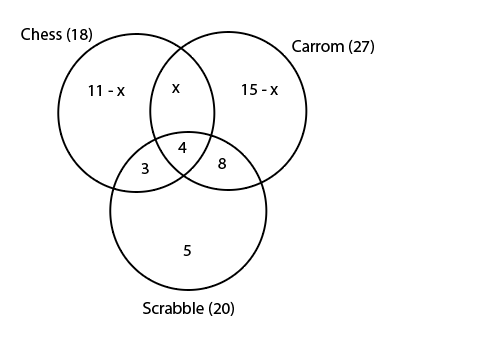
Now, total students=40.
So, Chess+ 5+8+15-x=40
=>18+28-x=40
=> 46-x=40
.'. x=6
The value of $$20_{C_1} + 2 \times 20_{C_2} + 3 \times 20_{C_3} + ..... + 20 \times 20_{C_{20}}$$ is
Solution
Let S= $$\left(0\times\ ^{20}C_0\right)+\left(1\times^{20}C_1\ \right)+\left(2\times^{20}C_2\ \right)+\left(3\times^{20}C_3\ \right)+...\left(19\times^{20}C_{19}\ \right)+\left(20\times^{20}C_{20}\ \right)$$.---------Eqn 1.
When we reverse the RHS and write again, we get
S= $$\left(20\times\ ^{20}C_20\right)+\left(19\times^{20}C_19\ \right)+\left(18\times^{20}C_18\ \right)+\left(17\times^{20}C_17\ \right)+...\left(1\times^{20}C_{1}\ \right)+\left(0\times^{20}C_{0}\ \right)$$.--------- Eqn 2.
When we use $$^nC_r=^nC_{n-r}$$, we can re-write the second equation as:
S= $$\left(20\times\ ^{20}C_0\right)+\left(19\times^{20}C_1\ \right)+\left(18\times^{20}C_2\ \right)+\left(17\times^{20}C_3\ \right)+...\left(1\times^{20}C_{19}\ \right)+\left(0\times^{20}C_{20}\ \right)$$.-----------Eqn 3.
Adding Eqn 1 and Eqn 3, we will get,
2S= 20($$^{20}C_0+^{20}C_1+^{20}C_2+^{20}C_3.....+^{20}C_{19}+^{20}C_{20}$$
=> 2S=20$$\times\ 2^{20}$$
=>S= $$\ \frac{\ 20\times\ 2^{20\ }}{2}$$
.'. S= 20$$\times2^{19}\ $$
The circle $$x^2 + y^2 = 8$$ intersects the parabola $$y^2 = 2x$$ at a point P in the first quadrant. The acute angle between the tangents to the circle and the parabola at the point P is
Solution
First, we will try and find the point of intersection of the two curves.
We do so by equating the two curves.
So, $$x^2+\ y^2-8=y^2-2x$$
=> $$x^2+2x\ -8=0$$
=> (x+4)(x-2)=0
=> x= -4 or 2.
But since, the point of intersection lies on the first quadrant, x=2.
By putting the value of x in any of the two curves, we can find the value of y.
'.' $$y^2=2x$$
=> $$y^2=4$$
=> y= 2 or -2. But the point of intersection is in first quadrant, so y=2.
So, P= (2,2)
Now, for the parabola $$y^2=2x$$, tangent can be found by differentiating the curve at (2,2).
=> $$2y\ \frac{\ dy}{dx}=2$$
=>$$\frac{\ dy}{dx}=\ \frac{\ 1}{y}$$
=> $$\frac{\ dy}{dx}=\ \frac{\ 1}{2}$$
.'. Angle made by the tangent to parabola at P, tan$$\alpha\ $$= $$\ \frac{\ 1}{2}$$.
Similarly, tangent at the circle $$x^2+y^2=8$$ can be found by differentiating the curve at (2,2)
=> $$2x+2y\ \frac{\ dy}{dx}=0$$
=> $$2y\ \frac{\ dy}{dx}=-2x$$
=> $$\frac{\ dy}{dx}=\ \frac{\ -x}{y}$$
=> $$\frac{\ dy}{dx}=\ -1$$.
.'. Angle made by the tangent to circle at P, tan$$\beta\ $$= -1
Now, the acute angle between the two tangents is represented by $$\alpha\ -\beta\ $$.
We will use the expression $$\tan\left(\alpha-\beta\right)\ =\ \ \frac{\ \tan\ \alpha\ -\tan\ \beta\ }{1+\tan\ \alpha\ \tan\ \beta\ }$$
=> $$\tan\left(\alpha\ -\beta\ \right)=\ \ \frac{\ \ \frac{\ 1}{2}-\left(-1\right)}{1-\frac{\ 1}{2}}$$
=>$$\tan\left(\alpha\ -\beta\ \right)=\ \ \frac{\ \ \ \frac{\ 3}{2}}{\ \ \frac{\ 1}{2}}$$
=>$$\tan\left(\alpha\ -\beta\ \right)=\ \ 3$$
.'. $$\alpha\ -\beta\ =\ \ \tan^{-1}\left(3\right)$$. therefore, option A
In an isosceles right triangle $$PQR, \angle PRQ = 90^\circ$$. The points S and T are two trisection points of QR. The value of $$\tan(\angle SPT)$$ is
Solution
Let the isosceles sides be of the length 3x units each. Then, we can draw the triangle with given point as:

Angle SPT= B-A.
tanA= $$\ \frac{\ RT}{PR}=\ \frac{\ x}{3x}=\ \frac{\ 1}{3}\ $$
tanB= $$\ \frac{\ RS}{PR}=\ \frac{\ 2x}{3x}=\ \frac{\ 2}{3}\ $$
So, $$\tan\left(B-A\right)=\ \ \frac{\ \tan B-\tan\ A}{1+\tan\ A\tan\ B}\ $$.
=> $$\ \tan\left(B-A\right)=\ \ \frac{\ \ \frac{\ 2}{3}-\ \frac{\ 1}{3}}{1+\ \frac{\ 2}{9}}$$
=>$$\ \tan\left(B-A\right)=\ \ \frac{\ \ \frac{\ 1}{3}}{\ \ \frac{\ 11}{9}}=\ \frac{\ 3}{11}$$
Let $$f: (0, \infty) \rightarrow (0, \infty)$$ be a strictly decreasing function. Consider $$h(x) = \frac{f\left(\frac{x}{1 + x}\right)}{1 + f\left(\frac{x}{1 + x}\right)}$$ Which one of the following is always true?
Solution
$$\ h\left(x\right)=\ \ \frac{\ f\left(\ \frac{\ x}{1+x}\right)}{1+f\left(\ \frac{\ x}{1+x}\right)}=\ \frac{1+\ f\left(\ \frac{\ x}{1+x}\right)-1}{1+f\left(\ \frac{\ x}{1+x}\right)}=1-\ \frac{\ 1}{1+f\left(\ \frac{\ x}{1+x}\right)}=1-\ \frac{\ 1}{1+f\left(\ \frac{\ 1+x-1}{1+x}\right)}=1-\ \frac{\ 1}{1+f\left(\ 1-\frac{\ 1}{1+x}\right)}$$.
Now, Since f is a strictly decreasing function and its domain is positive, then, $$f\left(\ \frac{\ 1}{x+1}\right)$$ will be a strictly increasing function. Again, $$f\left(\ 1-\frac{\ 1}{x+1}\right)$$ will be a strictly decreasing function.
Let us assume $$1+f\left(\ 1-\frac{\ 1}{x+1}\right)$$= g(x).
So, g(x) is a strictly decreasing function.
h(x)= $$1-\ \frac{\ 1}{g\left(x\right)}$$.
$$\frac{\ 1}{g\left(x\right)}$$ becomes strictly increasing function, but $$1-\frac{\ 1}{g\left(x\right)}$$ will finally be strictly decreasing function.
Therefore, h(x) becomes strictly decreasing function- Option A.
How many distinct 5 x 5 matrices are there such that each entry is either 0 or 1 and each row sum and each column sum is 4?
Solution
With either 0 or 1 as an entry, a sum of 4 is possible only with four 1s and one Zero.
So, each column and row must have four 1s and one 0.
Let us consider the first row, we can put the O in any of the 5 places.
So, number of ways of placing 1 zero in the first row=5.
In the second row, we cannot put the zero in the same column as that put by the first, as it will result in two )s in the same column. So, the second 0 can be but in any of the remaining 4 places.
Similarly, for the third zero, we will have 3 ways to do so. And so on.
So, total number of ways to put 5 zeroes in the 5$$\times\ 5$$ matrix is 5*4*3*2*1= 120.
The sum of an infinite geometric series of real numbers is 14, and the sum of the cubes of the terms of this series is 392. The first term of the series is
Solution
Let the first term of the infinite G.P. be a and the common ratio be r.
So, Sum of infinite GP= $$\ \frac{\ a}{1-r}=14$$ .............. (1)
The cubes of the terms of original GP= $$a^3,\ \left(ar\right)^3,\ \left(ar^2\right)^3...$$= $$a^3,\ a^3r^3,\ a^3r^6...$$
So, in the new infinite GP, first term is $$a^3$$ and the common ratio is $$r^3$$
Therefore, sum to infinite terms= $$\frac{\ a^3\ }{1-r^3}$$ ...............(2)
Cubing the eqn 1 and dividing by eqn 2, we get,
$$\frac{\ \frac{\ a^3}{\left(1-r\right)^3}\ }{\ \frac{\ a^3}{1-r^3}}=\ \ \frac{\ 14\times\ 14\times\ 14}{392}$$
=>$$\ \frac{1-r^3\ }{\left(1-r\right)^3}\ =\ \ \frac{\ 14\times\ 14\times\ 14}{392}$$
=> $$\ \frac{\left(1-r\right)\left(1+r^2+r\right)}{\left(1-r\right)^3}\ =\ \ \ 7$$
=>$$\ \frac{\left(1+r^2+r\right)}{\left(1-r\right)^2}\ =\ \ \ 7$$
=> $$\ \left(1+r^2+r\right)\ =\ \ 7\left(1+r^2-2r\right)$$
=>$$\ 1+r^2+r\ =\ \ 7+7r^2-14r$$
=>$$\ -6-6r^2+15r\ =\ 0$$
=>$$2r^2-5r+2\ =\ 0$$
=>$$2r^2-4r-r+2\ =\ 0$$
=>$$2r\left(r-2\right)-1\left(r-2\right)=0$$
=>(2r-1)(r-2)=0
.'.r= 1/2 or 2.
In the case of infinite GP, -1 < r < 1.
So, r = 1/2
Putting this value in eqn 1, we get,
$$\ \frac{\ a}{1-\ \frac{\ 1}{2}}=14$$
2a=14
a = 7
Hence, the correct answer is option C.
The radius of the incircle of the triangle formed by the x-axisand the lines 3x + 4y - 24 = 0, 3x - 4y + 24 = 0 is
Solution
For 3x+4y-24=0 can be re-written as $$3x+4y=24$$
=>$$\frac{3x+4y\ \ }{24}=1$$
=>$$\ \frac{\ x}{8}+\ \frac{\ y}{6}=1$$.
So, this becomes the equation of the straight line of the form $$\ \frac{\ x}{a}+\ \frac{\ y}{b}=1$$, where a and b are x and y intercepts respectively. The X and Y intercepts for this equation are 8 and 6 respectively.
Similarly 3x-4y+24=0 can be re-written as $$\ \frac{\ x}{-8}+\ \frac{\ y}{6}=1$$. The X and Y intercepts for this equation are 8 and -6 respectively.
So, we get the following triangle and the incircle can be drawn as:
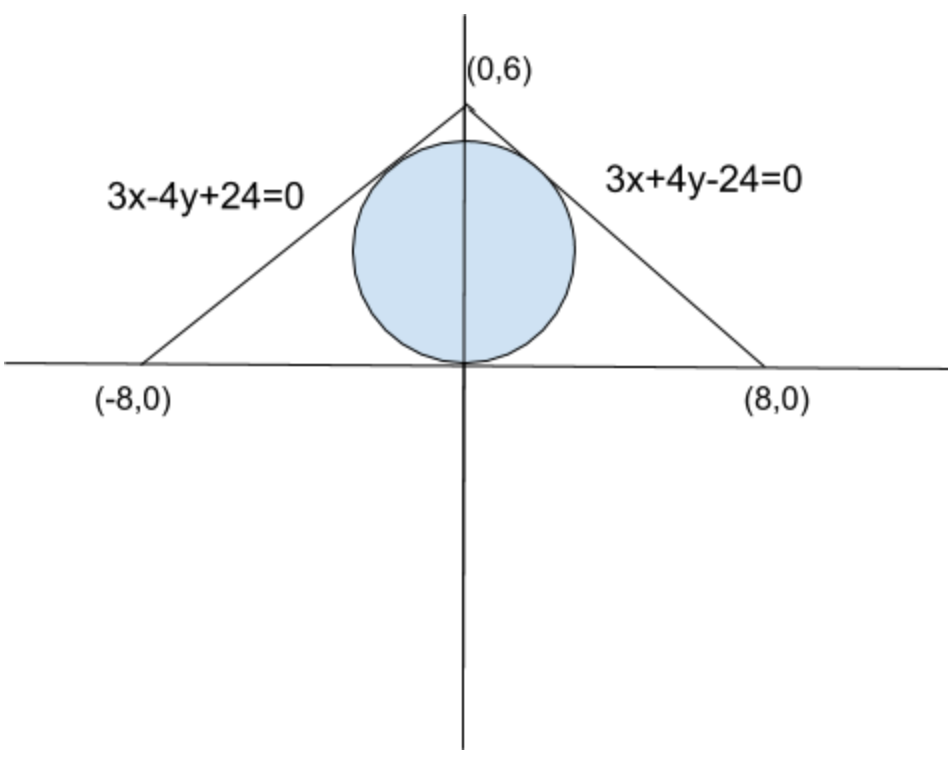
So, the triangle has sides of length 10,10 and 16.
Area of the triangle= $$\ \frac{\ 1}{2}\times\ Base\times\ Height$$= $$\ \frac{\ 1}{2}\times\ 16\times\ 6$$= 48
We know that r*s= Area of the triangle, where r is the inradius and s is the semi-perimeter. s= $$\ \frac{\ 1}{2}\left(16+10+10\right)$$= 18
So, 18r= 48
=> Or, r= $$\ \frac{\ 48}{18}=\ \ \frac{\ 8}{3}$$
The expression $$\tan^{-1}\left(\frac{1}{1 + 1.2}\right) + \tan^{-1}\left(\frac{1}{1 + 2.3}\right) + \tan^{-1}\left(\frac{1}{1 + 3.4}\right) + ........ + \tan^{-1}\left(\frac{1}{1 + n(n + 1)}\right)$$ simplifies to
Solution
We will use the formula $$\tan^{-1}\alpha\ -\tan^{-1}\beta\ =\ \tan^{-1}\left(\frac{\alpha\ -\beta\ \ \ }{1+\ \alpha\ \beta\ }\right)$$
The given equation can be re-written as $$\tan^{-1}\left(\ \frac{\ 2-1}{1+1.2}\right)+\tan^{-1}\left(\ \frac{\ 3-2}{1+3.2}\right)+...\ \tan^{-1}\left(\ \frac{\ \left(n+1\right)-n}{1+n\left(n+1\right)}\right)$$
= $$\left(\tan^{-1}2-\tan^{-1}1\right)+\left(\tan^{-1}3-\tan^{-1}2\right)+...\ \left(\tan^{-1}\left(n+1\right)-\tan^{-1}n\right)$$
=$$\tan^{-1}\left(n+1\right)-\tan^{-1}1$$
Let $$g(x) = f(x) + f(2 + x)$$, where $$f(x) = \begin{cases}1 - \mid x \mid, & \mid x \mid \leq 1\\0, & \mid x \mid > 1\end{cases}$$ The number of points where the function g is not differentiable is
Solution
We will break the function into different parts and then plot the graph.
f(x)= 0; x$$\in\left(-\infty\ ,-1\right)\ $$
$$f\left(x\right)=1+x;\ x\in\left[-1\ ,0\right)\ $$
$$f\left(x\right)=1-x;\ x\in\left[0,1\right]$$
$$f\left(x\right)=1-x;\ x\in\left(1,\infty\ \right)$$
f(x)=

f(x+2) is same as f(x), but shifted 2 units to the left.
So, f(x+2) can be drawn as:

We can observe that the parts where f(x+2) takes non zero value only where f(x)=0. So, The grapgh of g(x0= f(x)+ f(x+2) will be superimposed upon each other, and there won't be any change in values.
The graph of g(x) will be:

Now, g(x) will be non-differentiable at sharp corners, because at those points Left Hand limit will not equal to Right hand limit.
The graph of g(x) has 5 such sharp edges at (-3,0), (-2,1), (-1,0), (0,1) and (1,0). Therefore g(x) is non-differentiable at 5 points.
If $$A = \left(\begin{array}{c}1 & 0\\ -1 & 1\end{array}\right)$$, then $$A^{50}$$ is
Solution
Given $$A = \left(\begin{array}{c}1 & 0\\ -1 & 1\end{array}\right)$$, then $$A^{50}$$
$$\ A^2$$= $$\begin{bmatrix}1 & 0\\ -1 &1 \end{bmatrix}.\begin{bmatrix}1 & 0\\ -1 &1 \end{bmatrix}$$
=$$\begin{bmatrix}(1)(1)+0(-1) & 1(0)+0(1)\\ (1)(-1)+(1)(-1) &(-1)(0)+(1)(1) \end{bmatrix}$$
=$$\begin{bmatrix}1 & 0\\ -2 &1 \end{bmatrix}$$.
Now, $$\ A^3$$= $$\begin{bmatrix}1 & 0\\ -2 &1 \end{bmatrix}.\begin{bmatrix}1 & 0\\ -1 &1 \end{bmatrix}$$
=$$\begin{bmatrix}(1)(1)+0(-1) & 1(0)+0(1)\\ (1)(-2)+(1)(-1) &(-2)(0)+(1)(1) \end{bmatrix}$$
=$$\begin{bmatrix}1 & 0\\ -3 &1 \end{bmatrix}$$.
So, in general $$\ A^n$$= $$\begin{bmatrix}1 & 0\\ -n &1 \end{bmatrix}$$.
Therefore, $$\ A^{50}$$= $$\begin{bmatrix}1 & 0\\ -50 &1 \end{bmatrix}$$, which is given in Option C
A curve is drawn such that the slope at any point P = (x,y) is equal to x. The curve represents a family of
Solution
It is given that the slope of the curve at any point P is equal to x.
It is also known that, to find the slope at any point P(x,y), we can find $$\ \frac{\ dy}{dx}$$ of the curve at that point P.
For $$\ \frac{\ dy}{dx}$$ of a curve to be equal to x, the original curve must be of the form $$\ ax^2\ +c$$, where a and c are any constants.
Now, y= $$\ ax^2\ +c$$ represents a family of parabolas.
Hence, option B
Let f be a differentiable function on [-2, 2] such that f(-2) = 1, f(2) = 5 and $$\mid \frac{df(x)}{dx}\mid \leq 1$$ for all $$x \epsilon [-2, 2]$$. The value of f(0) is
Solution
Given that $$\left|\ \frac{\ df\left(x\right)}{dx}\right|\le\ 1$$
Hence $$-1\le\ \ \frac{\ df\left(x\right)}{dx}\le\ 1$$. Taking definite intergral from [-2 ,2]
-1*(5 - 1) $$\le\ $$ f(2) - f(-2) $$\le\ $$ (5-1)
$$-4\le\ 4\le\ 4$$. It is only possible when $$\ \frac{\ df\left(x\right)}{dx}$$ is always equal to 1. Therefore f(x) is a straight line with slope 1
f(x) = x+3, f(0) = 3
For a set S, we denote by S', the complement of the set S. Let X, Y, Z be Sets such that $$Y \subseteq X$$. Which of the following is always true?
Solution
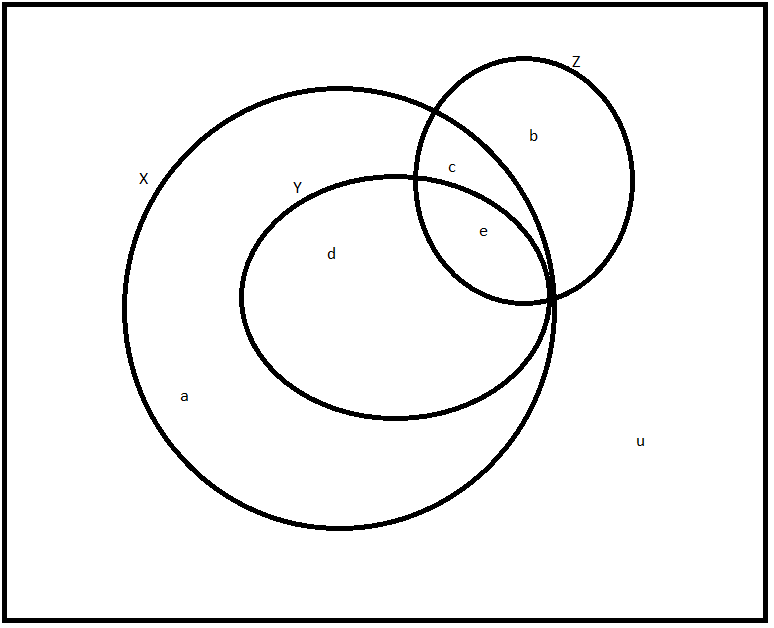
Consider the above Diagram
For option A $$X\cap Z$$ = c+e and $$Y\cap Z$$ = e. Hence option A is False
For Option B $$Y'\cap Z'$$ = a+u and $$X'\cap Z'$$ = u. Hence option B is False
For Option C $$X\cap\left(Y\cup Z\right)$$ = c+d+e and $$Y\cup\left(X\cap Z\right)$$ = c+d+e. Hence option C is True
For option D $$X'\cap Z$$ = b and $$Y'\cap Z$$ = b+c. Hence option D is False
A sequence $$\left\{x_n \right\}$$ of real numbers is defined as follows:
$$x_0 = 1, x_1 = 2,$$ and $$x_n = \frac{1 + x_{n - 1}}{x_{n - 2}}$$ for n = 2, 3, 4 ...
It follows that $$x_{2018}$$ is
Solution
Given that $$x_0=1\ and\ x_1=2\ $$
From above formula we get $$x_2=3,\ x_3=2,\ x_4=1,\ x_5\ =\ 1\ and\ x_6=2$$
We see that the pattern repeats itself in the period of five with $$x_{5k}=1,\ x_{5k+1}=2,\ x_{5k+2}=3,\ x_{5k+3}\ =\ 2\ and\ x_{5k+4}=1$$
2018 is of form 5k+3 hence $$x_{2018}=2$$
The number of real roots of the equation
$$2 \sin\left(\frac{x^2 + x}{6}\right) = 2^x + 2^{-x}$$ is
Solution
In RHS of the equation,
The min value is attained is 2 when x = 0 ( from A.M-GM inequality)
For the LHS side the max value is 2 when sin term has value of 1. But it can not be obtained when x=0
Hence, there are no real solution for the given equation
The number of points where the function
$$f(x) = \begin{cases}(x + 1)^4 & x \leq 1\\(x - 5)^2 & x > 1\end{cases}$$ attains its local maximum is
Solution
For $$x\le\ 1$$ the graph of the function is an upward parabola that attains its min at x = -1 and value is 0, at x = 1 its value is 16
Similarly for $$x>1$$ we see that its upward parabola which has value of 16 at x= 1 and decreases till x=5 at which its value is 0. After which the values increases again.
It can be seen local maxima is attained at x=1 only
A new sequence is obtained from the sequence of positive integers {1,2,3,---} by deleting all the perfect squares. The $$2018^{th}$$ term of the new sequence is
Solution
Let us write all the number the numbers from 1 to 2018. Here we find that there are 44 numbers that are perfect squares which are 1,4,9... 1936($$44^2$$). Thus after removing the perfect square it has total of 2018-44 = 1974 terms.
Taking next 44 terms from 2019, it will be (2019,2020,2021..... 2062) in which there is 1 perfect square (2025 which is $$45^2$$) hence it is removed and now there is total of 2017 terms. Next term has to be 2063 which is also $$2018^{th}$$ term
Consider the function
$$f(x) = \frac{e^{-\mid x \mid}}{max\left\{e^x, e^{-x}\right\}}, x \epsilon R$$ It follows that
Solution
For $$x<0$$ , f(x) = $$2e^x$$ and it is a continuous function with approaching the value 2 as $$x\longrightarrow\ 0$$
For $$x\ge\ 0$$ , f(x) = $$2e^{-x}$$ and it is a continuous function with approaching the value 2 as $$x\longrightarrow\ 0$$
Therefore the function is continuous.
However, $$x\longrightarrow\ 0^-$$ f'(x) = 2 but $$x\longrightarrow\ 0^+$$ f'(x) = -2
Thus it is not differentiable at exactly 1 point
Let n be the number of ways in which 5 men and 6 women can stand in a queue such that all the women stand consecutively. Let m be the number of ways in which the same 11 persons can stand in a queue such that exactly 5 women stand consecutively. The value of $$\frac{m}{n}$$ is
Solution
For n, we consider B as a group that has all 6 women. Total arrangement of B and 5 men is 6!. Further within B women can rearrange themselves in 6! ways.
Thus n = 6! $$\ \times\ $$6!
For m, consider a group $$B_1$$ which has 5 women and $$B_2$$ has remaining 1 woman. Arrangement of $$B_1$$,$$B_2$$ and 5 men can be done in 7! ways. From this we need to subtract the permutation in which $$B_1$$ and $$B_2$$ are together. Which is $$2!\times\ 6!$$ . Total ways $$=\ 7!\ -\ 2!\times 6!$$ .Which equals $$5\times\ 6!$$. Futhermore in $$B_1$$ the selection and arrangement of 5 women can be done in $$_5^6C\times\ \ 5!$$ = 6! ways.
m = $$5\times\ 6!\times\ 6!$$
$$\ \frac{\ m}{n}=5$$
The locus of the centre of a circle that passes through the origin and cuts off a length 2a from the line y = c is
Solution
Let the locus of the center be represented by (h,k)
Since it passes through origin. Radius r = $$\sqrt{\ h^2+k^2}$$
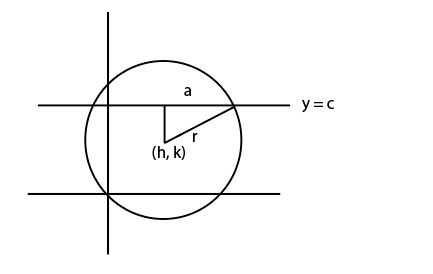
Since it cuts off chord of length = 2a on y=c. We draw 1 perpendicular bisector of the chord till the center and make a line which is intersecting point of line y=c and the circle.
We obtain a right triangle that has "r" as its hypotenuse and a and |c-k| as its sides.
Applying Pythogoras theorm,
$$r^2\ =\ a^2\ +\ \left(c-k\ \right)^2$$
it implies
$$h^2+k^2\ =\ a^2\ +\ \left(c-k\ \right)^2$$
$$h^2+k^2\ =\ a^2\ +\ c^2+k^2\ -2ck$$
$$h^2+2ck\ =\ a^2\ +\ c^2$$
replacing (h,k) by (x,y)
we get $$x^2+2cy\ =\ a^2\ +\ c^2$$
Consider the function $$f(x) = [x + 1] - \sin\left(\frac{\pi}{2}[x]\right)$$ for $$x \epsilon R$$, where [x] denotes the greatest integer less than or equal to x. Let $$l_1 = \lim_{x \rightarrow 0^-}f(x)$$ and $$l_2 = \lim_{x \rightarrow 0^+}f(x)$$ It follows that
Solution
$$l_1 = \lim_{x \rightarrow 0^-}f(x)$$
When $$x\longrightarrow\ 0^-$$ then $$\left[x\right]$$ = -1
f(x) can be written as $$[x]+1-\sin\ \left(\ \frac{\pi\ \ }{2}\left[x\right]\right)$$.
Putting [x] = -1 we get $$l_1$$ = $$-1+1-\sin\ \left(\ \frac{\ \pi\ }{2}\times\ \left(-1\right)\ \right)$$ = $$-\sin\ \left(\ \frac{\ \pi\ }{2}\times\ \left(-1\right)\ \right)$$ = 1
for $$l_2$$, $$x\longrightarrow\ 0^+$$ thus [x] = 0
putting it in f(x). $$l_2$$ = 0+1-0 = 1
Hence $$l_1 =l_2=1$$
Consider the following system of equations:
$$\begin{bmatrix}1 & 2 & 3 & 4 \\5 & 6 & 7 & 8 \\a & 9 & b & 10 \\6 & 8 & 10 & 13\end{bmatrix}\begin{bmatrix}x_1 \\x_2 \\x_3 \\x_4 \end{bmatrix} = \begin{bmatrix}0 \\0 \\0 \\0 \end{bmatrix}$$
The locus of all $$(a, b) \epsilon R^2$$ such that this system has at least two distinct solutions for $$(x_1, x_2, x_3, x_4)$$ is
Solution
Let the above equation be written as Ax=b
where A = $$\begin{bmatrix}1 & 2 & 3 & 4 \\5 & 6 & 7 & 8 \\a & 9 & b & 10 \\6 & 8 & 10 & 13 \end{bmatrix}$$
x = $$\begin{bmatrix}x_1 \\x_2 \\x_3 \\x_4 \end{bmatrix}$$
b = $$\begin{bmatrix}0 \\0 \\0 \\0 \end{bmatrix}$$
It is evident that $$x_1=x_2=x_3=x_4=\ 0\ $$ is a solution for the question.
It is stated that the equation has at least 2 distinct solution which implies infinite solution exists. and thus det(A) = 0.
Calculating det(A) we get det(A) = 4(a+b-18)
Equating it with 0, we get a+b-18=0 which is a straight line equation
The area bounded by the curve $$y^2 = x^2 - x^4$$ is
Solution
Since we see that both y and x has even terms, it implies the curve is symmetric along x-axis as well as y-axis.
Required area = 4*(area in quadrant I)
Area in quadrant I is given by
A =$$_0\int^1\sqrt{\ x^2-x^4}dx\ $$
A = $$_0\int^1x\sqrt{1-x^2}dx$$
take $$1-x^2\ =\ t^2$$, then $$-2x\ dx\ =\ 2\ t\ dt$$. when x =0 then t = 1 and when x = 1 then t = 0
Updated integral can be written as
$$\int_0^1t^{2\ }dt$$ = $$\left[\frac{t^3\ }{3}\right]_0^1\ =\ \ \frac{\ 1}{3}$$
Required area = 4*A = $$\ \frac{\ 4}{3}$$
The sum of the infinite series
$$\cot^{-1}2 +\cot^{-1}8 +\cot^{-1}18 +\cot^{-1}32 +\cot^{-1}50 + ......$$ is
Solution
We see that 2,8,18... can be represented as $$2n^2$$ where n$$\in\ N$$
Required sum = $$\Sigma_1^{\infty}\left(\cot^{-1}\left(2n^2\ \right)\right)\ =\ \Sigma_1^{\infty}\left(\tan^{-1}\left(\frac{\ 1}{2n^2}\ \right)\right)$$
=$$\Sigma_1^{\infty}\left(\tan^{-1}\left(\frac{\ 2}{4n^2}\ \right)\right)$$
= $$\Sigma_1^{\infty}\left(\tan^{-1}\left(\frac{\ \left(2n+1\right)-\left(2n-1\right)}{1+\left(4n^2-1\right)}\ \right)\right)$$
= $$\Sigma\ _1^{\infty\ }\ \tan^{-1}\left(2n+1\right)\ -\ \tan^{-1}\left(2n-1\right)$$
= $$\tan^{-1}\infty\ -\ \tan^{-1}1$$
=$$\ \frac{\ \pi\ }{2}-\ \frac{\ \pi\ }{4}\ =\ \ \frac{\ \pi\ }{4}$$