Loose
PGDBA 2016 Question Paper
In each of the questions a word has been used in sentences in four different ways. Choose the option corresponding to the sentence in which the usage of the word is incorrect or inappropriate
Solution
The words lose and loose are homophones.
Lose means to be deprived of something or to be defeated.
Whereas, "loose" means not firm or detached.
Here the word "loose" is used correctly in all the options except option C.
In option C the term is used in the context of being defeated in a game. The correct word is "lose".
Therefore the right option is C.
Advise
Solution
"Advise" is a verb that means to give suggestion or counsel to.
In all of the options except B, the usage of the word is correct.
In B, the term "advise" does not fit as the person is seeking guidance.
People often get confused between the words advise and advice. These are homophones and the word "advice" is a noun that means suggestion or guidance.
For the following questions answer them individually
Arrange the sentences in the most logical order to form a coherent paragraph. From the given options choose the most appropriate option.
i. The last thing airline pilots need is an additional hazard caused by Unmanned Aerial Vehicles (UAVs) weighing as much or more than a Canadian goose.
ii. In 2009 a collision with a flock of migratory Canadian geese caused a US Airways flight to suffer complete loss of power after take-off from LaGuardia airport, New York.
iii. The bird strike could have easily ended in disaster but for the skill of the pilot. Captain Chesley Sullenberger, who famously brought the stricken Airbus A320 down for a splash landing in the Hudson River without loss of life.
iv. One of the most feared birds encountered by aircrafts is the common Canadian goose, weighing anything up to 6 kg.
Solution
To form a coherent paragraph, the sentences should flow logically, building a clear narrative or argument. Sentence iv introduces the Canadian goose as a significant threat to aircraft, providing context about its weight and danger. Sentence ii then gives a specific example of this danger, describing the 2009 US Airways incident involving a collision with Canadian geese. Sentence iii follows naturally, explaining the outcome of that incident and highlighting the pilot’s skill in averting disaster. Finally, sentence i concludes the paragraph by connecting the earlier example to a broader point about the additional hazard posed by UAVs, which could be as heavy as or heavier than a Canadian goose, reinforcing the overall concern for airline safety.
The most logical order is: iv (introducing the Canadian goose), ii (an example of a bird strike), iii (resolution of the example), and i (broader implications with UAVs). This matches option a: iv, ii, iii, i.
Arrange the sentences in the most logical order to form a coherent paragraph. From given options choose the most appropriate option.
i. Collecting antiquities was also popular with the aristocracy during the Renaissance, and became even more so when young upper-class European men started to do the Grand Tour in the late 17th century.
ii. In ancient Rome the elite sought out Greek bronzes, sculptures and vases; some cunning merchants tried to make new ones look older and boost their price.
iii. Antique furniture went mainstream in Europe in the second half of the 19th century, as the bourgeoisie found themselves with more disposable income and developed a desire to invest in their homes.
iv. The desire to live in the presence of history has ebbed and flowed.
Solution
Sentence (iv) is an opening statement that puts forward the idea of collecting pieces of history as a fad has gradually moved from place to place and faded.
In this question, the options follow a timeline, so it is easy to arrange the other three sentences.
Starting with the sentence dealing with the most ancient time, sentence (ii) talks about collecting antiques in ancient Rome.
Sentence (i) advances to the Renaissance period and the 17th century.
(iii) talks about an even more modern period, the 19th century.
So the correct order is (iv)(ii)(i)(iii).
Consider the following phrases:
i. dominated by such brutal forces
ii. there certainly may be times when one's own culture, society and tradition are so reified
iii. When debate and conversation are so dried up or simply made impossible that the social critic
iv. becomes the social exile
To form a complete sentence, the correct order of the phrases above is:
Solution
(ii) talks about a situation where one's own culture, society and tradition are made to seem unquestionably real. (iii) carries the sentence forward stating the consequences of such a situation. The idea of it affecting the social critique due to the lack of debate and conversation is introduced. (i) reemphasises that it is the result of brutal forces that such a situation has happened. (iv) states what exactly happens to social critiques in such a case.
Hence the correct order is (ii)(iii)(i)(iv)
Therefore the correct answer is C.
Read the passage and answer the questions that follow:
Passage I
Constructivist, constructivism, interpretivist, and interpretivism are terms that routinely appear in the lexicon of social science methodologists and philosophers. Yet, their particular meanings are shaped by the intent of their users. As general descriptors for a loosely coupled family of methodological and philosophical persuasions, these terms are best regarded as sensitizing concepts. They steer the interested reader in the general direction of where instances of a particular kind of inquiry can be found. However, they 'merely suggest directions along which to look' rather than 'provide descriptions of what to see'.
Proponents of these persuasions share the goal of understanding the complex world of lived experience from the point of view of those who live it. This goal is variously spoken of as an abiding concern for the life world, for the emic point of view, for understanding meaning, for grasping the actor's definition of a situation, for Verstehen. The world of lived reality and situation-specific meanings that constitute the general object of investigation is thought to be constructed by social actors. That, particular actors, in particular places, at particular times, fashion meaning out of events and phenomena through prolonged, complex processes of social interaction involving history, language, and action.
The constructivist or interpretivist believes that to understand this world of meaning one must interpret it. The inquirer must elucidate the process of meaning construction and clarify what and how meanings are embodied in the language and actions of social actors. To prepare an interpretation is itself to construct a reading of these meanings; it is to offer the reader the inquirer's construction of the constructions of the actors one studies.
Although they share this general framework for human inquiry, constructivist and interpretivist persuasions are unique in the manner in which each answers these questions: What is the purpose and aim of human inquiry (as distinct from inquiry into the physical world)? How can we know about the world of human action?
The terms constructivism and interpretivism refer to.
Solution
This is explicitly stated in the first paragraph of the passage: "As general descriptors for a loosely coupled family of methodological and philosophical persuasions, these terms are best regarded as sensitizing concepts."
The terms constructivism and interpretivism refer to: D. sensitizing concepts
According to the author, a constructivist or an interpretivist is
Solution
According to the author, a constructivist explore and discover teh world of meanings hence they will be rooted on the context in which they made their discovery.
Therefore the correct option is B.
According to the author, constructivists and interpretivists are
Solution
In the passage, the author mentions that constructivists believe that to understand the world of meanings, one should interpret it. They do not create anything new, they explore the world for the meanings and discover how meanings are embodied in the language and actions of social actors.
Hence the correct choice is option A.
According to the passage, the term Verstehen refers to
Solution
In the passage, "Verstehen" is mentioned as one of the terms used to describe the goal of understanding the complex world of lived experience from the perspective of those who live it. It specifically refers to grasping the actor's definition of a situation. Therefore, Option D is the correct answer.
Option A: Verstehen is about understanding the meaning from the actor's perspective, not the process itself.
Option B: Verstehen focuses on the subjective understanding of situations from the actor’s viewpoint, not the complexity of lived experience.
Option C: This relates to the construction of meaning in social interactions, but Verstehen is not about the act of creating meaning itself.
Read the passage and answer the questions that follow:
Passage II
Reverence is a dirty word at the Almeida Theatre in Islington, North London. Rupert Goold, the artistic director, and Robert Icke, his associate, are resolved to take dusty, distant cultural artefacts of drama and shake them hard. so that they will entertain modern audiences, especially those with no previous knowledge of the plays. Mr Icke holds that to save the classics from withering, a director must be willing even to reinterpret the original author's intentions.
This summer Messrs Goold and Icke have directed freshly translated versions of the oldest of all "dusty theatrical artefacts": the ancient Greek tragedies of Aeschylus and Euripides. These versions ruthlessly rewrite texts and alter plots. In Euripides's "Medea'. the last of the season of three plays which opened on 1st October directed by Mr Goold. Medea murders her two children as revenge on her unfaithful husband. Not at the Almeida: in this version, her sons die—or perhaps do not—by eating sleeping pills.
Mr Icke's version of "Oresteia" by Aeschylus is described as "a new adaptation", but classics scholars insist that it is much more than that. The masked male chorus which propels all Greek tragedy, so memorable in Sir Peter Hall's production at the National Theatre in 1981, is jettisoned. Mr Icke's -Oresteie starts with 46 pages of text (out of 113 in all) that are a dramatisation of the long choral ode in Aeschylus's "Agamemnon-. It deals with his decision to sacrifice his daughter Iphigenia to ensure his ships a fair wind for Troy. Mr Icke believes that, without this prelude, it is hard to appreciate fully the ensuing, awe-inspiring family tragedy in which his wife Klytemnestra kills Agamemnon to avenge their daughter's death, and then is murdered in turn by their son Orestes. The extra material makes for a long evening, but it speeds by. Only the "Bakkhai". the second of the Almeida's three plays, conforms to the traditional Greek unities of time and place, and as in ancient Greece, has all the speaking roles played by three actors, backed by a chorus (though of Bacchic ladies rather than masked men).
The Greek season defines the Almeida's style of work. Mr Goold has unearthed a rich new seam of modem theatre by reviving and generally energising work by authors such as Luigi Pirandello and Bret Easton Ellis. His delightful version of "The Merchant of Venice"- set in Las Vegas, was played largely for laughs, with the verse adapting easily to a singsong southern American accent. Even his failures, such as a "King Lear and Puccini at the English National Opera, had moments that linger in the memory.
Actors like working there. Since small theatres like the Almeida cannot pay well, actors choose the work over the money. In this Greek season, the two most memorable performances are by Lia Williams as Klytemnestra and Kate Fleetwood, who is Mr Goold's wife, as Medea. Each exhibits an emotional range that holds the action together. The rage, temper and insult of the dialogue between Medea and her husband Jason, here conducted on their mobile phones, reveal a direct linguistic link from ancient Greece to contemporary soap opera.
Whatever quibbles there might be about the editing, cutting and rewriting of the texts, surely the significant question about this ambitious project is whether the audience is gripped by the performances. Enthusiastic word-of-mouth suggests the answer is yes.
In this passage, the word "reverence" can be interpreted as
Solution
In the passage, the idea conveyed is that the artistic directors, Rupert Goold and Robert Icke, reject the notion of treating classical works with untouchable respect. Instead, they believe in reinterpreting and even altering these ancient texts to make them more relevant and engaging for modern audiences. This aligns with Option D in that "reverence" here refers to treating something as sacred or beyond alteration, which the directors deliberately challenging.
Option A: This definition refers to physical gestures of respect, such as bowing or curtsying. In the passage, it refers to a specific attitude toward classical works rather than specific physical gestures.
Option B: The passage critiques the notion of treating classics with such sacred reverence that they cannot be altered.The directors do not honor these works in that manner; instead, they actively challenge this idea.
Option C: This means admiring something deeply. Again, the problem isn’t admiration; rather, it’s about treating the plays as if they’re too special to be reimagined. The directors believe that classics should be updated, not just admired.
The Almeida Theatre is unique because
Solution
From the passage, we understand that the Almeida Theatre is unique because it reinterprets classics like ancient Greek tragedies, including Euripides's Medea and Aeschylus's Oresteia, by altering plots, rewriting texts, and changing traditional elements to make them more relatable and engaging for modern audiences. Thus, the correct option is C.
Option A: The passage does not mention that the location of the Almeida Theatre in Islington makes it unique.
Option B: While the Almeida Theatre does reinterpret ancient Greek tragedies, this isn't its only focus. The passage also mentions that the theatre works on various authors and works, including modern playwrights like Luigi Pirandello and Bret Easton Ellis.
Option D: The passage does not mention that the Almeida Theatre only employs family members of the directors.
The author does not agree that Mr Icke's version of Oresteia by Aeschylus is a "a new adaptation" because
Solution
In the passage, the author does not agree that Mr. Icke's version of Oresteia is just a "new adaptation". This is because the additional material is used to help the audience better understand the background of Agamemnon’s sacrifice of his daughter Iphigenia, and the events that follow. This additional material alters the original plot structure and provides important context to the tragedy, thus going beyond a simple adaptation. This is captured in Option D.
Option A: This is true, but it is not the reason why the author thinks it's more than an adaptation.
Option B: This refers to a different play (Medea), directed by Mr. Goold, not Oresteia by Mr. Icke.
Option C: The author acknowledges that Mr. Icke’s version includes a long prelude about Iphigenia’s sacrifice, but this point is about providing context for the tragedy.
The author uses the term "artefact" in the text to mean
Solution
The word artefact means an object made by a human being, typically one of cultural or historical interest. But in this context, the author is using it to refer to something more relevant to literature.
Hence the better choice would be option C.
A suitable title for this passage could be
Solution
In the passage, the discussion is about how Almeida Theatre is different and unique from other theatres. The main idea of the passage is the theatre and not the plays or actors, though they are integral parts of the passage.
Hence the suitable option would be D.
Some attempts to engage modern audiences by M/s Goold and Icke, as discussed in the passage include
Solution
In the passage, there are mentions of various attempts at modernisation
Options C & D are irrelevant as there is no mention of either option in the passage.
Option A is not given as an example of modernisation but rather as an example of ruthlessly rewritten texts and altered plots.
In the third paragraph, we see the idea mentioned in Option B, where various attempts are described as a new adaptation or in other words, modernisation.
Hence, the answer is Option B.
For the following questions answer them individually
Every passenger is either in the first class or in the tourist class of a cruise. Each passenger is in tourist class if and only if he is wealthy. Some passengers are wealthy. Not all passengers are wealthy.
From the above statement, which of the following conclusions can be certainly drawn.
Solution
Let $$a$$ denote the number of passengers who are in first class, and $$b$$ denote the number of passengers who are in the tourist class. The total number of passengers is $$a+b$$. We are given that some passengers are wealthy, but not all. It can be inferred that the remaining passengers are not wealthy. All of the non- wealthy passengers will definitely be in the first class, and all the wealthy passengers will definitely be in the tourist class. Thus $$b> 0$$ and $$b<a+b$$ gives $$a>0$$, hence some of the passengers will be non- wealthy and they'll sit in the first class. Some of the passengers, therefore, are in tourist class.
Let $$\text{F}_1$$ and $$\text{F}_2$$ be sentences as stated below:
$$\text{F}_1$$ : If the president does not want to take the responsibility and the rioters are not tired of rioting, then riots will spread.
$$\text{F}_2$$ : If the president does not have the appropriate authority or if he does not want to take the responsibility, then neither order will be restored nor will the riots stop spreading unless the rioters become tired of rioting and the local authorities begin to take conciliatory actions.
Then which of the following statements is true ?
Solution
The information presented in $$\text{F}_1$$ is a subset of (and logically follows from) the information presented in $$\text{F}_2$$. We can therefore say that $$\text{F}_1$$ is a logical consequence of $$\text{F}_2$$, but not vice versa (because $$\text{F}_2$$ is more general as compared to $$\text{F}_1$$, as the former mentions 'unless' while the latter is merely a 'if this then that' statement). Therefore, option B is the correct answer.
If Amisha works hard, then either Santosh or Ravi will enjoy themselves. If Santosh enjoys himself, then Amisha will not work hard. If Devika enjoys herself, then Ravi will not enjoy himself. Therefore, if Amisha works hard then which of the following statements follows?
Solution
Statement 1: If Amisha works hard, then either Santosh or Ravi will enjoy themselves
Statement 2: If Santosh enjoys himself, then Amisha will not work hard
Statement 3: If Devika enjoys herself, then Ravi will not enjoy himself
Since Amisha works hard, either Santosh or Ravi will enjoys themselves, but if Santosh enjoys himself, Amisha will not work hard, this means Santosh cannot enjoy himself and it's Ravi who will have to enjoy himself whenever Amisha works hard. And since Ravi enjoys himself whenever Amisha works hard, Devika will not enjoy herself (from statement 3). Option D is correct.
Read the paragraph and answer the questions that follow:
If Praveen is Maninder's next door neighbour, then Praveen's annual income is more than Rs. one million. If Praveen's annual income is more than Rs. one million then Earth is square. Earth is not square. If Madhukar is Maninder's next door neighbour, then Madhukar flies from the hostel to the class. If Madhukar goes by cycle from the hostel to the class, he does not fly from the hostel to the class. Madhukar goes by cycle from the hostel to the class. If Praveen is not Maninder's next door neighbour then either Madhukar or Deepayan is Maninder's next door neighbour. Which of the following statements follows?
If Shashank goes to the meeting then a complete report will be made: but if Shashank does not go to the meeting, then a special election will be required. If a complete report is made then an investigation will be launched. If an investigation is launched then some members will have to face disciplinary action. But if no investigation is launched then the organization will disintegrate very rapidly. If a special election is not required then which of the following statements follows?
Solution
According to the given passage, If a special election is not required, it suggests that Shashank goes to the meeting. So, If Shashank goes to the meeting then a complete report will be made. If a complete report is made then an investigation will be launched. If an investigation is launched then some members will have to face disciplinary action. From this, we can say that option D is the correct answer. Options A, B, and C, all present situations which are opposite of what will happen.
Read the following graph and answer to the questions below.
The following histogram represents the frequency distribution of marks of 80 students in a class. Here the class interval a-b includes all marks greater than or equal to a and less than b except for the interval 80-100, where both the end points are included.
No.of Students

Marks
The number of students scoring less than 60 marks is
Solution
The number of students scoring less than 60 = 5+20+30=55
The number of students scoring less than 80 marks but not less than 40 marks is
Solution
The number of students scoring less than 80 marks but not less than 40 marks = 30+15 = 45
The arithmetic mean of marks is
Solution
There is a discrepancy in this question that appeared in PGDBA 2016. Assuming that the average in each range lies exactly in the middle, we can get the answer to be 51.25. But it has not been mentioned and hence, the question is incorrect.
The number of students scoring at least 50 marks is
Solution
let all the students in the group 40-60, score atleast 50,
Then the number off students who score atleast 50 = 30+15+10= 55
Percentage = (55/80)*100 = 68.75%
let all the students in the group 40-60, score less than 50,
Then the number off students who score atleast 50 = 15+10= 25
Percentage = (25/80)*100 = 31.25%
C is the correct answer.
The number of students scoring less than 30 marks is
Solution
Here we have to find the extreme cases
Let us consider all the students indicated by the graph 20-40 scored more than 30,
Then the number of students scored less than 30 = 5
Percentage of students scored less than 30 = $$\frac{5}{80}$$ = 6.25%
Let us consider all the students indicated by the graph 20-40 scored less than 30,
Then the number of students scored less than 30 = 25
Percentage of students scored less than 30 = $$\frac{25}{80}$$ = 31.25%
B is the correct answer.
For the following questions answer them individually
With eleven distinct consonants and five distinct vowels, how many distinct six letter words can be formed if middle two positions are occupied by vowels (may be repeated) and first two and last two positions are occupied by consonants (all distinct)?
Solution
Let the six-letter word be ABCDEF
Number of possibilities for A = 11, B = 10, C = 5, D=5, E = 9, F = 8
Required number of ways = 11*10*5*5*9*8 = 198000
A positive integer is called a palindrome if it reads the same forward and backwards. The number of eight-digit palindromes divisible by 5 is
Solution
For the number to be divisible by 5, the last digit must be either 0 or 5
If 0 is the last digit then the first digit must also be 0, then it will be a 7 digit number.
So the last digit can only be 5.
If the last digit is 5, then the first digit is also 5.
We have select values of second, third, fourth digits only because fifth, sixth and seventh will be same as second, third, fourth digits.
Second, third and fourth digits can have 10 possibilities.
The required number of ways = 1*10*10*10 = 1000
A is the correct answer.
The product of the real solutions $$x$$ of the equation
$$x^2 + 4 \mid x \mid - 4 = 0$$ is
Solution
$$x^2 + 4 \mid x \mid - 4 = 0$$
Case 1:
x > 0
$$x^2 + 4 x - 4 = 0$$
x = -2+2$$\sqrt{2}$$, -2-2$$\sqrt{2}$$
Since x > 0, x = -2+2$$\sqrt{2}$$
Case 2:
x < 0
$$x^2 - 4 x - 4 = 0$$
x = 2+2$$\sqrt{2}$$, 2-2$$\sqrt{2}$$
Since x < 0, x = 2-2$$\sqrt{2}$$
Product of values of x
= (-2 + 2$$\sqrt{2}$$) * (2 - 2$$\sqrt{2}$$)
= -12 + 8$$\sqrt{2}$$
= $$-4(\sqrt2 - 1)^2$$
If the coefficient of $$x^{12}$$ in the expansion of $$(x^3 + 1)^m$$ is 210, then the coefficient of $$x^{15}$$ is
Solution
If m = 10 => $$10_{C_6}\left(x^3\right)^4\left(1\right)^6=\ 210x^{12}$$
Hence $$10_{C_5}\left(x^3\right)^5\left(1\right)^5=\ 252x^{15}$$
Consider an arithmetic progression of positive terms with the first term as $$\alpha$$. Let $$S_n$$ denote the sum of the first n terms of this arithmetic progression and let $$\frac{S_m}{S_n} = \frac{m^2}{n^2}$$ for m ≠ n. Then the $$50^{th}$$ term is
Solution
$$\frac{m^2}{n^2}$$ = $$\frac{\frac{m*(2\alpha+ (m-1)d)}{2}}{\frac{n*(2\alpha+ (n-1)d)}{2}}$$
$$\frac{m}{n}$$ = $$\frac{(2\alpha+ (m-1)d)}{(2\alpha+ (n-1)d)}$$
$$m(2\alpha+ (n-1)d) = n(2\alpha+ (m-1)d))$$
$$(n-m)d=(n-m)2\alpha\ $$
d = 2$$\alpha$$
$$50^{th}$$ term = $$\alpha$$+49*2$$\alpha$$ = 99$$\alpha$$
The first term of a series is unity. Every even term is thrice the term preceding it and every odd term is seven times the term preceding it. The sum of the first hundred terms is
Solution
The series is 1, 3*1, 7*3*1, 3*7*3*1, 7*3*7*3*1, 3*7*3*7*3*1.........100 terms
The series of the even terms = 3*1, 3*7*3*1, 3*7*3*7*3*1.....
Sum of the first 50 even terms = $$\frac{3(21^{50}-1)}{20}$$
The series of the odd terms = 1, 7*3*1, 7*3*7*3*1.....
Sum of the first 50 even terms = $$\frac{1(21^{50}-1)}{20}$$
Required sum = $$\frac{3(21^{50}-1)}{20}$$+$$\frac{1(21^{50}-1)}{20}$$
=4*$$\frac{21^{50}-1}{20}$$
=$$\frac{1}{5}(21^{50} - 1)$$
A is the correct answer.
The sum of all solutions of the equation $$4 \sin^2 x - 4 \cos x = 1$$ in the interval $$[0, 2\pi]$$ is
Solution
$$4 \sin^2 x - 4 \cos x = 1$$
=> $$4\left(1-\cos\ ^2x\right)-4\cos x-1=0$$
=> $$4\cos\ ^2x+4\cos x+1=4$$
$$\left(2\cos x+1\right)^2=2^2$$
$$2\cos x+1=\pm\ 2$$
$$2\cos x=1\ or\ 2\cos x=-3$$
$$\cos x=\frac{1}{2}\ or\ \cos x=-\frac{3}{2}$$
-3/2 is not possible
Hence x can be $$\frac{\pi}{3}\ or\ 2\pi\ -\frac{\pi}{3}$$
Sum = $$2\pi$$
Let QRS be a triangular park in xy-plane with side RS = 375 meters and angle QRS = 90°. A pole PQ vertical to the xy-plane is fixed at Q with height PQ = h. if tan PRQ = $$\frac{17}{25}$$ and tan PSQ = $$\frac{8}{25}$$ then the value of h (in meters) is
Solution

$$\frac{h}{SQ}=\frac{8}{25}$$
$$\frac{h}{RQ}=\frac{17}{25}$$
=> $$SQ^2=\frac{25^2}{8^2}h^2$$
$$RQ^2=\frac{25^2}{17^2}h^2$$
$$SQ^2=RQ^2+375^2$$
Upon solving, h = 136
The system of linear equations
$$x + y + kz = 1$$
$$x + ky + z = 1$$
$$kx + y + z = 1$$
has
Solution
 Share
Share
The system will have a unique solution if x=y=z
Substituting in 1, we get x+x+kx=1 => x(2+k) =1
=> x = 1/2+k = y = z, where k is not equal to -2
Hence it has a unique solution for infinitely many choices of k
The least value of $$4^{\sin x} + 4^{\cos x}$$ for $$x \in R$$, is
Solution
Using $$A.M.\ge\ G.M.$$
$$\frac{\left(4^{\sin x}+4^{\cos x}\right)}{2}\ge\ \sqrt{\ 4^{\sin x+\cos x}}$$
or, $$\left(4^{\sin x}+4^{\cos x}\right)\ge2\ \sqrt{\ 4^{\sin x+\cos x}}$$.
$$\left(4^{\sin x}+4^{\cos x}\right)\ge2\ \sqrt{\ 2^{2\left(\sin x+\cos x\right)}}=2.2^{\sin x+\cos x}=2^{1+\sin x+\cos x}$$
The minimum value of sinx +cosx when x lies in R is $$-\sqrt{\ 2}$$
Thus, the minimum value of the expression is $$2^{1-\sqrt{\ 2}}$$
The value of
$$\sum_{n = 0}^\infty \frac{n_{C_{0}} + n_{C_{1}} + ..... +n_{C_{n}}}{n_{P_{n}}}$$
is
Solution
Numerator is equal to $$2^n$$
Hence $$\sum_{n = 0}^\infty \frac{n_{C_{0}} + n_{C_{1}} + ..... +n_{C_{n}}}{n_{P_{n}}}$$ = $$\sum_{n=0}^{\infty}\frac{2^n}{n!}$$
We know $$e^x=\frac{x^n}{n!}$$
Hence e^2
Suppose

,$$x \epsilon \left(-\frac{\pi}{2}, \frac{\pi}{2}\right)$$ .Then $$\lim_{x \rightarrow 0} \frac{f(x)}{x^2}$$
Solution
f(x) = $$cosx (x^2*2-x*2x) - x(2sinx *2-2x*tanx) + 1(2sinx *x-tanx*x^2)$$
= $$x^2\tan x-2x\sin x$$
$$\lim_{x \rightarrow 0} \frac{f(x)}{x^2}$$
$$=\lim_{x\rightarrow0}\frac{x^2\tan x}{x^2}-\frac{\left(2x\sin x\right)}{x^2}$$
=$$\lim_{x\rightarrow0}\tan x-\frac{2\sin x}{x}$$
= 0-2=-2
B is the correct answer.
Let $$P = \begin{bmatrix}2 & \alpha & 3 \\-\alpha & 2 & 0\\3 & -2 & \alpha \end{bmatrix}$$,where $$\alpha$$ is a real number such that det(P) = cofactor of second diagonal element of P. Then det(adj ($$P^{-1}$$)) equals
Solution
det P = $$2\left(2\alpha\ \right)-\alpha\ \left(-\alpha\ ^2\right)+3\left(2\alpha\ -6\right)=\ \alpha\ ^3+10\alpha\ -18$$
cofactor of $$a_{22}=2\alpha\ -9$$
$$\alpha\ ^3+10\alpha\ -18=2\alpha\ -9$$
$$\alpha\ ^3+8\alpha\ -9=0$$
=> $$\alpha\ =1$$
det(P) = $$2\alpha\ -9\ =-7$$
$$\det\left(adj\left(P^{-1}\right)\right)=\left[\det\left(P^{-1}\right)\right]^{3-1}$$ since $$\det\left(adjA\right)=\left(\det A\right)^{n-1}$$
= $$\left[\frac{1}{\det\left(P\right)}\right]^2=\frac{1}{49}$$
Let
$$ f(x) = \lim_{n \rightarrow \infty}\frac{x}{n}\left(\frac{1}{1 + e^{-\frac{x}{n}}} + \frac{1}{1 + e^{-\frac{2x}{n}}} + ... + \frac{1}{1 + e^{-x}}\right)$$, x > 0. Then $$\lim_{x \rightarrow 0}\left(\frac{2f(x) - x}{x^2}\right)$$ is
The curve $$y = \frac{3}{2}\sqrt x, x \geq 0$$; the $$x$$-axis; the lines $$x - 1 = 0$$ and $$x - 4 = 0$$ form a closed region R in the first quadrant. A straight line $$y = mx$$ divides the region R into two parts of equal area. Then the value of $$m$$ is
If [a] denotes the greatest integer less than or equal to a for $$a \in R$$, then the value of the integral
$$\int_{0}^{1.7} [x^2] dx$$ is equal to
Which of the following functions is differentiable at x = 0 ?
Let the function f be given by $$f(x) = \begin{cases}x + x^2 \sin(\frac{\pi}{x}); & x \neq 0 \\0; & x = 0\end{cases}$$
then $$\left( f'(1) - f'(0) \right)$$ is
Solution
$$f'\left(x\right)=1+2x\sin\ \frac{\pi}{x}+x^2\cos\ \frac{\pi}{x}\left(-\frac{\pi}{x^2}\ \right)$$ = $$f'\left(x\right)=1+2x\sin\ \frac{\pi}{x}-\pi\ \cos\ \frac{\pi}{x}$$
=> $$f'\left(1\right)=1+2\sin\ \pi-\pi\ \cos\ \pi=1+\pi\ $$
$$f'\left(0\right)=\lim_{h->0}\ \frac{\left(f\left(0+h\right)-f\left(0\right)\right)}{h}$$ = $$f'\left(0\right)=\lim_{h->0}\ \frac{f\left(h\right)-0}{h}$$ = $$f'\left(0\right)=\lim_{h->0}\ \frac{\left(h+h^2\sin\ \frac{\pi}{h}\right)}{h}$$
=$$f'\left(0\right)=\lim_{h->0}\ \left(1+h\sin\ \frac{\pi}{h}\right)=1+0\ =1$$
Hence $$f'\left(1\right)-f'\left(0\right)=1+\pi\ -1=\pi\ $$
Let the function $$f$$ be given by
$$f(x) = \begin{cases}-(x -1)^4; & x \leq 2\\(x - 3)^3; & x > 2\end{cases}$$
Then local extrema of $$f$$ exist at
The points in the xy-plane, which satisfy the equation
$$\sqrt{(x - 1)^2 + (y + 2)^2} = \sqrt{(x + 3)^2 + (y - 2)^2}$$
Solution
We are given the equation, $$\sqrt{(x - 1)^2 + (y + 2)^2} = \sqrt{(x + 3)^2 + (y - 2)^2}$$
Squaring on both sides, we get,
$$(x-1)^2+(y+2)^2\ =\ (x+3)^2+(y-2)^2$$
$$x^{2\ }+\ 1\ -\ 2x\ +\ y^2\ +\ 4\ +\ 4y\ =\ x^{2\ }+\ 9\ +\ 6x\ +\ y^2\ +\ 4\ -\ 4y\ $$
$$8y\ =\ 8x\ +\ 8$$
$$y\ =\ x\ \ +\ 1$$
The above statement represents a straight line.
Hence, the correct answer is option A.
Two pairs of straight lines $$x^2 — 7x + 6 = 0$$ and $$y^2 — 14y + 40 = 0$$ intersect to form a rectangle. Let the diagonals of the rectangle intersect at the point W. A circle with center W and with tangents as lines $$y^2 — 14y + 40 = 0$$ intersects lines $$x^2 — 7x + 6 = 0$$ at points P, Q, R, S. The area of the rectangle PQRS is
Solution
$$x^2 — 7x + 6 = 0$$ => x= 1, x=6$$PM\ =\sqrt{\ PW^2-MW^2}$$
$$y^2 — 14y + 40 = 0$$ => y= 4, y=10

$$W\ =\ \left(\frac{1+6}{2},\frac{4+10}{2}\right)\ =\ \left(\frac{7}{2},7\right)$$
QR = 6-1 =5
r = (10-4)/2 = 3
PW = r= 3
MW = QR/2 = 5/2
$$PM\ =\sqrt{\ PW^2-MW^2}$$ = $$\frac{\sqrt{\ 11}}{2}$$
PQ=2PM = $$\sqrt{\ 11}$$
Area of PQRS = QR x PQ = $$5\sqrt{\ 11}$$
Normals to the parabola $$y^2 = 4x$$ are drawn at two points P and Q on it. These normals intersect the parabola at the point R (9, -6). Then PQ equals
Solution
$$y^2 = 4x$$ , a =1
Equation of normal is $$y=mx-2am-am^3$$
=> $$y=mx-2m-m^3$$
It passes through R(9,-6)
=> -6 = 9m -2m - $$m^3$$
=> $$\left(m+1\right)\left(m-3\right)\left(m+2\right)=0$$
=> m =-1,3,-2
$$y^2 = 4x$$
$$2yy'=4\ =>\ y'=\frac{2}{y}$$
Slope of the normal = -y/2
-y/2 = -1 => y=2 => x= 1 hence one point is P(1,2)
-y/2 = 3 => y=-6 => x=9 hence secoond point is R(9,-6)
-y/2=-2 => y =4 => x=4 hence third point is Q(4,4)
PQ = $$\sqrt{\ 13}$$
If $$f : R \rightarrow R$$ be a continuous function satisfying $$f(x) + f(3 - x) = 4$$, then $$\int_{0}^{3} f(x) dx$$ is equal to
Solution
$$\int_0^3f(x)dx=\int_0^3f(3-x)dx=A\left(say\right)$$ (using property of definite integrals).
Given $$f(x) + f(3 - x) = 4$$
Integrating with limit 0 to 3, we have
$$\int_0^3f(x)dx+\int_0^3f(x)dx=\int_0^34dx$$
$$A+A=4\left[3-0\right]$$
I=6.
Let PQRS be a cyclic quadrilateral. Let O be the centre of the circumcircle of the quadrilateral. Then which of the following statements is NOT true?
Solution
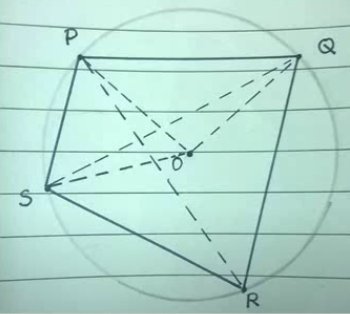
The angle which an arc of a circle subtends at the centre is double that which it subtends at any point on the remaining part of the circumference.
$$\angle\ POQ=2\angle\ PSQ$$
Angles in the same segment of a circle are equal to one another
$$\angle\ PRQ=\angle\ PSQ$$
OPS is isosceles ( OP =OS =radius)
$$\angle\ OPS=\angle\ OSP$$
$$\angle\ PRQ\ \ne\ \angle\ POQ$$
Let $$P$$ and $$Q$$ be two distinct nonempty sets. Then $$(P \cup Q)^c \cup (P^c \cap Q)$$ equals
Solution
$$(P \cup Q)^c \cup (P^c \cap Q)$$ = $$\left(P^c\cap Q^c\right)\cup(P^c\cap Q)\ =\ P^c\cap\left(Q^cUQ\right)$$
= $$\ P^c\cap universal\ set$$
= $$\ P^c$$