Join WhatsApp Icon JEE WhatsApp Group

NTA JEE Main 9th April 2014 Online - Physics

For the following questions answer them individually

An experiment is performed to obtain the value of acceleration due to gravity g by using a simple pendulum of length L. In this experiment time for 100 oscillations is measured by using a watch of 1 second least count and the value is 90.0 seconds. The length L is measured by using a meter scale of least count 1 mm and the value is 20.0 cm. The error in the determination of g would be:

The position of a projectile launched from the origin at t = 0 is given by $$\vec{r} = (40\hat{i} + 50\hat{j})$$ m at t = 2s. If the projectile was launched at an angle $$\theta$$ from the horizontal, then $$\theta$$ is (take g = 10 ms$$^{-2}$$).

Water is flowing at a speed of 1.5 m s$$^{-1}$$ through a horizontal tube of cross-sectional area $$10^{-2}$$ m$$^2$$ and you are trying to stop the flow by your palm. Assuming that the water stops immediately after hitting the palm, the minimum force that you must exert should be (density of water = $$10^3$$ kg m$$^{-3}$$)

A block A of mass 4 kg is placed on another block B of mass 5 kg, and the block B rests on a smooth horizontal table. If the minimum force that can be applied on A so that both the blocks move together is 12 N, the maximum force that can be applied on B for the blocks to move together will be:

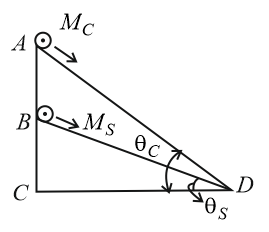
A cylinder of mass M$$_C$$ and sphere of mass M$$_S$$ are placed at points A and B of two inclines, respectively. (See figure). If they roll on the incline without slipping such that their accelerations are the same, then the ratio $$\frac{\sin\theta_C}{\sin\theta_S}$$ is:

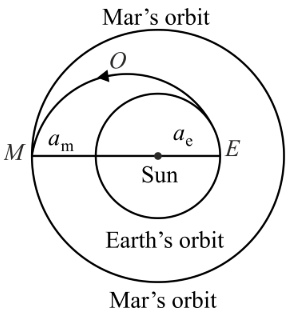
India's Mangalyan was sent to the Mars by launching it into a transfer orbit EOM around the sun. It leaves the earth at E and meets Mars at M. If the semi-major axis of Earth's orbit is $$a_e = 1.5 \times 10^{11}$$ m, that of Mar's orbit $$a_m = 2.28 \times 10^{11}$$ m, taking Kepler's laws, give the estimate of time for Mangalyan to reach Mars from Earth.

image

In materials like aluminium and copper, the correct order of magnitude of various elastic modulii is:

A capillary tube is immersed vertically in water and the height of the water column is $$x$$. When this arrangement is taken into a mine of depth d, the height of the water column is $$y$$. If R is the radius of earth, the ratio $$\frac{x}{y}$$ is:

Water of volume 2 L in a closed container is heated with a coil of 1 kW. While water is heated, the container loses energy at a rate of 160 J/s. In how much time will the temperature of water rise from 27°C to 77°C? (Specific heat of water is 4.2 kJ/kg and that of the container is negligible).

The equation of state for a gas is given by $$PV = nRT + \alpha V$$, where n is the number of moles and $$\alpha$$ is a positive constant. The initial temperature and pressure of one mole of the gas contained in a cylinder are T$$_0$$ and P$$_0$$ respectively. The work done by the gas when its temperature doubles isobarically will be:

Modern vacuum pumps can evacuate a vessel down to a pressure of $$4.0 \times 10^{-15}$$ atm. at room temperature (300 K). Taking R = 8.3 JK$$^{-1}$$ mole$$^{-1}$$, 1 atm = $$10^5$$ Pa and $$N_{Avogadro} = 6 \times 10^{23}$$ mole$$^{-1}$$, the mean distance between molecules of gas in an evacuated vessel will be of the order of:

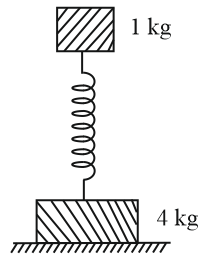
Two bodies of masses 1 kg and 4 kg are connected to a vertical spring, as shown in the figure. The smaller mass executes simple harmonic motion of angular frequency 25 rad s$$^{-1}$$, and amplitude 1.6 cm while the bigger mass remains stationary on the ground. The maximum force exerted by the system on the floor is (take $$g = 10$$ m s$$^{-2}$$).

The amplitude of a simple pendulum, oscillating in air with a small spherical bob, decreases from 10 cm to 8 cm in 40 seconds. Assuming that Stokes law is valid, and ratio of the coefficient of viscosity of air to that of carbon dioxide is 1.3, the time in which amplitude of this pendulum will reduce from 10 cm to 5 cm in carbondioxide will be close to (ln 5 = 1.601, ln 2 = 0.693).

A transverse wave is represented by: $$y = \frac{10}{\pi} \sin\left(\frac{2\pi}{T}t - \frac{2\pi}{\lambda}x\right)$$. For what value of the wavelength the wave velocity is twice the maximum particle velocity?

The magnitude of the average electric field normally present in the atmosphere just above the surface of the Earth is about 150 N/C, directed inward towards the center of the Earth. This gives the total net surface charge carried by the Earth to be: [Given: $$\epsilon_0 = 8.85 \times 10^{-12}$$ C$$^2$$/N-m$$^2$$, $$R_E = 6.37 \times 10^6$$ m]

A d.c. main supply of e.m.f. 220 V is connected across a storage battery of e.m.f. 200 V through a resistance of 1 $$\Omega$$. The battery terminals are connected to external resistance $$R$$. The minimum value of $$R$$, so that a current passes through the battery to charge it is:

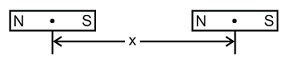
The mid points of two small magnetic dipoles of length $$d$$ in end-on positions, are separated by a distance $$x$$ ($$x \gg d$$). The magnitude of force between them is proportional to $$x^{-n}$$ where n is:

The magnetic field of earth at the equator is approximately $$4 \times 10^{-5}$$ T. The radius of earth is $$6.4 \times 10^6$$ m. Then the dipole moment of the earth will be nearly of the order of:

When the rms voltages $$V_L$$, $$V_C$$ and $$V_R$$ are measured respectively across the inductor L, the capacitor C and the resistor R in a series LCR circuit connected to an AC source, it is found that the ratio $$V_L : V_C : V_R = 1 : 2 : 3$$. If the rms voltage of the AC source is 100 V, then $$V_R$$ is close to:

Match List I (Wavelength range of electromagnetic spectrum) with List II (Method of production of these waves) and select the correct option from the options given below the lists.

List I:                                           List II:
(a) 700 nm to 1 mm                     (i) Vibration of atoms and molecules 
(b) 1 nm to 400 nm                      (ii) Inner shell electrons in atoms moving from one energy level to a lower level
(c) < 10$$^{-3}$$ nm                               (iii) Radioactive decay of the nucleus
(d) 1 mm to 0.1 m                        (iv) Magnetron valve

A diver looking up through the water sees the outside world contained in a circular horizon. The refractive index of water is $$\frac{4}{3}$$, and the diver's eyes are 15 cm below the surface of the water. Then the radius of the circle is:

The focal lengths of objective lens and eye lens of a Galilean Telescope are respectively 30 cm and 3.0 cm. Telescope produces virtual, erect image of an object situated far away from it at least distance of distinct vision from the eye lens. In this condition the Magnifying Power of the Galilean Telescope should be:

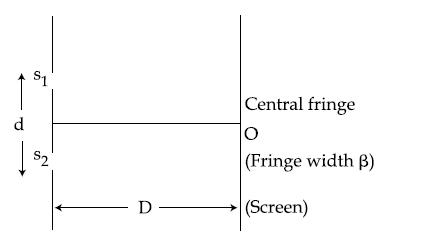
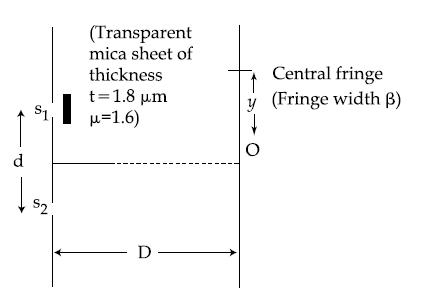
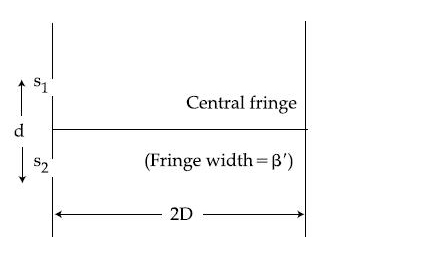
Using monochromatic light of wavelength $$\lambda$$, an experimentalist sets up the Young's double slit experiment in three ways as shown. If she observes that $$y = \beta'$$, the wavelength of light used is:

An n-p-n transistor has three leads A, B and C. Connecting B and C by moist fingers, A to the positive lead of an ammeter, and C to the negative lead of the ammeter, one finds large deflection. Then, A, B and C refer respectively to:

A transmitting antenna at the top of a tower has a height 32 m and the height of the receiving antenna is 50 m. What is the maximum distance between them for satisfactory communication in line of sight (LOS) mode?