
Join Our JEE Preparation Group
Prep with like-minded aspirants; Get access to free daily tests and study material.
Sign in
Please select an account to continue using cracku.in
↓ →
Join Our JEE Preparation Group
Prep with like-minded aspirants; Get access to free daily tests and study material.
Two bodies of masses 1 kg and 4 kg are connected to a vertical spring, as shown in the figure. The smaller mass executes simple harmonic motion of angular frequency 25 rad s$$^{-1}$$, and amplitude 1.6 cm while the bigger mass remains stationary on the ground. The maximum force exerted by the system on the floor is (take $$g = 10$$ m s$$^{-2}$$).
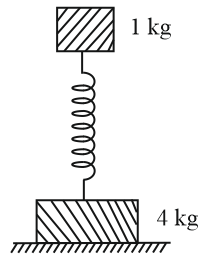
The force exerted by the system on the floor is the sum of the weight of the $$4\text{ kg}$$ mass and the downward force exerted by the spring.
The spring constant $$k$$ can be determined from the angular frequency $$\omega$$ and the oscillating mass $$m_1 = 1\text{ kg}$$:
$$k = m_1 \omega^2 = 1 \times (25)^2 = 625\text{ N/m}$$
$$k x_0 = m_1 g \implies x_0 = \frac{1 \times 10}{625}\text{ m}$$
$$F_{s,max} = k(x_0 + A) = k x_0 + k A$$
$$F_{s,max} = m_1 g + k A = 10 + (625 \times 0.016) = 10 + 10 = 20\text{ N}$$
$$F_{floor} = m_2 g + F_{s,max}$$
$$F_{floor} = (4 \times 10) + 20 = 40 + 20 = 60\text{ N}$$
Was this solution helpful?
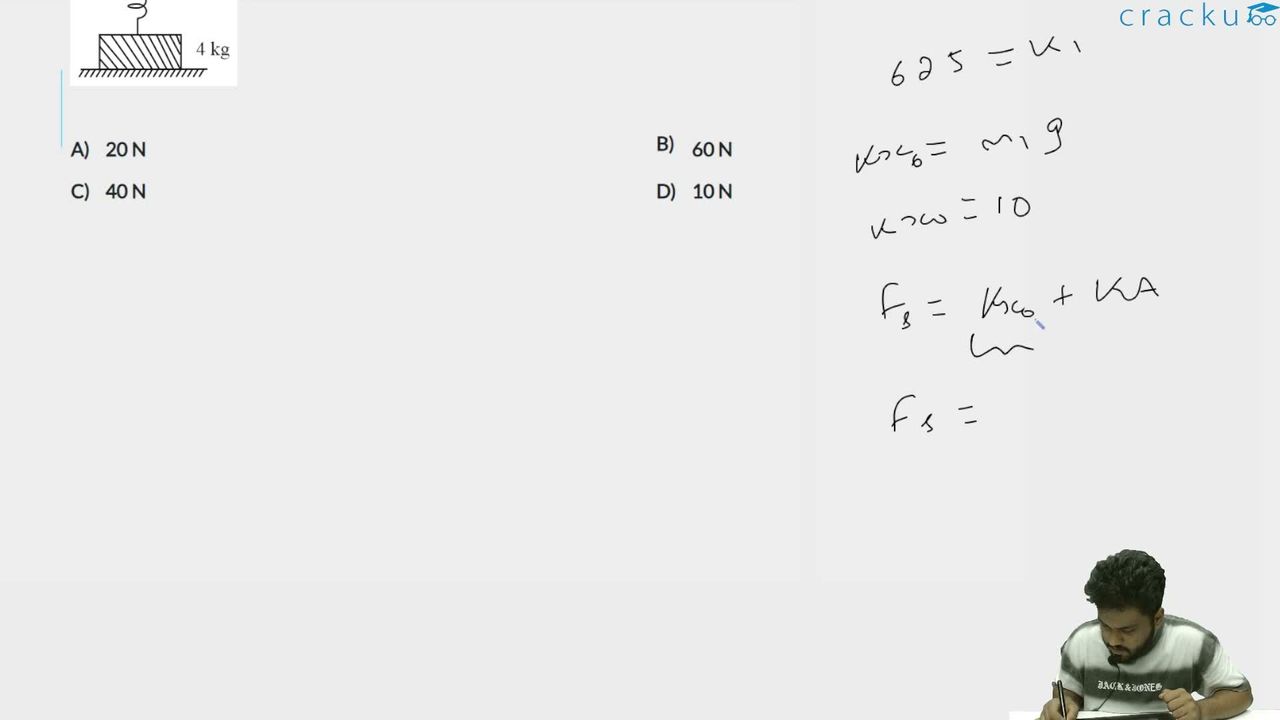
Click on the Email ☝️ to Watch the Video Solution
Create a FREE account and get:
_1.webp)

Educational materials for JEE preparation

Ask our AI anything

AI can make mistakes. Please verify important information.
AI can make mistakes. Please verify important information.


