
Join Our JEE Preparation Group
Prep with like-minded aspirants; Get access to free daily tests and study material.
Sign in
Please select an account to continue using cracku.in
↓ →
Join Our JEE Preparation Group
Prep with like-minded aspirants; Get access to free daily tests and study material.
Modern vacuum pumps can evacuate a vessel down to a pressure of $$4.0 \times 10^{-15}$$ atm. at room temperature (300 K). Taking R = 8.3 JK$$^{-1}$$ mole$$^{-1}$$, 1 atm = $$10^5$$ Pa and $$N_{Avogadro} = 6 \times 10^{23}$$ mole$$^{-1}$$, the mean distance between molecules of gas in an evacuated vessel will be of the order of:
To find the mean distance between molecules in the evacuated vessel, we start by using the ideal gas law and the given parameters. The pressure is $$4.0 \times 10^{-15}$$ atm, but we need it in Pascals since other units are in SI. Given that 1 atm = $$10^5$$ Pa, we convert:
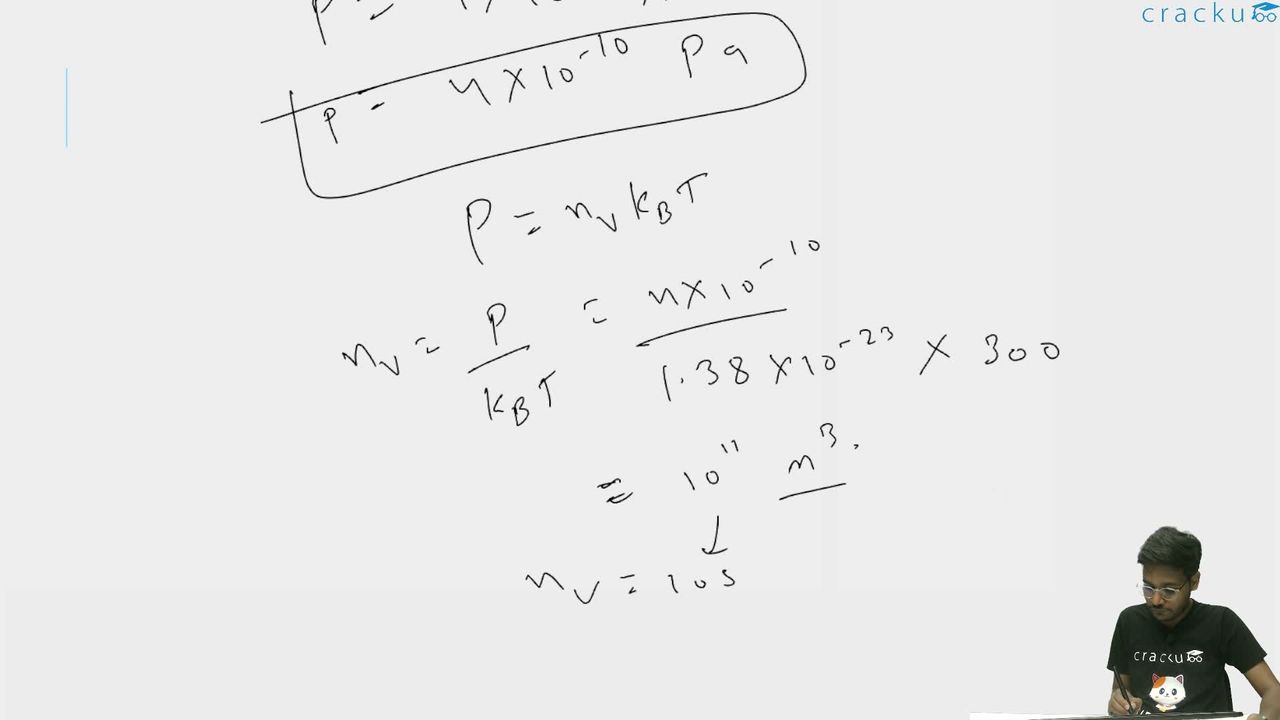
Pressure $$P = 4.0 \times 10^{-15} \times 10^5 = 4.0 \times 10^{-10}$$ Pa.
The temperature $$T = 300$$ K, gas constant $$R = 8.3$$ J K$$^{-1}$$ mol$$^{-1}$$, and Avogadro's number $$N_A = 6 \times 10^{23}$$ mol$$^{-1}$$. The mean distance between molecules is related to the number density $$n_v$$, which is the number of molecules per cubic meter. From the ideal gas law:
$$PV = nRT$$
where $$n$$ is the number of moles. Since the number of molecules $$N = n \times N_A$$, we substitute:
$$PV = \left(\frac{N}{N_A}\right) RT$$
Rearranging for pressure:
$$P = \frac{N}{V} \times \frac{R}{N_A} \times T$$
Here, $$\frac{N}{V} = n_v$$ is the number density, and $$\frac{R}{N_A} = k$$ is Boltzmann's constant. So:
$$P = n_v k T$$
Solving for $$n_v$$:
$$n_v = \frac{P}{k T}$$
But $$k = \frac{R}{N_A}$$, so:
$$n_v = \frac{P N_A}{R T}$$
Now plug in the values:
$$n_v = \frac{(4.0 \times 10^{-10}) \times (6 \times 10^{23})}{8.3 \times 300}$$
First, calculate the numerator:
$$4.0 \times 10^{-10} \times 6 \times 10^{23} = 24 \times 10^{13} = 2.4 \times 10^{14}$$
Next, the denominator:
$$8.3 \times 300 = 2490$$
So:
$$n_v = \frac{2.4 \times 10^{14}}{2490}$$
Dividing:
$$2490 = 2.49 \times 10^3$$
$$n_v = \frac{2.4 \times 10^{14}}{2.49 \times 10^3} = \frac{2.4}{2.49} \times 10^{11} \approx 0.964 \times 10^{11} = 9.64 \times 10^{10}$$ molecules per cubic meter.
The volume per molecule $$V_m$$ is the reciprocal of $$n_v$$:
$$V_m = \frac{1}{n_v} = \frac{1}{9.64 \times 10^{10}} \approx 1.037 \times 10^{-11}$$ cubic meters.
The mean distance $$d$$ between molecules is approximately the cube root of the volume per molecule, since each molecule occupies a cubic space:
$$d = \left(V_m\right)^{1/3} = \left(1.037 \times 10^{-11}\right)^{1/3}$$
We can separate the terms:
$$d = \left(1.037\right)^{1/3} \times \left(10^{-11}\right)^{1/3}$$
First, $$\left(10^{-11}\right)^{1/3} = 10^{-11/3} = 10^{-3.6667}$$. Since $$10^{-3} = 0.001$$ and $$10^{-0.6667} \approx 0.2154$$ (because $$10^{2/3} \approx 4.6416$$, so $$10^{-2/3} \approx 1/4.6416 \approx 0.2154$$), we get:
$$10^{-3.6667} \approx 0.001 \times 0.2154 = 2.154 \times 10^{-4}$$
Next, $$\left(1.037\right)^{1/3}$$. Using approximation $$(1 + x)^n \approx 1 + nx$$ for small $$x$$, where $$x = 0.037$$ and $$n = 1/3$$:
$$\left(1.037\right)^{1/3} \approx 1 + \frac{0.037}{3} = 1 + 0.012333 \approx 1.012333$$
But a more accurate calculation shows that $$1.012^3 = 1.03643488$$, which is slightly less than 1.037. The difference is $$1.037 - 1.03643488 = 0.00056512$$. The derivative of $$x^3$$ is $$3x^2$$, so at $$x = 1.012$$, $$3 \times (1.012)^2 \approx 3 \times 1.024144 = 3.072432$$. The increment is:
$$\Delta x \approx \frac{0.00056512}{3.072432} \approx 0.000184$$
Thus:
$$\left(1.037\right)^{1/3} \approx 1.012 + 0.000184 = 1.012184$$
Now multiply:
$$d \approx 1.012184 \times 2.154 \times 10^{-4} \approx 2.1807 \times 10^{-4}$$ meters.
Converting to millimeters (since 1 meter = 1000 mm):
$$2.1807 \times 10^{-4} \text{ m} = 0.21807 \text{ mm}$$
This value is approximately 0.22 mm, which is of the same order as 0.2 mm (both are $$10^{-4}$$ meters). The options are in different units, so comparing:
Our calculated distance $$2.18 \times 10^{-4}$$ m is closest to $$2 \times 10^{-4}$$ m, which is 0.2 mm.
Hence, the correct answer is Option B.
Was this solution helpful?
Click on the Email ☝️ to Watch the Video Solution
Create a FREE account and get:
_1.webp)

Educational materials for JEE preparation

Ask our AI anything

AI can make mistakes. Please verify important information.
AI can make mistakes. Please verify important information.


