
Join Our JEE Preparation Group
Prep with like-minded aspirants; Get access to free daily tests and study material.
Sign in
Please select an account to continue using cracku.in
↓ →
Join Our JEE Preparation Group
Prep with like-minded aspirants; Get access to free daily tests and study material.
India's Mangalyan was sent to the Mars by launching it into a transfer orbit EOM around the sun. It leaves the earth at E and meets Mars at M. If the semi-major axis of Earth's orbit is $$a_e = 1.5 \times 10^{11}$$ m, that of Mar's orbit $$a_m = 2.28 \times 10^{11}$$ m, taking Kepler's laws, give the estimate of time for Mangalyan to reach Mars from Earth.
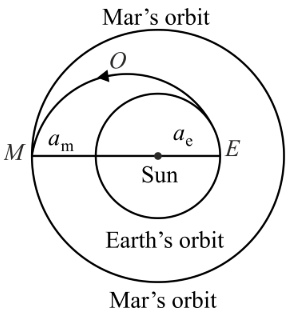
To estimate the time taken for Mangalyan to travel from Earth to Mars using a transfer orbit around the sun, we apply Kepler's laws. The transfer orbit is elliptical, with the sun at one focus. Mangalyan leaves Earth at perihelion (closest point to the sun) and meets Mars at aphelion (farthest point). The semi-major axis of Earth's orbit is given as $$a_e = 1.5 \times 10^{11}$$ m, and for Mars, $$a_m = 2.28 \times 10^{11}$$ m.
For the transfer orbit, the perihelion distance equals Earth's orbital radius ($$a_e$$), and the aphelion distance equals Mars' orbital radius ($$a_m$$). The semi-major axis of the transfer orbit ($$a_t$$) is the average of these distances:
$$ a_t = \frac{a_e + a_m}{2} = \frac{1.5 \times 10^{11} + 2.28 \times 10^{11}}{2} = \frac{3.78 \times 10^{11}}{2} = 1.89 \times 10^{11} \text{ m} $$
Kepler's third law states that the square of the orbital period ($$T$$) is proportional to the cube of the semi-major axis ($$a$$): $$T^2 \propto a^3$$. For Earth, the orbital period $$T_e$$ is 1 year (365 days), and the semi-major axis is $$a_e$$. For the transfer orbit, the period $$T_t$$ relates to $$a_t$$ by the same proportionality constant. Therefore, we can write:
$$ \frac{T_t^2}{T_e^2} = \frac{a_t^3}{a_e^3} $$
Solving for $$T_t$$:
$$ T_t = T_e \left( \frac{a_t}{a_e} \right)^{3/2} $$
The travel time from Earth to Mars is half the period of the transfer orbit, as Mangalyan travels from perihelion to aphelion, covering half the ellipse. Thus, the travel time $$\tau$$ is:
$$ \tau = \frac{T_t}{2} = \frac{T_e}{2} \left( \frac{a_t}{a_e} \right)^{3/2} $$
Substitute the values $$T_e = 365$$ days, $$a_t = 1.89 \times 10^{11}$$ m, and $$a_e = 1.5 \times 10^{11}$$ m:
$$ \frac{a_t}{a_e} = \frac{1.89 \times 10^{11}}{1.5 \times 10^{11}} = \frac{1.89}{1.5} = 1.26 $$
Now compute $$\left( \frac{a_t}{a_e} \right)^{3/2} = (1.26)^{3/2}$$:
First, find $$(1.26)^{3}$$:
$$ 1.26 \times 1.26 = 1.5876 $$
$$ 1.5876 \times 1.26 = 1.5876 \times 1.2 + 1.5876 \times 0.06 = 1.90512 + 0.095256 = 2.000376 $$
Now, $$(1.26)^{3/2} = \sqrt{(1.26)^3} = \sqrt{2.000376}$$. Using $$\sqrt{2} \approx 1.414213562$$ and approximating $$\sqrt{2.000376} \approx \sqrt{2} \times \sqrt{1.000188} \approx 1.414213562 \times (1 + \frac{0.000188}{2}) = 1.414213562 \times 1.000094 \approx 1.414213562 + 1.414213562 \times 0.000094$$:
$$ 1.414213562 \times 0.000094 = 0.000132936074828 $$
$$ \sqrt{2.000376} \approx 1.414213562 + 0.000132936074828 = 1.414346498074828 \approx 1.4143465 $$
Now substitute into the formula for $$\tau$$:
$$ \tau = \frac{365}{2} \times 1.4143465 = 182.5 \times 1.4143465 $$
Compute step by step:
$$ 182.5 \times 1.4 = 255.5 $$
$$ 182.5 \times 0.014 = 2.555 $$
$$ 182.5 \times 0.0003465 \approx 182.5 \times 0.0003 = 0.05475 \quad \text{and} \quad 182.5 \times 0.0000465 \approx 0.00848625 $$
$$ 0.0003465 \approx 0.0003 + 0.0000465 \quad \text{so} \quad 0.05475 + 0.00848625 = 0.06323625 $$
Sum the parts:
$$ 255.5 + 2.555 = 258.055 $$
$$ 258.055 + 0.06323625 = 258.11823625 \approx 258.12 \text{ days} $$
The calculated travel time is approximately 258.12 days. Comparing with the options:
A. 220 days
B. 500 days
C. 260 days
D. 320 days
The value 258.12 days is closest to 260 days.
Hence, the correct answer is Option C.
Was this solution helpful?
Create a FREE account and get:
_1.webp)

Educational materials for JEE preparation

Ask our AI anything

AI can make mistakes. Please verify important information.
AI can make mistakes. Please verify important information.


