
Join Our JEE Preparation Group
Prep with like-minded aspirants; Get access to free daily tests and study material.
Sign in
Please select an account to continue using cracku.in
↓ →
Join Our JEE Preparation Group
Prep with like-minded aspirants; Get access to free daily tests and study material.
Using monochromatic light of wavelength $$\lambda$$, an experimentalist sets up the Young's double slit experiment in three ways as shown. If she observes that $$y = \beta'$$, the wavelength of light used is:
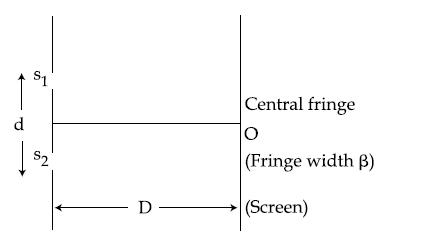
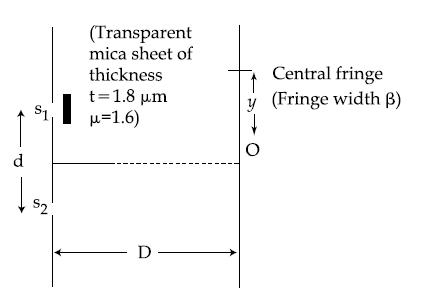
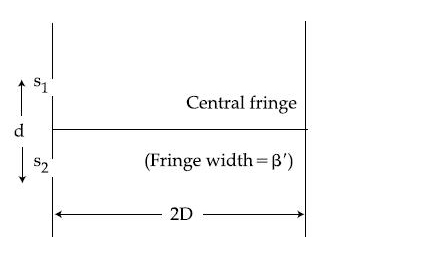
The standard formula for fringe width is $$\beta = \frac{\lambda D}{d}$$.
From Case 1: The initial configuration has a screen distance $$D$$ and slit separation $$d$$. $$\beta = \frac{\lambda D}{d}$$
From Case 3: The screen distance is doubled to $$2D$$, while the slit separation remains $$d$$. The new fringe width is $$\beta' = \frac{\lambda (2D)}{d} = 2\beta$$
From Case 2: When a transparent mica sheet of thickness $$t$$ and refractive index $$\mu$$ is introduced in front of one of the slits, the entire fringe pattern shifts. The distance $$y$$ that the central fringe shifts is given by the formula:
$$y = \frac{D}{d}(\mu - 1)t$$
We are given the condition: $$y = \beta'$$
$$\frac{D}{d}(\mu - 1)t = \frac{\lambda (2D)}{d}$$
$$(\mu - 1)t = 2\lambda$$
$$(1.6 - 1) \times (1.8 \times 10^{-6}) = 2\lambda$$
$$0.6 \times 1.8 \times 10^{-6} = 2\lambda$$
$$1.08 \times 10^{-6} = 2\lambda$$
$$\lambda = \frac{1.08 \times 10^{-6}}{2} = 0.54 \times 10^{-6}\text{ m}$$
$$\lambda = 540 \times 10^{-9}\text{ m} = 540\text{ nm}$$
Was this solution helpful?
Create a FREE account and get:
_1.webp)

Educational materials for JEE preparation

Ask our AI anything

AI can make mistakes. Please verify important information.
AI can make mistakes. Please verify important information.


