For the following questions answer them individually
The quantum number of four electrons are given below:
I. $$n = 4, l = 2, m_l = -2, m_s = -1/2$$
II. $$n = 3, l = 2, m_l = 1, m_s = +1/2$$
III. $$n = 4, l = 1, m_l = 0, m_s = +1/2$$
IV. $$n = 3, l = 1, m_l = 1, m_s = -1/2$$
The correct order of their increasing energies will be:
The size of the iso-electronic species Cl$$^{-}$$, Ar and Ca$$^{2+}$$ is affected by:
Which one of the following equations does not correctly represent the first law of thermodynamics for the given processes involving an ideal gas? (Assume non-expansion work is zero)
For silver, $$C_p$$ (J K$$^{-1}$$ mol$$^{-1}$$) = 23 + 0.01T. If the temperature T of 3 moles of silver is raised from 300 K to 1000 K at 1 atm pressure, the value of $$\Delta H$$ will be close to:
If solubility product of Zr$$_3$$(PO$$_4$$)$$_4$$ is denoted by K$$_{sp}$$ and its molar solubility is denoted by S, then which of the following relation between S and K$$_{sp}$$ is correct?
In order to oxidize a mixture of one mole of each of FeC$$_2$$O$$_4$$, Fe$$_2$$(C$$_2$$O$$_4$$)$$_3$$, FeSO$$_4$$ and Fe$$_2$$(SO$$_4$$)$$_3$$ in acidic medium, the number of moles of KMnO$$_4$$ is:
Given that,
$$E^{0}_{O_2/H_2O} = +1.23$$ V;
$$E^{0}_{S_2O_8^{2-}/SO_4^{2-}} = 2.05$$ V;
$$E^{0}_{Br_2/Br^{-}} = +1.09$$ V;
$$E^{0}_{Au^{3+}/Au} = 1.4$$ V
The strongest oxidizing agent is:
100 mL of a water sample contains 0.81 g of calcium bicarbonate and 0.73 g of magnesium bicarbonate. The hardness of this water sample expressed in terms of equivalents of CaCO$$_3$$ is: (molar mass of calcium bicarbonate is 162 g mol$$^{-1}$$ and magnesium bicarbonate is 146 g mol$$^{-1}$$)
The correct order of hydration enthalpies of alkali metal ions is:
Diborane B$$_2$$H$$_6$$ reacts independently with O$$_2$$ and H$$_2$$O to produce, respectively:
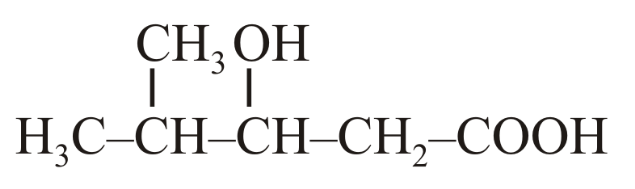
The IUPAC name of the following compound is:
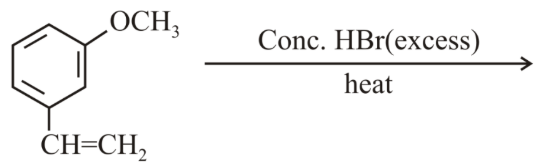
The major product of the following reaction is:
Which is wrong with respect to our responsibility as a human being to protect our environment?
Assertion: Ozone is destroyed by CFCs in the upper stratosphere.
Reason: Ozone holes increase the amount of UV radiation reaching the earth.
Element B forms ccp structure and A occupies half of the octahedral voids, while oxygen atoms occupy all the tetrahedral voids. The structure of bimetallic oxide is:
The vapour pressures of pure liquids A and B are 400 and 600 mm Hg respectively at 298 K. On mixing the two liquids, the sum of their volumes is equal to the volume of the final mixture. The mole fraction of liquid B is 0.5 in the mixture. The vapour pressure of the final solution, the mole fractions of components A and B in the vapour phase, respectively are:
For the reaction 2A + B $$\rightarrow$$ C, the values of initial rate at different reactant concentrations are given in the table below.
[A] (mol L$$^{-1}$$) Â Â [B] (mol L$$^{-1}$$) Â Â Initial Rate (mol L$$^{-1}$$s$$^{-1}$$)
0.05 Â Â Â Â Â Â Â Â Â Â Â Â Â Â 0.05 Â Â Â Â Â Â Â Â Â Â Â Â Â Â 0.045
0.10 Â Â Â Â Â Â Â Â Â Â Â Â Â Â 0.05 Â Â Â Â Â Â Â Â Â Â Â Â Â Â 0.090
0.20 Â Â Â Â Â Â Â Â Â Â Â Â Â Â 0.10 Â Â Â Â Â Â Â Â Â Â Â Â Â Â 0.72
The rate law for the reactions is:
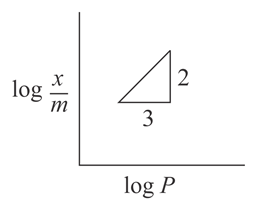
Adsorption of a gas follows Freundlich adsorption isotherm. x is the mass of the gas adsorbed on mass m of the adsorbent. The plot of $$\log\frac{x}{m}$$ vs $$\log p$$ is shown in the given graph. $$\frac{x}{m}$$ is proportional to:
Which respect to an ore, Ellingham diagram helps to predict the feasibility of its:
The lanthanide ion that would show colour is:
The correct order of the spin-only magnetic moment of metal ions in the following low-spin complexes, [V(CN)$$_6$$]$$^{4-}$$, [Fe(CN)$$_6$$]$$^{4-}$$, [Ru(NH$$_3$$)$$_6$$]$$^{3+}$$ and [Cr(NH$$_3$$)$$_6$$]$$^{2+}$$, is:
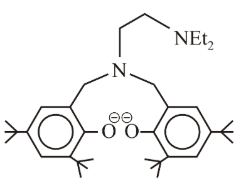
The following ligand is:
An organic compound neither reacts with neutral ferric chloride solution nor with Fehling solution. It however, reacts with Grignard reagent and gives positive iodoform test. The compound is:
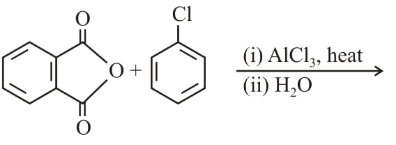
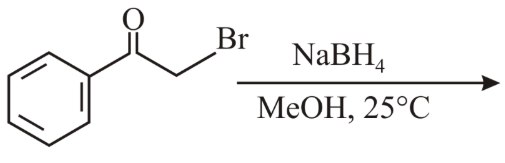
The major product of the following reaction is:

NaBH$$_4$$, MeOH, 25°C
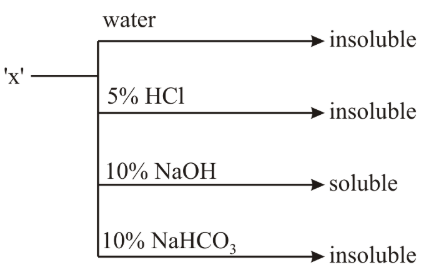
An organic compound 'X' showing the following solubility profile is:
Which of the following amines can be prepared by Gabriel phthalimide reaction?
Coupling of benzene diazonium chloride with 1-naphthol in alkaline medium will give:
In the following compounds, the decreasing order of basic strength will be:
Maltose on treatment with dilute HCl gives: