
Join Our JEE Preparation Group
Prep with like-minded aspirants; Get access to free daily tests and study material.
Sign in
Please select an account to continue using cracku.in
↓ →
Join Our JEE Preparation Group
Prep with like-minded aspirants; Get access to free daily tests and study material.
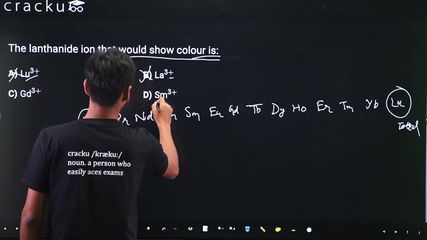
We recall the well-known fact for lanthanide (4f) ions: an ion displays colour in solution or in the solid state only when an $$f\!-\!f$$ electronic transition is possible within its 4f subshell. Such a transition is possible when the 4f subshell is partially but not exactly half-filled or completely filled. In three special cases the ion is practically colourless because no low-energy $$f\!-\!f$$ transition is available:
1. $$4f^0$$ configuration (no 4f electrons)
2. $$4f^7$$ configuration (exactly half-filled)
3. $$4f^{14}$$ configuration (completely filled)
Now we write the electronic configurations of the given trivalent lanthanide ions. The neutral atoms follow the general sequence $$[Xe]\;6s^2\,4f^{\,n}\,5d^{\,m}\,6p^{\,0}$$, and when three electrons are removed to give the $$+3$$ oxidation state, the two 6s electrons and one 5d (if present) are lost first. Thus, for the ions we have:
La: $$[Xe]\,6s^2\,5d^1\,4f^0 \;\longrightarrow\; \text{La}^{3+}: [Xe]\,4f^0$$
Gd: $$[Xe]\,6s^2\,4f^7\,5d^1 \;\longrightarrow\; \text{Gd}^{3+}: [Xe]\,4f^7$$
Lu: $$[Xe]\,6s^2\,4f^{14}\,5d^1 \;\longrightarrow\; \text{Lu}^{3+}: [Xe]\,4f^{14}$$
Sm: $$[Xe]\,6s^2\,4f^6 \;\longrightarrow\; \text{Sm}^{3+}: [Xe]\,4f^5$$
We now compare each configuration with the three special colourless cases:
• $$\text{La}^{3+}$$ has $$4f^0$$, falling directly under the first colourless category. So it is colourless.
• $$\text{Gd}^{3+}$$ has $$4f^7$$, the exactly half-filled case. This belongs to the second colourless category. Hence it is colourless.
• $$\text{Lu}^{3+}$$ has $$4f^{14}$$, the completely filled case. It matches the third colourless category and is therefore colourless.
• $$\text{Sm}^{3+}$$ has $$4f^5$$, which is neither empty, nor exactly half-filled, nor completely filled. Therefore an $$f\!-\!f$$ transition of suitable energy is possible, and the ion appears coloured.
So only $$\text{Sm}^{3+}$$ shows colour.
Hence, the correct answer is Option D.
Was this solution helpful?
Click on the Email ☝️ to Watch the Video Solution
Create a FREE account and get:
_1.webp)

Educational materials for JEE preparation

Ask our AI anything

AI can make mistakes. Please verify important information.
AI can make mistakes. Please verify important information.
