Dimensional formula for thermal conductivity is (here K denotes the temperature):

Join Our JEE Preparation Group
Prep with like-minded aspirants; Get access to free daily tests and study material.
Sign in
Please select an account to continue using cracku.in
↓ →
Join Our JEE Preparation Group
Prep with like-minded aspirants; Get access to free daily tests and study material.
Dimensional formula for thermal conductivity is (here K denotes the temperature):
Login to view the detailed solution.
A tennis ball is released from a height h and after freely falling on a wooden floor it rebounds and reaches height h/2. The velocity versus height of the ball during its motion may be represented graphically by: (graphs are drawn schematically and on not to scale)
Login to view the detailed solution.
Starting from the origin at time t = 0, with initial velocity $$5\hat{j}$$ ms$$^{-1}$$, a particle moves in the $$x$$-$$y$$ plane with a constant acceleration of $$\left(10\hat{i} + 4\hat{j}\right)$$ ms$$^{-2}$$. At time t, its coordinates are (20 m, $$y_0$$ m). The values of t and $$y_0$$ are, respectively:
Login to view the detailed solution.
.webp)
Blocks of masses m, 2m, 4m and 8m are arranged in a line of a frictionless floor. Another block of mass m, moving with speed v along the same line (see figure) collides with mass m in perfectly inelastic manner. All the subsequent collisions are also perfectly inelastic. By the time the last block of mass 8m starts moving the total energy loss is p% of the original energy. Value of 'p' is close to:

Login to view the detailed solution.
On the $$x$$-axis and at a distance $$x$$ from the origin, the gravitational field due to a mass distribution is given by $$\frac{Ax}{(x^2 + a^2)^{3/2}}$$ in the $$x$$-direction. The magnitude of the gravitational potential on the $$x$$-axis at a distance $$x$$, taking its value to be zero at infinity is:
Login to view the detailed solution.
An air bubble of radius 1 cm in water has an upward acceleration of 9.8 cms$$^{-2}$$. The density of water is 1 gm cm$$^{-3}$$ and water offers negligible drag force on the bubble. The mass of the bubble is $$(g = 980$$ cm/s$$^2)$$.
Login to view the detailed solution.
.webp)
The specific heat of water = 4200 J kg$$^{-1}$$ K$$^{-1}$$ and the latent heat of ice = $$3.4 \times 10^5$$ J kg$$^{-1}$$. 100 grams of ice at 0°C is placed in 200 g of water at 25°C. The amount of ice that will melt as the temperature of water reaches 0°C is close to (in grams)
Login to view the detailed solution.
Match the $$\frac{C_p}{C_v}$$ ratio for ideal gases with different type of molecules:
Molecule Type $$C_p/C_v$$
(A) Monoatomic (I) 7/5
(B) Diatomic rigid molecules (II) 9/7
(C) Diatomic non-rigid molecules (III) 4/3
(D) Triatomic rigid molecules (IV) 5/3
Login to view the detailed solution.
For a transverse wave travelling along a straight line, the distance between two peaks (crests) is 5 m, while the distance between one crest and one trough is 1.5 m. The possible wavelengths (in m) of the waves are:
Login to view the detailed solution.
.webp)
Two charged thin infinite plane sheets of uniform charge density $$\sigma_+$$ and $$\sigma_-$$, where $$|\sigma_+| > |\sigma_-|$$, intersect at the right angle. Which of the following best represents the electric field lines for the system:
Login to view the detailed solution.
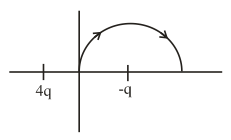
A two point charges $$4q$$ and $$-q$$ are fixed on the $$x$$-axis at $$x = \frac{-d}{2}$$ and $$x = \frac{d}{2}$$, respectively. If the third point charge 'q' is taken from the origin to $$x = d$$ along the semicircle as shown in the figure, the energy of the charge will:
Login to view the detailed solution.
A battery of 3.0 V is connected to a resistor dissipating 0.5 W of power. If the terminal voltage of the battery is 2.5 V, the power dissipated within the internal resistance is:
Login to view the detailed solution.
.webp)
A small bar magnet is placed with its axis at 30° with an external magnetic field of 0.06 T experiences a torque of 0.018 Nm. The minimum work required to rotate it from its stable to unstable equilibrium position is:
Login to view the detailed solution.
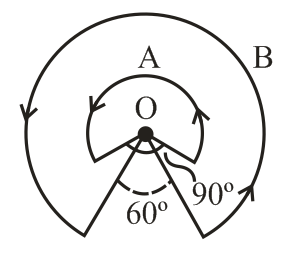
A wire A, bent in the shape of an arc of a circle, carrying a current of 2 A and having radius 2 cm and another wire B, also bent in the shape of an arc of a circle, carrying a current of 3 A and having radius of 4 cm, are placed as shown in the figure. The ratio of the magnetic fields due to the wires A and B at the common centre O is:
Login to view the detailed solution.
A small bar magnet is moved through a coil at constant speed from one end to the other. Which of the following series of observations will be seen on the galvanometer G attached across the coil?
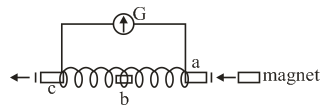
Three positions shown describe: (a) the magnet's entry (b) magnet is completely inside and (c) magnet's exit.
Login to view the detailed solution.

Choose the correct option relating wavelengths of different parts of electromagnetic wave spectrum:
Login to view the detailed solution.
A beam of plane polarized light of large cross-sectional area and uniform intensity of 3.3 W m$$^{-2}$$ falls normally on a polarizer (cross-sectional area $$3 \times 10^{-4}$$ m$$^2$$), which rotates about its axis with an angular speed of 31.4 rad s$$^{-1}$$. The energy of light passing through the polarizer per revolution, is close to:
Login to view the detailed solution.
Particle A of mass $$m_A = \frac{m}{2}$$ moving along the x-axis with velocity $$v_0$$ collides elastically with another particle B at rest having mass $$m_B = \frac{m}{3}$$. If both particles move along the x-axis after the collision, the change $$\Delta\lambda$$ in the wavelength of particle A, in terms of its de-Broglie wavelength $$(\lambda_0)$$ before the collision is:
Login to view the detailed solution.
_1.webp)
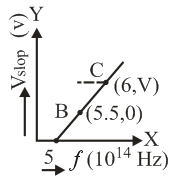
Given figure shows few data points in a photo-electric effect experiment for a certain metal. The minimum energy for ejection of electrons from its surface is: (Planck's constant h = 6.62 $$\times$$ 10$$^{-34}$$ J.s)
Login to view the detailed solution.
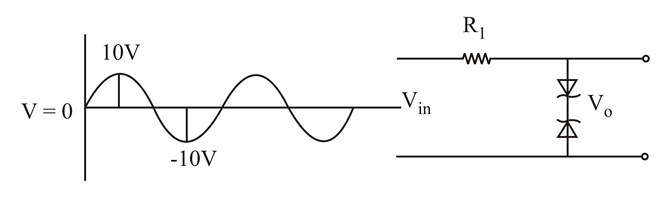
Take the breakdown voltage of the zener diode used in the given circuit as 6V. For the input voltage shown in the figure below, the time variation of the output voltage is: (Graphs drawn are schematic and not to the scale)
Login to view the detailed solution.
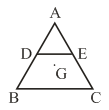
ABC is a plane lamina of the shape of an equilateral triangle. D, E are mid-points of AB, AC and G is the centroid of the lamina. Moment of inertia of the lamina about an axis passing through G and perpendicular to the plane ABC is $$I_0$$. If part ADE is removed, the moment of inertia of the remaining part about the same axis is $$\frac{NI_0}{16}$$ where N is an integer. Value of N is:
Login to view the detailed solution.
A circular disc of mass M and radius R is rotating about its axis with angular speed $$\omega_1$$. If another stationary disc having radius $$\frac{R}{2}$$ and same mass M is dropped co-axially on to the rotating disc. Gradually both discs attain constant angular speed $$\omega_2$$. The energy lost in the process is p% of the initial energy. Value of p is
Login to view the detailed solution.
A closed vessel contains 0.1 mole of a monoatomic ideal gas at 200 K. If 0.05 mole of the same gas at 400 K is added to it, the final equilibrium temperature (in K) of the gas in the vessel will be close to __________
Login to view the detailed solution.
In a compound microscope, the magnified virtual image is formed at a distance of 25 cm from the eye-piece. The focal length of its objective lens is 1 cm. If the magnification is 100 and the tube length of the microscope is 20 cm, then the focal length of the eye-piece lens (in cm) is __________
Login to view the detailed solution.
In the line spectra of hydrogen atom, difference between the largest and the shortest wavelengths of the Lyman series is 305 $$\mathring{A}$$. The corresponding difference for the Paschan series in $$\mathring{A}$$ is __________ (nearest integer)
Login to view the detailed solution.
Educational materials for JEE preparation
 Share
Share