Join WhatsApp Icon JEE WhatsApp Group

NTA JEE Main 2nd April 2017 Offline - Physics

For the following questions answer them individually

The following observations were taken for determining surface tension $$T$$ of water by capillary method:
diameter of capillary, $$D = 1.25 \times 10^{-2}$$ m
rise of water, $$h = 1.45 \times 10^{-2}$$ m
Using $$g = 9.80$$ m s$$^{-2}$$ and the simplified relation $$T = \frac{rhg}{2} \times 10^{3}$$ N m$$^{-1}$$, the possible error in surface tension is closest to:

A body of mass $$m = 10^{-2}$$ kg is moving in a medium and experiences a frictional force $$F = -kv^{2}$$. Its initial speed is $$v_{0} = 10$$ m s$$^{-1}$$. After 10 s its kinetic energy is $$\frac{1}{8}mv_{0}^{2}$$, then the value of $$k$$ will be:

The moment of inertia of a uniform cylinder of length $$l$$ and radius $$R$$ about its perpendicular bisector is $$I$$. What is the ratio $$l/R$$ such that the moment of inertia is minimum?

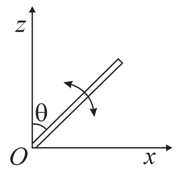
A slender uniform rod of mass $$M$$ and length $$l$$ is pivoted at one end so that it can rotate in a vertical plane (see figure). There is negligible friction at the pivot. The free end is held vertically above the pivot and then released. The angular acceleration of the rod when it makes an angle $$\theta$$ with the vertical is:

A man grows into a giant such that his linear dimensions increase by a factor of 9. Assuming that his density remains same, the stress in the leg will change by a factor of:

A copper ball of mass 100 g is at a temperature $$T$$. It is dropped in a copper calorimeter of mass 100 g, filled with 170 g of water at room temperature. Subsequently, the temperature of the system is found to be 75°C. $$T$$ is given by:
(Given: room temperature = 30°C, specific heat of copper = 0.1 cal g$$^{-1}$$ °C$$^{-1}$$)

An external pressure $$P$$ is applied on a cube at 0°C so that it is equally compressed from all sides. $$K$$ is the bulk modulus of the material of the cube and $$\alpha$$ is its coefficient of linear expansion. Suppose we want to bring the cube to its original size by heating. The temperature should be raised by:

$$C_{p} - C_{v} = \frac{R}{M}$$ and $$C_{v}$$ are specific heats at constant pressure and constant volume respectively. It is observed that, $$C_{p} - C_{v} = a$$ for hydrogen gas and $$C_{p} - C_{v} = b$$ for nitrogen gas. The correct relation between $$a$$ and $$b$$ is:

The temperature of an open room of volume 30 m$$^{3}$$ increases from 17°C to 27°C due to the sunshine. The atmospheric pressure in the room remains $$1 \times 10^{5}$$ Pa. If $$n_{i}$$ and $$n_{f}$$ are the number of molecules in the room before and after heating, then $$n_{f} - n_{i}$$ will be:

An observer is moving with half the speed of light towards a stationary microwave source emitting waves at frequency 10 GHz. What is the frequency of the microwave measured by the observer? (speed of light = $$3 \times 10^{8}$$ m s$$^{-1}$$)

An electric dipole has fixed dipole moment $$\vec{p}$$, which makes angle $$\theta$$ with respect to $$x$$-axis. When subjected to an electric field $$\vec{E}_{1} = E\hat{i}$$, it experiences a torque $$\vec{T}_{1} = \tau\hat{k}$$. When subjected to another electric field $$\vec{E}_{2} = \sqrt{3}E_{1}\hat{j}$$, it experiences a torque $$\vec{T}_{2} = -\vec{T}_{1}$$. The angle $$\theta$$ is:

A capacitance of 2 μF is required in an electrical circuit across a potential difference of 1.0 kV. A large number of 1 μF capacitors are available which can withstand a potential difference of not more than 300 V. The minimum number of capacitors required to achieve this is:

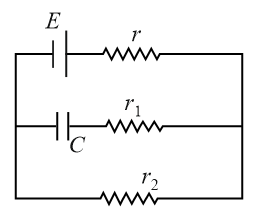
In the given circuit diagram, when the current reaches a steady-state in the circuit, the charge on the capacitor of capacitance $$C$$ will be:

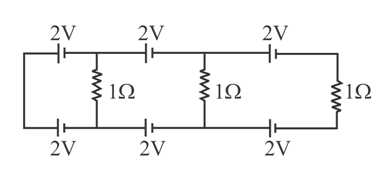
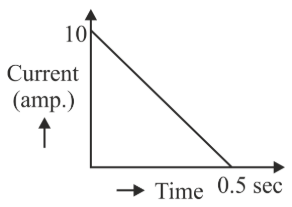
Which of the following statements is false?

When a current of 5 mA is passed through a galvanometer having a coil of resistance 15 Ω, it shows full-scale deflection. The value of the resistance to be put in series with the galvanometer to convert it into a voltmeter of range 0 - 10 V is:

A magnetic needle of magnetic moment $$6.7 \times 10^{-2}$$ A m$$^{2}$$ and moment of inertia $$7.5 \times 10^{-6}$$ kg m$$^{2}$$ is performing simple harmonic oscillations in a magnetic field of 0.01 T. Time taken for 10 complete oscillations is:

An electron beam is accelerated by a potential difference $$V$$ to hit a metallic target to produce X-rays. It produces continuous as well as characteristic X-rays. If $$\lambda_{min}$$ is the smallest possible wavelength of X-ray in the spectrum, the variation of $$\log\lambda_{min}$$ with $$\log V$$ is correctly represented in:

A diverging lens with magnitude of focal length 25 cm is placed at a distance of 15 cm from a converging lens of magnitude of focal length 20 cm. A beam of parallel light falls on the diverging lens. The final image formed is:

In a Young's double slit experiment, slits are separated by 0.5 mm, and the screen is placed 150 cm away. A beam of light consisting of two wavelengths, 650 nm and 520 nm, is used to obtain interference fringes on the screen. The least distance from the common central maximum to the point where the bright fringes due to both the wavelengths coincide is:

A particle $$A$$ of mass $$m$$ and initial velocity $$v$$ collides with a particle $$B$$ of mass $$\frac{m}{2}$$ which is at rest. The collision is head on, and elastic. The ratio of the de-Broglie wavelengths $$\lambda_{A}$$ to $$\lambda_{B}$$ after the collision is:

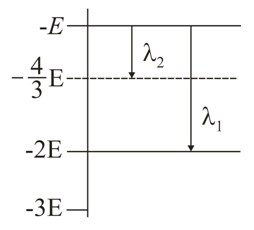
Some energy levels of a molecule are shown in the figure. The ratio of the wavelengths $$r = \frac{\lambda_{1}}{\lambda_{2}}$$, is given by:

A radioactive nucleus $$A$$ with a half-life $$T$$, decays into a nucleus $$B$$. At $$t = 0$$, there is no nucleus $$B$$. At some time $$t$$, the ratio of the number of $$B$$ to that of $$A$$ is 0.3. Then, $$t$$ is given by: (Consider $$\log_{e} x = \log x$$)

In amplitude modulation, the sinusoidal carrier frequency used is denoted by $$\omega_{c}$$ and the signal frequency is denoted by $$\omega_{m}$$. The bandwidth $$\Delta\omega_{m}$$ of the signal is such that $$\Delta\omega_{m} \ll \omega_{c}$$. Which of the following frequencies is not contained in the modulated wave?