
Join Our JEE Preparation Group
Prep with like-minded aspirants; Get access to free daily tests and study material.
Sign in
Please select an account to continue using cracku.in
↓ →
Join Our JEE Preparation Group
Prep with like-minded aspirants; Get access to free daily tests and study material.
In the given circuit diagram, when the current reaches a steady-state in the circuit, the charge on the capacitor of capacitance $$C$$ will be:
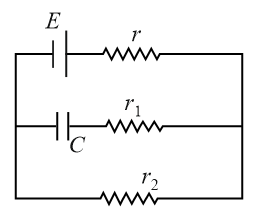
In a DC circuit, once the capacitor reaches its steady-state (is fully charged), it acts as an open circuit. This means that no current flows through the branch containing the capacitor $$C$$ and the resistor $$r_1$$. Consequently, the potential drop across $$r_1$$ is zero ($$V_{r_1} = I \times r_1 = 0 \times r_1 = 0$$).
Using Ohm's Law, the steady-state current $$I = \frac{E}{r + r_2}$$
The potential difference across $$r_2$$ is $$V_{r_2} = I \times r_2$$
$$V_{r_2} = \left( \frac{E}{r + r_2} \right) \times r_2 = \frac{E r_2}{r + r_2}$$
Since $$V_C = V_{r_2}$$ (steady state), $$V_C = \frac{E r_2}{r + r_2}$$
$$Q = C \times V$$
$$Q = C \times \left( \frac{E r_2}{r + r_2} \right)$$
$$Q = CE \frac{r_2}{r + r_2}$$
Was this solution helpful?
Create a FREE account and get:
_1.webp)

Educational materials for JEE preparation

Ask our AI anything

AI can make mistakes. Please verify important information.
AI can make mistakes. Please verify important information.
