 91- 6303239042
An expression containing certain physical quantities is $$(1273.43 - 51.7052 + 745) \times 21$$. After evaluation the correct answer is
Sign in
Please select an account to continue using cracku.in
↓ →
An expression containing certain physical quantities is $$(1273.43 - 51.7052 + 745) \times 21$$. After evaluation the correct answer is
A body of mass $$m$$ and radius $$R$$ rolling horizontally without slipping at a speed $$v$$ climbs a ramp to a height $$\frac{3v^2}{4g}$$. The rolling body can be
Loading solution...
A particle of mass 10 g starts from rest at $$t = 0$$ s from a point (0 m, 4 m) and gets accelerated at $$0.5\ \text{m/s}^2$$ along $$x - \sqrt{3}y + 4\sqrt{3} = 0$$ in XY plane. The angular momentum of the particle about the origin (in SI units) at $$t = 2$$ s is
Loading solution...
.webp)
A body released from a height $$H$$ hits elastically an inclined plane at a point P. After the impact the body starts moving horizontally and hits the ground. The height at which point P should be situated so as to have the total time of travel maximum is
Loading solution...
A thin rod of length $$l$$ in the shape of a semicircle is pivoted at one of its ends such that it is free to oscillate in its own plane. The frequency $$f$$ of small oscillations of the semicircular rod is
Loading solution...
Two air bubbles with radii $$r_1$$ and $$r_2$$ $$(r_2 > r_1)$$ formed of the same liquid stick to each other to form a common interface. Therefore, the radius of curvature of the common surface is
Loading solution...

A particle executes a periodic motion according to the relation $$x = 4\cos^2(50t)\sin(500t)$$. Therefore, the motion can be considered to be the superposition of n independent simple harmonic motions, where n is
Loading solution...
A car moving along a straight road at a speed of $$u$$ m/s applies brakes at $$t = 0$$ second. The ratio of distances travelled by the car during $$3^{rd}$$ and $$8^{th}$$ second is $$15 \colon 13$$. The car covers a distance of 0.25 m in the last second of its travel. Therefore, the acceleration $$a$$ (in $$\text{m/s}^2$$) and the speed $$u$$ (in m/s) of the car are respectively
Loading solution...
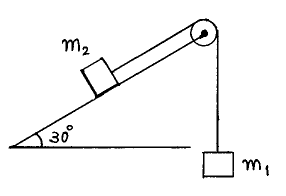
Masses $$m_1$$ and $$m_2$$ are connected to a string passing over a pulley as shown. Mass $$m_1$$ starts from rest and falls through a distance $$d$$ in time $$t$$. Now, by interchanging the masses the time required for $$m_2$$ to fall through the same distance is $$2t$$. Therefore, the ratio of masses $$m_1 \colon m_2$$ is
Loading solution...

The graph of specific heat of water (on Y axis) against temperature (on X axis) between $$0^\circ$$ C and $$100^\circ$$ C
Loading solution...
When a light wave is incident at the interface between two media, the reflection coefficient is given by $$\frac{(n - 1)^2}{(n + 1)^2}$$ where $$n$$ is the refractive index of the denser medium with respect to the rarer medium. Two stretched strings whose linear densities are 25 g/m and 9 g/m are joined together. Assuming the law of optics holds good here also, the reflection coefficient for the pulse along the strings is
Loading solution...
A certain perfect gas occupying 1 litre at 80 cm of Hg suddenly expands to 1190 cc while the pressure falls to 60 cm of Hg. Therefore, the gas is
Loading solution...
Two thin rods of lengths $$l_1$$ and $$l_2$$ at a certain temperature are joined to each other end to end. The composite rod is then heated through a temperature $$\theta$$. The coefficients of linear expansion of the two rods are $$\alpha_1$$ and $$\alpha_2$$ respectively. Then, the effective coefficient of linear expansion of the composite rod is
Loading solution...
A yo-yo has a spool of mass $$m$$ and radius $$R$$. A massless string is wound around an axle of radius $$b$$ and of negligible mass. If the yo-yo released from rest has a downward acceleration of $$\frac{g}{9}$$, the ratio $$\frac{R}{b}$$ is
Loading solution...
A pulley of negligible mass is suspended from a spring balance. Blocks weighing 5.0 kg and 3.0 kg are attached to the two ends of a string passing over the pulley. The reading on the spring balance will be
Loading solution...
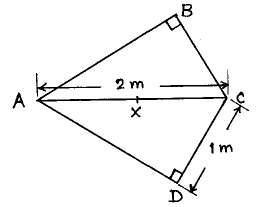
A uniform rod (ABCDAC) is bent in the shape of a kite as shown. If a point X along AC is the centre of mass of the structure, distance AX is
Loading solution...
Two particles, each of mass $$m$$ and charge $$q$$ are attached at the ends of a light rod of length $$2r$$. The rod is rotated at a constant angular speed $$\omega$$ about an axis perpendicular to the rod passing through its centre. The ratio of magnetic moment of the system to its angular momentum is
Loading solution...
A jet of water of cross-sectional area $$A$$ hits a plate normally with velocity $$v$$. The plate is moving in the direction of the jet with velocity $$V$$. Therefore, the force exerted on the plate is proportional to
Loading solution...
A heavy cylindrical shaft (pile) of mass $$M$$ is driven vertically through a distance $$s$$ into the ground by the blow of a pile-driver of mass $$m$$. The pile driver drops vertically through a distance $$h$$ onto the head of the pile. The average resistance of the ground is
Loading solution...
An optical fibre consists of a core (refractive index $$n_1$$) surrounded by a cladding (refractive index $$n_2$$). A ray of light enters the fibre from air at an angle $$\theta$$ with the fibre axis. The maximum value of $$\theta$$ for which the ray can propagate down the fibre is
Loading solution...
Two coils wound on the same magnetic core have inductances $$L_1$$ and $$L_2$$. When the two coils are connected in series, the effective inductance is
Loading solution...
A particle of mass $$m$$ and charge $$-q$$ moves along a diameter of a uniform spherical charge distribution of radius $$R$$ with total charge $$+Q$$. The angular frequency of the periodic motion performed by the particle is
Loading solution...
A spherical body of mass $$m_1$$ moving with a speed $$u_1$$ collides elastically with a lighter spherical body of mass $$m_2$$ initially at rest. The maximum angle through which the heavier body gets deflected after collision depends upon
Loading solution...
A non-conducting spherical shell of radius $$R$$ surrounds a point charge $$q$$. The electric flux through a cap of the shell of half angle $$\theta$$ is
Loading solution...
In a Young's double slit experiment the intensity at a point is $$I$$ where the corresponding path difference is one sixth of the wavelength of light used. If $$I_0$$ denotes the maximum intensity, the ratio $$\frac{I}{I_0}$$ is equal to
Loading solution...
A charge $$+q$$ is placed at a distance of $$d$$ from a point O. A conducting body surrounds point O such that $$q$$ remains outside. The electric field at O due to the induced charge is
Loading solution...
A coaxial cable consists of two thin cylindrical conducting shells of radii $$a$$ and $$b$$ $$(a < b)$$. The inductance per unit length of the cable is
Loading solution...
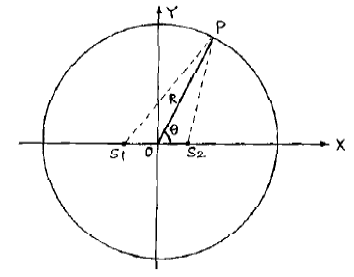
Two coherent sources of light $$S_1$$ and $$S_2$$, equidistant from the origin, are separated by a distance $$2\lambda$$ as shown. They emit light of wavelength $$\lambda$$. Interference is observed on a screen placed along the circle of large radius $$R$$. Point P is seen to be a point of constructive interference. Then, angle $$\theta$$ (other than $$0^\circ$$ and $$90^\circ$$) is
Loading solution...
If a current of 2 A passing through a certain electrolyte for $$t$$ minutes liberates 1 gram of oxygen, then $$t$$ is about
Loading solution...
A polarized light is incident on a polaroid. Let $$I_0$$ be the intensity of light transmitted by this polaroid. Now, a very large number (say N) of polaroids is placed in a row with their axes displaced through a small angle $$\theta$$ successively. If the last polaroid is crossed to the first one, the intensity of light transmitted by the last polaroid is about
Loading solution...
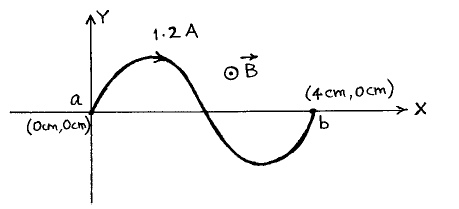
A wire $$ab$$ of length 10 cm is fixed in the shape of a sinusoidal curve as shown. The wire carries a current of 1.2 A. In a uniform magnetic field $$\vec{B}$$ of 0.1 T, the wire experiences a force whose magnitude is
Loading solution...
A charge $$(-2Q)$$ is distributed uniformly on a spherical balloon of radius $$R$$. Another point charge $$(+Q)$$ is situated at the centre of the balloon. The balloon is now inflated to twice the radius. Neglecting the elastic energy involved in the process, the change in total electric energy of the system is
Loading solution...
A rainbow is formed when a ray of sunlight passes through a spherical raindrop. Then the total angle through which the ray deviates is ($$i$$ and $$r$$ denote the angles of incidence and of refraction respectively)
Loading solution...
A series LCR circuit is connected to an ac source of frequency $$f$$ and a voltage $$V$$. At this frequency, reactance of the capacitor is 350 ohm while the resistance of the circuit is 180 ohm. Current in the circuit leads the voltage by $$54^\circ$$ and power dissipated in the circuit is 140 watt. Therefore, voltage $$V$$ is
Loading solution...
A car has a rear view mirror of focal length 20 cm. A truck 2 m broad and 1.6 m in height is overtaking the car with a relative speed of 15 km/hr. At the moment when the truck is 6 m behind the car, the car driver will see the image of the truck to be moving at a speed of
Loading solution...
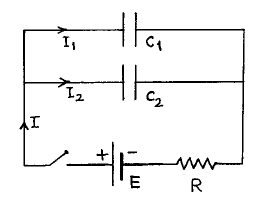
In the circuit shown below the switch is closed at $$t = 0$$. For $$0 < t < R(C_1 + C_2)$$, the current $$I_1$$ in the capacitor $$C_1$$ in terms of total current $$I$$ is
Loading solution...
The earth is getting energy from the sun whose surface temperature is $$T_s$$ and radius is $$R$$. Let the radius of the earth be $$r$$ and the distance from the sun be $$d$$. Assume the earth and the sun both to behave as perfect black bodies and the earth is in thermal equilibrium at a constant temperature $$T_e$$. Therefore, the temperature $$T_s$$ of the sun is $$xT_e$$ where $$x$$ is
Loading solution...
Imagine an atom made up of a proton and a hypothetical particle of double the mass as that of an electron but the same charge. Apply Bohr theory to consider transitions of the hypothetical particle to the ground state. Then, the longest wavelength (in terms of Rydberg constant for hydrogen atom) is
Loading solution...
The half life period of a radioactive element X is the same as the mean lifetime of another radioactive element Y. Initially both of them have the same number of atoms. Then,
Loading solution...
A sodium atom emits a photon of wavelength 590 nm and recoils with velocity $$v$$ equal to
Loading solution...
A practical diode (p-n junction) when forward biased is equivalent to
Loading solution...
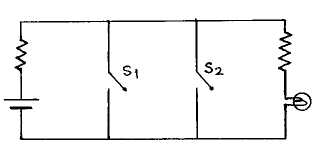
The circuit shown below is equivalent to
Loading solution...
Which one of the following statements in connection with a semiconducting material is NOT CORRECT?
Loading solution...
Generally light emitted from a source contains several wavelengths. Similarly the electrical voltage at the output of a sensor contains a mixture of dc and several ac components of different amplitudes and different frequencies. Filter circuits are used to pass desired frequencies and /or to eliminate undesired frequencies. The frequencies transmitted by the filter form the pass band while the frequencies eliminated by the filter form the stop band or rejection band.
We can think of four basic types of electrical filters- a low pass filter where frequencies below a certain cutoff frequency fcare passed. Similarly one can think of a high pass filter, band pass filter, band stop (or band rejection) filter. The cutoff frequency fc is the frequency at which the output voltage falls to 1/√2 times its maximum value.
An inductor and/or a capacitoris an essential component of a filter. Generally a resistance is included in a filter circuit to determine the time constant and hence the cutoff frequency.
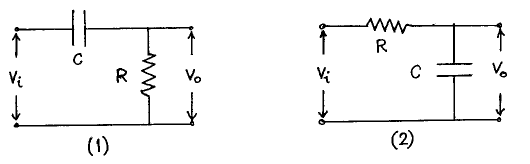
Refer to the RC networks (1) and (2) shown below. Which of the following statements is true?
Loading solution...
The input-output voltage relation for a certain high pass filter is given by $$\frac{V_o}{V_i} = \frac{\omega CR}{\sqrt{1 + \omega^2C^2R^2}}$$. The cut-off frequency $$f_c$$ for this filter will be
Loading solution...
The input-output voltage relation for a certain filter circuit is given by $$\frac{V_o}{V_i} = \frac{\omega\beta A}{\sqrt{(\omega_1^2 - \omega^2)^2 + \omega^2\beta^2}}$$ where $$\omega$$ is the angular frequency of the input while $$\omega_1$$, $$A$$ and $$\beta$$ are constants. This relation is meant for
Loading solution...
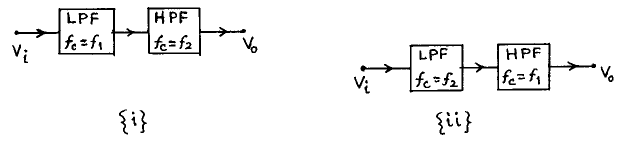
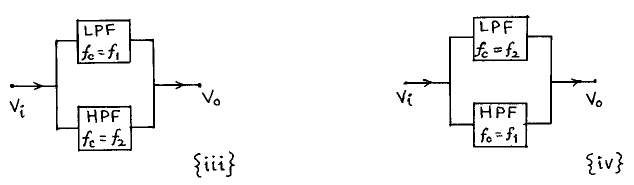
Refer to the following schematic diagrams of different combinations of a low pass filter (LPF) and a high pass filter (HPF). Assume $$f_1 < f_2$$. The combination that works as a band pass filter is
Loading solution...
Refer to the schematic diagram in Q. No. (47). The combination that works as a band elimination filter is
Loading solution...
An astrophysicist desires to study radiation at wavelengths higher than those for visible light coming from a certain celestial body. He must use an optical filter that is
Loading solution...
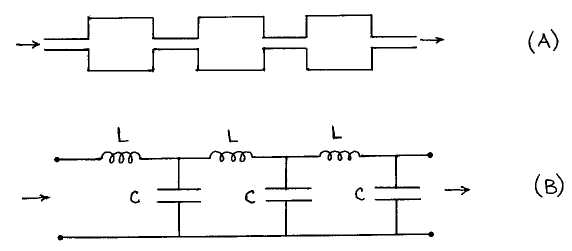
Figure (A) below shows an acoustical filter that consists of a set of identical cavities connected by narrow tubes and figure (B) shows its electrical analog. The acoustical filter represented by figure (A) is
Loading solution...
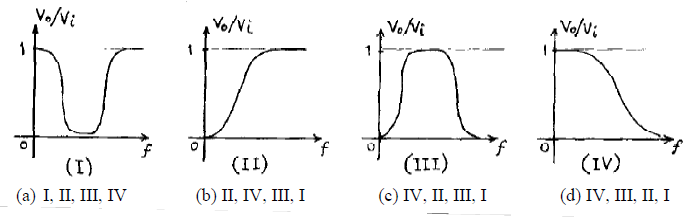
Graphs I, II, III and IV shown below represent the frequency response of different types of filter circuits. The correct order of these graphs corresponding to low pass, high pass, band pass and band stop filter is
Loading solution...
Equal volumes of two liquids (L1 and L2) are taken in two identical calorimeters. Both L1 and L2 are initially at about 80oC. Calorimeters are corked fitted with thermometers to record the temperatures of the liquids. The temperatures are recorded every 30 s alternating between the two liquids, that is the temperatures are recorded at an interval of 1 min for any one liquid. The graphs of temperature θ (C) versus time t (min)for two liquids L1 and L2are as shown.
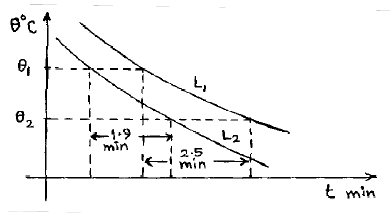
From the graphs it can be said that
Loading solution...
Equal volumes of the two liquids are necessary so that
Loading solution...
The nature of the outer surfaces of the calorimeters
Loading solution...
Which of the following arrangements would be the ideal environment for the two calorimeters?
Loading solution...
The two curves will
Loading solution...
Given mass of $$L_1$$ = 50 g and mass of $$L_2$$ = 62.5 g. If water equivalent of calorimeters is assumed to be negligible, then $$\left(\frac{s_1}{s_2}\right)$$ equals
Loading solution...
If $$\rho_1$$ and $$\rho_2$$ are the densities of $$L_1$$ and $$L_2$$ respectively then, identify the correct statement.
Loading solution...
If the experiment is carried out with equal masses of the two liquids, then
Loading solution...
The entire experiment is repeated with other two liquids having nearly the same specific heats. Then,
Loading solution...
Which of the following is or are the unit or units of magnetic field?
Loading solution...
The inductance of a solenoid varies
Loading solution...
Which of the following statement or statements in case of a thermodynamic process is or are correct? (The symbols carry their usual meaning.)
Loading solution...
With a rise of temperature
Loading solution...
Which of the following statement or statements is or are correct in case of a source of emf (such as a primary cell)?
Loading solution...
Which of the following statement or statements is or are correct in case of a resistance in a resistance box used in a laboratory?
Loading solution...
In a certain experiment density of the material of a small metallic cylindrical tube of a given mass is to be determined. Its length is about 3 cm, outer diameter more than about 1 cm and wall thickness about 2 mm, the flat base being a little thicker than 2 mm. Which of the following set or sets of apparatus can be used to determine the volume of the tube accurately?
Loading solution...
An object and a screen are separated by a distance $$D$$. A convex lens of focal length $$f$$ such that $$4f < D$$, is moved between the object and the screen to get two sharp images. If the two positions of the lens are separated by a distance $$L$$, then
Loading solution...
A transistor (pnp or npn) can be used as
Loading solution...
When photons each with energy 4.25 eV strike the surface of a metal A, the photoelectrons given out have maximum kinetic energy $$T_A$$ and the corresponding de Broglie wave length is $$\lambda_A$$. When another metal surface B is irradiated with photons each with energy 4.70 eV, the corresponding maximum kinetic energy $$T_B$$ is 1.50 eV less than $$T_A$$. If the de Broglie wave length $$\lambda_B$$ of these photoelectrons is twice that of $$\lambda_A$$, then
Loading solution...
Start your IIM journey with the right preparation and crack CAT 2026.

Educational materials for JEE preparation
