91- 6303239042
At constant T and P, 5.0 L of $$SO_2$$ are reacted with 3.0 L of $$O_2$$ according to the following equation $$2SO_2 (g) + O_2 (g) \rightarrow 2SO_3 (g)$$.
The volume of the reaction mixture at the completion of the reaction is
Sign in
Please select an account to continue using cracku.in
↓ →
At constant T and P, 5.0 L of $$SO_2$$ are reacted with 3.0 L of $$O_2$$ according to the following equation $$2SO_2 (g) + O_2 (g) \rightarrow 2SO_3 (g)$$.
The volume of the reaction mixture at the completion of the reaction is
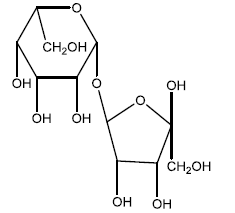
The following disaccharide is made up of
Loading solution...
One mole of 4-nitrocatechol (4-nitro-1,2-dihydroxybenzene) on treatment with an excess of NaH followed by one mole of methyl iodide gives
Loading solution...
.webp)
The colour changes of an indicator HIn in acid base titrations is given below.

Which of the following statements is correct?
Loading solution...
The table below gives the results of three titrations carried out with 0.200 M HCl to determine the molarity of a given NaOH solution using phenolphthalein as indicator. NaOH was taken in the burette and HCl was taken in a conical flask for the titrations.
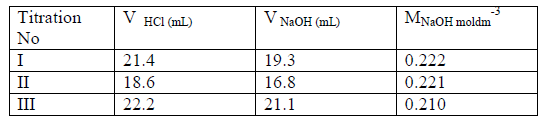
The actual molarity of the prepared NaOH solution was 0.220 $$\text{mol dm}^{-3}$$.
Which among the following could be the reason for the wrong value obtained in titration III?
Loading solution...
The solution with pH value close to 1 is
Loading solution...

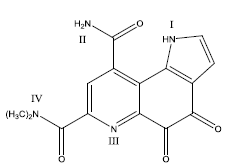
The most basic nitrogen in the following compound is
Loading solution...
For the reaction $$N_2 + 3H_2 \rightarrow 2NH_3$$, the rate expression is $$-\frac{d[NH_3]}{dt} = k[H_2][N_2]$$.
The correct statement is
I. The reaction is not elementary
II. The reaction is of second order
III. $$-\frac{d[H_2]}{dt} = -\frac{d[NH_3]}{dt}$$
Loading solution...
Which of the following is correct? A liquid with
Loading solution...

At $$25^\circ C$$, nitrogen exists as $$N_2$$ and phosphorous exists as $$P_4$$ because
Loading solution...
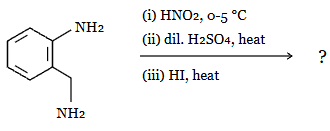
The product of the following reaction is
Loading solution...
Three samples of 100 g of water (samples I, II and III), initially kept at 1 atm pressure and 298 K were given the following treatments. Sample I was heated to 320 K and cooled to 298 K.
Sample II was heated to 300 K, cooled to 273 K and heated to 298 K.
Sample III was heated to 373 K and cooled to 298 K.
At the end of these processes, the internal energy of
Loading solution...
For the reaction
$$5Br^- (aq) + BrO_3^- (aq) + 6H^+ (aq) \rightarrow 3Br_2 (aq) + 3H_2O (l)$$
the rate expression was found to be $$-\frac{d[BrO_3^-]}{dt} = k[Br^-][H^+]^2[BrO_3^-]$$.
Which of the following statements is are correct?
I. Doubling the initial concentration of all the reactants will increase the reaction rate by a factor of 8
II. Unit of rate constant of the reaction in a buffer solution is $$\text{min}^{-1}$$
III. Doubling the concentration of all the reactants at the same time will increase the reaction rate by a factor of 16
IV. Rate of conversion of $$BrO_3^-$$ and rate of formation of $$Br^-$$ are the same
Loading solution...
In the Lewis structure of ozone $$(O_3)$$, the formal charge on the central oxygen atom is
Loading solution...
Which of the following on treatment with hot concentrated acidified $$KMnO_4$$ will give
2-methylhexane-1,6-dioic acid as the only organic product?
Loading solution...
For the following spontaneous process $$H_2O (l) \rightarrow H_2O (s)$$ at 268 K, which of the following is true?
Loading solution...
Lithium oxide ($$Li_2O$$, molar mass $$= 30$$ $$\text{g mol}^{-1}$$) is used in space shuttles to remove water vapour according to the following reaction $$Li_2O (s) + H_2O (g) \rightarrow 2LiOH (s)$$.
If 60 kg of water and 45 kg of $$Li_2O$$ are present in a shuttle
I. water will be removed completely
II. $$Li_2O$$ will be the limiting reagent
III. 100 kg of $$Li_2O$$ will be required to completely remove the water present
IV. 27 kg of water will remain in the shuttle at the end of the reaction
Loading solution...
The order of enol content in the following molecules is
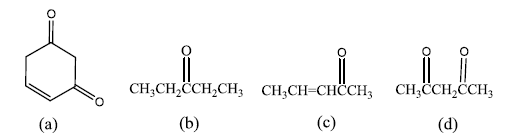
Loading solution...
The product of the following reaction is
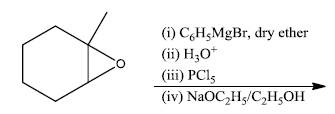
Loading solution...
At constant volume, 6.0 mol of $$H_2$$ gas at $$0^\circ C$$ and 100 kPa was heated to 250 kPa. The molar heat capacity of $$H_2$$ at constant pressure $$(C_P) = 28.9$$ $$\text{J mol}^{-1} \text{K}^{-1}$$ (assume that the heat capacity values do not change with temperature). The final temperature of the $$H_2$$ gas and the change in entropy of the process are
Loading solution...
The cubic unit cell of an oxide of metals A and B is as given below, in which oxygen,
A and B are represented by open circles, crossed circles and dark circles respectively.
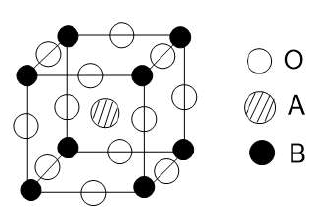
The formula of the oxide can be deduced as
Loading solution...
When a medal is electroplated with silver (Ag)
Loading solution...
The energy of an electron in Bohr's orbit of hydrogen atom is $$-13.6$$ eV. The total electronic energy of a 'hypothetical' He atom in which there are no electron electron repulsions is
Loading solution...
Iodine is a solid and sublimes at ordinary temperatures. This is because of
Loading solution...
The equilibrium constants of the following isomerisation reaction at 400 K and 298 K are 2.07 and 3.42 respectively.
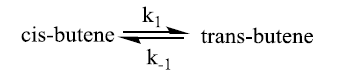
Which of the following is/are correct?
I. The reaction is exothermic
II. The reaction is endothermic
III. At 400 K 50 percent of cis-butene and 50 percent of trans-butene are present at equilibrium
IV. Both at 298 K and 400 K, $$k_1 = k_{-1}$$
Loading solution...
Which of the following will not give a straight line plot for an ideal gas?
Loading solution...
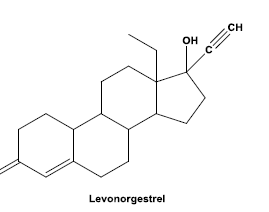
Levonorgestrel is a commonly used contraceptive. The number of chiral centers present in this molecule is
Loading solution...
Which of the following ethers cannot be prepared by Williamson Synthesis?
Loading solution...
IUPAC name of the complex ion $$[CrCl_2(ox)_2]^{3-}$$ is
Loading solution...
Sodium azide ($$NaN_3$$) is used in the airbag of cars. This is a safety device which inflates on an impact according to the reaction $$2NaN_3 \rightarrow 2Na + 3N_2$$. An air bag of a particular car can be filled with 44.8 L of gas at STP. The mass (g) of $$NaN_3$$ required to fill this airbag completely at 298K and 1 atm. pressure is
Loading solution...
Which of the following mixtures of water and $$H_2SO_4$$ would have mass percentage of $$H_2SO_4$$ close to 30?
Loading solution...
In chlorides, the common oxidation states of aluminium and thallium are +3 and +1 respectively because
Loading solution...
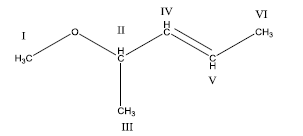
In the given compound the order of ease with which hydrogen atom can be abstracted from carbons I to VI is
Loading solution...
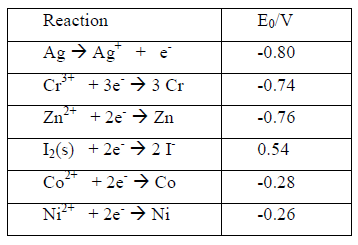
Use the table given below to answer questions 34 and 35 .The best reducing agent among the following is
Loading solution...
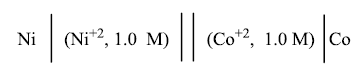
$$E^0$$ of the given cell is
Loading solution...
Which of the following is not a pair of a Lewis acid and a Lewis base?
Loading solution...
The type/s of isomerism that $$Co(NH_3)_4Br_2Cl$$ can exhibit is/are
Loading solution...
Pyrethrins are produced in chrysanthemum flowers and used as insecticides. Structure of pyrethrin I is given below.
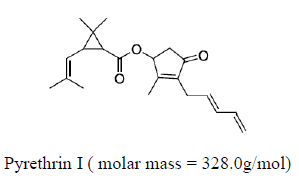
The volume of 0.05 $$\text{mol dm}^{-3}$$ bromine water that would react with 500 mg sample of Pyrethrin I is
Loading solution...
Coniferyl alcohol is isolated from pine trees. The following observations were made about this alcohol.
I. It forms methylated product with MeI in presence of a base
II. One equivalent of coniferyl alcohol reacts with two equivalents of benzoyl chloride
III. Upon ozonolysis, coniferyl alcohol gives a product Y of molecular formula $$C_2H_4O_2$$.
The structure of coniferyl alcohol would be
Loading solution...
Which of the following represents a polymer of prop-2-en-1-ol?
Loading solution...
A 500 mL glass flask is filled at 298 K and 1 atm pressure with three diatomic gases X, Y and Z. The initial volume ratio of the gases before mixing was $$5 \colon 3 \colon 1$$. The density of the heaviest gas in the mixture is not more than 25 times that of the lightest gas. When the mixture was heated, vigorous reactions take place between X and Y and X and Z in which all the three gases were completely used up. The gases X, Y, Z respectively are
Loading solution...
The reaction $$X + Y \rightarrow Z$$ is first order with respect to X and second order with respect to Y. The initial rate of formation of Z is R $$\text{mol dm}^{-3} \text{s}^{-1}$$ when $$[X]_0$$ and $$[Y]_0$$ are 0.40 mol $$dm^{-3}$$ and 0. mol $$dm^{-3}$$ respectively . If $$[X]_0$$ is halved and $$[Y]_0$$ is doubled, the value of the initial rate would become
Loading solution...
Which one of the following statements is not correct about glucose (molar mass of glucose $$= 180$$ $$\text{g mol}^{-1}$$)?
Loading solution...
The van der Waals equation for one mole of a real gas can be written as $$\left(P + \frac{a}{V^2}\right)(V - b) = RT$$. For the gases $$H_2$$, $$NH_3$$ and $$CH_4$$, the values of a in $$\text{bar L}^2 \text{mol}^{-2}$$ are 0.2453, 4.170 and 2.253 respectively. Which of the following can be inferred from the a values?
Loading solution...
Terpinen-4-ol is an active ingredient in tea tree oil and has the following structure.
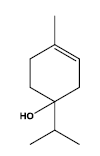
The correct observations for terpinen-4-ol is/are
I. It rotates the plane of plane polarized light
II. It reacts with Baeyer&'s reagent to form a triol
III. On reaction with NaBr and $$H_2SO_4$$, it gives a dibromo compound
IV. On ozonolysis it gives a compound with molecular formula $$C_{10}H_{18}O_3$$
Loading solution...
The correct order of the ability of the leaving groups is
Loading solution...
Metal M forms a carbonyl compound in which it is present in its lower valance state. Which of the following bonding is possible in this metal carbonyl?
Loading solution...
Acetic acid $$(CH_3COOH)$$ is partially dimerised to $$(CH_3COOH)_2$$ in the vapour phase. At a total pressure of 0.200 atm, acetic acid is 92.0 percent dimerized at 298 K. The value of equilibrium constant of dimerisation under these conditions is
Loading solution...
Silanes are silicon hydrides of general formula $$Si_nH_{2n+2}$$ and have several applications. From the data given below, the bond dissociation enthalpy of Si-Si bond can be deduced as.
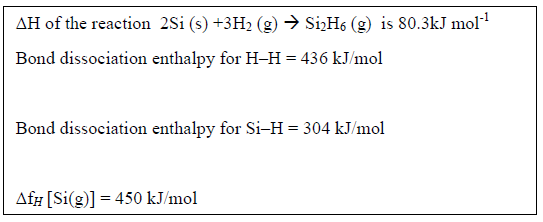
Loading solution...
In the following reaction, three products a, b, c are obtained.

The approximate experimental yields of the three compounds were 64%, 33% and 3%. Which of the following is the correct with respect to yield and the corresponding product?
Loading solution...
Which of the following represents the correct order of dipole moment?
Loading solution...
The best reaction sequence for the synthesis of 2-pentanone would be
Loading solution...
Haemoglobin is a Fe containing protein responsible for oxygen transport in the blood. The curves given below indicate the percentage saturation of haemoglobin by $$O_2$$ as a function of partial pressure of $$O_2$$.
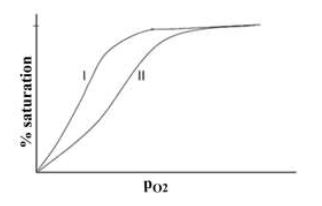
Which of the following statement/s is/are correct for the given curves?
I. In presence of $$CO_2$$, higher $$p_{O_2}$$ is needed for a given percentage saturation
II. In presence of $$CO_2$$, lower $$p_{O_2}$$ is needed for a given percentage saturation
III. The maximum percentage saturation is not affected by the presence of $$CO_2$$
IV. In the absence of $$CO_2$$, maximum saturation of haemoglobin occurs at lower $$p_{O_2}$$
Loading solution...
An appropriate reagent for the conversion of 1-propanol to 1-propanal is
Loading solution...
A student performed an experiment to determine the molecular formula of a given sample of hydrated copper (II) sulphate by weighing the sample before and after heating. The formula obtained experimentally was $$CuSO_4 \cdot 5.5H_2O$$ while the actual formula of the given sample is $$CuSO_4 \cdot 5H_2O$$. Which experimental error would account for the wrongly obtained result?
Loading solution...
Malic acid is a dicarboxylic acid present in apples and it has the following structure
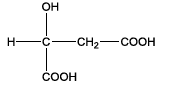
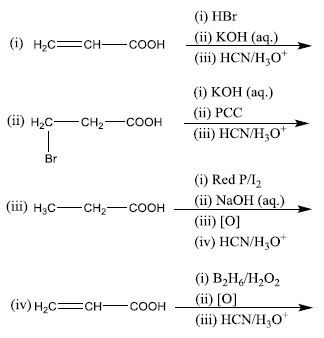
Which of the following synthetic routes will give the $$(\pm)$$ malic acid?
Loading solution...
Which of the following cannot act as an oxidising agent?
Loading solution...
Ellingham diagrams are plots of $$\Delta G^0$$ vs temperature which have applications in metallurgy.
$$2H_2 + O_2 \rightarrow 2H_2O$$, $$\Delta G (J) = -247500 + 55.85T$$........ (I),
$$2CO + O_2 \rightarrow 2CO_2$$, $$\Delta G (J) = -282400 + 86.81T$$........ (II).
The Ellingham diagrams for the oxidation of $$H_2$$ (I) and CO (II) are given below and the two lines intersect at $$T_E = 1125$$ K.
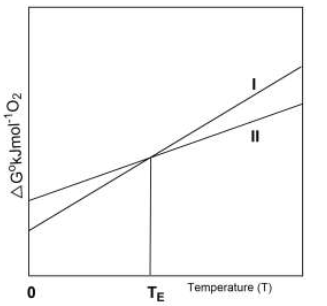
Which of the following is correct?
I. $$\Delta G^0$$ for reaction (i) is more negative at $$T < 1125$$ K
II. $$\Delta G^0$$ for the reduction of CO is more negative at $$T < 1125$$ K
III. $$H_2$$ is a better reducing agent at $$T > 1125$$ K
IV. $$H_2$$ is a better reducing agent at $$T < 1125$$ K
Loading solution...
Hydrazine used in rocket fuels can be obtained by the reaction of ammonia and hydrogen peroxide according to the equation $$2NH_3 (g) + H_2O_2 (l) \rightarrow N_2H_4 (l) + 2H_2O (l)$$ with $$\Delta H^0_{reaction} = -241$$ $$\text{kJ mol}^{-1}$$. If $$\Delta H^0$$ of formation of $$NH_3$$, $$H_2O_2$$ and $$H_2O$$ are $$-46.1$$, $$-187.8$$ and $$-285.8$$ $$\text{kJ mol}^{-1}$$ respectively, $$\Delta H^0$$ for the decomposition of hydrazine into $$N_2$$ and $$H_2$$ is
Loading solution...
$$Sn^{2+}$$ compounds like SnO and $$SnCl_2$$ are well known reducing agents, while $$PbO_2$$ acts as an oxidizing agent. Which of the following statements support these reactivities?
I. SnO is more stable than $$SnO_2$$
II. $$Sn^{4+}$$ is more stable than $$Sn^{2+}$$
III. $$Pb^{4+}$$ is more stable than $$Pb^{2+}$$
IV. $$Pb^{2+}$$ is more stable than $$Pb^{4+}$$
Loading solution...
A fuel and oxidant system consisting of N,N-dimethylhydrazine $$(CH_3)_2NNH_2$$ and $$N_2O_4$$ (both liquids) is used in space vehicle propulsion. The liquid components are mixed stoichiometrically so that $$N_2$$, $$CO_2$$ and $$H_2O$$ are the only products. If all gases are under the same reaction conditions, number of moles of gases produced from 1 mole of $$(CH_3)_2NNH_2$$ is
Loading solution...
An ether (X) with molecular formula $$C_5H_{10}O$$ reacts with excess of hot aq. HI to give a product which on further reaction with hot NaOH in ethanol forms 1,3-pentadiene. Structure of X is
Loading solution...
Compound Y with molecular formula $$C_8H_9Br$$ gives a precipitate on heating with alcoholic $$AgNO_3$$. Oxidation of Y gives product Z ($$C_8H_6O_4$$) which gives an anhydride upon heating. Compound Y is
Loading solution...
The observed effective magnetic moment of two octahedral complexes, $$K_4[Mn(CN)_6] \cdot 3H_2O$$ (X) and $$K_4[Mn(SCN)_6]$$ (Y) are 2.18 BM and 6.06 BM, respectively. Which of the following is correct?
I. X is a low spin complex with two unpaired electrons
II. Y is a high spin complex with 5 unpaired electrons
III. X is a high spin complex with two unpaired electrons
IV. Y is a low spin complex with 5 unpaired electrons
Loading solution...
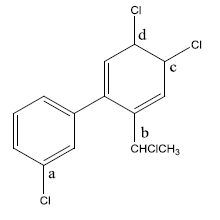
The increasing reactivity of the sites (a-d) in the following compound in $$S_N1$$ reaction is
Loading solution...
Which of the following has the shortest bond length?
Loading solution...
Which of the following statement/s is/are correct about weak acids in aqueous solutions?
I. When $$pH = pK_a$$ of a monoprotic acid, 50% of the acid is ionised
II. If $$pH = pK_{a2}$$ of a diprotic acid, the average charge of all the ionised species is 0.5
III. When $$pH = pK_a + 1$$, 10% of the acid is ionised
IV. When $$pH = 7$$, 50% of a monobasic acid is ionised
Loading solution...
Iodine number is the grams of iodine atoms (atomic mass $$= 127$$ $$\text{g mol}^{-1}$$) that can react completely with 100 g of a vegetable oil. Iodine monochloride (ICl) is a reagent used to determine iodine number. In an experiment, 25.00 $$\text{cm}^3$$ of 0.100 $$\text{mol dm}^{-3}$$ ICl was added to 127 g of the oil. The unreacted ICl was found to be equivalent to 40.00 $$\text{cm}^3$$ of 0.10 $$\text{mol dm}^{-3}$$ of $$Na_2S_2O_3$$. The iodine number of the oil can be deduced as
Loading solution...
When NiO is doped with a small quantity of $$Li_2O$$
Loading solution...
When a sample of gas kept at $$20^\circ C$$ and 4.0 atm is heated to $$40^\circ C$$ at constant volume
Loading solution...
Addition of bromine to cis-3-hexene gives
Loading solution...
An organic compound X forms an orange yellow precipitate with 2,4-DNP reagent. It does not react with aqueous $$[Ag(NH_3)_2]NO_3$$. X on reduction with $$NaBH_4$$ gives a secondary alcohol and on oxidation with nitric acid yields a dicarboxylic acid containing the same number of carbon atoms. On bromination, X gives a monobromo product. On the basis of these reactions, it can be concluded that X
I. contains aldehydic carbonyl group II. contains ketonic carbonyl group
III. contains ester carbonyl group IV. does not contain C=C bonds
Loading solution...
The undissociated form of a weak organic acid HA can be extracted from the aqueous phase into an organic phase using a water-immiscible organic solvent according to the following scheme.
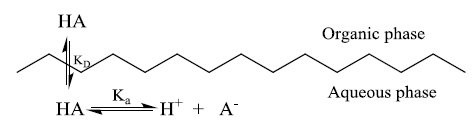
Which of the following is/are correct for this extraction?
I. $$\frac{[HA]_{org}}{[HA]_{aq}}$$ depends on the pH of the aqueous phase
II. HA can be efficiently extracted from basic aqueous solutions
III. $$\frac{[HA]_{org}}{[HA]_{aq}}$$ depends on the initial concentration of HA
IV. $$\frac{[HA]_{org}}{[HA]_{aq} + [A^-]}$$ depends on the pH of the aqueous phase
Loading solution...
The correct order of reactivity in nucleophilic substitution reaction of the following compounds a, b, and c would be, where (a) is $$CH_3CH_2CONH_2$$, (b) is $$CH_3CH_2COOCH_3$$ and (c) is $$CH_3CH_2COCl$$
Loading solution...
The complex ion that does not have d electrons in the metal atom is
Loading solution...
The order in which the compounds a, b and c react with $$CH_3I$$ would be
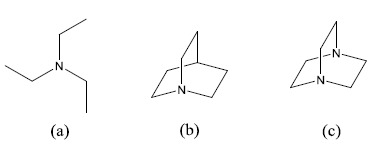
Loading solution...
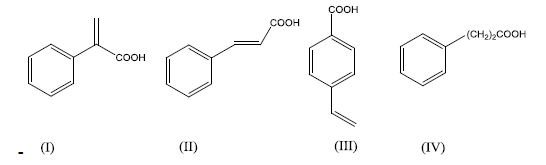
An organic compound P with molecular formula $$C_9H_8O_2$$ on oxidation gives benzoic acid as one of the products. The possible structure/s of P is/are shown below.
Loading solution...
The energy of an electron in the ground state of H atom is $$-13.6$$ eV. The negative sign indicates that
Loading solution...
Radius of Ar atom is 145 pm. The percentage volume occupied by an Ar atom at STP is
Loading solution...
The reduction of $$O_2$$ to $$H_2O$$ in acidic solution, $$O_2 (g) + 4H^+ (aq) + 4e^- \rightarrow 2H_2O (l)$$, has a standard reduction potential of 1.23 V. If the pH of the acid solution is increased by one unit, half cell potential will
Loading solution...
Start your IIM journey with the right preparation and crack CAT 2026.

Educational materials for JEE preparation