91- 6303239042
A bottle of $$\text{H}_3\text{PO}_4$$ solution contains 70% (w/w) acid. If the density of the solution is $$1.54 \text{ g cm}^{-3}$$, the volume of the $$\text{H}_3\text{PO}_4$$ solution required to prepare 1 L of 1 N solution is
Sign in
Please select an account to continue using cracku.in
↓ →
A bottle of $$\text{H}_3\text{PO}_4$$ solution contains 70% (w/w) acid. If the density of the solution is $$1.54 \text{ g cm}^{-3}$$, the volume of the $$\text{H}_3\text{PO}_4$$ solution required to prepare 1 L of 1 N solution is
Wood or cattle dung ash is used for cleaning cooking utensils in many parts of India. The statement that is not true for this ash is
Loading solution...
The two projection formulae that represent a pair of enantiomers are
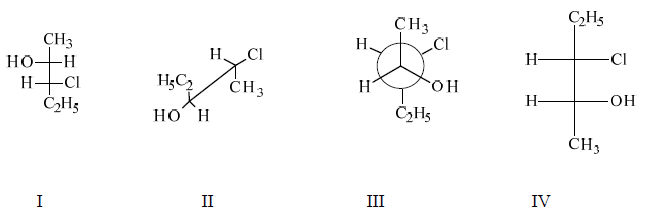
Loading solution...
.webp)
When 1 L of 0.1 M sulphuric acid solution is allowed to react with 1 L of 0.1 M sodium hydroxide solution, the amount of sodium sulphate (anhydrous) that can be obtained from the solution formed and the concentration of $$\text{H}^+$$ in the solution respectively are
Loading solution...
The best sequence of reactions for the following conversion is
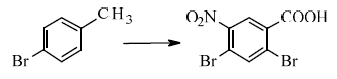
Loading solution...
If $$\lambda_0$$ and $$\lambda$$ are the threshold wavelength and the wavelength of the incident light, respectively on a metal surface, the velocity of the photoelectron ejected from the metal surface is ($$m_e$$ = mass of electron, h = Planck's constant, c = speed of light)
Loading solution...

A current of 5.0 A flows for 4.0 h through an electrolytic cell containing a molten salt of metal M. This results in deposition of 0.25 mol of the metal M at the cathode. The oxidation state of M in the molten salt is (1 Faraday = $$96485 \text{ C mol}^{-1}$$)
Loading solution...
The major product (Y) of the following reaction is -
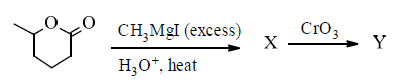
Loading solution...
The compound that will <b>NOT</b> react with hot concentrated aqueous alkali at atmospheric pressure is
Loading solution...

The nature of $$\text{CsAuCl}_3$$ is (this compound contains Au in two oxidation states and there is no Au-Au bond)
Loading solution...
The standard electrode potentials, $$E^0$$ of $$\text{Fe}^{3+}/\text{Fe}^{2+}$$ and $$\text{Fe}^{2+}/\text{Fe}$$ at 300 K are +0.77 V and $$-0.44$$ V, respectively. The $$E^0$$ of $$\text{Fe}^{3+}/\text{Fe}$$ at the same temperature is
Loading solution...
The incorrect statement for lanthanides among the following statements is
Loading solution...
4-Hydroxy-4-methylpentanal on heating with excess of methanol in the presence of an acid catalyst followed by dehydration of the product gives
Loading solution...
Ice crystallizes in a hexagonal lattice. At a certain low temperature, the lattice constants are a = 4.53 $$\mathring{\text{A}}$$ and c = 7.41 $$\mathring{\text{A}}$$. The number of $$\text{H}_2\text{O}$$ molecules contained in a unit cell ($$d \approx 0.92 \text{ g cm}^{-3}$$ at the given temperature) is
Loading solution...
In the redox reaction $$2\text{MnO}_4^- + 5\text{C}_2\text{O}_4^{2-} + 16\text{H}^+ \rightarrow 2\text{Mn}^{2+} + 10\text{CO}_2 + 8\text{H}_2\text{O}$$, 20 mL of 0.1 M $$\text{KMnO}_4$$ react quantitatively with
Loading solution...
The vapor pressure of benzene is 53.3 kPa at $$60.6 ^\circ\text{C}$$, but it fall to 51.5 kPa when 19 g of a nonvolatile organic compound is dissolved in 500 g benzene. The molar mass of the nonvolatile compound is
Loading solution...
Sodium metal dissolves in liquid ammonia and forms a deep blue solution. The color is due to absorption of light by
Loading solution...
An organic base (X) reacts with nitrous acid at $$0 ^\circ\text{C}$$ to give a clear solution. Heating the solution with KCN and cuprous cyanide followed by continued heating with conc. HCl gives a crystalline solid. Heating this solid with alkaline potassium permanganate gives a compound which dehydrates on heating to a crystalline solid. X is -
Loading solution...
The de Broglie wavelength of an object of mass 33 g moving with a velocity of $$200 \text{ m s}^{-1}$$ is of the order of
Loading solution...
A person having osteoporosis is suffering from lead poisoning. Ethylene diamine tetra acetic acid (EDTA) is administered for this condition. The best form of EDTA to be used for such administration is -
Loading solution...
A water sample from a municipal water supply was found to have a pH = 7.0. On evaporating 2 L of this water, 2.016 g of white solid was left behind in the evaporation vessel, so the total dissolved solid (TDS) content of this water was $$1008 \text{ mg L}^{-1}$$. However, addition of soap to a bucket of this water did not produce any visible scum. Based on these findings, one can conclude that
Loading solution...
The best reaction sequence to convert 2-methyl-1-bromopropane into 4-methyl-2-bromopentane is
Loading solution...
Metallic copper dissolves in
Loading solution...
A 50 mL solution of pH = 1 is mixed with a 50 mL solution of pH = 2. The pH of the mixture is
Loading solution...
The Fischer projection formula that represents the following compound is
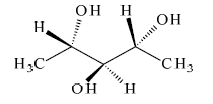
Loading solution...
Four statements for the following reaction are given below.
$$[\text{CoCl}_2(\text{NH}_3)_4]^+ + \text{Cl}^- \rightarrow [\text{CoCl}_3(\text{NH}_3)_3] + \text{NH}_3$$
(I) only one isomer is produced if the reactant complex ion is a trans isomer
(II) three isomers are produced if the reactant complex ion is a cis isomer
(III) two isomers are produced if the reactant complex ion is a trans isomer
(IV) two isomers are produced if the reactant complex ion is cis isomer.
The correct statements are
Loading solution...
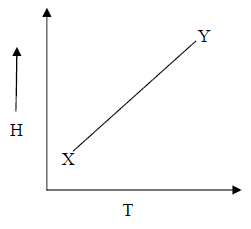
The process in which an ideal gas undergoes change from X to Y as shown in the following diagram is
Loading solution...
With respect to halogens, four statements are given below.
(I) The bond dissociation energies for halogens are in the order $$\text{I}_2 < \text{F}_2 < \text{Br}_2 < \text{Cl}_2$$
(II) The only oxidation state is $$-1$$
(III) The amount of energy required for the excitation of electrons to first excited state decreases progressively as we move from F to I
(IV) They form $$\text{HX}_2^-$$ species in their aqueous solutions (X = halogen).
The correct statements are
Loading solution...
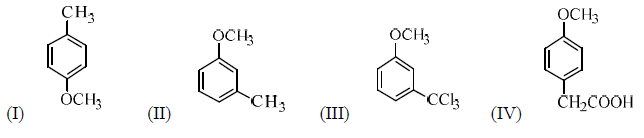
The order of reactivity of the following compounds in electrophilic monochlorination at the most favorable position is
Loading solution...
The limiting molar conductivities of KCl, $$\text{KNO}_3$$ and $$\text{AgNO}_3$$ are 149.9, 145.0 and 133.4 $$\text{S cm}^2 \text{ mol}^{-1}$$, respectively, at $$25 ^\circ\text{C}$$. The limiting molar conductivity of AgCl at the same temperature in $$\text{S cm}^2 \text{ mol}^{-1}$$ is
Loading solution...
Imagine that in any atom about 50% of the space is occupied by the atomic nucleus. If a silver foil is bombarded with $$\alpha-$$particles, majority of the $$\alpha-$$particles would
Loading solution...
An organic compound X is a disubstituted benzene containing 77.8% carbon and 7.5% hydrogen. Heating an alkaline solution of X with chloroform gives a steam volatile compound Y. Heating Y with acetic anhydride and sodium acetate gives a sweet smelling crystalline solid Z. Z is
Loading solution...
The emf of a cell corresponding to the reaction $$\text{Zn (s)} + 2\text{H}^+ \text{(aq)} \rightarrow \text{Zn}^{2+} (0.1 \text{ M}) + \text{H}_2 \text{(g)}$$ is 0.199 V at 298 K, where $$E^0_{\text{Zn}/\text{Zn}^{2+}} = 0.76 \text{ V}$$. The approximate pH of the solution at the electrode where hydrogen is being produced is ($$p_{\text{H}_2} = 1$$ atm)
Loading solution...
The vapor pressure of two pure isomeric liquids X and Y are 200 torr and 100 torr respectively at a given temperature. Assuming a solution of these components to obey Raoult's law, the mole fraction of component X in vapor phase in equilibrium with the solution containing equal amounts of X and Y, at the same temperature, is
Loading solution...
n-Butylcyclohexane is formed through the following sequence of reactions. In the above scheme of reactions, X is -

Loading solution...
In a first order reaction, 75% of the reactant disappears in 1.386 h, the rate constant of the reaction is close to
Loading solution...
Four statements for Cr and Mn are given below.
(I) $$\text{Cr}^{2+}$$ and $$\text{Mn}^{3+}$$ have the same electronic configuration.
(II) $$\text{Cr}^{2+}$$ is a reducing agent while $$\text{Mn}^{3+}$$ is an oxidizing agent.
(III) $$\text{Cr}^{2+}$$ is an oxidizing agent while $$\text{Mn}^{3+}$$ is a reducing agent.
(IV) both Cr and Mn are oxidizing agents.
The correct statements are
Loading solution...
Four processes are indicated below.
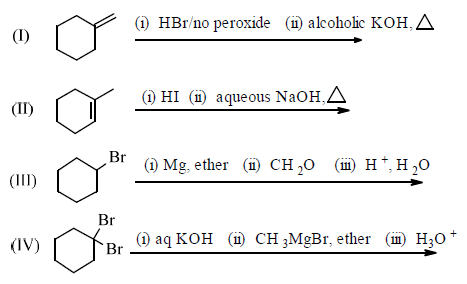
The processes that do not produce 1-methylcyclohexanol are
Loading solution...
The reaction that is least feasible is
Loading solution...
Glucose when dissolved in water leads to cooling of the solution. Suppose you take 250 mL water at room temperature in an open container (such as a bowl) made of thermally insulated material and dissolve a spoonful of glucose in it. If you are able to accurately measure the heat absorbed by this solution in reaching back to room temperature (assuming negligible changes in the composition and the amount of solution during this process), you will be measuring
Loading solution...
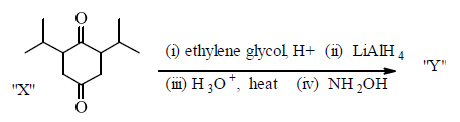
Compound X undergoes the following sequence of reactions to form Y. Compound Y is -
Loading solution...
The complex that shows optical activity is
Loading solution...
100 mL of 0.3 M acetic acid is shaken with 0.8 g wood charcoal. The final concentration of acetic acid in the solution after adsorption is 0.125 M. The mass of acetic acid adsorbed per gram of charcoal is
Loading solution...
The reaction that does not produce nitrogen is
Loading solution...
The species having highest bond energy is
Loading solution...
The product X of the following sequence of reactions is
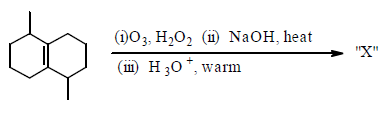
Loading solution...
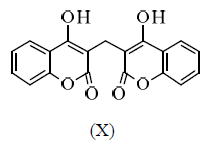
Dicoumarol (X) is an anticoagulant. The number of possible monochloro substituted isomeric derivatives and the volume of hydrogen liberated at STP by the reaction of 0.5 mol of dicoumarol with sodium are respectively
Loading solution...
The structure of a molecule of $$\text{N(SiMe}_3)_3$$ is
Loading solution...
For an electron whose x-positional uncertainty is $$1.0 \times 10^{-10}$$ m, the uncertainty in the x-component of the velocity in $$\text{m s}^{-1}$$ will be of the order of
Loading solution...
The order of $$p\pi -d\pi$$ interaction in the compounds containing bond between Si/P/S/Cl and oxygen is in the order
Loading solution...
The solubility products $$(K_{sp})$$ of three salts MX, $$\text{MY}_2$$ and $$\text{MZ}_3$$ are $$1 \times 10^{-8}$$, $$4 \times 10^{-9}$$ and $$27 \times 10^{-8}$$, respectively. The correct order for solubilities of these salts is
Loading solution...
Three isomeric compounds M, N, and P ($$\text{C}_5\text{H}_{10}\text{O}$$) give the following tests.
(i) M and P react with sodium bisulfite to form an adduct
(ii) N consumes 1 mol of bromine and also gives turbidity with conc. HCl and anhydrous $$\text{ZnCl}_2$$ after prolong heating
(iii) M reacts with excess of iodine in alkaline solution to give yellow crystalline compound with a characteristic smell
(iv) p-Rosaniline treated with sulphur dioxide develops pink colour on shaking with P.
The structures of M, N, and P, respectively are
Loading solution...
The unbalanced equation for the reaction of $$\text{P}_4\text{S}_3$$ with nitrate in aqueous acidic medium is given below. $$\text{P}_4\text{S}_3 + \text{NO}_3^- \rightarrow \text{H}_3\text{PO}_4 + \text{SO}_4^{2-} + \text{NO}$$. The number of mol of water required per mol of $$\text{P}_4\text{S}_3$$ is
Loading solution...
Certain combinations of cations and anions lead to the formation of colored salts in solid state even though each of these ions with other counter ions may produce colorless salts. This phenomenon is due to temporary charge transfer between the two ions. Out of the following, the salt that can exhibit this behavior is
Loading solution...
Desosamine has the following structure.
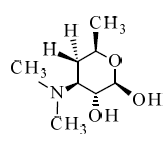
The number of functional groups which react with hydroiodic acid, the number of chiral centres, and the number of stereoisomers possible respectively are
Loading solution...
If k is the rate constant of the reaction and T is the absolute temperature, the correct plot is
Loading solution...
1,3-pentadiene and 1,4-pentadiene are compared with respect to their intrinsic stability and reaction with HI. The correct statement is
Loading solution...
From the given structures, the correct structure(s) of $$\text{PF}_3\text{Cl}_2$$ is/are
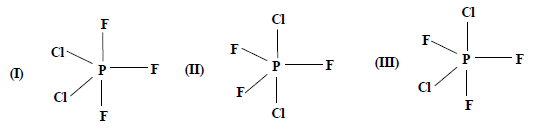
Loading solution...
The ratio of the masses of methane and ethane in a gas mixture is $$4 \colon 5$$. The ratio of number of their molecules in the mixture is
Loading solution...
The hydrocarbon that cannot be prepared effectively by Wurtz reaction is
Loading solution...
Glacial acetic acid dissolves in
(I) liquid $$\text{H}_2\text{S}$$, as $$\text{H}_2\text{S}$$ is a polar covalent compound
(II) liquid $$\text{NH}_3$$, as it can form hydrogen bond
(III) liquid $$\text{HClO}_4$$, as it can protonate acetic acid.
The correct option is
Loading solution...
The energy of an electron in the first Bohr orbit is $$-13.6$$ eV. The energy of $$\text{Be}^{3+}$$ in the first excited state is
Loading solution...
Many protein-based biomaterials, such as waste hair and feathers, can absorb heavy metal ions from wastewater. It has been observed that metal uptake by these materials increases in alkaline condition. The enhanced uptake in alkaline conditions is due to
Loading solution...
Compound X reacts with diborane followed by alkaline hydrogen peroxide to form compound Y. Y on reaction with a mixture of sodium bromide in sulphuric acid followed by bromobenzene and sodium in ether gives n-pentylbenzene. Compound X is
Loading solution...
When any solution passes through a cation exchange resin that is in acidic form, $$\text{H}^+$$ ion of the resin is replaced by cations of the solution. A solution containing 0.319 g of an isomer with molecular formula $$\text{CrCl}_3 \cdot 6\text{H}_2\text{O}$$ is passed through a cation exchange resin in acidic form. The eluted solution requires $$19 \text{ cm}^3$$ of 0.125 N NaOH. The isomer is
Loading solution...
In an experiment, it was found that for a gas at constant temperature, PV = C. The value of C depends on
Loading solution...
The compound that undergoes solvolysis in aq. ethanol most easily is
Loading solution...
Silver nitrate solution when added to a colorless aqueous solution E forms a white precipitate which dissolves in excess of E. If the white precipitate is heated with water, it turns black and the supernatant solution gives a white precipitate with acidified barium nitrate solution. Therefore, E is
Loading solution...
The metal M crystallizes in a body centered lattice with cell edge 400 pm. The atomic radius of M is
Loading solution...
The reaction that does not proceed in forward direction is
Loading solution...
The order of basicity of the following compounds is

Loading solution...
The appropriate sequence of reactions for obtaining 2-phenylbutanoic acid from benzene is
Loading solution...
The quantity that does not change for a sample of a gas in a sealed rigid container when it is cooled from $$120 ^\circ\text{C}$$ to $$90 ^\circ\text{C}$$ at constant volume is
Loading solution...
An ideal gas taken in an insulated chamber is released into interstellar space. The statement that is nearly true for this process is
Loading solution...
4-amino-3-methylbutanoic acid is treated with thionyl chloride followed by ammonia to obtain compound X. X on reaction with bromine in an alkaline medium gave compound Y. For estimation, Y was titrated with perchloric acid. The volume of 0.1 M perchloric acid needed to react with 0.22 g of Y is
Loading solution...
For $$[\text{FeF}_6]^{3-}$$ and $$[\text{CoF}_6]^{3-}$$, the statement that is correct is
Loading solution...
Cotton fibers consist of cellulose polymers with neighboring polymers chains held together by hydrogen bonds between -OH groups in the glucose units. Due to these hydrogen bonds
Loading solution...
For the following reaction, formation of the product is favored by $$\text{A}_2(g) + 4\text{B}_2(g) \rightleftharpoons 2\text{AB}_4(g)$$, $$\Delta H < 0$$
Loading solution...
Imagine a hypothetical situation in which capacity of any molecular orbital is 3 instead of 2 and the combination rules for the formation of molecular orbitals remain the same. The number of delocalized pi-electrons stipulated by the modified Huckel's rule of aromaticity is (n = integer, including zero)
Loading solution...
One mole crystal of a metal halide of the type MX with molecular weight $$119 \text{ g}$$ having face centered cubic structure with unit cell length $$6.58 \mathring{\text{A}}$$ was recrystallized. The density of the recrystallized crystal was found to be $$2.44 \text{ g cm}^{-3}$$. The type of defect introduced during the recrystalization is
Loading solution...
Start your IIM journey with the right preparation and crack CAT 2026.

Educational materials for JEE preparation