$$AB$$ is a straight road of length 400 metres. From $$A$$, Samrud runs at a speed of $$6 \text{ m/s}$$ towards $$B$$ and at the same time Saket starts from $$B$$ and runs towards $$A$$ at a speed of $$5 \text{ m/s}$$. After reaching their destinations, they return with the same speeds. They repeat it again and again. How many times do they meet each other in 15 minutes?
NMTC kaprekar ( sub junior level) 7th and 8th Aug 23 2025
For the following questions answer them individually
Solution
In 15 minutes, that is 900 seconds, the two runners together cover $$(6 + 5) \times 900 = 9900$$ metres. Along a road of length 400 metres they come together once for every 400 metres of combined running. Since $$\frac{9900}{400} = 24.75$$, exactly 24 such meetings are completed, so they meet 24 times.
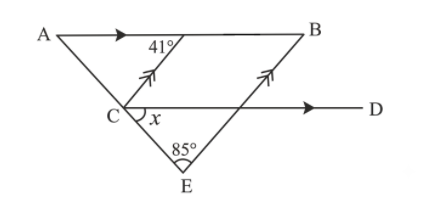
In the adjoining figure, the measure of the angle $$x$$ is
Solution
$$AB$$ is parallel to $$CD$$ and the two slanting lines carrying the arrow marks are parallel to each other. Using corresponding angles on the transversal through $$C$$ and $$E$$, the angle at $$C$$ above the line $$CD$$ is $$85^\circ$$, and alternate angles with $$AB$$ parallel to $$CD$$ give $$41^\circ$$ for the part of it lying above $$CD$$. Hence $$x = 180^\circ - 85^\circ - 41^\circ = 54^\circ$$.
The value of $$x$$ which satisfies $$\frac{1}{x+a} + \frac{1}{x+b} = \frac{1}{x+a+b} + \frac{1}{x}$$ is
Solution
$$\dfrac{1}{x+a} + \dfrac{1}{x+b} = \dfrac{1}{x+a+b} + \frac{1}{x}$$
$$\dfrac{2x+a+b}{(x+a)(x+b)}= \dfrac{2x+a+b}{x(x+a+b)} $$
So, for the equality to hold, we get $$2$$ cases here
CASE 1: $$2x+a+b=0$$
So, $$x=\dfrac{-(a+b)}{2}$$
CASE 2: $$2x+a+b\neq0$$
$$\dfrac{2x+a+b}{(x+a)(x+b)}= \dfrac{2x+a+b}{x(x+a+b)} $$
So, $$2x+a+b$$ can be cancelled out from both sides of the equality, as it's a non-zero number
$$\dfrac{1}{(x+a)(x+b)}= \dfrac{1}{x(x+a+b)} $$
Cross-multiplying, we get:
$$x(x+a+b)=(x+a)(x+b)$$
or, $$x^2+ax+bx=x^2+ax+bx+ab$$
$$ab=0$$
So, this means either $$a$$ or $$b$$ or both are zero.
That means the equality will be satisfied here at some particular value of $$a$$ and $$b$$ and not every value of $$a$$ and $$b$$
So, for any value of $$a$$ and $$b$$, the equality holds only if $$x=\dfrac{-(a+b)}{2}$$
Hence, Option D is correct.
.webp)
Two sides of an isosceles triangle are 23 cm and 17 cm respectively. The perimeter of the triangle (in cm ) is
Solution
The repeated side may be $$23$$ cm, giving perimeter $$23 + 23 + 17 = 63$$, or it may be $$17$$ cm, giving $$17 + 17 + 23 = 57$$. Both are genuine triangles because $$17 + 17 = 34 > 23$$. So the perimeter is $$63$$ or $$57$$.
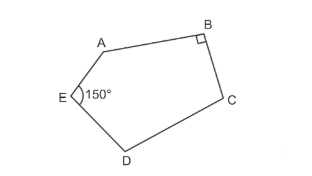
$$ABCDE$$ is a pentagon with $$\angle B = 90^\circ$$ and $$\angle E = 150^\circ$$. If $$\angle C + \angle D = 180^\circ$$ and $$\angle A + \angle D = 180^\circ$$, then the external angle $$\angle D$$ is
Solution
The interior angles of a pentagon add up to $$540^\circ$$, so $$\angle A + \angle C + \angle D = 540^\circ - 90^\circ - 150^\circ = 300^\circ$$. Substituting $$\angle A = 180^\circ - \angle D$$ and $$\angle C = 180^\circ - \angle D$$ gives $$360^\circ - \angle D = 300^\circ$$, so the interior angle $$\angle D = 60^\circ$$. The external angle at $$D$$ is therefore $$180^\circ - 60^\circ = 120^\circ$$.
The unit's digit of the product $$3^{2025} \times 7^{2024}$$ is
Solution
The unit digits of powers of 3 repeat in the block 3, 9, 7, 1 with period 4, and $$2025 = 4 \times 506 + 1$$, so $$3^{2025}$$ ends in 3. The unit digits of powers of 7 repeat as 7, 9, 3, 1, and 2024 is a multiple of 4, so $$7^{2024}$$ ends in 1. The product therefore ends in $$3 \times 1 = 3$$.
.webp)
The smallest positive integer $$n$$ for which $$18900 \times n$$ is a perfect cube is
Solution
TO BE FILLED - printed options need checking. Since $$18900 = 2^2 \times 3^3 \times 5^2 \times 7$$, the exponents of 2, 5 and 7 must be raised to multiples of 3, which needs $$n = 2 \times 5 \times 7^2 = 490$$, a value that does not appear among the options printed for this problem.
Two numbers $$a$$ and $$b$$ are respectively $$20\%$$ and $$50\%$$ more of a third number $$c$$. The percentage of $$a$$ to $$b$$ is
Solution
Here $$a = 1.2c$$ and $$b = 1.5c$$, so $$\frac{a}{b} = \frac{1.2c}{1.5c} = \frac{4}{5} = 0.8$$. As a percentage this is 80 %.
If $$a + b = 2$$, $$\frac{1}{a} + \frac{1}{b} = 18$$, then $$a^3 + b^3$$ lies between
Solution
Since $$\frac{1}{a} + \frac{1}{b} = \frac{a+b}{ab} = 18$$, we get $$ab = \frac{2}{18} = \frac{1}{9}$$. Then $$a^3 + b^3 = (a+b)^3 - 3ab(a+b) = 8 - 3 \times \frac{1}{9} \times 2 = 8 - \frac{2}{3} = \frac{22}{3}$$. As $$\frac{22}{3} \approx 7.33$$, the value lies between 7 and 8.
.webp)
If $$\sqrt{12 + \sqrt[3]{x}} = \frac{7}{2}$$ and $$x = \frac{p}{q}$$, $$p, q$$ are natural numbers with G.C.D. $$(p, q) = 1$$, then $$p + q$$ is
Solution
Squaring both sides gives $$12 + \sqrt[3]{x} = \frac{49}{4}$$, so $$\sqrt[3]{x} = \frac{49}{4} - 12 = \frac{1}{4}$$. Cubing gives $$x = \frac{1}{64}$$, so $$p = 1$$ and $$q = 64$$, which are coprime. Hence $$p + q = 65$$.
The smallest number of 4-digits leaving a remainder of 1 when divided by 2 or 3 or 4 or 6 has
Solution
A number leaving remainder 1 on division by 2, 3, 4, 5 and 6 is of the form $$60k + 1$$, because the LCM of these divisors is 60. The smallest 4-digit number of this form is $$60 \times 17 + 1 = 1021$$. Its digits are 1, 0, 2 and 1, so it contains only one zero.
If $$a \colon b = 2 \colon 3$$, $$b \colon c = 4 \colon 5$$ and $$a + c = 736$$, then the value of $$b$$ is
Solution
Making the value of $$b$$ common in both ratios gives $$a \colon b \colon c = 8 \colon 12 \colon 15$$. Then $$a + c$$ corresponds to $$8 + 15 = 23$$ parts, so one part is $$\frac{736}{23} = 32$$. Hence $$b = 12 \times 32 = 384$$.
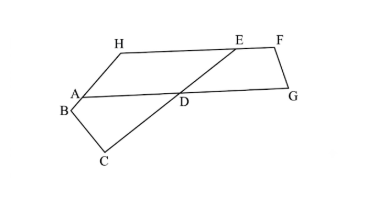
In the given figure, $$\angle B = 110^\circ$$; $$\angle C = 80^\circ$$; $$\angle F = 120^\circ$$; $$\angle ADC = 30^\circ$$ $$2\angle DGF = \angle DEF$$. The measure of $$\angle BHF$$ is
Solution
In the quadrilateral $$DEFG$$ the angle at $$D$$ is vertically opposite to $$\angle ADC$$ and so equals $$30^\circ$$, giving $$\angle DEF + \angle DGF = 360^\circ - 30^\circ - 120^\circ = 210^\circ$$. Using $$\angle DEF = 2\angle DGF$$ we get $$\angle DEF = 140^\circ$$, so the angle between $$ED$$ and the line $$HEF$$ on the other side is $$40^\circ$$. Applying the angle sum of the quadrilateral $$HBCE$$, $$\angle BHF = 360^\circ - 110^\circ - 80^\circ - 40^\circ = 130^\circ$$.
If $$\frac{1}{b+c} + \frac{1}{c+a} = \frac{2}{a+b}$$, then the value of $$\frac{a^2 + b^2}{c^2}$$ is
Solution
Combining the left side gives $$\frac{a + b + 2c}{(b+c)(c+a)} = \frac{2}{a+b}$$, so $$(a+b)(a+b+2c) = 2(b+c)(c+a)$$. Expanding both sides gives $$a^2 + 2ab + b^2 + 2ac + 2bc = 2ab + 2bc + 2ac + 2c^2$$, which reduces to $$a^2 + b^2 = 2c^2$$. Hence $$\frac{a^2 + b^2}{c^2} = 2$$.
If 3 men or 4 women can do a job in 43 days, the number of days the same job is done by 7 men and 5 women is
Solution
The whole job equals $$3 \times 43 = 129$$ man-days and also $$4 \times 43 = 172$$ woman-days, so one man does $$\frac{1}{129}$$ and one woman $$\frac{1}{172}$$ of the job each day. Working together, 7 men and 5 women do $$\frac{7}{129} + \frac{5}{172} = \frac{28 + 15}{516} = \frac{43}{516} = \frac{1}{12}$$ of the job per day. Hence the job takes 12 days.
The expression $$49(a + b)^2 - 46(a - b)^2$$ is factorized into $$(la + mb)(na + pb)$$, then the numerical value of $$(l + m + n + p)$$ is
Backspace
789
456
123
0.-
Clear All
789
456
123
0.-
Clear All
Solution
An expression of the form $$u^2(a+b)^2 - v^2(a-b)^2$$ is a difference of two squares, so it factorises as $$[(u - v)a + (u + v)b][(u + v)a + (u - v)b]$$. The four coefficients then add up to $$(u - v) + (u + v) + (u + v) + (u - v) = 4u$$. Here $$u = 7$$, so $$l + m + n + p = 4 \times 7 = 28$$.
The integer part of the solution of the equation in $$x$$, $$\frac{1}{3}(x - 3) - \frac{1}{4}(x - 8) = \frac{1}{5}(x - 5)$$ is
Backspace
789
456
123
0.-
Clear All
789
456
123
0.-
Clear All
Solution
Multiplying throughout by 60 clears the fractions and gives $$20(x - 3) - 15(x - 8) = 12(x - 5)$$. Simplifying, $$5x + 60 = 12x - 60$$, so $$7x = 120$$ and $$x = \frac{120}{7} \approx 17.14$$. The integer part of this solution is 17.
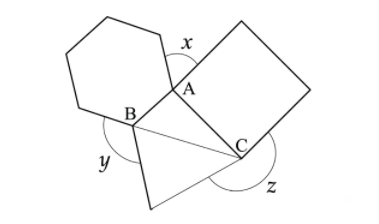
In the adjoining figure, $$ABC$$ is a triangle in which $$\angle BAC = 100^\circ$$, $$\angle ACB = 30^\circ$$. An equilateral triangle, a square and a regular hexagon are drawn as shown in the figure. The measure (in degrees) of $$(x + y + z)$$ is
Backspace
789
456
123
0.-
Clear All
789
456
123
0.-
Clear All
Solution
The third angle of the triangle is $$180^\circ - 100^\circ - 30^\circ = 50^\circ$$, so the three angles of the triangle add to $$180^\circ$$. At each vertex of the triangle the angles round that point add to $$360^\circ$$, and the polygons contribute their interior angles $$60^\circ$$, $$90^\circ$$ and $$120^\circ$$, each at two vertices. Hence $$x + y + z = 3 \times 360^\circ - 180^\circ - 2(60^\circ + 90^\circ + 120^\circ) = 1080^\circ - 180^\circ - 540^\circ = 360^\circ$$.
The mean of 5 numbers is 105 . The first number is $$\frac{2}{5}$$ times the sum of the other 4 numbers. The first number is
Backspace
789
456
123
0.-
Clear All
789
456
123
0.-
Clear All
Solution
The five numbers add up to $$5 \times 105 = 525$$. If the first number is $$f$$, the other four add up to $$525 - f$$, so $$f = \frac{2}{5}(525 - f)$$. This gives $$5f = 1050 - 2f$$, so $$7f = 1050$$ and $$f = 150$$.
$$PQRS$$ is a square. The sides $$PQ$$ and $$RS$$ are increased by 30 % each and the sides $$QR$$ and $$PS$$ are increased by 20 % each. The area of the quadrilateral thus obtained exceeds the area of the square by _________ %.
Backspace
789
456
123
0.-
Clear All
789
456
123
0.-
Clear All
Solution
If the square has side $$a$$, its area is $$a^2$$ and the new rectangle has sides $$1.3a$$ and $$1.2a$$. Its area is $$1.3a \times 1.2a = 1.56a^2$$. The excess is $$0.56a^2$$, which is 56 % of the original area.
If $$x^2 + (2 + \sqrt{3})x - 1 = 0$$ and $$x^2 + \frac{1}{x^2} = a + b\sqrt{c}$$, then $$(a + b + c)$$ is
Backspace
789
456
123
0.-
Clear All
789
456
123
0.-
Clear All
Solution
Dividing the equation by $$x$$ gives $$x - \frac{1}{x} = -(2 + \sqrt{3})$$. Squaring both sides, $$x^2 + \frac{1}{x^2} - 2 = (2 + \sqrt{3})^2 = 7 + 4\sqrt{3}$$, so $$x^2 + \frac{1}{x^2} = 9 + 4\sqrt{3}$$. Comparing, $$a = 9$$, $$b = 4$$ and $$c = 3$$, so $$a + b + c = 16$$.
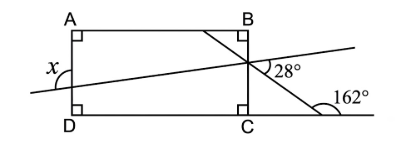
In the given figure, $$ABCD$$ is a rectangle. The measure of angle $$x$$ is _______________ degrees.
Backspace
789
456
123
0.-
Clear All
789
456
123
0.-
Clear All
The sum of all positive integers $$m, n$$ which satisfy $$m^2 + 2mn + n = 44$$ is
Backspace
789
456
123
0.-
Clear All
789
456
123
0.-
Clear All
Solution
Solving for $$n$$ gives $$n = \frac{44 - m^2}{2m + 1}$$, which must be a positive integer, so $$m$$ can only be 1, 2, 3, 4, 5 or 6. Testing these, only $$m = 2$$ with $$n = 8$$ and $$m = 3$$ with $$n = 5$$ work. The sum of all these values is $$2 + 8 + 3 + 5 = 18$$.
Given $$a = 2025$$, $$b = 2024$$, the numerical value of $$\left(a + b - \frac{4ab}{a+b}\right) \div \left(\frac{a}{a+b} - \frac{b}{b-a} + \frac{2ab}{b^2 - a^2}\right)$$ is
Backspace
789
456
123
0.-
Clear All
789
456
123
0.-
Clear All
Solution
The first bracket equals $$\frac{(a+b)^2 - 4ab}{a+b} = \frac{(a-b)^2}{a+b}$$. Taking $$(a+b)(b-a)$$ as the common denominator, the second bracket equals $$\frac{a(b-a) - b(a+b) + 2ab}{(a+b)(b-a)} = \frac{-(a-b)^2}{(a+b)(b-a)} = \frac{a-b}{a+b}$$. Dividing the first by the second gives $$a - b = 2025 - 2024 = 1$$.
In the sequence $$0, 7, 26, 63, 124, \ldots$$ the $$6^{\text{th}}$$ term is
Backspace
789
456
123
0.-
Clear All
789
456
123
0.-
Clear All
Solution
Each term is one less than a perfect cube, since $$0 = 1^3 - 1$$, $$7 = 2^3 - 1$$, $$26 = 3^3 - 1$$, $$63 = 4^3 - 1$$ and $$124 = 5^3 - 1$$. So the $$n$$th term is $$n^3 - 1$$ and the sixth term is $$6^3 - 1 = 216 - 1 = 215$$.
If $$A = \sqrt{281 + \sqrt{53 + \sqrt{112 + \sqrt{81}}}}$$, $$B = \sqrt{92 + \sqrt{55 + \sqrt{75 + \sqrt{36}}}}$$ then $$A - B$$ is
Backspace
789
456
123
0.-
Clear All
789
456
123
0.-
Clear All
Solution
Working from the innermost radical of $$A$$, $$\sqrt{81} = 9$$, then $$\sqrt{112 + 9} = 11$$, then $$\sqrt{53 + 11} = 8$$ and finally $$A = \sqrt{281 + 8} = \sqrt{289} = 17$$. Similarly for $$B$$, $$\sqrt{36} = 6$$, $$\sqrt{75 + 6} = 9$$, $$\sqrt{55 + 9} = 8$$ and $$B = \sqrt{92 + 8} = 10$$. Hence $$A - B = 17 - 10 = 7$$.
The average of the numbers $$a, b, c, d$$ is $$(b + 4)$$. The average of pairs $$(a, b)$$, $$(b, c)$$ and $$(c, a)$$ are respectively 16, 26 and 25 . Then the average of $$d$$ and 67 is
Backspace
789
456
123
0.-
Clear All
789
456
123
0.-
Clear All
Solution
The pair averages give $$a + b = 32$$, $$b + c = 52$$ and $$c + a = 50$$, so adding them, $$2(a + b + c) = 134$$ and $$a + b + c = 67$$. Hence $$a = 15$$, $$b = 17$$ and $$c = 35$$. The average of the four numbers is $$b + 4 = 21$$, so $$a + b + c + d = 84$$ and $$d = 84 - 67 = 17$$, making the average of $$d$$ and 67 equal to $$\frac{17 + 67}{2} = 42$$.
$$ABC$$ is a quadrant of a circle of radius 10 cm . Two semicircles are drawn as in the figure.
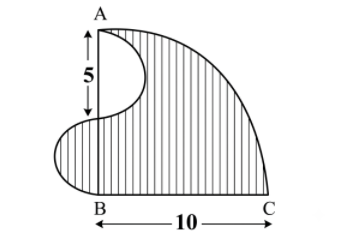
The area of the shaded portion is $$k\pi$$, where $$k$$ is a positive integer. The value of $$k$$ is
Backspace
789
456
123
0.-
Clear All
789
456
123
0.-
Clear All
Solution
The radius $$AB$$ is 10 cm and the two semicircles stand on its two halves, each of length 5 cm, so the two semicircles have exactly the same area. One of them is cut out of the quadrant while the other is added on outside it, so the two changes cancel. The shaded area is therefore the area of the quadrant, $$\frac{1}{4} \times \pi \times 10^2 = 25\pi$$, giving $$k = 25$$.
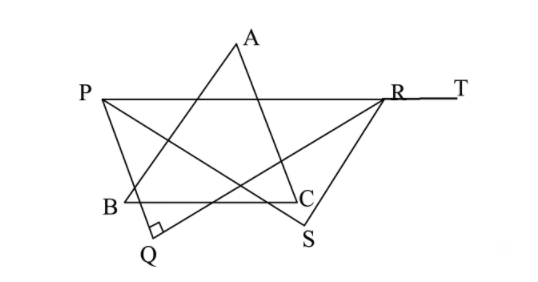
In the figure, $$ABC$$ and $$PQR$$ are two triangles such that $$\angle A \colon \angle B \colon \angle C = 5 \colon 6 \colon 7$$ and $$\angle PRQ = \angle B$$. $$PS$$ makes an angle $$\frac{\angle P}{3}$$ with $$PQ$$ and $$RS$$ makes an angle $$\frac{\angle SRT}{5}$$ with $$RQ$$. Then the measure of $$\angle S$$ is
Backspace
789
456
123
0.-
Clear All
789
456
123
0.-
Clear All
Solution
TO BE FILLED - figure required
In a two-digit positive integer, the units digit is one less than the tens digit. The product of one less than the units digit and one more than the tens digit is 40. The number of such two-digit integers is
Backspace
789
456
123
0.-
Clear All
789
456
123
0.-
Clear All
Solution
Let the tens digit be $$t$$, so the units digit is $$t - 1$$. The condition gives $$(t - 2)(t + 1) = 40$$, that is $$t^2 - t - 42 = 0$$, so $$(t - 7)(t + 6) = 0$$. Only $$t = 7$$ is a digit, so the only such number is 76 and there is exactly 1 such integer.