If $$x^2 + x = 1$$, then the value of $$\frac{x^7 + 34}{x + 2}$$ is equal to
Sign in
Please select an account to continue using cracku.in
↓ →
Join Our JEE Preparation Group
Prep with like-minded aspirants; Get access to free daily tests and study material.
If $$x^2 + x = 1$$, then the value of $$\frac{x^7 + 34}{x + 2}$$ is equal to
$$x^2 = 1 - x$$
We can find
$$x^3 = x - x^2 = x - (1-x) = 2x-1$$
$$x^4 = 2x^2 - x = 2(1-x) -x =2-3x $$,
$$x^5 = 2x-3x^2 = 2x-3(1-x) = 5x - 3$$,
$$x^6 = 5x^2-3x = 5(1-x)-3x = 5 - 8x$$
$$x^7 = 5x-8x^2 = 5x-8(1-x) = 13x - 8$$.
Hence $$\dfrac{x^7 + 34}{x + 2} = \dfrac{13x - 8 + 34}{x + 2} = \dfrac{13(x + 2)}{x + 2} = 13$$.
The angle between the hour hand and the minute hand of a clock at the time 9.38 pm is
Minute hand comples $$360\degree$$ in $$60$$ minutes.
This means in a minute it covers $$\dfrac{360}{60} = 6\degree$$
The minute hand at $$38$$ minutes is at $$38 \times 6\degree = 228\degree$$ from the $$12$$ mark.
The hour hand covers $$360\degree$$ in $$12$$ hours. In one hour it covers $$ \dfrac{360}{12} = 30\degree$$. And in one minute it covers $$\dfrac{30\degree}{60} = 0.5\degree$$
Thus, the hour hand is at $$9 \times 30\degree + 38 \times 0.5\degree = 270\degree + 19\degree = 289\degree$$.
The angle between them is $$289\degree - 228\degree = 61\degree$$.
In the adjoining figure, $$AOB$$ is a diameter of the circle with centre O. PC and PD are two tangents. Then the measure of $$\angle EPD$$ is
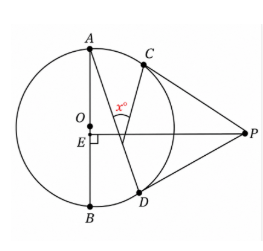
TO BE FILLED - figure required
The value of $$x$$ satisfying $$4^x - 3^{x - 1/2} = 3^{x + 1/2} - 2^{2x - 1}$$ is of the form $$\frac{a}{b}$$ where $$\gcd(a, b) = 1$$. Then the value of $$\left(\frac{a+b}{a-b}\right)$$ is equal to
Transposingto get the same bases on either side of the equation we get,
$$2^{2x} + 2^{2x - 1} = 3^{x + 1/2} + 3^{x - 1/2}$$, that is $$\dfrac{3}{2} \cdot 2^{2x} = \dfrac{4}{\sqrt{3}} \cdot 3^{x}$$.
This simplifies to
$$2^{2x - 3} = 3^{\frac{2x-3}{2}}$$
$$\left(\dfrac{2}{\sqrt{3}}\right)^{2x - 3} = 1 \implies 2x - 3 = 0$$
$$x = \dfrac{3}{2}$$.
This gives $$a = 3$$ and $$b = 2$$
$$\dfrac{a+b}{a-b} = \dfrac{5}{1} = 5$$.
The number of polynomials of the form $$(x^3 + ax^2 + bx + c)$$ which are divisible by $$x^2 + 1$$ where $$a, b, c \in 1, 2, 3, 4, \ldots, 12$$ is
If $$x^2 + 1$$ divides the cubic, the other factor must be $$x + d$$,
Let
$$x^3 + ax^2 + bx + c = (x^2 + 1)(x + d) = x^3 + dx^2 + x + d$$.
Comparing coefficients gives $$a =d, b = 1$$ and $$c = d$$. Since $$a$$ can be any of the 12 allowed values and then $$c$$ gets fixed, there are 12 such polynomials.
The number of real solutions of the equation $$\frac{(x+2)(x+3)(x+4)(x+5)}{(x-2)(x-3)(x-4)(x-5)} = 1$$ is
The denominator cannot be zero, so $$x\neq2,3,4,5$$.
We are given $$\dfrac{(x+2)(x+3)(x+4)(x+5)}{(x-2)(x-3)(x-4)(x-5)}=1$$.
Multiplying both sides by the denominator, we get $$ (x+2)(x+3)(x+4)(x+5)=(x-2)(x-3)(x-4)(x-5) $$.
We can pair the factors on both sides to get the same coefficient for $$x$$ as follows:
$$ (x+2)(x+5)=x^2+7x+10 $$
$$ (x+3)(x+4)=x^2+7x+12 $$.
Similarly,
$$ (x-2)(x-5)=x^2-7x+10 $$
$$ (x-3)(x-4)=x^2-7x+12 $$.
Therefore, the equation becomes $$ (x^2+7x+10)(x^2+7x+12)=(x^2-7x+10)(x^2-7x+12) $$.
Let $$ A=x^2+10 $$.
Then we get $$ (A+7x)(A+7x+2)=(A-7x)(A-7x+2) $$.
Expanding both sides gives $$ A^2+14Ax+49x^2+2A+14x=A^2-14Ax+49x^2+2A-14x $$.
Cancelling the common terms, we get $$ 28Ax+28x=0 $$.
Factoring, $$ 28x(A+1)=0 $$.
Since $$ A=x^2+10 $$, we get $$ 28x(x^2+11)=0 $$.
Therefore, $$ x(x^2+11)=0 $$.
So either $$ x=0 $$ or $$ x^2+11=0 $$.
But $$ x^2+11=0 $$ gives $$ x^2=-11 $$, which has no real solution because the square of a real number can never be negative.
Hence, the only real solution is $$ x=0 $$.
Therefore, the number of real solutions is $$ 1$$.
If $$a = \sqrt{23a + b}$$, $$b = \sqrt{23b + a}$$, $$a \neq b$$, then the value of $$\sqrt{a^2 + b^2 + 48}$$ is
Squaring the equations we get
$$a^2 = 23a + b$$ and $$b^2 = 23b + a$$.
Subtracting the two gives us
$$a^2 - b^2 = 22(a-b) \implies (a-b)(a+b) = 22(a-b) $$
As $$a \neq b$$ this gives
$$a + b = 22$$.
Adding the two equations we get,
$$a^2 + b^2 = 24(a + b) = 528$$
$$\sqrt{a^2 + b^2 + 48} = \sqrt{576} = 24$$.
In the adjoining figure, PA and PB are tangents to the circle. $$AC$$ is parallel to $$PB$$. Then measure of $$\angle CDA$$ is
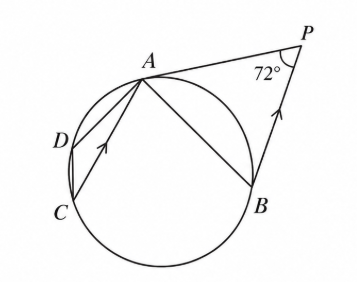
$$PA = PB$$ and the angle at $$P$$ is $$72\degree$$
The base angles are
$$\angle PAB = \angle PBA = \dfrac{1}{2} (180-72) =54\degree$$ (Angle sum property of an isosceles triangle.
As $$AC$$ is parallel to $$PB$$
$$\angle CAB = \angle ABP = 54\degree$$(Interior alternate angles)
Now, using the alternate segment theorem,
$$\angle ACB = \angle ABP = 54\degree$$
$$\implies \angle CBA = 180\degree - 54\degree - 54\degree = 72\degree$$
Now, ABCD forms a cyclic quadrilateral, which implies that opposite angles are supplementary.
$$ \angle CDA = 180\degree- \angle CBA = 180\degree- 72\degree = 108\degree$$
If $$\sqrt{\frac{19^8 + 19^x}{19^x + 1}} = 361$$, then $$x$$ satisfies the equation
Squaring the equation on both sides we get
$$19^8 + 19^x = 19^4(19^x + 1)$$
$$19^8 - 19^4 = 19^x(19^4 - 1)$$,
$$19^4(19^4 - 1) = 19^x(19^4 - 1)$$
Hence $$ x = 4$$.
Substituting $$x = 4$$ in the options, only option 4 satisfies the condition
$$3(16) - 11(4) - 4 = 48 - 48 = 0$$
If $$S = 4^2 + 2 \cdot 5^2 + 3 \cdot 6^2 + \ldots + 25 \cdot 28^2$$, then the value of $$\frac{S}{325}$$ is equal to
The general term can be expressed as
$$n(n+3)^2 = n^3 + 6n^2 + 9n$$ for $$n$$ from 1 to 25.
$$\sum n(n+3)^2 = \sum n^3 + 6\sum n^2 + 9\sum n$$
$$\sum n^3 = \dfrac{n^2(n+1)^2}{4} = \dfrac{25^2(25+1)^2}{4}= 105625$$
$$\sum n^2 =\dfrac{n(n+1)(2n+1)}{6} =\dfrac{25(25+1)(50+1)}{6} = 5525$$
$$\sum n =\dfrac{n(n+1)}{2}=\dfrac{25(26+1)}{2}= 325$$,
We get $$S = 105625 + 6(5525) + 9(325) = 141700$$.
Hence $$\dfrac{S}{325} = 436$$.
A sequence $$\{a_n\}$$, $$n \geq 1$$ with $$a_1 = \frac{1}{2}$$ and $$a_n = \frac{a_{n-1}}{2na_{n-1} + 1}$$ is given. Then the value of $$a_1 + a_2 + a_3 + \ldots + a_{2024}$$ is equal to
We are given
$$a_1=\dfrac{1}{2}$$
and
$$a_n=\dfrac{a_{n-1}}{2na_{n-1}+1}.$$
We want to find
$$a_1+a_2+a_3+\cdots+a_{2024}.$$
First, take the reciprocal of both sides of the given equation:
$$\dfrac{1}{a_n}=\dfrac{2na_{n-1}+1}{a_{n-1}}.$$
Splitting the fraction,
$$\dfrac{1}{a_n}=2n+\dfrac{1}{a_{n-1}}.$$
Therefore,
$$\dfrac{1}{a_n}=\dfrac{1}{a_{n-1}}+2n.$$
Now we know that
$$a_1=\dfrac{1}{2},$$
$$\dfrac{1}{a_1}=2\times 1$$
$$\dfrac{1}{a_2}=\dfrac{1}{a_1}+2 \times 2$$
$$\dfrac{1}{a_3}=\dfrac{1}{a_2}+2 \times 3$$
$$\dfrac{1}{a_4}=\dfrac{1}{a_3}+2 \times 4$$
.
.
.
$$\dfrac{1}{a_n}=\dfrac{1}{a_{n-1}}+2 \times n$$
Adding all the equations we get
$$\dfrac{1}{a_n}=2\sum n = n(n+1)$$
Hence,
$$a_n=\dfrac{1}{n(n+1)}.$$
Now split this fraction:
$$\dfrac{1}{n(n+1)}=\dfrac{1}{n}-\dfrac{1}{n+1}.$$
Therefore,
$$a_n=\dfrac{1}{n}-\dfrac{1}{n+1}.$$
Now substitute this into the required sum:
$$a_1+a_2+a_3+\cdots+a_{2024}$$
$$=\left(1-\dfrac{1}{2}\right)+\left(\dfrac{1}{2}-\dfrac{1}{3}\right)+\left(\dfrac{1}{3}-\dfrac{1}{4}\right)+\cdots+\left(\dfrac{1}{2024}-\dfrac{1}{2025}\right).$$
Notice that most terms cancel:
$$\cancel{1-\dfrac{1}{2}}+\cancel{\dfrac{1}{2}-\dfrac{1}{3}}+\cancel{\dfrac{1}{3}-\dfrac{1}{4}}+\cdots+\left(\dfrac{1}{2024}-\dfrac{1}{2025}\right).$$
Everything in the middle cancels, leaving only
$$1-\dfrac{1}{2025}.$$
Therefore,
$$1-\dfrac1{2025}=\dfrac{2025-1}{2025}$$
$$=\dfrac{2024}{2025}$$
If $$\alpha$$ and $$\beta(\alpha > \beta)$$ satisfy the equation $$x^{1 + \log_{10} x} = 10x$$ then the value of $$\alpha + \frac{1}{\beta}$$ is equal to
Applying logarithms to base 10 on both sides we get
$$\log_{10}{x^{1 + \log_{10} x} }= \log_{10}{10x}$$
$$({1 + \log_{10} x})\log_{10}{x }= \log_{10}{10} + \log_{10}{x} $$
$$({1 + \log_{10} x})\log_{10}{x }= 1 + \log_{10}{x} $$
writing $$t = \log_{10} x$$, the equation becomes
$$(1 + t)t = 1 + t$$,
$$t^2 = 1$$
$$t = \pm 1$$.
$$log_{10}{x} = \pm 1$$
$$x = 10, x = \dfrac{1}{10}$$
Since we know that $$\alpha>\beta$$, the roots are $$\alpha = 10$$ and $$\beta = \dfrac{1}{10}$$,
This gives us
$$\alpha + \dfrac{1}{\beta} = 10 + 10 = 20$$.
In the adjoining figure, four successively touching circles are placed in the interior of $$\angle AOB$$. The first (smallest) has a radius 7 cm . The third circle has a radius 28 cm . Then the radius of the largest circle (in cm ) is
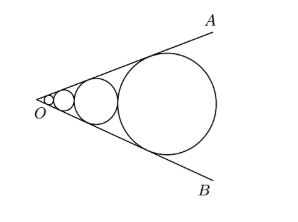
Consider
$$\triangle OCE, \triangle ODF$$
$$ \angle OCE = \angle ODF = 90\degree$$ (Angle made by radius with the tangent)
$$\angle COE = \angle DOF$$
Thus, by AA similarity criterion, the triangles are similar to each other. We can extend this to all the circles to find that the triangles made in such a way by the line passing through their centres, the radius and the tangent are all similar.
Let $$OE = x$$
Thus, using similarity we can write
$$ \dfrac{x}{r_1} = \dfrac{x + r_1+r_2}{r_2} $$
We can further extend this to all four circles to write
$$ \dfrac{x}{r_1} = \dfrac{x + r_1+r_2}{r_2} = \dfrac{x+r_1+r_2+r_3}{r_3} = \dfrac{x+r_1+r_2+r_3+r_4}{r_4}$$
Let the common value be $$k$$.
Then,
$$\dfrac{x}{r_1}=k$$
$$x=kr_1.$$
Also,
$$\dfrac{x+r_1}{r_2}=k$$
$$x+r_1=kr_2.$$
Since $$x=kr_1$$,
$$kr_1+r_1=kr_2$$
$$r_1(k+1)=kr_2$$
Therefore,
$$\dfrac{r_2}{r_1}=\dfrac{k+1}{k}.$$
Now consider the next pair:
$$\dfrac{x+r_1+r_2}{r_3}=k.$$
Since $$x+r_1=kr_2$$,
$$x+r_1+r_2=kr_2+r_2$$
$$=r_2(k+1).$$
Therefore,
$$kr_3=r_2(k+1)$$
and hence
$$\dfrac{r_3}{r_2}=\dfrac{k+1}{k}.$$
Similarly,
$$\dfrac{r_4}{r_3}=\dfrac{k+1}{k}.$$
Thus,
$$\boxed{\dfrac{r_2}{r_1}=\dfrac{r_3}{r_2}=\dfrac{r_4}{r_3}}$$
Therefore, the radii form a geometric progression.
$$\dfrac{r_2}{r_1}=\dfrac{r_3}{r_2}=\dfrac{r_4}{r_3}$$
Let this common ratio be $$k$$.
Thus, the radii form a geometric progression:
$$r_1,\ r_2,\ r_3,\ r_4$$
We are given
$$r_1=7$$ and $$r_3=28$$
Therefore,
$$r_3=r_1k^2$$
$$28=7k^2$$
$$\implies k^2=4$$
Since the radii are increasing, $$k=2$$.
Therefore,
$$r_4=r_3k$$
$$r_4=28(2)$$
$${r_4=56}$$
The coefficient of $$x$$ in the equation $$x^2 + px + q = 0$$ was taken as 17 , in place of 13 and its roots were found to be -2 and -15 . If $$\alpha, \beta$$ are the roots of the original equation, then the equation whose roots are $$\frac{\alpha}{\beta}$$ and $$\frac{\beta}{\alpha}$$ is
The constant $$q$$ was taken correctly which can be found from the prouct of the wrong roots obtained.
$$(-2)(-15) = 30$$, so $$q = 30$$.
The original equation is
$$x^2 + 13x + 30 = 0$$
Factorising we get
$$ (x+3)(x+10) = 0$$
with roots $$\alpha = -3$$ and $$\beta = -10$$.
Then
$$\dfrac{\alpha}{\beta} + \dfrac{\beta}{\alpha} = \dfrac{9 + 100}{30} = \dfrac{109}{30}$$ and the product is 1.
Hence, the required equation is
$$x^2 - (\text{sum of roots})x + \text{(product of roots)}= 0$$.
$$x^2 - \left(\dfrac{109}{30}\right)x + 1= 0$$.
$$30x^2 - 109x + 30 = 0$$.
If $$(1 + xy + x + y)^2 - (1 - xy + x - y)^2 = ky(1 + x)^2$$, then $$k$$ equals to
$$(1 + xy + x + y)^2 - (1 - xy + x - y)^2 = (1+xy+x+y+1-xy+x-y)(1+xy+x+y -1+xy-x+y)$$
Simplifying the RHS by cancelling out terms we get
$$(2+2x)(2xy+2y) = 4y(1+x)(1+x) = 4y(1+x)^2$$
Thus, $$ k = 4$$
When $$x^{10} + 1$$ is divided by $$x^2 + 1$$, we get
$$ax^8 + bx^7 + cx^6 + dx^5 + ex^4 + fx^3 + gx^2 + hx + k$$
as quotient. Then the value of
$$a^{2024} + b^{2024} + c^{2024} + d^{2024} + e^{2024} + f^{2024} + g^{2024} + h^{2024} + k^{2024}$$ is
$$x^{10} + 1 = (x^2)^5 + 1$$
Using the property that $$ a^n + b^n$$ is exactly divisible by $$a+b$$ when $$n$$ is odd, we can say that
$$x^2 + 1$$ divides $$x^{10}+1$$ exactly
We can simply multiply $$ax^8 + bx^7 + cx^6 + dx^5 + ex^4 + fx^3 + gx^2 + hx + k$$ with $$x^2 +1$$ and compare with $$x^{10}+1$$
$$(ax^8 + bx^7 + cx^6 + dx^5 + ex^4 + fx^3 + gx^2 + hx + k)(x^2+1) = ax^{10}+bx^9 + cx^8 + dx^7 + ex^6 + fx^5 + gx^4 + hx^3 + kx^2 + ax^8 + bx^7 + cx^6 + dx^5 + ex^4 + fx^3 + gx^2 + hx + k$$
Grouping the coefficients of the terms we get
$$ax^{10} + bx^9 + (a+c)x^8 + (b+d)x^7 + (c+e)x^6 + (d+f)x^5 + (e+g)x^4 + (f+h)x^3 + (g+k)x^2 + hx + k = x^{10}+1$$
Equating the coefficients on both sides we get
$$ a= 1, b = 0, c=-1, d=0, e=1, f=0, g=-1, h=0,k=1$$
$$a^{2024} + b^{2024} + c^{2024} + d^{2024} + e^{2024} + f^{2024} + g^{2024} + h^{2024} + k^{2024} = 1+0+1+0+1+0+1+0+1 =5 $$
The equation $$x^4 - 4x^3 + ax^2 + bx + 1 = 0$$ has 4 positive roots. Then $$a + b$$ is
The four positive roots have sum 4 and product 1, so their arithmetic mean is 1 and their geometric mean is also 1.
Equality in the AM-GM inequality forces all four roots to equal 1, so the equation is $$(x - 1)^4 = x^4 - 4x^3 + 6x^2 - 4x + 1 = 0$$.
Hence $$a = 6$$, $$b = -4$$ and $$a + b = 2$$.
In the adjoining figure, $$BOC$$ is the diameter of the semicircle with centre O. DE is the tangent at D . If $$AB = k(AE)$$, then the numerical value of $$k$$ is
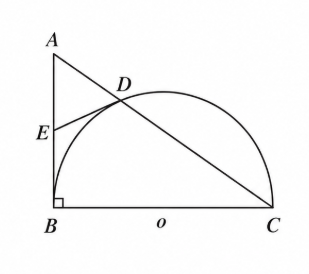
Since $$AB$$ is perpendicular to the diameter at $$B$$ hence it is also a tangent at $$B$$
Now the two tangents from the same point to the circle are equal which implies
$$EB = ED$$ and $$\angle EDO = 90\degree$$
Consider $$\triangle EDO, \triangle EBO$$
$$ED = EB, BO =DO = r, EO = EO$$
Thus, the triangles are congruent to each other
$$\angle EOB = \angle EOD = x$$
Consider $$\triangle DOC$$
$$\angle DOC = 180 -2x$$
$$ CO = DO = r$$.
Thus, it's an isosceles triangle
$$\angle DCO=\dfrac{1}{2}(180-(180-2x))=x$$
Now, consider $$\triangle EOB, \triangle ACB$$
$$\angle ACB = \angle EOB = x$$
$$\angle ABC = \angle EBO = 90\degree$$
Thus, by AA similarity criterion, the triangles are similar to each other
$$ \dfrac{AE}{AB} = \dfrac{BO}{BC} = \dfrac{r}{2r} = \dfrac{1}{2}$$
$$\implies AB = 2AE$$
$$ k = 2$$
In triangle $$ABC$$,
$$\tan A \colon \tan B \colon \tan C = 1 \colon 2 \colon 3$$.
If $$\frac{AC}{AB} = \frac{p\sqrt{q}}{r}$$, where $$q$$ is Square free and $$\gcd(p, r) = 1$$ then the value of $$p + q + r$$ is
In any triangle,
$$\tan A+\tan B+\tan C=\tan A\tan B\tan C$$
We are given that the ratios of the tangents of the three angles are
$$\tan A:\tan B:\tan C=1:2:3.$$
Using the ratio, we can write them as
$$\tan A=t,\qquad \tan B=2t,\qquad \tan C=3t.$$
Substituting these values in the triangle identity,
$$t+2t+3t=t(2t)(3t)$$
$$6t=6t^3$$
Dividing both sides by $$6t$$,
$$1=t^2$$
Since the angles of a triangle are positive, their tangents are positive in this case. Hence,
$$t=1.$$
Therefore,
$$\tan A=1,\qquad \tan B=2,\qquad \tan C=3.$$
$$\tan B=\dfrac{\text{opposite}}{\text{adjacent}}=2=\dfrac{2}{1},$$
we can consider a right triangle with sides $$2,1,\sqrt{5}$$. Therefore,
$$\sin B=\dfrac{2}{\sqrt{5}}.$$
Similarly,
$$\tan C=3=\dfrac{3}{1},$$
so the hypotenuse is
$$\sqrt{3^2+1^2}=\sqrt{10}.$$
Therefore,
$$\sin C=\dfrac{3}{\sqrt{10}}.$$
By the sine rule,
$$\dfrac{AC}{AB}=\dfrac{\sin B}{\sin C}.$$
Substituting the values of $$\sin B$$ and $$\sin C$$,
$$\dfrac{AC}{AB}=\dfrac{\dfrac{2}{\sqrt{5}}}{\dfrac{3}{\sqrt{10}}}.$$
Dividing by a fraction is the same as multiplying by its reciprocal:
$$\dfrac{AC}{AB}=\dfrac{2}{\sqrt{5}}\times\dfrac{\sqrt{10}}{3}.$$
Therefore,
$$\dfrac{AC}{AB} =\dfrac{2\sqrt{10}}{3\sqrt{5}}.$$
Since
$$\dfrac{\sqrt{10}}{\sqrt{5}}=\sqrt{\dfrac{10}{5}}=\sqrt{2},$$
we get
$$\dfrac{AC}{AB}=\dfrac{2\sqrt{2}}{3}.$$
Thus,
$${\dfrac{AC}{AB}=\dfrac{2\sqrt{2}}{3}}.$$
$$p=2,\qquad q=2,\qquad r=3,$$
then
$$p+q+r=2+2+3=7$$
Simon was given a number and asked to divide it by 120. He divided the number by 5,6 and 7 and got 3,2 and 2 as remainders respectively. The remainder when the number is divided by 120 is
Let the number be $$N$$.
When the number is successively divided by $$5,6,$$ and $$7$$, the remainders are $$3,2,$$ and $$2$$ respectively.
Therefore,
$$N=5q_1+3$$
The quotient $$q_1$$ is then divided by $$6$$:
$$q_1=6q_2+2$$
The quotient $$q_2$$ is then divided by $$7$$:
$$q_2=7q_3+2$$
Now substitute backwards.
From
$$q_2=7q_3+2,$$
we get
$$q_1=6(7q_3+2)+2$$
$$=42q_3+12+2$$
$$=42q_3+14.$$
Therefore,
$$N=5(42q_3+14)+3$$
$$=210q_3+70+3$$
$$=210q_3+73.$$
So the number can be written as
$$N=210q_3+73.$$
The greatest number that leaves the same remainder when it divides 30,53 and 99 is
Let the required number be $$d$$.
Since $$d$$ leaves the same remainder when dividing $$30,53,$$ and $$99$$, we can write
$$30=dq_1+r$$
$$53=dq_2+r$$
$$99=dq_3+r$$
where $$r$$ is the same remainder in all three cases.
Now, if two numbers leave the same remainder when divided by the same number, their difference will be exactly divisible by that number.
$$53-30=(dq_2+r)-(dq_1+r)$$
The remainders cancel:
$$53-30=d(q_2-q_1)$$
Therefore, $$53-30$$ is exactly divisible by $$d$$.
Similarly,
$$99-53$$ is also exactly divisible by $$d$$.
$$53-30=23$$
$$99-53=46.$$
Therefore, $$d$$ must be a common divisor of $$23$$ and $$46$$.
The greatest common divisor is
$$\gcd(23,46)=23.$$
Hence, the greatest possible value of $$d$$ is $$ 23$$
If $$f(x + 1) = x^2 - 3x + 2$$ and if the roots of the equation $$f(x) = 0$$ are $$\alpha$$ and $$\beta$$, then the value of $$\alpha^2 + \beta^2$$ is
Putting $$y = x + 1$$, so that $$x = y - 1$$, gives $$f(y) = (y-1)^2 - 3(y-1) + 2 = y^2 - 5y + 6$$. The roots of $$y^2 - 5y + 6 = 0$$ are 2 and 3, so $$\alpha^2 + \beta^2 = 4 + 9 = 13$$.
The maximum volume of a cylinder is cut from a cube of edge $$a$$. The volume of the remaining solid is $$ka^3$$, where $$k = \frac{p}{q}$$, $$\gcd(p, q) = 1$$. Taking $$\pi = \frac{22}{7}$$, the value of $$p + q$$ is
The largest cylinder has radius $$\dfrac{a}{2}$$ and height $$a$$, so its volume is
$$\pi \dfrac{a^3}{4} = \dfrac{22}{7} \times \dfrac{a^3}{4} = \dfrac{11a^3}{14}$$.
The remaining solid has volume
$$a^3 - \dfrac{11a^3}{14} = \dfrac{3a^3}{14}$$, so
$$k = \dfrac{3}{14}$$ and $$p + q = 3 + 14 = 17$$.
If the irreducible quadratic factor of $$5x^4 + 9x^3 - 2x^2 - 4x - 8$$ is $$ax^2 + bx + c$$, then the value of $$a^2 + b^2 - c^2$$ is
Through trial and error we can see that $$x = 1$$ and $$x = -2$$ are roots of the polynomial
We can factorise it as
$$(x - 1)(x + 2)(5x^2 + 4x + 4)$$.
The quadratic $$5x^2 + 4x + 4$$ has discriminant $$16 - 80 < 0$$, so it is the irreducible factor.
Hence $$a = 5$$, $$b = 4$$, $$c = 4$$ and
$$a^2 + b^2 - c^2 = 25 + 16 - 16 = 25$$.
In the adjoining figure, POQ is the diameter of the semicircle with centre O. OABC is a square whose area is $$36 \text{ cm}^2$$. If $$QD = x \text{ cm}$$, the value of $$x\sqrt{3}$$ is
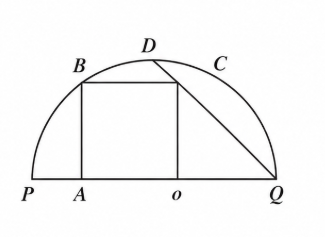
From the area of the square, we can deduce that length of the side of the square is $$6$$ cm.
$$OB$$ is the radius of the circle and can be found as it's also the diagonal of the square which is $$6\sqrt{2}$$ cm.
$$LQ = \sqrt{OQ^2 + OL^2} = \sqrt{6^2 + (6\sqrt{2})^2} =\sqrt{108} cm$$
Consider $$\triangle PQD, \triangle LQO$$
$$\angle QOL = \angle QDP = 90\degree$$ (Angle made by the diameter on any point of the circle is 90 \degree)
$$\angle DQP = \angle OQL$$ (Common)
Thus, by AA similarity criterion, $$\triangle PQD \sim \triangle LQO$$
$$\dfrac{DQ}{OQ} = \dfrac{PQ}{QL} = \dfrac{2\times 6\sqrt{2}}{\sqrt{108}} $$
$$ DQ = 6\sqrt{2}\dfrac{2\times 6\sqrt{2}}{\sqrt{108}} = 8\sqrt{3}$$ cm
$$ x = 24$$
If $$a = \sqrt{2024}$$, $$b = \sqrt{2025}$$, the value of $$2(ab)^{1/2}(a + b)^{-1}\left\{1 + \frac{1}{4}\left(\sqrt{\frac{a}{b}} - \sqrt{\frac{b}{a}}\right)^2\right\}^{1/2}$$ is
$$1 + \dfrac{1}{4}\left(\sqrt{\dfrac{a}{b}} - \sqrt{\dfrac{b}{a}}\right)^2$$ can be expanded using $$(a+b)^2$$ formula to get
$$1 + \dfrac{1}{4}\left(\dfrac{a}{b} + \dfrac{b}{a} - 2\right) = \dfrac{4ab + a^2 + b^2 - 2ab}{4ab} = \dfrac{(a+b)^2}{4ab}$$.
As $$a,b >0$$, its square root is
$$\dfrac{a+b}{2\sqrt{ab}}$$
Now, the expression reduces to
$$\dfrac{2\sqrt{ab}}{a+b} \times \dfrac{a+b}{2\sqrt{ab}} = 1$$
In a decreasing geometric progression, the $$2^{\text{nd}}$$ term is 6. The sum of all infinite terms of the progression is one-eighth of the sum to infinity of the squares of the terms. The sum of the $$1^{\text{st}}$$ and the $$4^{\text{th}}$$ terms is $$\frac{p}{q}$$ where $$p, q$$ are relatively prime to each other. Then the value of $$\left[\frac{p}{q}\right]$$, where $$[x]$$ represents the greatest integer not exceeding $$x$$ is
With first term $$A$$ and ratio $$r$$, the sum of infinite terms of a geometric progression is
$$\dfrac{A}{1-r}$$
From the statement in the question we can write
$$\dfrac{A}{1-r} = \dfrac{1}{8} \cdot \dfrac{A^2}{1-r^2}$$
$$A = 8(1 + r)$$
We are also given that second term is $$6$$
$$\implies Ar = 6$$
Substituting in the above equation we get
$$4r^2 + 4r - 3 = 0 \implies r = \dfrac{1}{2} \text{ or} r = \dfrac{-3}{2} $$
For the sum of infinite terms to be a finite value, we need $$|r|<1$$
$$r = \dfrac{1}{2}$$ and $$A = 12$$.
The first and fourth terms add to
$$A+ Ar^3 = 12\left(1+\dfrac{1}{8}\right) = \dfrac{27}{2}$$, so $$\left[\dfrac{p}{q}\right] = \left[13.5\right] = 13$$.
The value of $$\left(\frac{\sqrt{10}}{10}\right)^{(\log_{10} 9) - 2}$$ is of the form $$\frac{a}{b}$$, where $$a, b$$ are relatively prime to each other. Then $$a - b$$ is equal to
We are given the expression
$$10^{-\frac{1}{2}(\log_{10}9-2)}$$
First, distribute $$-\frac{1}2$$ inside the bracket:
$$10^{-\frac12\log_{10}9+1}$$
Using the rule
$$a^{m+n}=a^m\times a^n,$$
we can write this as
$$10^{-\frac12\log_{10}9}\times10$$
Now use the logarithm rule
$$10^{\log_{10}9}=9.$$
Therefore,
$$10^{-\frac12\log_{10}9}=\left(10^{\log_{10}9}\right)^{-\frac12}.$$
So,
$$\left(10^{\log_{10}9}\right)^{-\frac12}=9^{-\frac12}.$$
$$9^{-\frac12}=\dfrac{1}{3}.$$
Therefore, the original expression becomes
$$10\times\dfrac{1}{3}=\dfrac{10}{3}.$$
Hence,
$$a=10,\qquad b=3.$$
Therefore,
$$a-b=10-3=7$$
ABCD is a square. BE is the tangent to the semicircle on AD as diameter. The area of the triangle BCE is $$216 \text{ cm}^2$$. The radius of the semicircle (in cm ) is
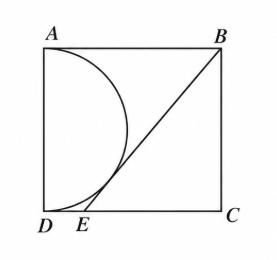
Let the side of the square be $$2r$$ and $$DE = t$$.
Tangents drawn to a circle from the same point are equal. Let $$T$$ be the point of contact of $$BE$$ with the semicircle
$$BA = BT, DE = DT$$
$$\implies BE = BA + DE = 2r + t$$
From the right angled triangle $$BCE$$ we get
$$(2r + t)^2 = (2r)^2 + (2r - t)^2$$,
which simplifies to $$t = \dfrac{r}{2}$$.
Then the area is $$\dfrac{1}{2} \times 2r \times \left(2r - \dfrac{r}{2}\right) = \dfrac{3r^2}{2} = 216$$
$$r^2 = 144 \implies r = 12$$.
$$a, b, c, d$$ are real constants in a $$f(x) = ax^{2025} + bx^{2023} + cx^{2021} + dx^{2019}$$ and $$f(-4) = 18$$. Then the maximum value of $$|f(4)| + |2\cos x|$$ is
Every power appearing in $$f$$ is odd, so $$f$$ is an odd function and $$f(4) = -f(-4) = -18$$, giving $$|f(4)| = 18$$. Since $$|2\cos x|$$ can be at most 2, the maximum value of the sum is $$18 + 2 = 20$$.
Predict your JEE Main percentile, rank & performance in seconds
Educational materials for JEE preparation