Sign in
Please select an account to continue using cracku.in
↓ →

Join Our JEE Preparation Group
Prep with like-minded aspirants; Get access to free daily tests and study material.
In the adjoining figure, PA and PB are tangents to the circle. $$AC$$ is parallel to $$PB$$. Then measure of $$\angle CDA$$ is
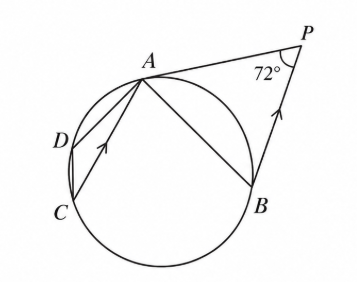
$$PA = PB$$ and the angle at $$P$$ is $$72\degree$$
The base angles are
$$\angle PAB = \angle PBA = \dfrac{1}{2} (180-72) =54\degree$$ (Angle sum property of an isosceles triangle.
As $$AC$$ is parallel to $$PB$$
$$\angle CAB = \angle ABP = 54\degree$$(Interior alternate angles)
Now, using the alternate segment theorem,
$$\angle ACB = \angle ABP = 54\degree$$
$$\implies \angle CBA = 180\degree - 54\degree - 54\degree = 72\degree$$
Now, ABCD forms a cyclic quadrilateral, which implies that opposite angles are supplementary.
$$ \angle CDA = 180\degree- \angle CBA = 180\degree- 72\degree = 108\degree$$
Was this solution helpful?
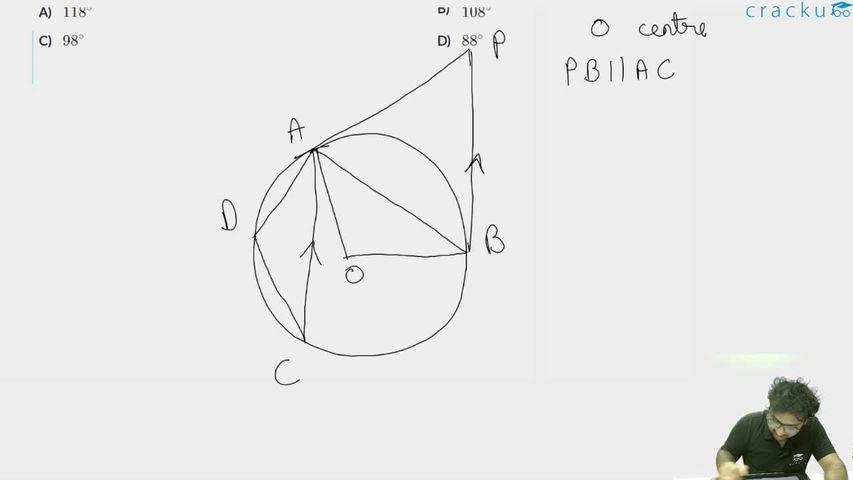
Click on the Email ☝️ to Watch the Video Solution
_1.webp)
Predict your JEE Main percentile, rank & performance in seconds

Educational materials for JEE preparation

Ask our AI anything

AI can make mistakes. Please verify important information.
AI can make mistakes. Please verify important information.
 91- 6303239042