Sign in
Please select an account to continue using cracku.in
↓ →

Join Our JEE Preparation Group
Prep with like-minded aspirants; Get access to free daily tests and study material.
The number of real solutions of the equation $$\frac{(x+2)(x+3)(x+4)(x+5)}{(x-2)(x-3)(x-4)(x-5)} = 1$$ is
The denominator cannot be zero, so $$x\neq2,3,4,5$$.
We are given $$\dfrac{(x+2)(x+3)(x+4)(x+5)}{(x-2)(x-3)(x-4)(x-5)}=1$$.
Multiplying both sides by the denominator, we get $$ (x+2)(x+3)(x+4)(x+5)=(x-2)(x-3)(x-4)(x-5) $$.
We can pair the factors on both sides to get the same coefficient for $$x$$ as follows:
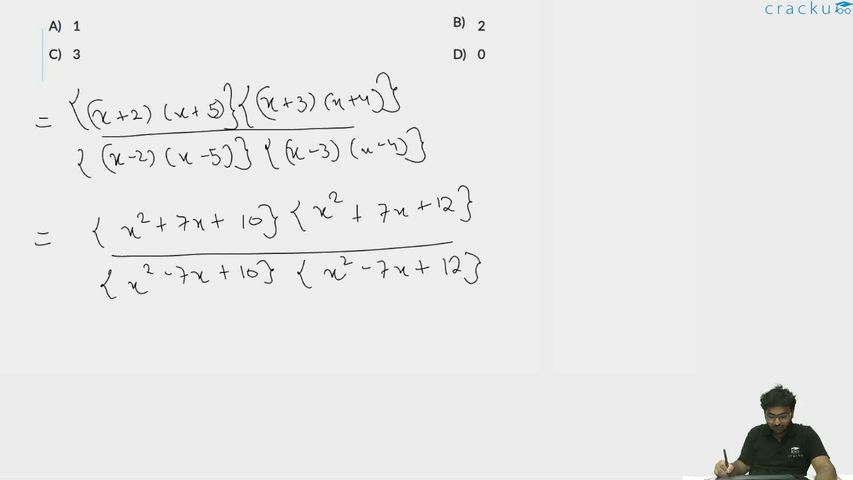
$$ (x+2)(x+5)=x^2+7x+10 $$
$$ (x+3)(x+4)=x^2+7x+12 $$.
Similarly,
$$ (x-2)(x-5)=x^2-7x+10 $$
$$ (x-3)(x-4)=x^2-7x+12 $$.
Therefore, the equation becomes $$ (x^2+7x+10)(x^2+7x+12)=(x^2-7x+10)(x^2-7x+12) $$.
Let $$ A=x^2+10 $$.
Then we get $$ (A+7x)(A+7x+2)=(A-7x)(A-7x+2) $$.
Expanding both sides gives $$ A^2+14Ax+49x^2+2A+14x=A^2-14Ax+49x^2+2A-14x $$.
Cancelling the common terms, we get $$ 28Ax+28x=0 $$.
Factoring, $$ 28x(A+1)=0 $$.
Since $$ A=x^2+10 $$, we get $$ 28x(x^2+11)=0 $$.
Therefore, $$ x(x^2+11)=0 $$.
So either $$ x=0 $$ or $$ x^2+11=0 $$.
But $$ x^2+11=0 $$ gives $$ x^2=-11 $$, which has no real solution because the square of a real number can never be negative.
Hence, the only real solution is $$ x=0 $$.
Therefore, the number of real solutions is $$ 1$$.
Was this solution helpful?
Click on the Email ☝️ to Watch the Video Solution
_1.webp)
Predict your JEE Main percentile, rank & performance in seconds

Educational materials for JEE preparation

Ask our AI anything

AI can make mistakes. Please verify important information.
AI can make mistakes. Please verify important information.
 91- 6303239042
