Sign in
Please select an account to continue using cracku.in
↓ →

Join Our JEE Preparation Group
Prep with like-minded aspirants; Get access to free daily tests and study material.
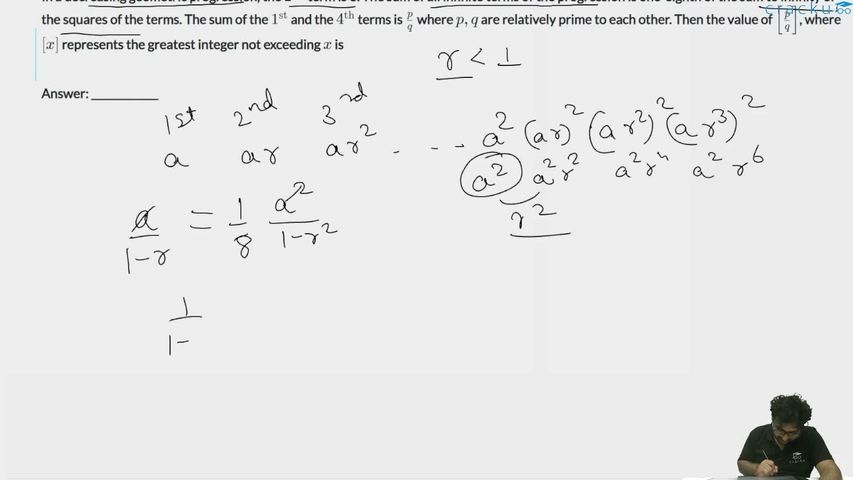
In a decreasing geometric progression, the $$2^{\text{nd}}$$ term is 6. The sum of all infinite terms of the progression is one-eighth of the sum to infinity of the squares of the terms. The sum of the $$1^{\text{st}}$$ and the $$4^{\text{th}}$$ terms is $$\frac{p}{q}$$ where $$p, q$$ are relatively prime to each other. Then the value of $$\left[\frac{p}{q}\right]$$, where $$[x]$$ represents the greatest integer not exceeding $$x$$ is
Correct Answer: 13
With first term $$A$$ and ratio $$r$$, the sum of infinite terms of a geometric progression is
$$\dfrac{A}{1-r}$$
From the statement in the question we can write
$$\dfrac{A}{1-r} = \dfrac{1}{8} \cdot \dfrac{A^2}{1-r^2}$$
$$A = 8(1 + r)$$
We are also given that second term is $$6$$
$$\implies Ar = 6$$
Substituting in the above equation we get
$$4r^2 + 4r - 3 = 0 \implies r = \dfrac{1}{2} \text{ or} r = \dfrac{-3}{2} $$
For the sum of infinite terms to be a finite value, we need $$|r|<1$$
$$r = \dfrac{1}{2}$$ and $$A = 12$$.
The first and fourth terms add to
$$A+ Ar^3 = 12\left(1+\dfrac{1}{8}\right) = \dfrac{27}{2}$$, so $$\left[\dfrac{p}{q}\right] = \left[13.5\right] = 13$$.
Was this solution helpful?
Click on the Email ☝️ to Watch the Video Solution
_1.webp)
Predict your JEE Main percentile, rank & performance in seconds

Educational materials for JEE preparation

Ask our AI anything

AI can make mistakes. Please verify important information.
AI can make mistakes. Please verify important information.
 91- 6303239042
